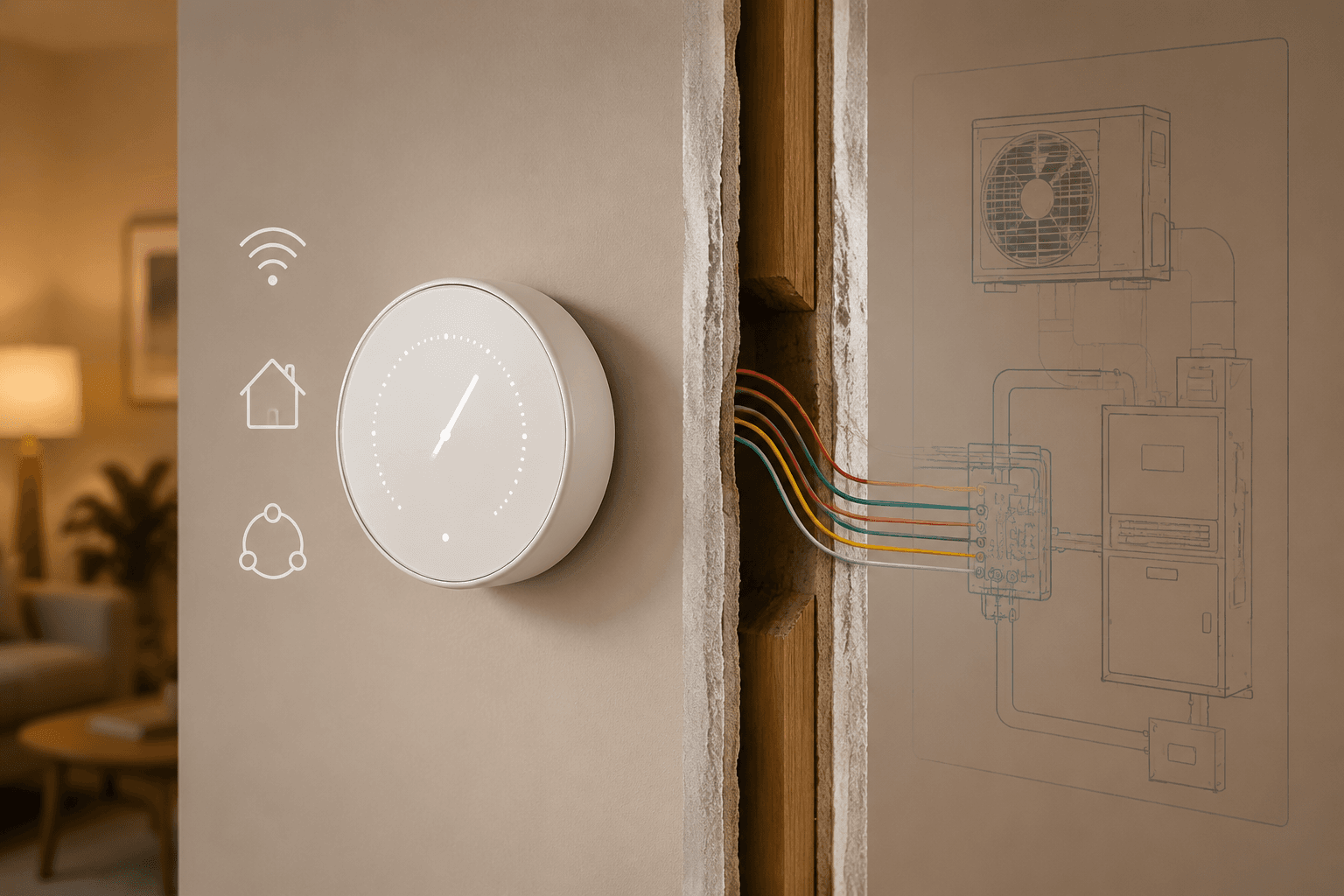
The best smart thermostat in 2026 is the one your wall can power, your HVAC system can safely run, and your household will actually let do its job. Brand matters, but it comes after the less glamorous checks: whether there is a C-wire, whether the system is conventional or something trickier, whether the home already runs on Alexa, Google, Apple Home, or SmartThings, and whether one thermostat reading in the hallway represents the rooms people use.
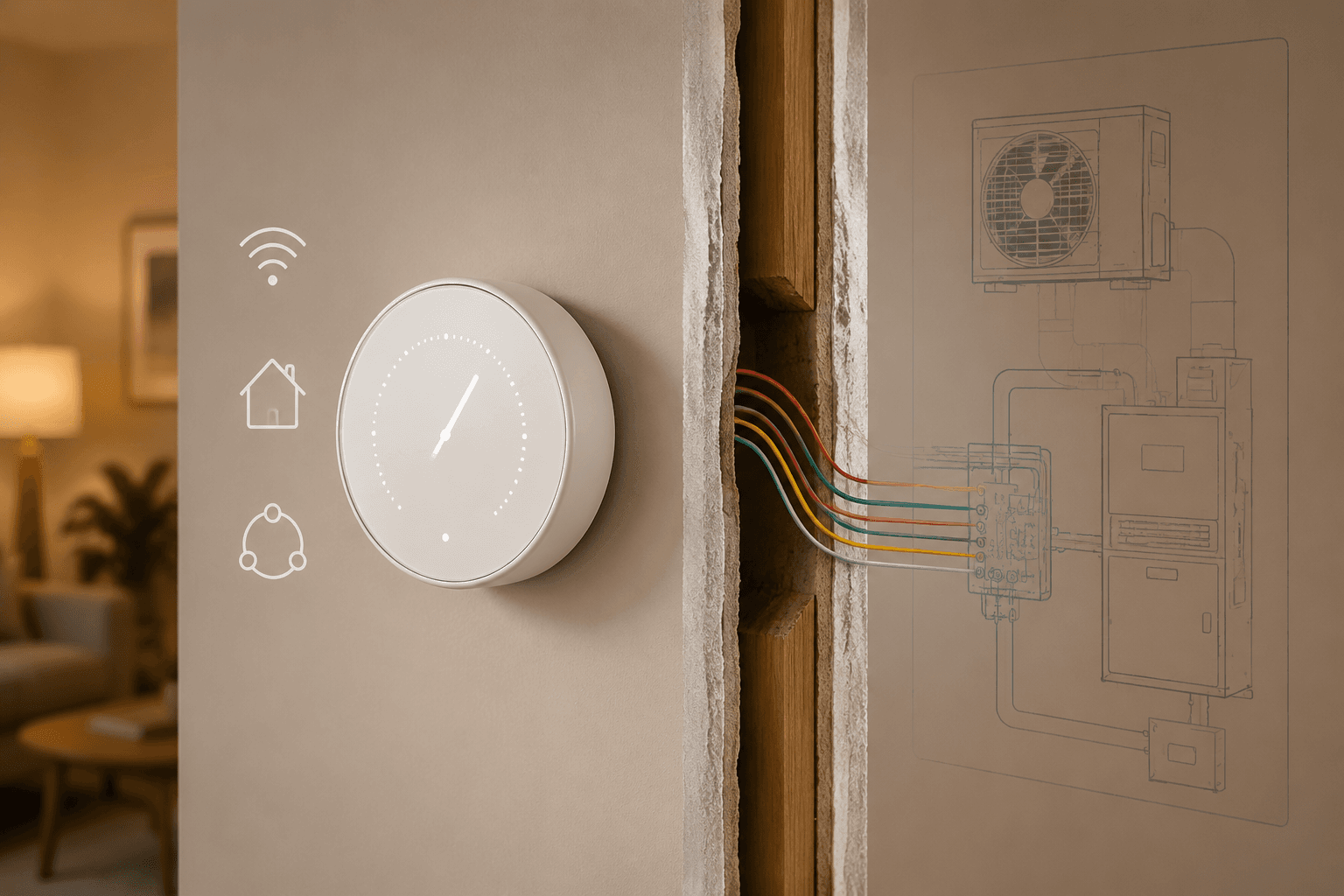
Ecobee Smart Thermostat Premium is the strongest broad recommendation right now because Consumer Reports, Wirecutter, CNET, and PCMag all put it near the top for a mix of performance, features, sensors, and platform reach.[1][2][3][4] That consensus is useful. It still does not mean Ecobee is the right answer for every wall plate.
| Best fit | Smart thermostat | C-wire situation | Ecosystem fit | Remote sensor strength | Price position | Savings and rebate relevance | Safe current buy? |
|---|---|---|---|---|---|---|---|
| Best overall for most compatible homes | Ecobee Smart Thermostat Premium | Generally expects C-wire or included adapter | Alexa, Apple Home, Google, SmartThings; broadest platform story | Excellent; sensor included and central to the product | Premium | ENERGY STAR context applies; rebates can matter | Yes |
| Best Google-centered premium pick | Google Nest Learning Thermostat, 4th Gen | Can operate without a C-wire in many homes, though compatibility still needs checking | Strongest for Google Home households | Weaker than Ecobee for room-by-room balancing | Premium | ENERGY STAR context applies; payback depends on price and behavior | Yes |
| Best budget Alexa pick | Amazon Smart Thermostat | Often needs C-wire or power adapter path | Alexa-first; not for Google or Apple Home households | None | Budget, often around $58–$80 | Low upfront cost can shorten payback quickly | Yes |
| Best multi-room comfort option if available | Honeywell Home T9 | Generally expects C-wire or adapter support | Works across major platforms, but check current app and availability details | Strong; remote room sensors are the point | Midrange to premium depending on stock | Useful where uneven rooms cause over-conditioning | Uncertain; availability appears discontinued or backordered |
| Best Ecobee value alternative | Ecobee Smart Thermostat Enhanced or Essential | Generally expects C-wire or adapter path | Good platform coverage, with fewer premium extras | Good when paired with compatible sensors | Midrange or lower than Premium | Often the better payback choice after rebates | Yes |
For a closer feature-by-feature comparison of the big four brands, use the Nest vs Ecobee vs Honeywell vs Amazon comparison. The rest of this guide starts where most returns start: compatibility.
Start With the Wall, Not the App
The C-wire is the small installation detail that causes the most outsized grief. It supplies continuous 24-volt power so the thermostat can keep Wi-Fi, sensors, displays, and software features running without stealing power from the heating or cooling call. Roughly half of U.S. homes lack a C-wire, which is why “works without C-wire” and “includes adapter” are not footnotes; they are buying criteria.
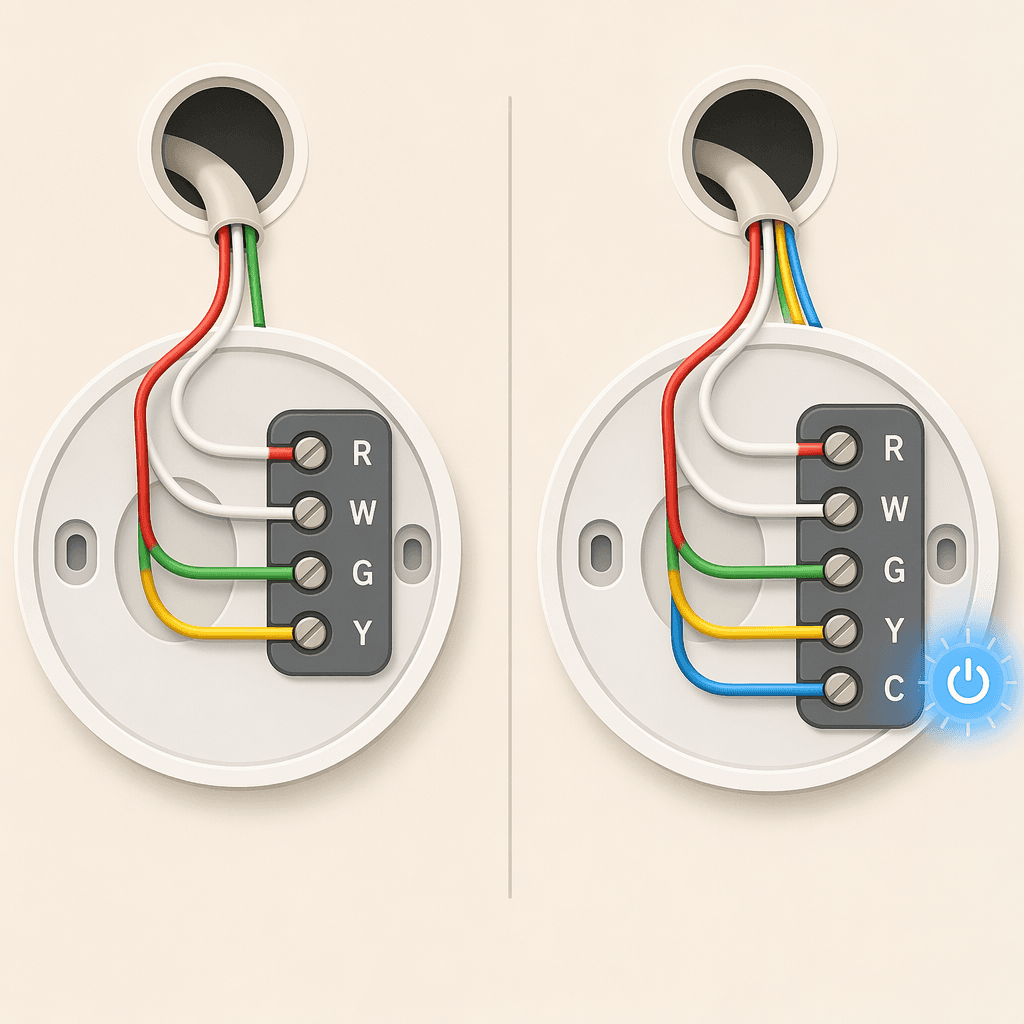
Nest gets attention here because its thermostats can run without a C-wire in many installations. That does not mean every C-wire-free home is automatically safe. Some systems tolerate power sharing better than others, and symptoms may show up as intermittent Wi-Fi drops, short cycling, or a thermostat that behaves fine until weather gets extreme. Ecobee and Honeywell generally expect a C-wire or adapter kit, which is less romantic at checkout but often cleaner once installed.
Before picking a model, take the old thermostat off the wall after cutting power at the breaker, photograph the wiring, and check both the visible terminals and the furnace or air-handler control board. If the system is not a standard forced-air furnace and central AC setup—electric baseboard, heat pump with auxiliary heat, boiler, mini-split, dual-fuel, zoned dampers—the thermostat choice narrows fast. The HVAC-system compatibility guide is the better next stop for those setups.
- If there is a C-wire: Ecobee, Honeywell, Amazon, and Nest all remain possible, subject to system compatibility.
- If there is no C-wire: Nest may be the simplest candidate, but an adapter or professional install may still be the more stable choice.
- If the home has heat pump, auxiliary heat, boiler, line-voltage, or mini-split equipment: verify model-specific support before comparing features.
- If the thermostat controls multiple zones or unusual accessories: do not assume a consumer smart thermostat can replace the current control without changes.
For a slower walkthrough of this decision sequence, use the five-decision smart thermostat buying guide. It is the guide to open before ordering, not after the breaker is already off.
Ecobee Premium Is the Broadest Pick, With One Big Assumption
Ecobee Smart Thermostat Premium earns its place at the top of many lists because it solves more real household problems than most competitors. Consumer Reports’ 2026 lab-tested roundup, Wirecutter’s 2026 recommendations, CNET’s 2026 testing, and PCMag’s 2026 testing all support Ecobee Premium as a leading smart thermostat, especially for feature completeness, remote sensor quality, and ecosystem breadth.[1][2][3][4]
The included remote sensor matters more than the shiny faceplate. A thermostat in a hallway is often measuring the one place nobody sits for long. Ecobee lets the system pay attention to rooms that are occupied or chronically uncomfortable, which can prevent the familiar pattern where the downstairs feels fine while an upstairs bedroom runs several degrees warmer or colder. For homes with uneven rooms, Ecobee’s sensor approach is a comfort feature first and a savings feature second.
Its platform support is also unusually forgiving. It works across Alexa, Apple Home, Google, and SmartThings in a way that makes it easier to recommend for households that are not fully committed to one tech ecosystem. That flexibility is part of why Ecobee Premium is the safest premium answer for many homes, especially when different family members use different phones or voice assistants.
The assumption is power. Ecobee generally wants a C-wire or the adapter route. If the wiring is friendly, Premium is the most complete choice. If the wiring is not friendly, the “best overall” label becomes a weekend project, a service call, or a return label. Buyers trying to stay inside the Ecobee family should compare Premium, Enhanced, and Essential in the Ecobee model guide before paying for features they may not need.
Nest Learning Thermostat Fits Google Homes Better Than Mixed Homes
The Google Nest Learning Thermostat, 4th Gen, is the premium pick that feels most like an object people want on the wall. It is also the model most associated with automated schedule learning. In 2026 comparisons, its strengths are AI-driven automation and design, especially for homes already centered on Google Home.
That ecosystem condition matters. Nest gives the most back when the household already uses Google routines, Google Home controls, and Google-friendly devices. Put it in a mixed Apple/Alexa household and some of the polish becomes less useful. It can still be a good thermostat, but the purchase is less obvious.
Nest also has a different answer to uneven rooms than Ecobee. If the main complaint is that one bedroom or office is consistently uncomfortable, Ecobee and Honeywell have the stronger remote-sensor case. If the main goal is a handsome thermostat that learns patterns well in a Google household and may avoid a C-wire installation headache in some homes, Nest is a very reasonable premium choice.
Amazon Smart Thermostat Is the Budget Pick, Not the Universal Bargain
Amazon Smart Thermostat is compelling because the price is so low—often around $58 to $80—that rebates and energy savings can make the payback math move quickly. It is the best entry point for Alexa households in the current market, but it is not a cheap Ecobee. It lacks remote sensors and does not support Google Home or Apple HomeKit in the way many mixed-platform households would want.
That makes it a narrow, useful recommendation: choose it when the home is already Alexa-centered, the HVAC system is compatible, the wiring works or can be adapted cleanly, and the thermostat location already represents the rooms people care about. Do not choose it if the real problem is a nursery, bedroom, or home office that never matches the hallway temperature.
For Uneven Rooms, Sensors Matter More Than Learning
Remote sensors are easy to oversell, but they are also one of the few smart thermostat features that can change daily comfort in a visible way. The right question is not “does this thermostat have sensors?” It is “will the HVAC system act on the rooms that are uncomfortable, and will that improve the occupied rooms without making other rooms worse?”
Ecobee models and Honeywell Home T9 are the leading names for multi-room balancing. Honeywell T9 deserves mention because its remote room sensors are strong, but its current-buy status is less clean. Existing device coverage notes that the T9 appears discontinued or backordered, so treat it as a good option if already available through a trusted seller, not as the default recommendation to chase at any price. The Honeywell T9 profile is worth checking before building a purchase around it.
Sensors are most useful in homes where the thermostat is in a poor location, one level gets sun exposure and the other does not, or the rooms that matter change by time of day. They are less useful when the HVAC system itself is undersized, ductwork is badly imbalanced, or one room has an insulation problem a thermostat cannot fix. For a deeper look, compare the remote sensor options and the limits of remote sensors before assuming sensors will solve a comfort problem.
Savings Are Real, but the Dollar Figure Needs Context
ENERGY STAR-certified smart thermostats have a verified average HVAC-cost reduction of 8%, which is the best baseline number to use when comparing savings claims.[5] The U.S. Department of Energy also supports the underlying mechanism: a household can save up to 10% a year on heating and cooling by setting the thermostat back 7 to 10 degrees Fahrenheit for 8 hours a day.[6]
The old ENERGY STAR-style dollar shorthand of about $50 per year is less useful for 2026 because energy prices have changed. A 2026 analysis that synthesizes ENERGY STAR, DOE, EIA, and current energy-price assumptions estimates that 8% to 10% savings works out to roughly $155 to $237 per year for a typical U.S. household.[7] That is a reasonable planning range, not a primary EPA number and not a guarantee for every home.
A household with high heating and cooling bills, stable schedules, and a poorly managed old thermostat may see meaningful savings. A household that already uses careful setbacks or has mild weather may see less. Comfort choices matter too: if remote sensors make the system run longer to keep a bedroom comfortable, the thermostat may be doing exactly what the household wanted even if the energy bill does not drop dramatically.
Utility rebates commonly run from $50 to $200, and that can change the math more than a small feature difference between models. A discounted Amazon thermostat can pay back quickly; a premium Ecobee may still make sense if the rebate is strong and the sensors solve a real comfort issue. For the full payback math, use the smart thermostat savings guide instead of treating a single national estimate as your bill.
Matter Helps, but It Does Not Erase Ecosystem Choices
Matter support is improving cross-platform smart home compatibility in 2026, but it is not a magic label that makes every thermostat behave the same way everywhere. Setup paths, feature exposure, sensor behavior, voice controls, and app-only settings can still differ by brand and platform.
If the household is already committed to Google, Nest has the cleanest argument. If it is Alexa-first and budget-sensitive, Amazon is the obvious low-cost candidate. If Apple Home or mixed-platform flexibility matters, Ecobee deserves extra weight. Readers choosing mainly by platform should use the smart thermostat ecosystem guide before assuming a Matter logo means every feature will land where they expect.
Privacy-sensitive buyers may also want to compare value and data trade-offs across Sensi, Nest, and Ecobee. That is a different decision from pure compatibility, and the Sensi, Nest, and Ecobee comparison is a better fit for that branch of the decision.
How to Narrow the Choice Without Overspending
Once incompatible models are gone, the decision becomes calmer. Premium thermostats are worth paying for when they remove a real pain point: uneven rooms, multi-platform households, better automation, or a cleaner app experience that people will actually use. They are not worth paying for just because the current thermostat is boring.
| Your situation | Start here | Be careful about |
|---|---|---|
| You want the safest premium recommendation and have compatible wiring | Ecobee Smart Thermostat Premium | Paying for Premium if Enhanced or Essential would meet the same needs |
| You use Google Home heavily and care about automation and design | Google Nest Learning Thermostat, 4th Gen | Assuming it is the best room-sensor solution |
| You use Alexa and want the lowest sensible upfront cost | Amazon Smart Thermostat | Buying it for a home that needs remote room sensing |
| You have hot and cold rooms that matter more than app polish | Ecobee models or Honeywell T9 if available | Expecting sensors to fix ductwork, insulation, or HVAC sizing problems |
| You have unusual HVAC equipment | Model-specific compatibility check first | Letting ecosystem preference outrank equipment support |
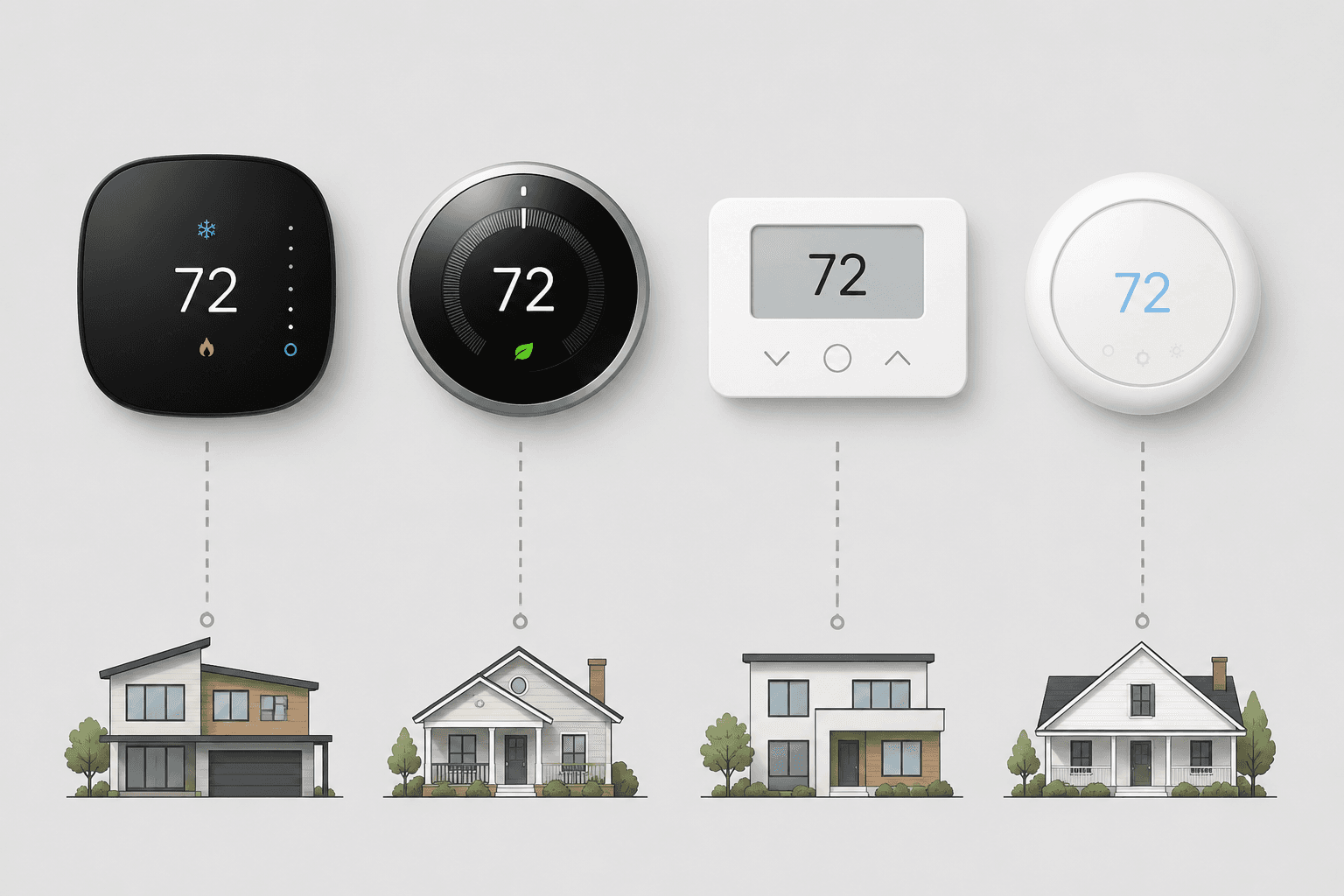
Ecobee Smart Thermostat Premium is the strongest broad recommendation for 2026. Nest Learning Thermostat is the strongest premium pick for committed Google households that value automation and design. Amazon Smart Thermostat is the budget Alexa pick. Honeywell T9 remains important for room-sensor discussions, but its uncertain availability keeps it from being a clean current default.
None of them should be bought before confirming wiring, HVAC compatibility, smart home platform fit, and whether remote sensors solve a real problem in the home.
References
- 8 Best Smart Thermostats of 2026, Lab-Tested and Reviewed — Consumer Reports
- The 4 Best Smart Thermostats of 2026 — Wirecutter
- The Best Smart Thermostats of 2026: Prepare for the Heat — CNET
- The Best Smart Thermostats We've Tested for 2026 — PCMag
- ENERGY STAR Smart Thermostats FAQs — ENERGY STAR
- Thermostats — U.S. Department of Energy
- How Much Can a Smart Thermostat Actually Save You? (2026 Data) — CLIQ For Home
Data Updates
Know about updated rebate programs, changed subscription prices, or new ENERGY STAR certifications? Submit a note below to help keep this content current. For formal data corrections, use the contact page.
Comments
Join the discussion with an anonymous comment.