
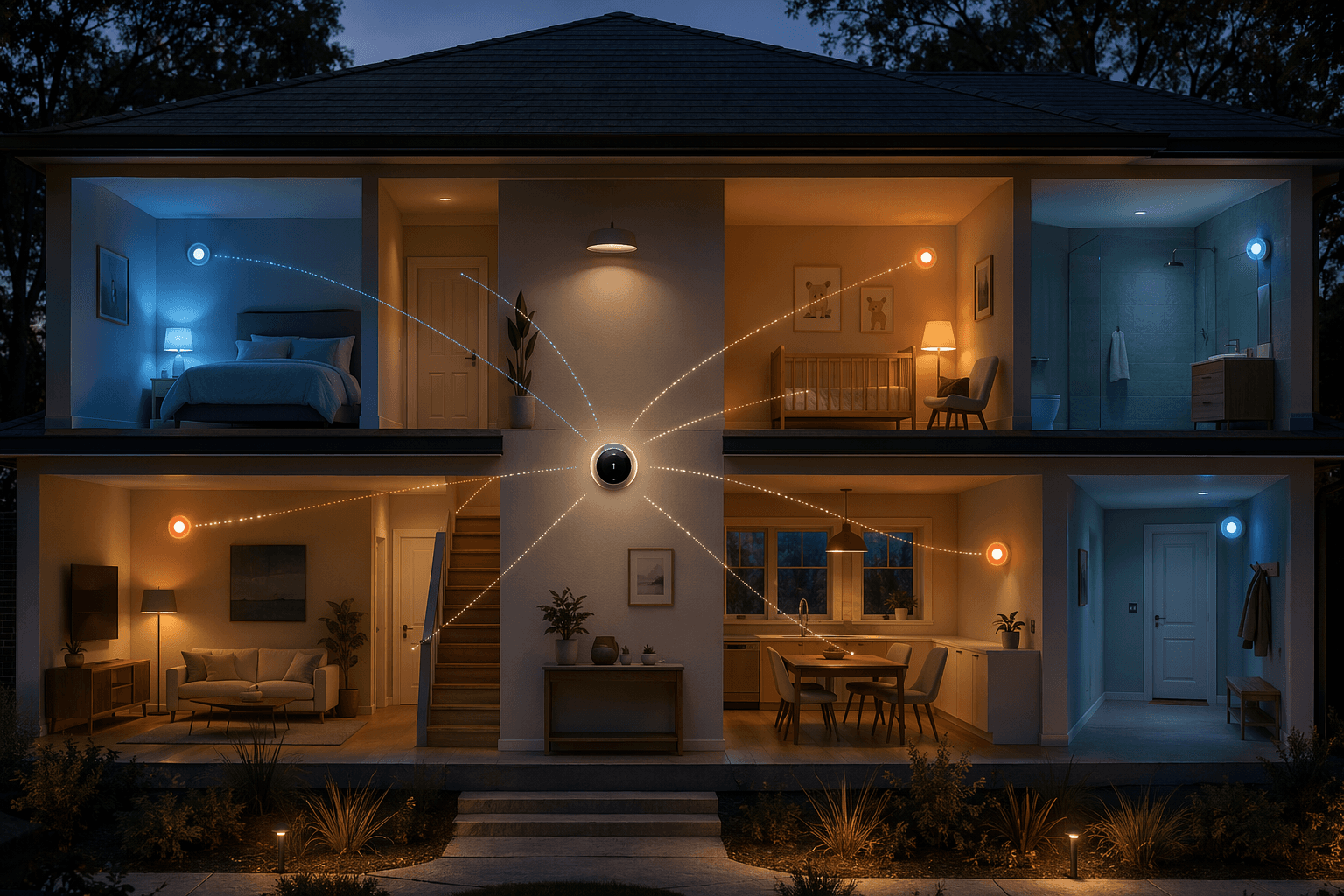
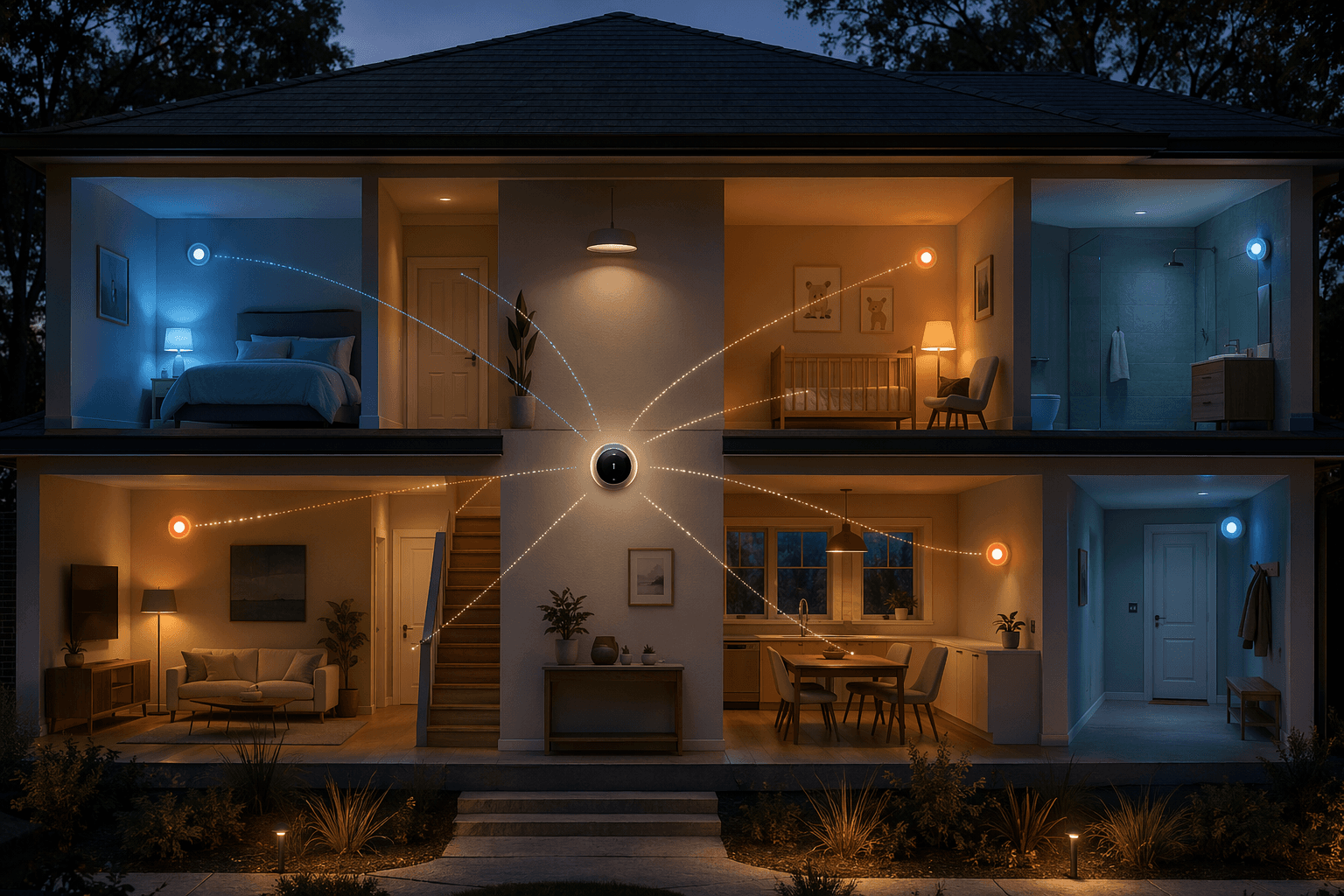
Buying a smart thermostat with remote sensor support sounds straightforward until the word “sensor” starts doing too much work. One brand’s sensor can notice that someone is actually in the upstairs bedroom. Another only reports that the bedroom is 74°F. Another promises a much longer wireless reach, which matters a lot more in a long ranch house than in a tidy product comparison chart.
The useful question is not which thermostat has the nicest wall display. It is whether the system can change which room the HVAC system listens to, and whether it can do that predictably in the room that is currently being ignored.
The sensor differences that actually matter
If you are still deciding whether remote sensors are worth buying at all, start with Do You Actually Need Remote Sensors for Your Smart Thermostat?. This comparison assumes you already have a room that regularly loses the vote: a nursery, office, finished attic, far bedroom, or back addition.
| System | What the sensor detects | How rooms are weighted | Stated wireless range | Maximum sensors | Battery estimate | Sensor in common thermostat bundle |
|---|---|---|---|---|---|---|
| Ecobee SmartSensor | Temperature and occupancy; infrared occupancy sensing with 140° horizontal / 100° vertical field of view up to 20 ft [1] | Can use Follow Me to focus comfort on occupied rooms [1] | About 60 ft, using 915 MHz radio | Up to 32 sensors per account | Up to 5 years, manufacturer estimate [1] | Ecobee Smart Thermostat Premium commonly includes 1 sensor; Ecobee Essential includes none |
| Honeywell Home T9 sensor | Temperature, humidity, and occupancy [2] | Can average selected rooms and use sensor data for comfort decisions [2] | Up to 200 ft stated range [2] | Up to 20 sensors [2] | About 1 year, manufacturer estimate | T9 commonly includes 1 sensor, but Honeywell lists the T9 as discontinued [2] |
| Nest Temperature Sensor, 2nd gen | Temperature only; no occupancy sensing [3] | Room priority is set by schedule rather than automatic occupancy averaging [3] | About 50 ft over Bluetooth Low Energy | Up to 6 sensors per thermostat | Up to 3 years, manufacturer estimate [3] | Nest Learning Thermostat, 4th gen, commonly includes 1 sensor |
| Sensi Touch 2 remote sensors | Remote temperature sensing for supported Sensi systems | More basic remote sensing support rather than a heavily automated occupancy system | Range depends on home conditions and placement | Up to 15 sensors | Battery life depends on sensor use and conditions | Sensi Touch 2 commonly includes no sensors |
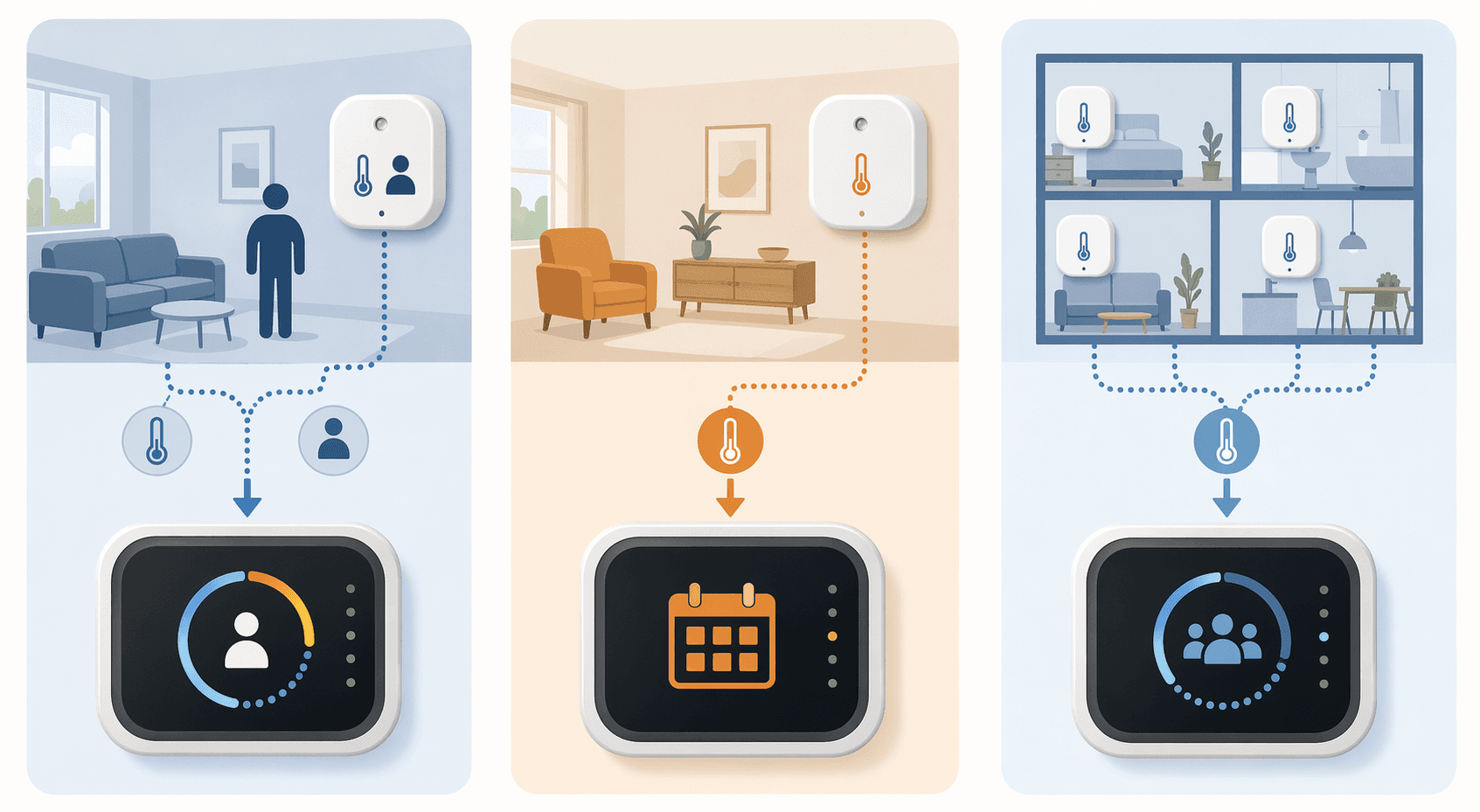
Those rows are not minor accessory specs. They describe who gets listened to. A thermostat in a hallway can be perfectly satisfied while a closed bedroom is uncomfortable. A remote sensor only fixes that if the thermostat uses the sensor’s reading in a way that matches how the room is actually used.
Ecobee changes behavior when rooms are occupied
Ecobee is the cleanest example of a remote sensor system doing more than extending the thermostat’s thermometer. Its SmartSensor measures temperature and detects occupancy, with an infrared field of view listed at 140° horizontal, 100° vertical, and up to 20 ft [1]. That matters in ordinary rooms because the system is not only asking, “What temperature is the bedroom?” It can also ask, “Is anyone actually using that bedroom right now?”
With Follow Me, Ecobee can prioritize occupied rooms instead of treating every sensor reading as equally important all day [1]. In a house where the office is used during the afternoon, the kids’ rooms matter at night, and the downstairs hallway is mostly a passageway, that is the kind of logic that can stop the wrong space from dominating comfort.
The catch is that “occupied” is still a sensor interpretation, not a person making a comfort vote. Placement matters. A sensor tucked behind a monitor, aimed away from the bed, or hidden behind furniture may not see the room the way a person experiences it. Ecobee’s occupancy angle and distance spec are useful because they turn that vague warning into a placement problem: put the sensor where people actually sit, sleep, or move within its view.
Honeywell T9 reaches farther, with an availability caveat
Honeywell’s T9 sensor system is interesting for a different reason: reach. Honeywell lists the T9 sensor range at up to 200 ft, and the sensors detect temperature, humidity, and occupancy [2]. In a long single-story house, a detached-feeling addition, or a thermostat location that sits far from the rooms people complain about, that range claim is not a footnote. It may be the reason the sensor can be placed where it is needed at all.
The T9 also supports up to 20 sensors, which puts it well above Nest’s published sensor ceiling and below Ecobee’s larger account-level capacity [2]. That gives it a natural fit for homes with several rooms worth monitoring, especially if humidity readings are useful alongside temperature. A back bedroom that is both warmer and more humid than the hallway tells a more specific story than temperature alone.
There is one practical wrinkle: Honeywell’s own product page lists the T9 as discontinued [2]. Retail availability may continue for a while, and homeowners may still find units for sale, but that status changes the buying calculation. A strong sensor spec is less comforting if add-on sensors, warranty expectations, or future replacement options become harder to count on.
Nest is simpler: pick the room by schedule
Nest’s Temperature Sensor is easier to understand because it does less. Google describes the 2nd gen Nest Temperature Sensor as a temperature sensor, not an occupancy sensor [3]. It does not watch for presence and then automatically shift comfort toward the occupied room. Instead, Nest lets the user choose which sensor should control comfort during scheduled periods [3].
That can be perfectly adequate when the problem room follows a predictable pattern. If the bedroom matters from evening to morning and the living area matters the rest of the day, scheduled priority is not a weakness. It is simple, readable, and less likely to surprise someone who just wants the thermostat to follow a known routine.
It is weaker when the house changes shape every day. A work-from-home office, alternating custody bedroom, guest room, or playroom used at irregular times asks for presence-aware logic. Nest can know the room temperature, but the sensor itself does not know whether the room is occupied [3].
Sensi belongs in the comparison, but not for the same reason
Sensi Touch 2 is worth considering for buyers who want remote sensor support without building the whole thermostat decision around sensor intelligence. Its appeal is more basic: compatibility, a familiar thermostat experience, and support for multiple remote sensors. It is not the system to study first if the central problem is automatic occupied-room comfort.
That does not make it a bad fit. Some homes do not need elaborate room logic. If the goal is simply to give the thermostat better information from a few rooms, and the household is not expecting the system to follow people around, Sensi can be a more modest way into remote sensing. For broader brand context, the Sensi thermostat lineup is the better place to compare the thermostats themselves.
Range numbers are planning numbers, not promises
The range spread is large enough to change the shortlist: roughly 60 ft for Ecobee, up to 200 ft for Honeywell T9, and about 50 ft for Nest over Bluetooth Low Energy. Those numbers should be treated as planning numbers. Walls, floors, duct chases, masonry, metal, mirrors, appliances, and wireless interference all get a vote that the product box does not fully explain.
A two-story house can be harder than the straight-line distance suggests. The far bedroom may be only 35 ft away if measured through air, but the signal may be crossing a floor, a bathroom wall, and a closet. A long ranch can create the opposite problem: fewer floor transitions, but a much longer horizontal path. This is where Honeywell’s stated 200 ft range becomes genuinely relevant, while Nest and Ecobee buyers should be more careful about sensor placement and return policies.
Sensor count matters differently. A home with one bad bedroom may not care whether the system supports 6, 15, 20, or 32 sensors. A larger house with several bedrooms, a basement, and a home office might. Still, more sensors are not automatically better. If a thermostat averages too many rooms that are used at different times, it can chase a mathematical average that makes nobody especially comfortable.
Match the sensor logic to the room problem
| Home problem | Sensor system trait to prioritize | Best fit from this group |
|---|---|---|
| A bedroom, nursery, or office is used at changing times | Occupancy detection plus automatic occupied-room comfort | Ecobee first; Honeywell T9 if availability and range work |
| A long ranch house or far addition strains wireless reach | Longest practical sensor range | Honeywell T9, with discontinued-status caution |
| A predictable bedroom schedule is the main issue | Manual scheduled room priority | Nest |
| Many rooms need basic monitoring | Higher sensor count and simple coverage expectations | Ecobee or Honeywell T9; Sensi if simpler sensing is enough |
| The thermostat and problem room are in different HVAC zones | Correct zone matching before sensor choice | Any brand can disappoint if the sensor is in the wrong zone |
That last row is the easiest expensive mistake. A sensor should be in a room served by the same HVAC zone as the thermostat controlling it. If the upstairs bedroom belongs to a different zone, asking the downstairs thermostat to satisfy that bedroom can overcool or overheat the rooms it actually controls. Remote sensors are not a zoning retrofit.
Cost is mostly about how many rooms you need to make visible
The thermostat price is only the first part of the system cost. Ecobee Smart Thermostat Premium and Honeywell T9 bundles commonly include one sensor, while Ecobee Essential and Sensi Touch 2 commonly include none. Nest Learning Thermostat, 4th gen, commonly includes one Nest Temperature Sensor. Add-on sensors are often sold individually or in multi-packs, and the final price depends on how many rooms need a voice.
This is where the purchase can become self-justifying or silly. One remote sensor in the ignored nursery can be the whole point of the upgrade. Six sensors scattered through rarely used rooms can make the system more complex without producing better comfort. Buy sensors for rooms that change the HVAC decision, not for rooms that merely look nice on an app screen.
The practical verdict
Ecobee is the strongest fit when the real problem is automatic comfort in occupied rooms. Its SmartSensor combines temperature and occupancy, and Follow Me gives the system a way to stop treating the hallway as the only room that matters [1]. For many uneven-temperature homes, that is the most meaningful sensor behavior in this comparison.
Honeywell T9 is compelling when distance, humidity sensing, and broad sensor coverage are the main constraints, but the discontinued listing on Honeywell’s own page has to be part of the decision [2]. Nest is better for simpler scheduled room targeting, especially when the uncomfortable room follows a routine and occupancy detection is not essential [3]. Sensi fits buyers who want remote sensor support without making sensor automation the center of the thermostat purchase.
The brand name matters less than three quieter details: whether the sensor can see occupancy, how the thermostat weights rooms, and whether the signal can physically reach the room causing the complaint. If those answers line up with the house, the remote sensor can change comfort. If they do not, it is just another temperature reading from a room that still waits its turn.
References
- SmartSensor for doors, windows, and rooms, ecobee
- T9 Smart Thermostat, Honeywell Home
- Nest Temperature Sensor (2nd gen), Google Store
Data Updates
Know about updated rebate programs, changed subscription prices, or new ENERGY STAR certifications? Submit a note below to help keep this content current. For formal data corrections, use the contact page.
Comments
Join the discussion with an anonymous comment.