The real problem: 29% of owners never program their thermostat
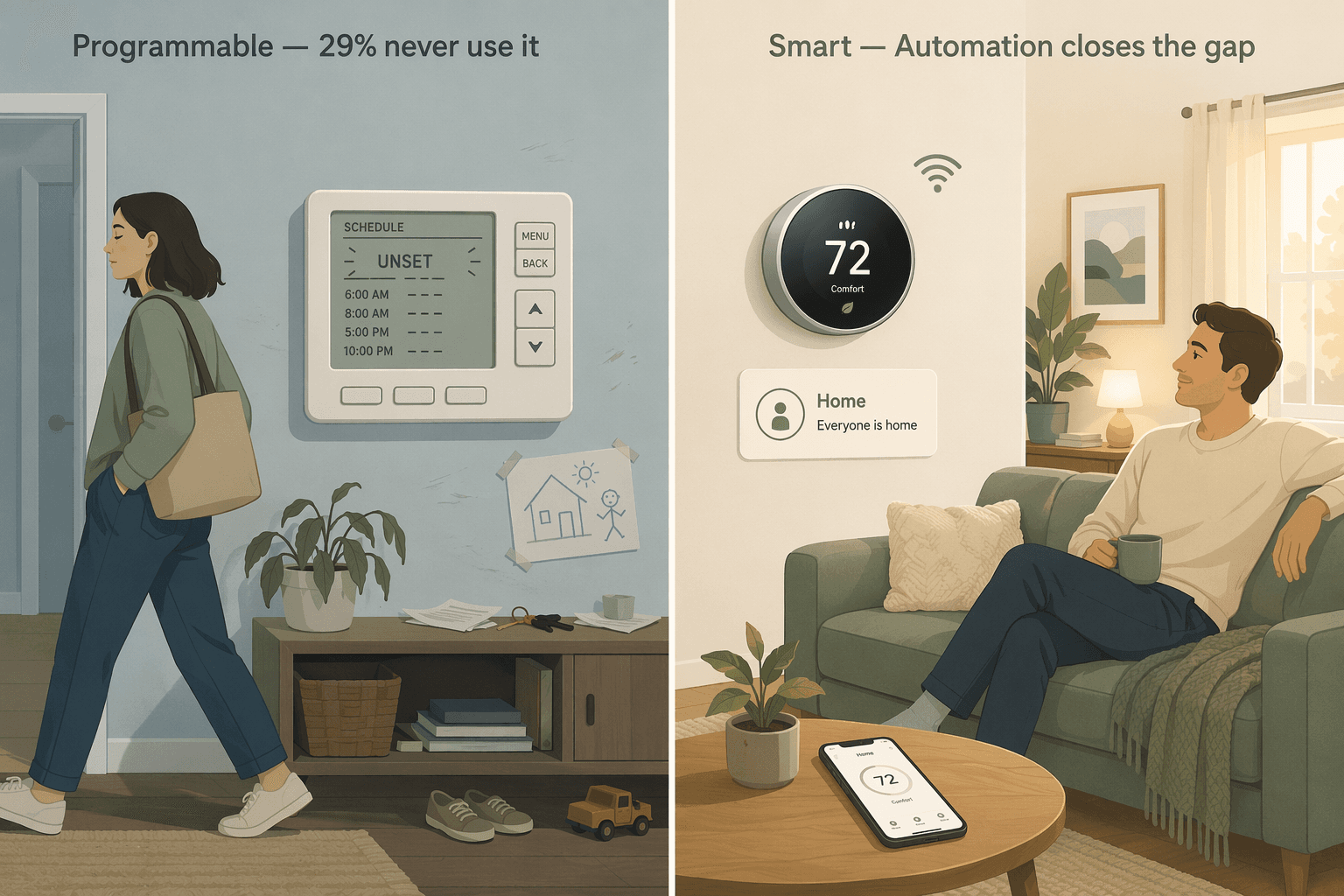
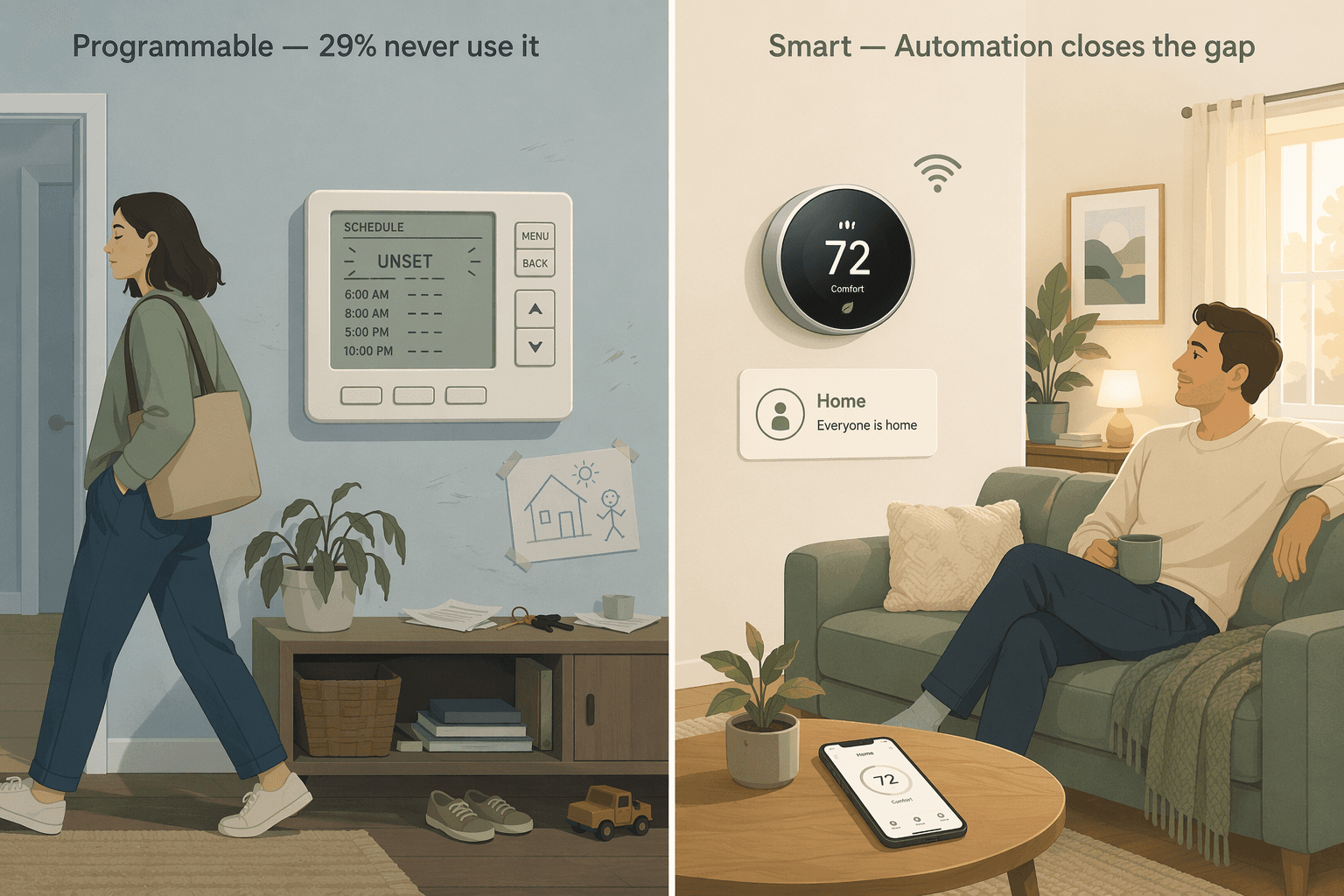
I'll start with the number that changes everything. In a February 2025 survey of 2,015 U.S. adults, Consumer Reports found that 29% of programmable thermostat owners never take advantage of scheduling features. That is not a fringe group. It is the single biggest reason the theoretical 10% savings rarely shows up on the actual utility bill.
The Department of Energy says turning your thermostat back 7–10°F for eight hours a day can cut heating and cooling by up to 10%. That number is real—but only if you actually set the schedule. Nearly a third of owners don't. The result: a device that could save money sits on the wall doing nothing different from a basic manual thermostat.
Even when programmed, results are often lousy
Among the 71% who do attempt to program, the results are often poor. ENERGY STAR puts it plainly: "Homeowners generally don't understand how programmable thermostats work and may not program them at all, which can lead to higher utility bills." The schedules get set once and never updated. The setback is too small or for too few hours. The manufacturer's default schedule—often the same in every box—stays unaltered.
The consequence: a device that could save 10% ends up saving little or nothing. And the homeowner, having already paid for a programmable, has no reason to think about it again until the energy bill stays high.
How smart thermostats solve the behavior problem
The hardware is similar. The difference: a smart thermostat doesn't need you to tell it when to save. It uses geofencing to know when you leave and return. It uses occupancy sensors to detect whether a room is empty. It can learn your schedule over a week and build an auto‑schedule without any manual input. Where a programmable thermostat relies on the owner's diligence—which, as we have seen, is unreliable—a smart thermostat automates the entire setback process.
According to data from electricrates.org, geofencing alone can add up to 23% extra savings beyond basic scheduling, simply by catching irregular absences—like leaving early for a dentist appointment or staying late for dinner—that a fixed schedule never covers. (I should note this figure comes from a secondary aggregator, not an independent study, so treat it as illustrative rather than definitive.)
The ENERGY STAR specification for smart thermostats requires a minimum of 8% heating runtime reduction and 10% cooling runtime reduction based on real‑world field data. That is the baseline. Many models exceed it, but the important thing is that the savings are realized in actual homes, not just on paper. I treat that 8% as the most reliable number in this article.
Actual savings: a head‑to‑head comparison
Here is the honest comparison. I separate the numbers by source, because a manufacturer claim and an independent average are not the same thing.
| Thermostat type or source | Savings | Conditions |
|---|---|---|
| Programmable (DOE estimate) | Up to 10% | Only if setback used diligently |
| ENERGY STAR smart thermostat average | ~8% | Independent, real‑world data |
| Nest (independent studies of actual customers) | 10–12% heating, 15% cooling | ~$140/year |
| Ecobee (manufacturer claim) | Up to 23% | Best‑case conditions |
| Mysa central HVAC (manufacturer claim) | Up to 26% | For electric baseboard, maximum potential |
The DOE's 10% is the theoretical maximum for a programmable—and it requires the user to set a 7–10°F setback for eight hours every day. ENERGY STAR's 8% is the average actually achieved by smart thermostat owners, measured across a nationwide sample. The manufacturer numbers (Ecobee 23%, Mysa 26%) come from controlled studies, often under ideal conditions. They are real but not representative of every home.
The practical difference: a programmable can save 10% if you use it perfectly. A smart thermostat saves 8–26%—and actually delivers that because it does the work for you. The gap is not the technology; it is the behavior.
Cost and rebates: the premium is smaller than it looks
Programmable thermostats run $20–$60 on the shelf. Smart thermostats range $100–$250. That looks like a big jump until you see the rebates. I've seen them cut the net price in half for many buyers.
- Mass Save (Massachusetts): up to $100 per thermostat
- AEP Ohio: $100 rebate
- PECO (Pennsylvania): $50 back on ENERGY STAR smart thermostats
- Georgia Power: $100 off Nest or Ecobee
- Southern California Edison + SoCalGas: combined $125 bill rebate
These are examples, not every available program, but they show a pattern: the net price can drop to $50–$150 for many buyers. That puts a smart thermostat in the same territory as a mid‑range programmable.
One more cost to consider: the C‑wire. Most smart thermostats need a common wire (C‑wire) for power. If your system does not have one, you may need an adapter or a professional installation that can add $50–$150. That is a real barrier, but it is a one‑time cost, and many rebates cover it indirectly.
When a programmable still makes sense (and when a smart might not)
I want to be clear: not every home should upgrade. There are clear boundaries.
- Variable‑speed heat pumps: Consumer Reports warns that energy‑saving setbacks can actually work against efficiency. Modern variable‑speed systems are designed to run at a constant temperature; the aggressive setbacks that save money on a furnace may make a heat pump run inefficiently. Check the manufacturer's recommendation before switching.
- Homes occupied most of the day: If someone is always home, there is less opportunity for setbacks. The savings shrink, though they do not disappear—geofencing can still catch the times the house is empty for errands or appointments.
- Fixed schedule + diligent programming: If you already set your programmable to a tight schedule and never skip a day, the savings gap with a smart thermostat is small. You are the rare exception where the programmable actually does its job.
- Renters or short‑term living: If you do not plan to stay long, the payback period may not justify the upfront cost, especially if you cannot take the thermostat with you.
- Temperate climate: Even in milder climates, a smart thermostat saves about 8% on average, according to Consumer Reports. The savings are smaller than in cold‑climate homes, but still real.
So should you upgrade? A decision based on your habits
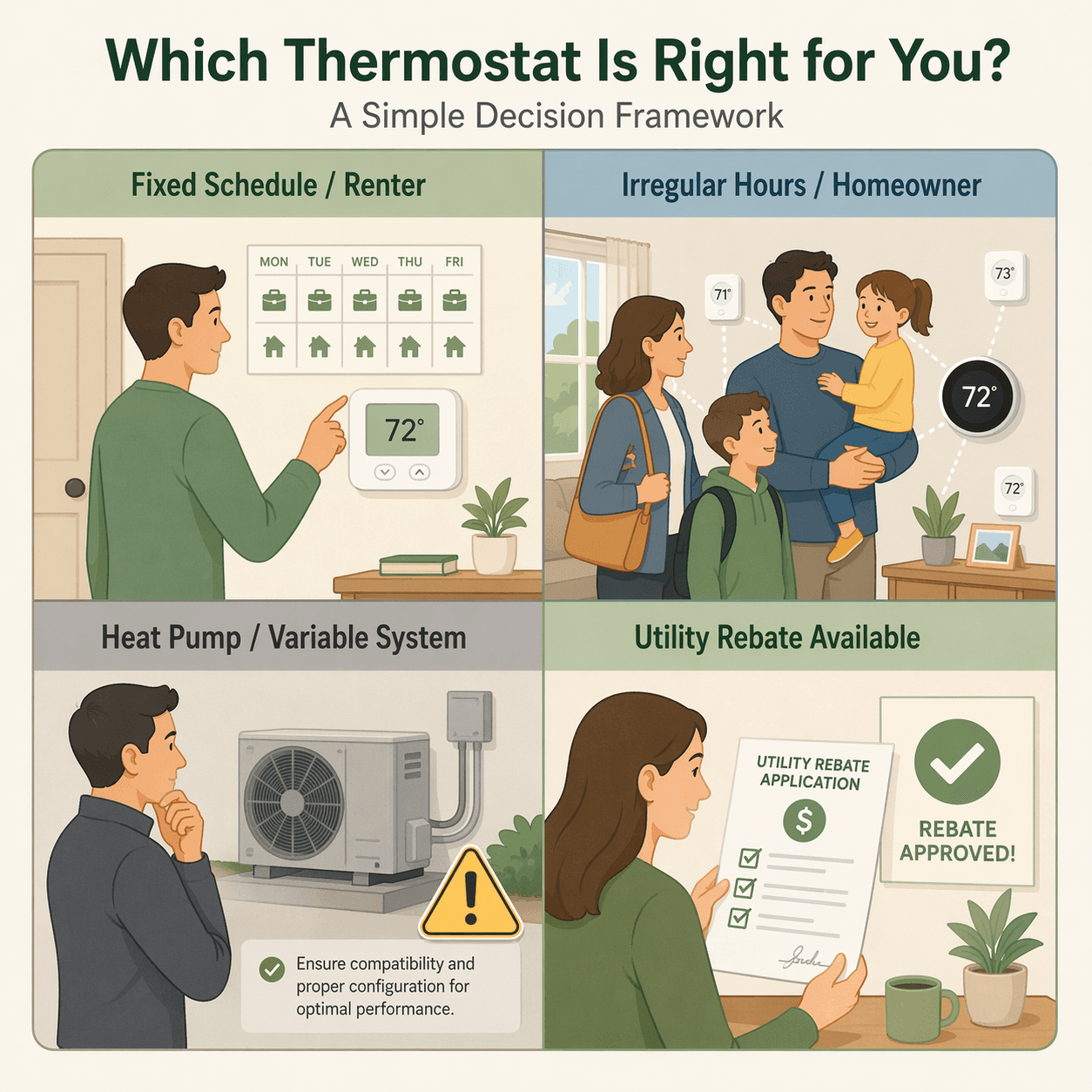
- You never program your thermostat (or rarely do): Upgrade to a smart thermostat. The automation will capture savings you are currently leaving on the table. Expect 8% or more with minimal effort.
- You program diligently and have a fixed schedule: Stick with the programmable. The gap is small, and you are already getting most of the potential savings. But if you want geofencing or remote control, the upgrade is still worth considering.
- You have a variable‑speed heat pump: Check the manufacturer's recommendation. Many heat pump makers advise against aggressive setbacks. A smart thermostat may not help, and could hurt.
- You have irregular or unpredictable hours: Upgrade. Geofencing alone can catch the unplanned absences that a fixed schedule misses. That is where the biggest additional savings come from.
If you decide to upgrade, the Best Smart Thermostat Buyer Guide 2026 will help you pick a model. And if you want a deeper look at how the numbers work out year by year, the Smart Thermostat Payback Period Calculator covers the full ROI math. But for most people, the decision comes down to one question: are you actually using the thermostat you already have?
If the answer is no, the upgrade will pay for itself.
Data Updates
Know about updated rebate programs, changed subscription prices, or new ENERGY STAR certifications? Submit a note below to help keep this content current. For formal data corrections, use the contact page.
Comments
Join the discussion with an anonymous comment.