
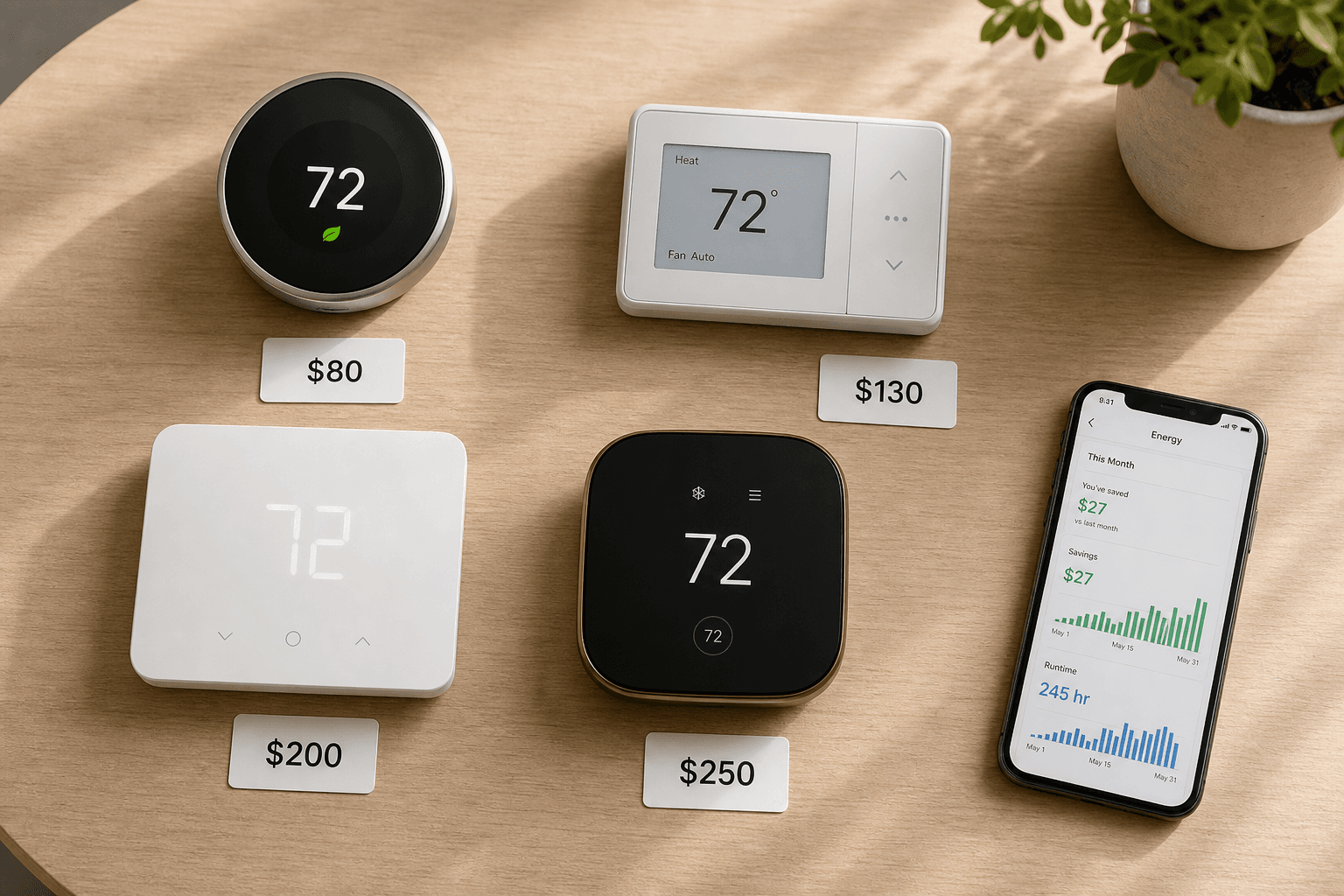
What the Average US Household Spends on Heating and Cooling
Before you can decide if a smart thermostat pays for itself, you need a baseline. The average American household spends roughly half of its annual energy bill on heating and cooling. According to ENERGY STAR, that amounts to more than $900 per year. However, when you factor in all HVAC-related costs — including electricity for fans, pumps, and auxiliary systems — the total annual spend for a typical single-family home in 2026 lands between $1,935 and $2,365.
This range comes from applying current US average energy prices to standard consumption patterns. It is the number you should keep in mind as we walk through the math. Every percentage point of savings on that baseline translates directly into dollars you keep.
The Government Data: What DOE and ENERGY STAR Actually Say
Manufacturer marketing often throws around savings claims of 20% or more. Those numbers are rarely backed by independent, large-scale testing. The figures you can trust come from two government sources: the US Department of Energy (DOE) and the EPA's ENERGY STAR program.
The DOE estimates that homeowners can save up to 10% per year on heating and cooling simply by setting the thermostat back 7–10°F for 8 hours per day. That is a straightforward behavioral change — lower the temperature while you sleep or while the house is empty. The challenge has always been remembering to do it consistently.
ENERGY STAR goes a step further. The program independently certifies smart thermostats based on actual field data, not lab simulations. According to the ENERGY STAR website, certified smart thermostats deliver at least an 8% reduction in heating and cooling costs when used as intended. That 8% figure is the most conservative, verified benchmark available — it is the floor, not the ceiling.
From Percentages to Dollars: $155–$237 Per Year in Savings
Here is where the numbers become concrete. Applying the 8–10% savings range to the $1,935–$2,365 annual HVAC spend produces the following annual savings:
| Savings Scenario | Percentage | Annual HVAC Spend | Annual Savings |
|---|---|---|---|
| Conservative (ENERGY STAR verified) | 8% | $1,935 | $155 |
| Conservative (ENERGY STAR verified) | 8% | $2,365 | $189 |
| Optimistic (DOE maximum) | 10% | $1,935 | $194 |
| Optimistic (DOE maximum) | 10% | $2,365 | $237 |
If your household falls near the national average, you can expect to save between $155 and $237 per year. That is not a marketing claim — it is the direct arithmetic of 8–10% of what you already spend.
To estimate your own savings, take your total annual heating and cooling cost (check your utility bills from the past 12 months) and multiply it by 0.08 for a conservative estimate or 0.10 for an optimistic one.
Why Smart Thermostats Beat Programmable Ones in the Real World
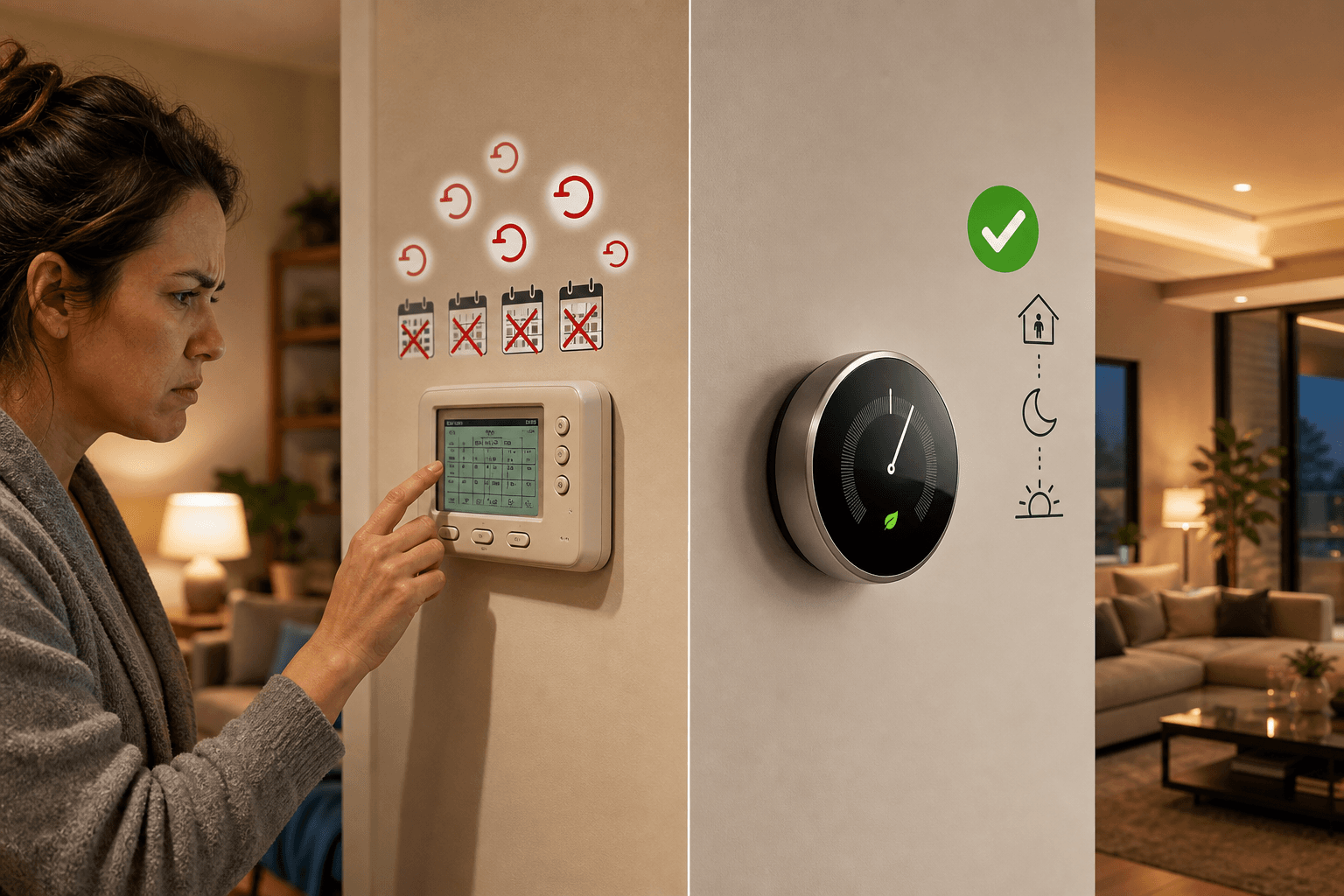
The DOE's 10% savings figure assumes you actually set the thermostat back every day. That is where programmable thermostats have historically failed. A field study conducted by the American Council for an Energy-Efficient Economy (ACEEE) and Cadmus found that 51–78% of programmable thermostat users regularly override their programmed schedules. The result: the theoretical savings never materialize.
Smart thermostats solve this problem through automation. They use occupancy sensors, geofencing, and learning algorithms to adjust temperatures without requiring you to touch the device. The same ACEEE study found that smart thermostats delivered 12.5–16.1% savings on gas heating, compared to just 5% for programmable models in the same households.
Payback Period by Price Tier: From $80 to $250
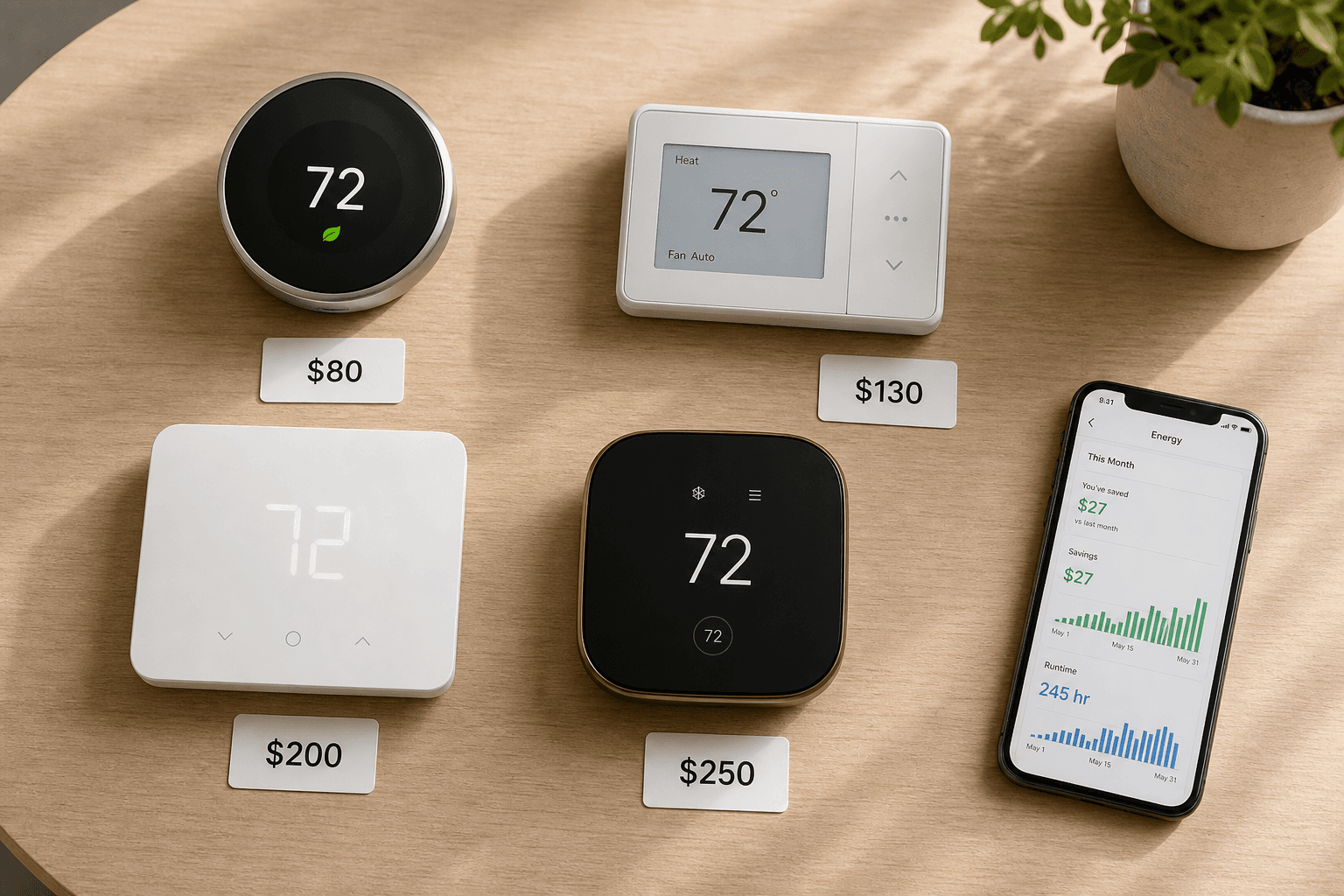
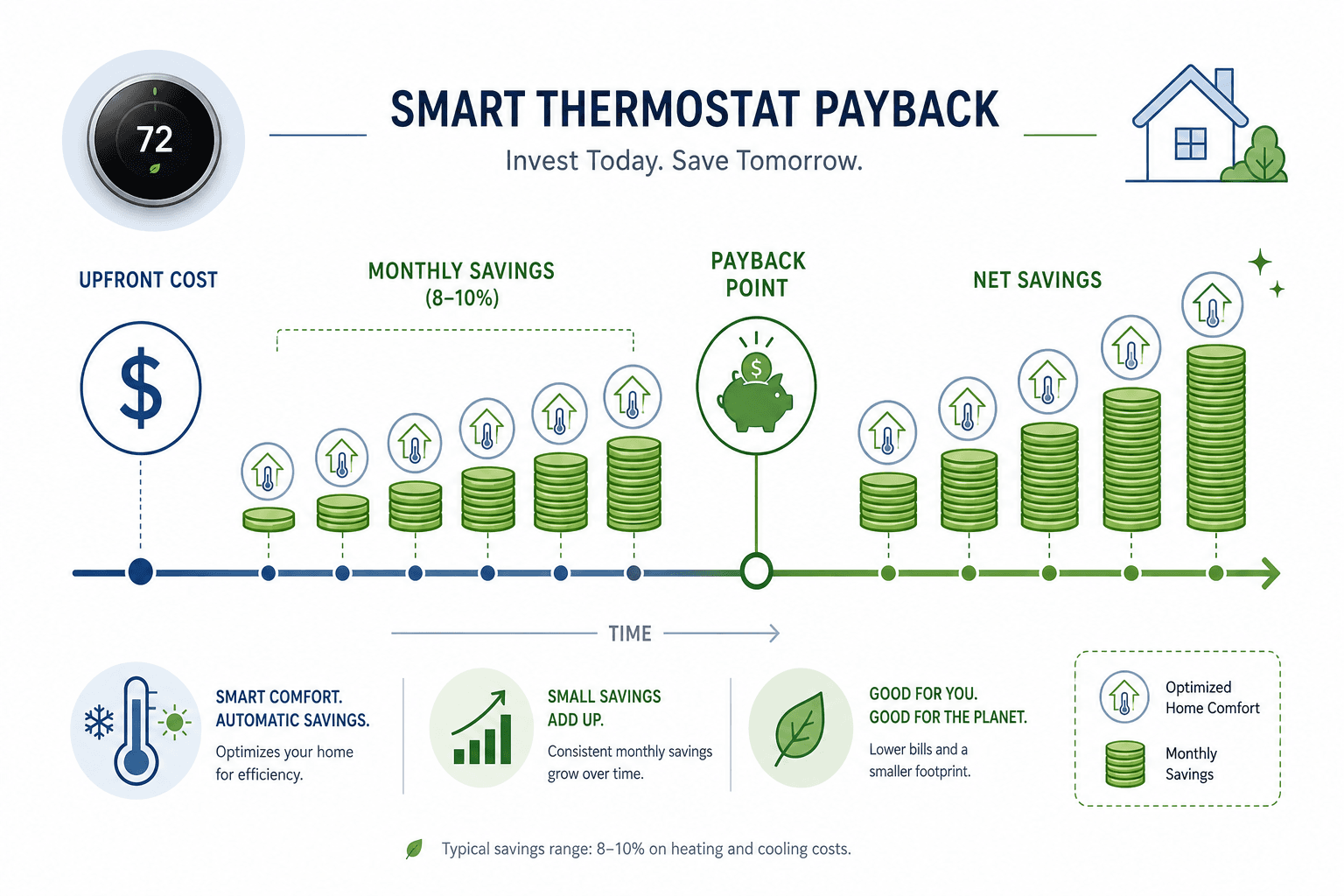
The upfront cost of a smart thermostat ranges from roughly $80 for a basic model to $250 for a premium device with a full-color display, remote sensors, and learning algorithms. The payback period depends on the purchase price and your annual savings.
| Price Tier | Typical Price | Annual Savings (8%) | Payback Without Rebate | Payback With $100 Rebate |
|---|---|---|---|---|
| Budget | $80 | $155 | 6.2 months | Free after rebate |
| Mid-Range | $140 | $170 | 9.9 months | 2.8 months |
| Premium | $250 | $189 | 15.9 months | 9.5 months |
Even a premium $250 thermostat pays for itself in about 16 months at the conservative 8% savings rate. With a typical $100 utility rebate, that drops to under 10 months. Given that a smart thermostat has an expected lifespan of 7–10 years, you will be saving money for the vast majority of its life.
For readers who want a personalized calculation based on their specific energy costs, climate, and thermostat price, the Smart Thermostat Payback Period Calculator provides a detailed breakdown.
Additional Savings: Utility Rebates and Demand-Response Credits
The payback math improves significantly when you factor in utility incentives. Many electric and gas utilities offer rebates of $50 to $200 for purchasing and installing an ENERGY STAR certified smart thermostat. These rebates are widely available across the US and can cut the upfront cost by more than half.
Beyond the one-time rebate, many utilities run demand-response programs that pay you to allow them to adjust your thermostat during peak grid events. Participants typically earn $20 to $50 per year in credits or bill discounts. Over the lifespan of the thermostat, these credits can add another $140 to $500 in savings.
For a detailed breakdown of specific rebate programs by state and utility, see our Smart Thermostat Energy Savings and ENERGY STAR Rebates in 2026 article.
ROI Over the Full 7–10 Year Lifespan
The most compelling argument for a smart thermostat is the cumulative savings over its expected lifespan. A well-built smart thermostat should last 7–10 years before needing replacement. Here is the projected net savings for a mid-range model over that period:
| Item | Conservative Estimate | Optimistic Estimate |
|---|---|---|
| Upfront cost (mid-range model) | -$140 | -$140 |
| Utility rebate | +$100 | +$150 |
| Annual savings (8–10%) | $170/year | $215/year |
| Demand-response credits | $25/year | $40/year |
| Total savings over 8 years | $1,360 | $1,720 |
| Net savings (after cost and rebate) | $1,320 | $1,730 |
Even with the most conservative assumptions — 8% savings, a modest $100 rebate, and $25/year in demand-response credits — the net savings exceed $1,300 over eight years. That is a return on investment of over 900% on the original $140 purchase.
Factors That Change the Math: Climate, Insulation, and Your Current Thermostat
The savings figures above are national averages. Your actual results will depend on several key variables:
- Climate zone: Homes in regions with extreme winters or summers (Northeast, Midwest, South) see larger absolute savings because their HVAC bills are higher. Mild-climate homes (coastal California, Pacific Northwest) will see smaller dollar savings.
- Insulation and home efficiency: A well-insulated home loses heat slowly, so setbacks are more effective. A drafty home will recover temperature quickly but also lose it quickly, reducing the benefit of setbacks.
- Your current thermostat type: If you are upgrading from a manual thermostat that you already adjust manually every day, the savings delta will be smaller — you are already getting some of the benefit. If you are upgrading from a programmable thermostat that you ignore or override, the savings will be larger.
- Local energy rates: Homes in areas with high electricity or natural gas rates (New England, Hawaii, California) will see larger dollar savings from the same percentage reduction.
- Household occupancy patterns: Homes that are empty for regular 8-hour periods (workday schedules) benefit most from setbacks. Homes with constant occupancy (retirees, remote workers, stay-at-home parents) see smaller savings.
The Verdict: Is a Smart Thermostat Worth It in 2026?
Based on independently verified data from the DOE and ENERGY STAR, the answer is a clear yes for the vast majority of US households. The math is straightforward:
- You will save $155–$237 per year on heating and cooling costs.
- Your upfront investment of $80–$250 will be recovered in 4–18 months.
- Utility rebates of $50–$200 can cut the payback period in half or eliminate it entirely.
- Over the 7–10 year lifespan, net savings will likely exceed $1,000.
The key condition is that you are upgrading from a manual or programmable thermostat that is not currently delivering consistent setbacks. If you already have a smart thermostat that is properly configured, the upgrade savings will be minimal. But if you are still using a basic thermostat or one that you constantly override, the ROI is compelling.
Discussion
Share your experience with the compared products, flag outdated pricing or specs, or ask clarifying questions about the comparison verdict.
Comments
Join the discussion with an anonymous comment.