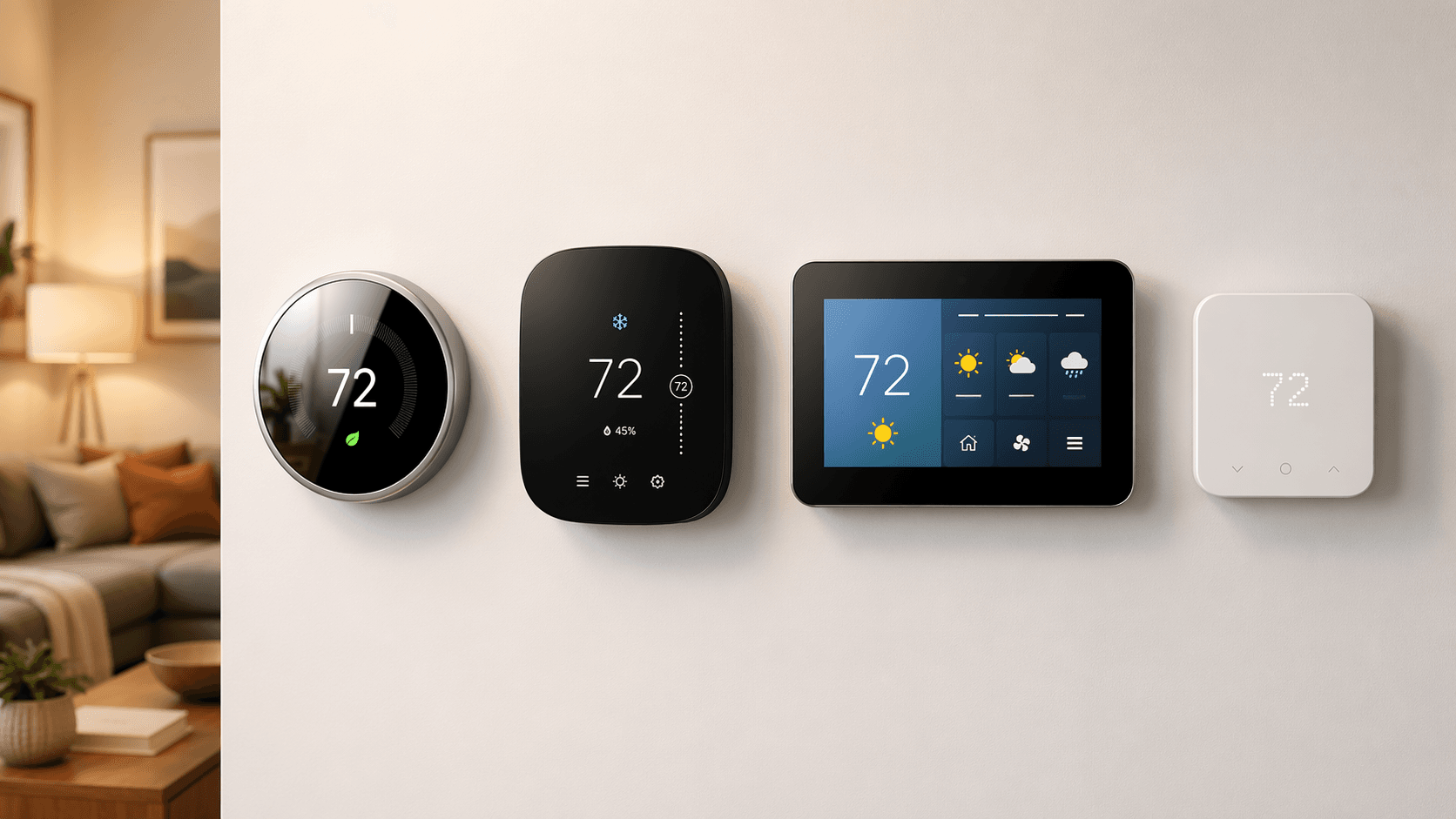
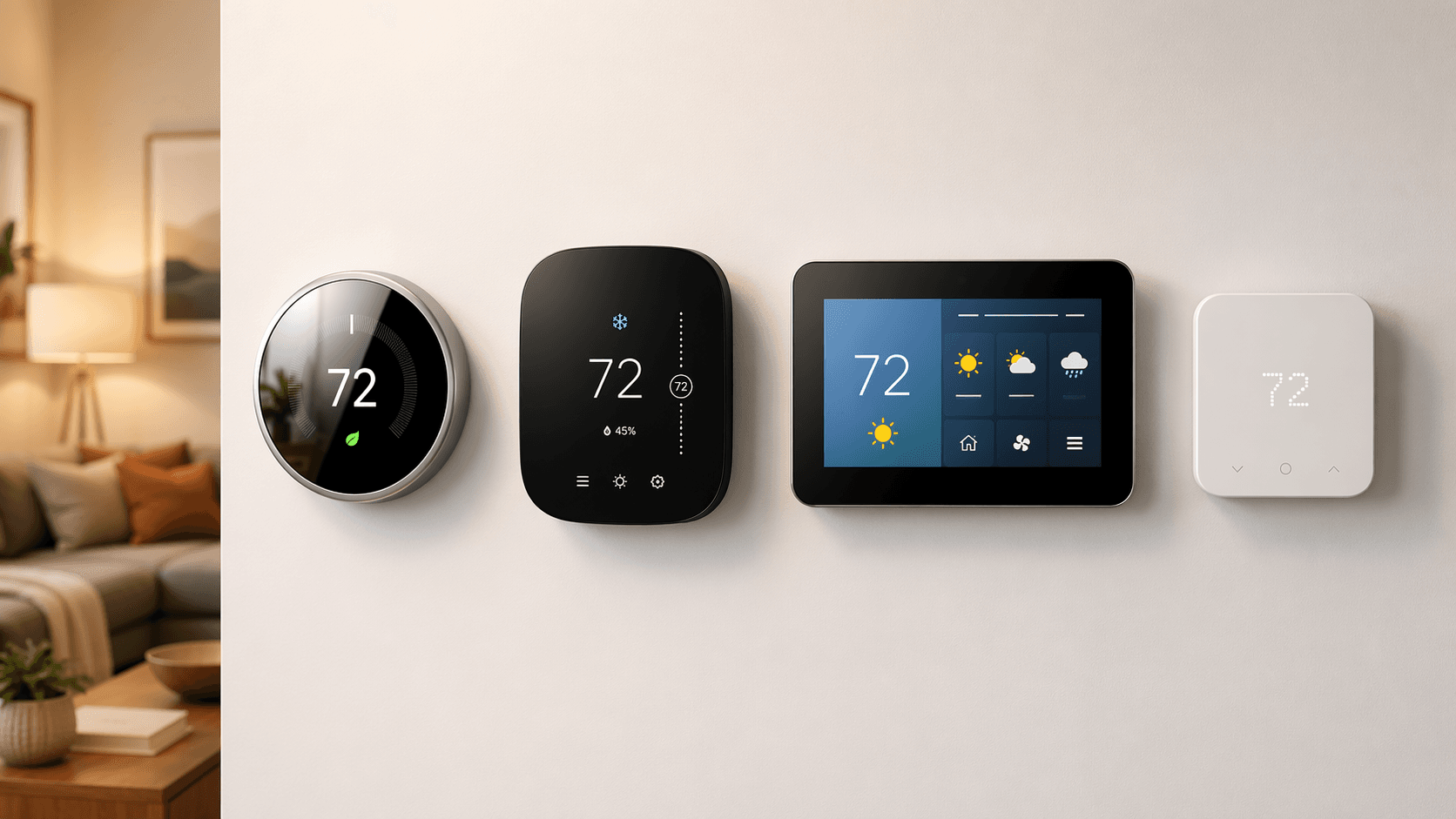
The best smart thermostat in 2026 is not one device for every house. If you want the thermostat to figure out your schedule with the least setup friction, start with the Google Nest Learning Thermostat 4th Gen. If your problem is that the hallway thermostat never represents the bedroom, office, or nursery, the Ecobee Smart Thermostat Premium is the stronger comfort pick. If you want the wall control itself to do more, including a large color display and live compatible doorbell feeds, the Honeywell Home X8S is the most ambitious interface. If you mostly want a low-cost thermostat with basic scheduling and Alexa support, the Amazon Smart Thermostat is still a legitimate answer rather than a consolation prize.
| Priority | Best fit | Why it stands out | Compromise to accept |
|---|---|---|---|
| Hands-off learning and easier install | Google Nest Learning Thermostat 4th Gen | Learns household patterns and CNET says it does not require a C-wire | Remote sensors are temperature-only, and one Wirecutter tester reported unwanted preference overrides |
| Multi-room comfort | Ecobee Smart Thermostat Premium | Includes a SmartSensor that reads temperature and occupancy, enabling Follow Me comfort behavior | Requires a C-wire, though Ecobee includes a Power Extender Kit |
| Display and sensor scale | Honeywell Home X8S | Large 5-inch color touchscreen, widget themes, compatible doorbell video feeds, and support for a large sensor network | No learning algorithm; it relies on schedules, motion, and geofencing |
| Price and simplicity | Amazon Smart Thermostat | Low-cost thermostat focused on basic scheduling and Alexa Hunches | No dedicated room sensors; Echo Dot temperature sensing is a workaround |
That is the shortlist answer. The longer answer depends on which annoyance you are trying to remove from daily life: changing the temperature too often, living with uneven rooms, squinting at an unhelpful wall display, or discovering that your “simple” upgrade has turned into a wiring project. Platform loyalty, energy-payback math, and whole-HVAC compatibility matter, but they are separate decisions. For those, use a dedicated smart thermostat ecosystem comparison, a smart thermostat energy savings guide, or a C-wire and HVAC compatibility guide. Here, the useful question is narrower: which compromise will bother you least after the thermostat is actually on the wall?
The Four Criteria That Matter After Week One
A smart thermostat has to survive the end of the novelty period. The app setup, the brand ecosystem, and the first pretty animation all fade quickly if the downstairs stays comfortable while the upstairs bedroom runs cold. Four areas keep showing up as the real fault lines between Nest, Ecobee, Honeywell, and Amazon.
- Learning approach: whether the thermostat builds a schedule for you, nudges a schedule from patterns, or simply follows what you program.
- Room sensor coverage: whether the system can understand comfort beyond the hallway thermostat location.
- Display quality: whether the wall control shows useful information at a glance or just looks expensive.
- Installation difficulty: whether the wiring reality matches the box-level promise.
CNET’s 2026 smart thermostat guide places the Nest Learning Thermostat 4th Gen and Ecobee Smart Thermostat Premium among the leading options, while also describing Ecobee’s eco+ mode as a major but underused feature; an Ecobee representative quoted by CNET called eco+ “the most underused feature” of the thermostat.[1] Wirecutter’s 2026 testing gives Ecobee Premium a particularly strong comfort finding, saying it “kept the temperature more consistently pleasant year-round than any other model,” while also documenting a Nest learning behavior that sometimes overrode one tester’s preferences.[2] Those two findings are a useful warning: the best automation is not always the automation that does the most.
Learning: Nest Is the Most Ambitious, Amazon Is the Most Basic
Nest is still the cleanest answer for a household that wants the thermostat to stop asking so many questions. The 4th Gen Learning Thermostat is built around schedule inference: it watches adjustments and household patterns, then uses that behavior to shape heating and cooling. When that works, it feels like the best version of a smart thermostat: fewer manual changes, fewer app visits, and less household debate over whether someone remembered to set the overnight temperature.
The catch is that learning can become intrusive when the device treats a repeated adjustment as permission to keep acting. Wirecutter reported that one tester’s Nest Learning Thermostat sometimes overrode preferences over several months.[2] That is not evidence that every Nest will behave badly, and it should not be inflated into a universal defect. It does matter because the failure mode is personal. A thermostat that changes a setting after you deliberately changed it is not merely making a technical mistake; it is reopening a comfort decision someone thought was settled.
Ecobee Premium takes a more structured route. Its strength is not that it disappears as completely as Nest can, but that it gives the household more explicit comfort tools. Eco+ can make automated adjustments, and Ecobee’s comfort settings let you define different expectations for home, away, and sleep periods.[1] That system can take more attention at the beginning. It asks you to understand zones, comfort profiles, and sensor participation rather than simply trusting the thermostat to infer everything.
Honeywell’s X8S is the least “learning” of the premium-looking models. Matter Alpha’s review describes scheduling, geofencing, and motion-based behavior rather than a Nest-like learning algorithm.[4] That is a real limitation if you want the thermostat to build a schedule with minimal instruction. It is not fatal for a household that prefers predictable rules. Some people would rather tell the thermostat what to do and have it obey cleanly than let it keep negotiating based on past behavior.
Amazon’s Smart Thermostat sits at the opposite end from Nest. Alexa Hunches can act on basic patterns, but this is not the same category of intelligence as Nest’s learning schedule. It is better understood as a low-cost thermostat with some automation attached. That framing makes it easier to judge fairly. Amazon is not the best smart thermostat for a house with complicated comfort patterns, but it can be enough for someone who wants remote control, simple scheduling, and a price that does not invite a long payback spreadsheet.
Room Sensors Decide Comfort More Often Than the Main Thermostat
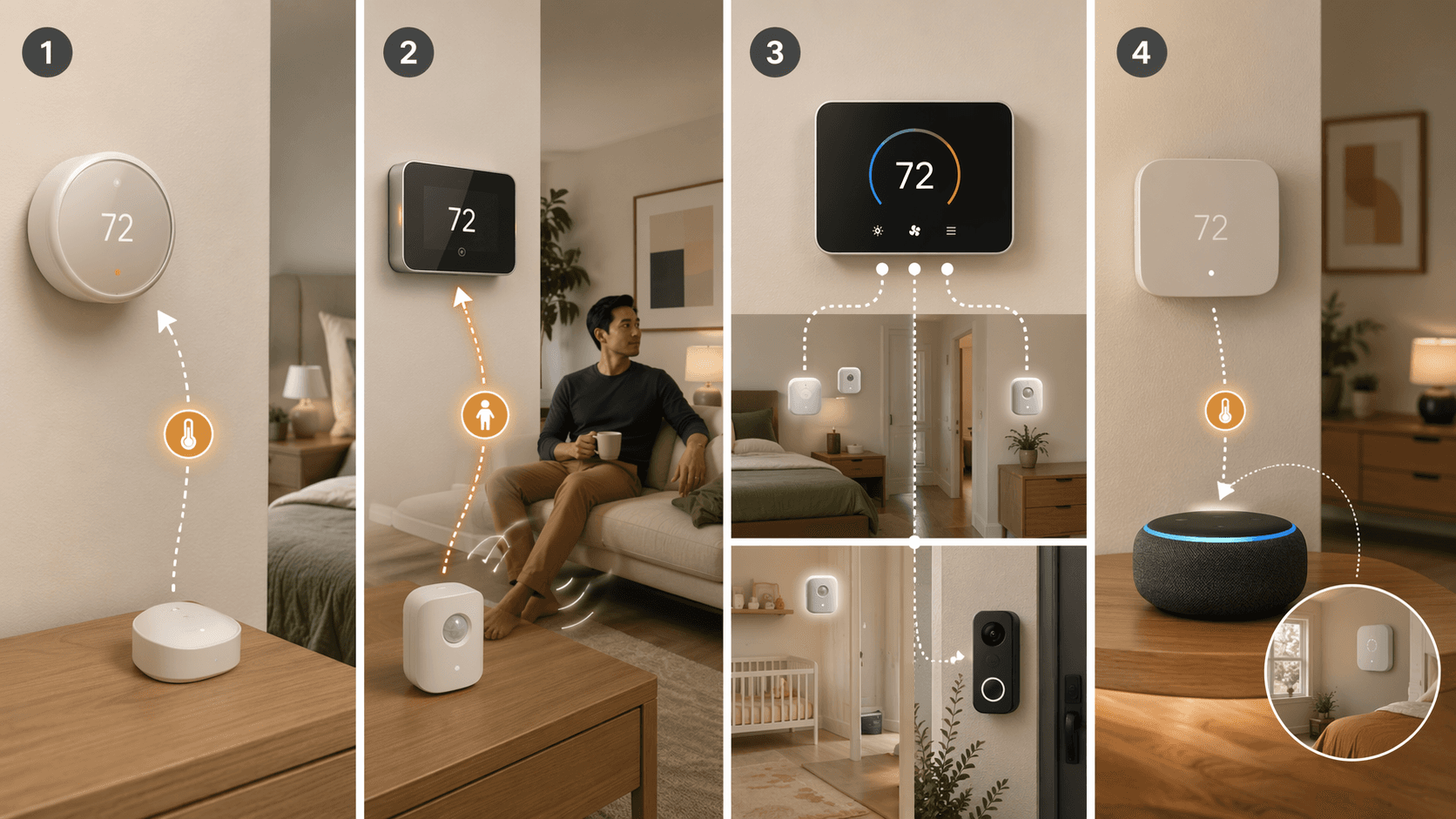
The sensor comparison is where the products separate most clearly. A thermostat mounted in a hallway is often making decisions for rooms it cannot feel. That is fine in a compact, even-temperature home. It is less fine in an older house with a sunny office, a cold nursery, or a second floor that never agrees with the first.
Ecobee Premium has the most useful room-sensor design for comfort because its SmartSensor combines temperature and occupancy. That combination matters. Temperature alone tells the system that a room is too warm or too cold; occupancy tells it whether anyone is actually there. Ecobee’s Follow Me behavior can then prioritize occupied spaces instead of blindly averaging empty rooms into the decision. Ecobee also includes one SmartSensor with the Premium model, which changes the out-of-box value compared with systems that require immediate sensor add-ons.[2] For a deeper model-by-model look inside Ecobee’s own range, see the Ecobee smart thermostat lineup comparison.
Nest’s sensor story is simpler and more limited. Reviewed notes that Nest’s remote sensor is temperature-only and that the system can use only one sensor at a time rather than blending several rooms at once.[3] In practice, that means a Nest sensor can help if you want the bedroom to control the overnight temperature, or the office to matter during work hours. It is less convincing as a whole-house comfort system because it does not know whether the room being prioritized is occupied.
Honeywell X8S is the scale play. Reviewed and Bob Vila both describe support for up to 20 room sensors, and Bob Vila’s testing describes X8S sensor specs that include occupancy detection.[3][5] That gives Honeywell a different kind of appeal from Ecobee. Ecobee’s sensor system feels more refined as a comfort engine for typical homes; Honeywell’s larger stated sensor capacity is interesting for bigger homes, unusual layouts, or households that want many rooms represented. The caveat is worth keeping visible: the up-to-20-sensor claim comes from reviewed sources, and sensor scale alone does not prove the thermostat will make better comfort decisions in every home.
Amazon does not have a dedicated room-sensor system in this comparison. Wirecutter notes that compatible 4th-gen and newer Echo Dot devices can be used as a temperature-sensing workaround.[2] That can be useful if you already own the right Echo hardware, but it is not the same as buying into a thermostat platform with purpose-built room sensors. It is a patch, not a comfort architecture.
| Model | Room sensor approach | Best practical use |
|---|---|---|
| Nest Learning Thermostat 4th Gen | Temperature-only remote sensor; one sensor can be prioritized at a time | Prioritizing a specific room during a specific period |
| Ecobee Smart Thermostat Premium | Temperature plus occupancy SmartSensor; one included | Balancing comfort around occupied rooms |
| Honeywell Home X8S | Large sensor network support, with reviewed coverage citing up to 20 sensors and occupancy detection | Representing many rooms in larger or more irregular homes |
| Amazon Smart Thermostat | No dedicated thermostat sensor; compatible Echo Dot workaround | Basic temperature reference where supported Echo devices already exist |
Displays: Honeywell Makes the Wall Control Matter
Honeywell’s X8S has the most consequential display in this group. Matter Alpha describes a 5-inch color touchscreen, customizable widget themes, and the ability to show live video feeds from compatible Ring and First Alert doorbells.[4] That is not a normal thermostat feature. In the right house, it can make the wall control feel like a useful glance point rather than a single-purpose temperature dial.
The question is whether that display changes thermostat satisfaction or just makes the device feel more premium. A live doorbell feed is useful if the thermostat sits near a kitchen, entry hall, or main traffic path where people naturally look. It is less meaningful if the thermostat is tucked in a hallway corner and everyone already checks doorbell video on a phone or smart display. Honeywell wins the display category, but the win is strongest when the thermostat location makes the screen part of daily movement.
Nest’s 4th Gen display is polished in a different way. CNET’s Nest review highlights Dynamic Farsight and weather animations, which let the thermostat show information as you approach rather than forcing every interaction through the app.[6] That is useful, and the round hardware remains one of the cleaner wall designs. Still, polish should not be confused with comfort control. The display makes Nest nicer to live with; the learning behavior and installation advantage are the bigger reasons to buy it.
Ecobee Premium’s interface is functional and information-rich without being the main event. Amazon’s display is deliberately plain. Neither is the reason to pick those models. Ecobee is about sensor-aware comfort, and Amazon is about keeping the purchase simple.
Installation: The C-Wire Is Where Confidence Gets Tested
Installation is the least glamorous part of this comparison and one of the most important. A thermostat that looks easy in an app can still become a frustrating afternoon if the wall has older wiring, no common wire, or labels that do not match the expected diagram. This is where Nest’s 4th Gen has a real practical advantage: CNET’s Nest review says it does not require a C-wire.[6]
That does not mean every installation will be effortless. HVAC systems vary, and anyone with unusual equipment should still check compatibility before removing the old thermostat. But in normal homeowner terms, “no C-wire required” removes one of the most common reasons a smart thermostat install stops halfway through.
Ecobee Premium requires a C-wire, but Ecobee includes a Power Extender Kit for homes that need it.[2] That is a responsible inclusion, not magic. Installing a PEK usually means opening the HVAC control board area, identifying terminals, and being comfortable working around system wiring with the power off. Many homeowners can do it. Some should not have to pretend they want to.
Honeywell X8S also needs a C-wire in the reviewed sources.[4] That requirement fits the device: a large touchscreen, sensor network support, and connected display features need steady power. Amazon’s thermostat is simpler and cheaper, but it still belongs in the same pre-install reality check. Before buying any of these, confirm the wiring and HVAC type against a smart thermostat compatibility guide rather than assuming the app will solve a missing wire.
Which One Should You Buy?
Choose the Google Nest Learning Thermostat 4th Gen if you want the most hands-off scheduling and the least wiring friction. It is the best fit for a household that mostly agrees on comfort and wants the thermostat to fade into the background. The caution is control: if you already know you dislike devices changing your preferences after you set them, Nest’s learning strength may become the part you watch most closely.
Choose the Ecobee Smart Thermostat Premium if the thermostat’s current location is the problem. Its included occupancy-aware SmartSensor gives it the clearest comfort advantage for homes where the important room is not the hallway. It asks more from the buyer in setup and scheduling, and the C-wire requirement matters, but its comfort logic is the most convincing in this group. For price-specific doubts, the Ecobee Premium value analysis is the more useful next read.
Choose the Honeywell Home X8S if you want the best wall display and a broad sensor network matters more than automatic schedule learning. It is the most interesting thermostat here as a household control point, especially where the 5-inch screen and compatible doorbell feed would actually be seen. Buy it for that visible utility and sensor scale, not because it is quietly learning like Nest.
Choose the Amazon Smart Thermostat if cost and simplicity are the real constraints. It is not the strongest learning thermostat, not the strongest sensor thermostat, and not the strongest display thermostat. That does not make it a bad buy. For a straightforward home where basic scheduling and app control are enough, paying less and accepting fewer features can be the sensible trade.
For a broader pre-purchase framework, including decisions outside this four-model comparison, use the 2026 smart thermostat buying guide. For privacy and value trade-offs beyond these four picks, the Sensi vs Nest vs Ecobee comparison covers a different set of concerns.
The most comfortable answer is not the same as the most automated answer, and the most premium-looking thermostat is not automatically the one that will make the house feel better. Pick Nest if schedule learning and install ease matter most, Ecobee if occupied-room comfort matters most, Honeywell if display and sensor scale matter most, and Amazon if a lower price with basic smart control is enough.
References
- The Best Smart Thermostats of 2026, CNET
- The 4 Best Smart Thermostats of 2026, Wirecutter
- 10 Best Smart Thermostats: Keeping home comfortable of 2026, Reviewed
- Honeywell Home X8S review, Matter Alpha
- Honeywell Home X8S Smart Thermostat, Tested and Reviewed, Bob Vila
- Google Nest Learning Thermostat 4th Gen Review, CNET
Discussion
Share your experience with the compared products, flag outdated pricing or specs, or ask clarifying questions about the comparison verdict.
Comments
Join the discussion with an anonymous comment.