
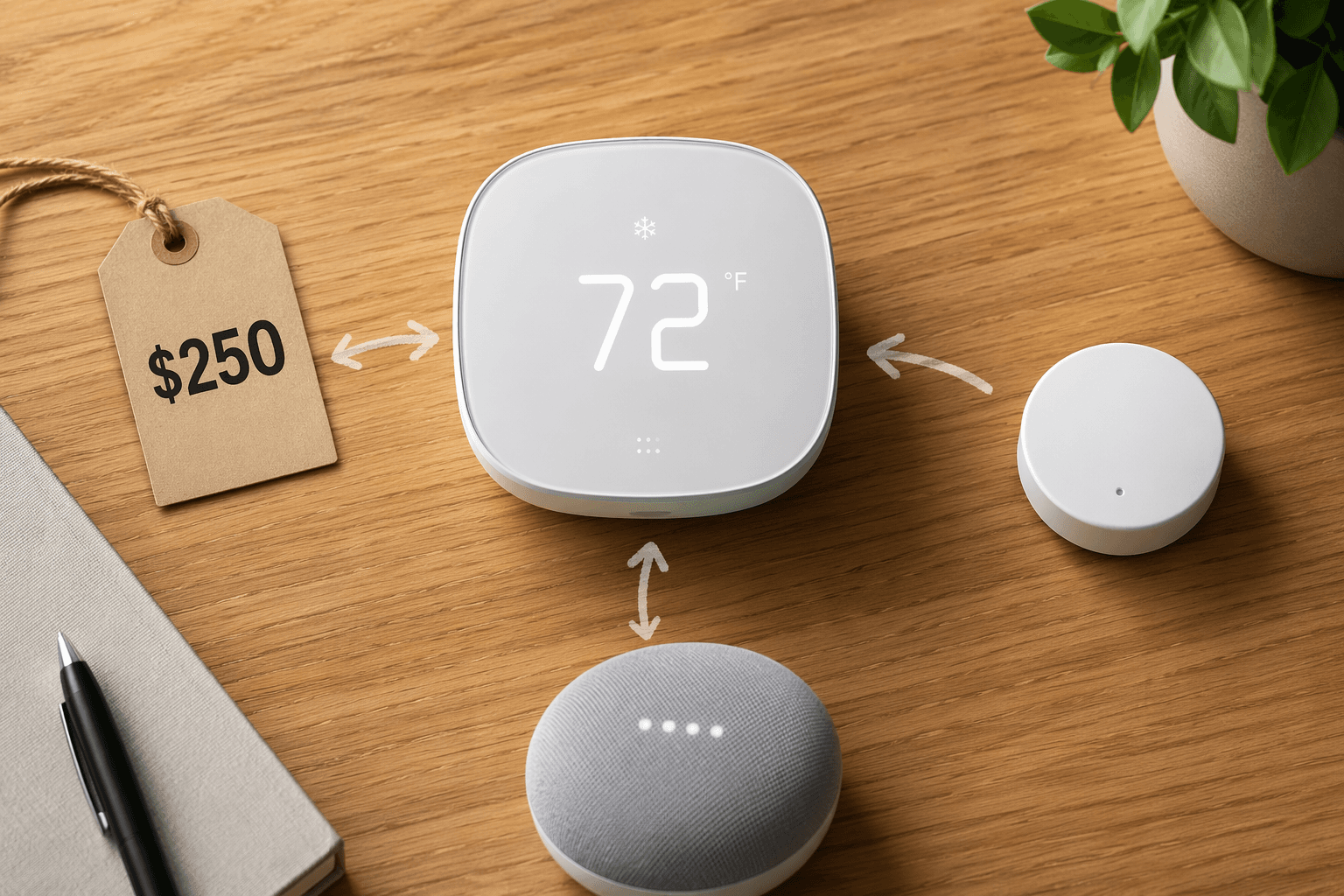
The ecobee Smart Thermostat Premium is easiest to judge by asking a blunt $250 question: are you buying thermostat performance, or are you buying a thermostat plus a room sensor, a small voice speaker, basic air-quality estimates, and extra HVAC support? If those extras will be used, the Premium can be a sensible buy. If they will mostly sit in the spec sheet, cheaper thermostats can deliver the same core conveniences: scheduling, app control, occupancy-aware setbacks, and energy-saving automation.
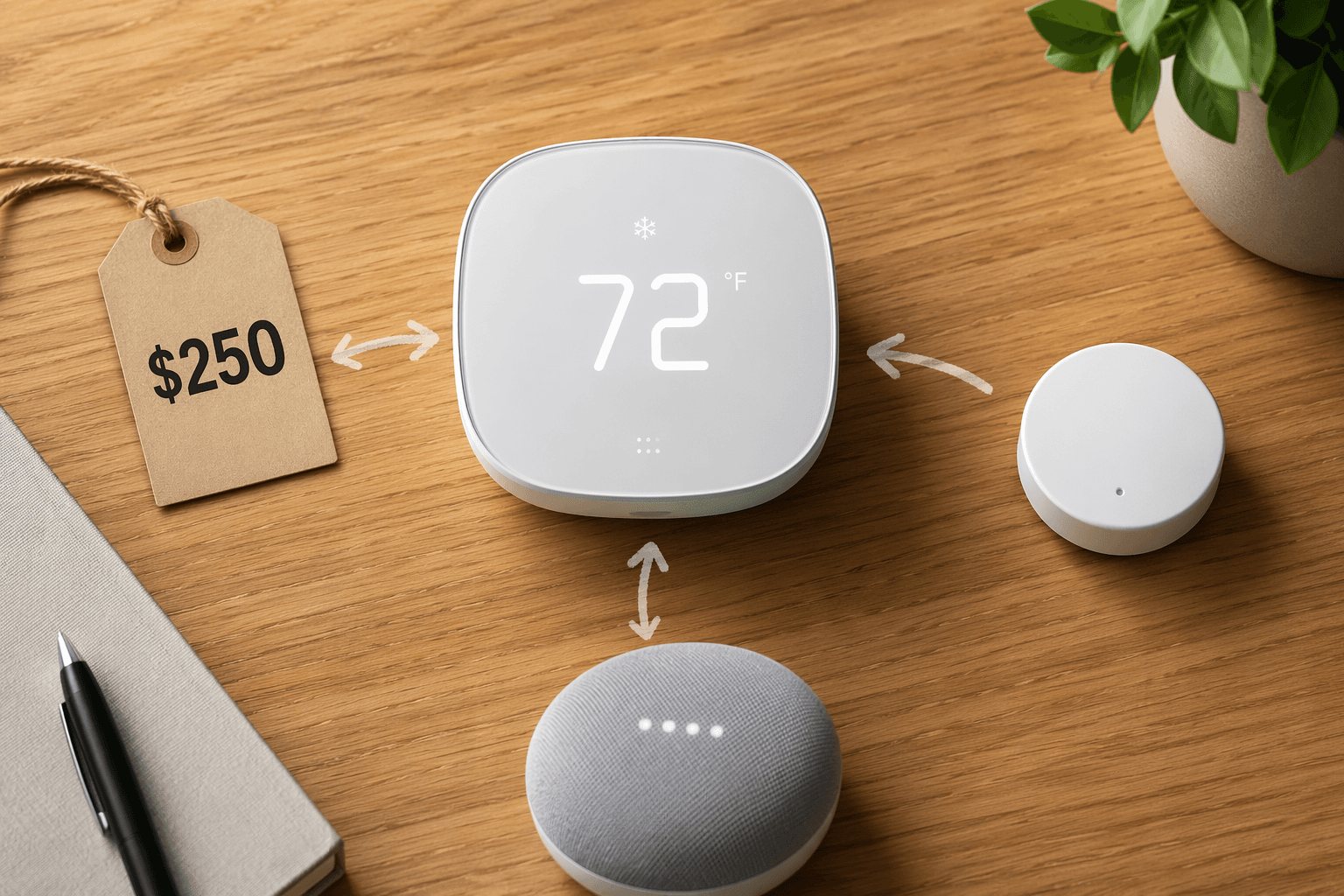
That does not make the Premium overpriced by default. Wirecutter and PCMag both ranked it as their top overall smart thermostat as of mid-2026, and that matters if you want the most complete Ecobee package rather than the cheapest acceptable one.[1][2] The mistake is treating “best thermostat” and “best buy for this house” as the same decision.
The Price Gap Is Real, But It Is Not All Mystery
In the comparison set, the Premium sits at $250, above the ecobee Enhanced at $200, the ecobee Essential at $140, and the Amazon Smart Thermostat’s much lower $58–$80 range. The Nest Learning Thermostat 4th Gen overlaps the Premium more than it undercuts it, usually landing around $230–$280, so it belongs in the premium-comparison lane rather than the budget escape lane.
| Thermostat | Typical price in this comparison | Best fit |
|---|---|---|
| ecobee Smart Thermostat Premium | $250 | Homes that will use the SmartSensor, speaker, air-quality estimates, and broader HVAC support |
| ecobee Smart Thermostat Enhanced | $200 | Most Ecobee buyers who want strong thermostat features without the full extras bundle |
| ecobee Smart Thermostat Essential | $140 | Basic Ecobee scheduling and app control at a lower entry price |
| Amazon Smart Thermostat | $58–$80 | Lowest upfront cost for smart thermostat basics |
| Nest Learning Thermostat 4th Gen | $230–$280 | Premium-to-premium shoppers comparing ecosystems and design preferences |
The cleanest comparison is Premium versus Enhanced, because the two are close enough that the extra $50 has to earn its keep. CNET’s Premium-versus-Enhanced comparison points to two concrete offsets: the Premium includes a SmartSensor with a $50 standalone value, and its built-in Alexa speaker is roughly comparable to a $35 Echo Dot-class device.[3] On paper, that accounts for about $85 of value against a $50 step-up from the Enhanced.
That math is attractive only if the items replace something real. A household that would have bought a room sensor anyway can treat the included SmartSensor almost like a credit. A household that already has Echo speakers in the rooms where voice control makes sense should not pretend the thermostat speaker is worth another $35 to them.
The SmartSensor Is The Most Convincing Premium Extra
The included SmartSensor is the Premium feature most likely to change daily comfort rather than simply decorate the device. A thermostat only knows the temperature near the wall where it is installed. A sensor lets the system pay attention to another room, which matters in homes where the nursery, bedroom, office, or upstairs sitting area runs warmer or colder than the hallway.
It is also the part of the Premium package that has the least hand-waving in the value calculation. If you were already planning to add a sensor, the Premium’s included SmartSensor narrows or wipes out the practical price difference versus the Enhanced.[3] If you live in a compact single-zone home where the thermostat is already in the room you use most, the sensor may be nice but not important.
This is where house layout beats product ranking. In a small apartment or open-plan ranch, the sensor may spend its life confirming what the thermostat already knows. In a two-story house with a too-warm bedroom, a cold home office, or a thermostat stuck in a drafty hallway, it can be the feature that makes the thermostat feel smarter after the setup excitement wears off.
The Air Quality Monitor Is Useful, But Easy To Overbuy
The Premium’s air quality feature is useful as a prompt: it can nudge you to open a window, run ventilation, or notice that indoor air has changed. It should not be priced in your head like a full dedicated air quality monitor.
CNET found that the Premium estimates volatile organic compounds and carbon dioxide, but does not measure PM2.5 and cannot automatically trigger HVAC fan circulation.[4] TechHive reached the same practical boundary, describing the air quality sensor as not a substitute for a dedicated monitor.[5]
That distinction matters because fine particulate measurement is one of the reasons people buy standalone indoor air monitors in the first place. If your concern is wildfire smoke, cooking particles, workshop dust, or health-sensitive monitoring, the Premium’s air quality estimate should be treated as a convenience layer, not the device that settles the question.
For everyday households, though, a soft warning can still be valuable. A feature does not have to be laboratory-grade to change behavior. It just has to show up at the right moment and be understood for what it is: a general signal, not a medical-grade measurement and not an automated ventilation controller.
The Built-In Speaker Depends Almost Entirely On Location
A thermostat speaker sounds convenient in a product demo. In a real house, the value depends on where the thermostat lives. If it is in a kitchen, living room, or central hallway where people naturally speak commands, the built-in Alexa or Siri capability may replace a small smart speaker. If it is in a side hallway, near bedrooms, or on a wall people rarely face, it may become the most premium feature nobody uses.
CNET’s comparison pegs the speaker-equivalent value at roughly $35, using an Echo Dot-class device as the reference point.[3] That is fair as replacement math, not as universal value. A home that already has an Echo, HomePod, or other assistant device nearby should discount the thermostat speaker heavily. A home with no smart speaker in the main living area can count it more generously.
Accessory Support, Wi-Fi, And Security Are Quiet Reasons To Step Up
The Premium is not only a sensor-and-speaker bundle. Ecobee’s official comparison says the Premium supports 2-wire HVAC accessories, while the Enhanced supports 1-wire accessories and the Essential supports none. The same comparison lists dual-band Wi-Fi and WPA3 support for the Premium, while the Essential is 2.4GHz only and lacks Bluetooth.[6]
For many buyers, those details will not matter. A basic furnace-and-AC setup on a stable 2.4GHz network does not become meaningfully better just because the thermostat spec sheet has more headroom. But if your system includes accessories, or you care about newer Wi-Fi and security support, the Premium has a practical argument that the cheaper Ecobee models do not fully match.
This is also where installation uncertainty has value. If you already know your system is simple, the cheaper model can be a confident choice. If you are replacing a thermostat in a house with more complicated HVAC equipment, the Premium’s broader support may reduce the chance that you buy the wrong version and end up troubleshooting the savings away.
Energy Savings Help, But They Do Not Prove The Premium Pays Back Faster
Energy savings are real enough to include in the value case, but they should not be used as if they belong only to the Premium. ENERGY STAR says certified smart thermostats save users an average of about $50 per year.[7] That figure applies broadly to certified smart thermostats, not specifically to Ecobee’s most expensive model.
Ecobee’s own April 2021 internal analysis claims savings of up to 26%, or about $284 per year, compared with a fixed 72°F hold.[8] That is a much more dramatic number, but it depends on the baseline. If someone is currently leaving the system fixed at 72°F all year, smart scheduling can produce a bigger change. If someone already uses setbacks, keeps conservative temperatures, or lives in a mild climate, the savings case narrows.
The right conclusion is smaller and more useful: a smart thermostat may help reduce energy use, especially when it replaces a static schedule or manual habits. The available savings figures do not show that the Premium itself saves enough more than the Enhanced, Essential, Amazon Smart Thermostat, or another certified model to justify the full price difference by energy savings alone.
Rebates Can Change The Decision More Than Any Feature Debate
Utility rebates are the one part of the math that can make the Premium feel much less like a $250 purchase. Ecobee’s rebate finder says rebates are available in more than 40 U.S. states, with typical offers around $50–$125 per unit.[9] At the high end, that can bring the effective Premium price down near $125 before taxes or installation costs.
The catch is that rebate rules are local. Some utilities may require a specific service territory, professional installation, enrollment in a demand-response program, or a compatible rate plan. The practical move is to check the rebate before deciding between models, not after ordering the thermostat.
A rebate also changes the relative comparison. A $100 rebate on the Premium may make it more attractive than an unrewarded cheaper thermostat. A similar rebate on the Enhanced or Essential may preserve the cheaper model’s advantage. The rebate is not a reason to stop comparing; it is a reason to compare the after-rebate price.
A Practical Break-Even Read
The Premium makes the most sense when its extra pieces replace purchases or solve annoyances that would otherwise remain. Against the Enhanced, the $50 SmartSensor and roughly $35 speaker-equivalent value explain why the Premium’s $50 higher price can be reasonable.[3] Against the Essential or Amazon Smart Thermostat, the gap is much larger, so the question becomes less about itemized hardware and more about whether you actually want the Ecobee ecosystem’s fuller version.
| Household situation | How the Premium math usually looks |
|---|---|
| You planned to buy an Ecobee room sensor anyway | Premium gains a strong value argument because the included SmartSensor offsets much of the step up from Enhanced |
| You already have smart speakers where voice control matters | Discount the built-in speaker; it is likely duplicate hardware |
| You live in a small, even-temperature, single-zone home | Enhanced, Essential, or Amazon may deliver better return because the sensor and advanced comfort features matter less |
| You have uneven rooms or a thermostat in a bad location | Premium becomes easier to justify because the included sensor can improve comfort where people actually spend time |
| You want serious air pollution monitoring | Do not count the Premium as a replacement for a dedicated PM2.5-capable air quality monitor |
| You have HVAC accessories or care about dual-band Wi-Fi and WPA3 | Premium has a quieter but legitimate hardware-support advantage |
| You qualify for a large utility rebate | Recalculate from the after-rebate price; the Premium may move from indulgent to sensible |
The weak break-even case is the familiar smart-home overbuy: a single-zone home, an existing voice assistant, no accessory HVAC equipment, and no real need for air quality prompts. In that house, the Premium can still look better on the wall, but the cheaper thermostat may handle the job people remember to use after the first month.
Which Cheaper Option Makes More Sense?
The Amazon Smart Thermostat is the obvious answer when upfront price dominates. It belongs in homes where the goal is basic smart scheduling and app control, not a premium display, room-sensor strategy, or broad Ecobee feature set. The tradeoff is that you are choosing the low-cost route, not a cheaper version of the Premium’s whole package.
The ecobee Essential is the better Ecobee entry point for buyers who want the brand’s basic ecosystem without paying for extras they already know they will not use. It gives the cost-conscious homeowner a way to avoid leaving Ecobee entirely just because the Premium is too much thermostat for the house.
The ecobee Enhanced is the most natural default for many Ecobee shoppers. It sits close enough to the Premium that the decision should turn on the sensor, speaker, air quality estimates, and accessory support. If those features do not answer a problem in your home, the Enhanced is the cleaner buy.
The Nest Learning Thermostat 4th Gen is a different kind of comparison. It is not the bargain alternative; it is the premium competitor. Bring it into the decision if you are comparing design, ecosystem, learning behavior, and overall product feel. Do not use it as proof that the Ecobee Premium is too expensive, because the price bands overlap.
Final Decision Matrix
- Buy the ecobee Smart Thermostat Premium if you want Ecobee’s best package and will use the included SmartSensor, air quality estimates, built-in speaker, and broader HVAC accessory support.
- Buy the ecobee Enhanced if you mainly want strong Ecobee scheduling, app control, and smart thermostat behavior without paying for the Premium’s extras.
- Buy the ecobee Essential if you want a lower-cost path into the Ecobee ecosystem and your HVAC setup does not need the higher-end accessory support.
- Buy the Amazon Smart Thermostat if the lowest upfront price matters more than premium materials, room-sensor strategy, or Ecobee-specific features.
- Consider the Nest Learning Thermostat 4th Gen if you are shopping premium-to-premium and care more about ecosystem fit or design preference than saving the most money.
The Premium is worth $250 when its extras become used hardware in the house, not just better bullets on a comparison chart. Without the sensor value, speaker replacement, air-quality prompts, HVAC support, or a meaningful rebate, the cheaper options are easier to defend.
References
- The Best Smart Thermostats, Wirecutter, https://www.nytimes.com/wirecutter/reviews/the-best-thermostat/
- The Best Smart Thermostats, PCMag, https://www.pcmag.com/picks/the-best-smart-thermostats
- Ecobee Smart Thermostat Premium vs. Ecobee Smart Thermostat Enhanced, CNET, https://www.cnet.com/home/energy-and-utilities/ecobee-smart-thermostat-premium-vs-ecobee-smart-thermostat-enhanced/
- Ecobee Smart Thermostat Premium Review, CNET, https://www.cnet.com/home/energy-and-utilities/ecobee-smart-thermostat-premium-review/
- Ecobee Smart Thermostat Premium review, TechHive, https://www.techhive.com/article/701975/ecobee-smart-thermostat-premium-review.html
- Smart thermostats, ecobee, https://www.ecobee.com/en-us/smart-thermostats/
- Smart Thermostats, ENERGY STAR, https://www.energystar.gov
- ecobee SmartOwners save up to 26% on heating and cooling costs, ecobee, April 2021, https://www.ecobee.com
- Rebate Finder, ecobee, https://www.ecobee.com/en-us/rebates/
Discussion
Share your experience with the compared products, flag outdated pricing or specs, or ask clarifying questions about the comparison verdict.
Comments
Join the discussion with an anonymous comment.