Why device counts stopped telling you anything
You used to ask: which smart home platform supports the most gadgets? That question made sense in 2022. Amazon Alexa counted 140,000 devices. Apple HomeKit had a thousand. The gap looked like it decided everything. Then Matter arrived. As of mid-2026, Matter supports 850-plus certified devices. That number does not erase the raw count difference, but it collapses the practical gap for the devices a normal home actually buys — lights, locks, thermostats, plugs. A Philips Hue bulb works with Alexa, Google, HomeKit, and SmartThings through Matter. A Yale Assure Lock works the same way. The choice of platform no longer determines which devices you can own. The device-count race is over.
The real battle has moved to something you actually notice every day: how intelligent the platform feels when you talk to it, and what it does without being asked.
What the AAIS score actually measured — and what it didn't
SmartHomeExplorer’s AI Assistant Intelligence Score (AAIS) is the only published attempt to rank platforms on AI capability. The numbers: Alexa+ 79, Google Gemini 77, Apple Intelligence 62. If you stop at those three digits, they look like an objective verdict. They are not. AAIS is a proprietary methodology from a single site. The aggregate number tells you less than the dimensions underneath.
Here is what the score actually breaks down into, and what each dimension means for someone living in the house:
| Dimension | What it measures | Alexa+ | Gemini | Apple |
|---|---|---|---|---|
| NLU | Understanding natural, conversational commands | High | Very High | Medium |
| Proactive automation | Suggesting routines after repeated actions | 12+ trigger types (Hunches) | Limited | None |
| Multi-step reasoning | Handling complex, multi-command sequences | Partial | Good | Poor |
| Privacy | Local vs cloud processing, data retention | Fair (4.5/10) | Poor (5.5/10) | Excellent (9.5/10) |
| Ecosystem control depth | Granular device control beyond on/off | High | Medium | Medium |
The numbers are directional, not definitive. I would not use a 79 vs 77 gap to decide a platform. But the pattern across the dimensions tells a real story: each platform made a different bet, and each bet carries a trade-off the user will feel every day.
Three different bets
Alexa+ sits at the top of the composite because of one feature that genuinely changes daily life: Hunches. Amazon says the system learns your routines by observing repeated actions. Turn off the lights, lock the door, and lower the thermostat at 10 p.m. three nights in a row, and Alexa will ask if you want to save that as a routine. It is not magic — it is pattern detection in the cloud — but the result is the closest thing to a proactive assistant you can buy today. The catch: Alexa+ needs constant cloud access and the data that comes with it. AAIS gives it a privacy score of 4.5/10; Home Automation Cookbook rates it 'Fair'. Alexa+ is free with Prime or $20 a month standalone. That monthly cost is high, but for households already in the Amazon ecosystem, the intelligence gain is real.
Google Gemini’s strength is natural language understanding. The 'Ask Home' feature lets you query your home state in plain English: 'Are any windows open?' Gemini checks the sensors and tells you. It is a small thing, but it is the kind of interaction that makes a smart home feel aware rather than merely responsive. Security.org tested voice assistants and reported that Google Assistant correctly answered 93% of questions — the highest of any platform. I want to be fair about what that test measured: simple factual questions, not multi-step home commands. The accuracy for 'lock the front door and turn off the living room lights' is likely lower. Still, the base conversational ability is measurably ahead of the others. The price for that natural language is cloud dependency. Google Home Premium costs $10 to $20 a month. Home Automation Cookbook rates Google's privacy as 'Poor' — the lowest of the three. And Google is scaling back its own hardware; it stopped making smart displays and partnered with First Alert for smoke alarms. That does not affect current Gemini capability, but it signals a narrowing commitment to the smart home physical device space.
Apple Intelligence processes every voice command on its S7 chip inside the HomePod. No voice recordings leave the device. That architecture earns it an AAIS privacy score of 9.5/10 and an 'Excellent' rating from Home Automation Cookbook. If you care deeply about what data leaves your home, Apple is the only choice today. The trade-off is capability. Siri still cannot handle multi-step commands or maintain context across devices. You cannot ask 'are any windows open?' and get a cross-device answer — Siri only talks to one device at a time. The upcoming HomePad, expected this fall with an A18 chip and next-generation Siri, might close that gap. But it is not here yet. For now, Apple’s AI feels more like a well-trained guard dog than a conversational partner. Apple does not charge a subscription for its intelligence. You pay for the hardware: HomePod 2nd Gen at $299 or Apple TV 4K at $129. For a detailed hardware breakdown, see our Apple HomeKit Hub Buyer's Guide.
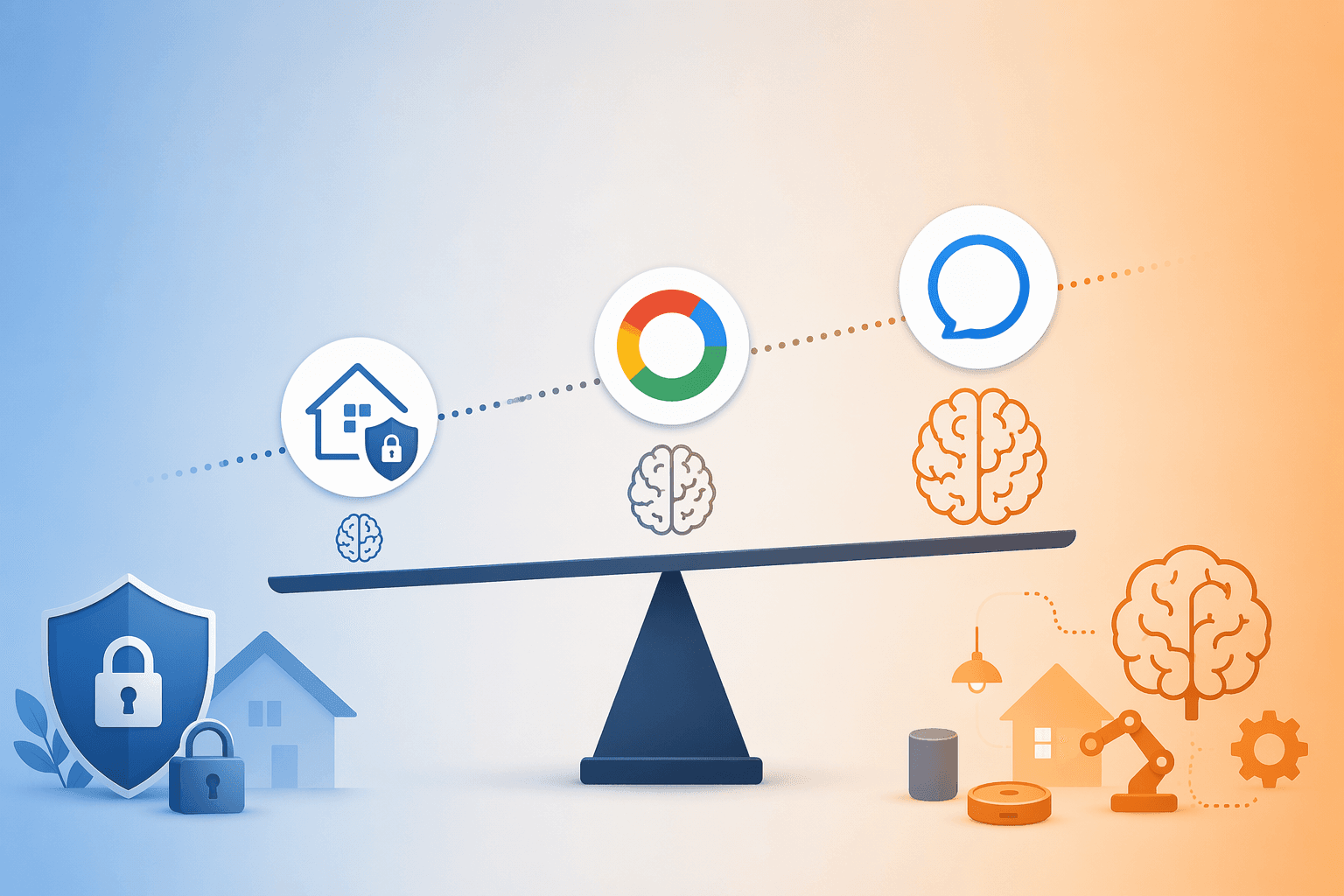
You might assume more privacy automatically means less intelligence. The truth is narrower: it depends on which intelligence you want.
| Platform | Privacy (AAIS) | Privacy (Cookbook) | Key AI capability |
|---|---|---|---|
| Apple Intelligence | 9.5/10 | Excellent | On-device processing, zero voice data stored |
| Google Gemini | 5.5/10 | Poor | Natural language queries, 'Ask Home' cross-device |
| Alexa+ | 4.5/10 | Fair | Proactive automation, pattern learning (Hunches) |
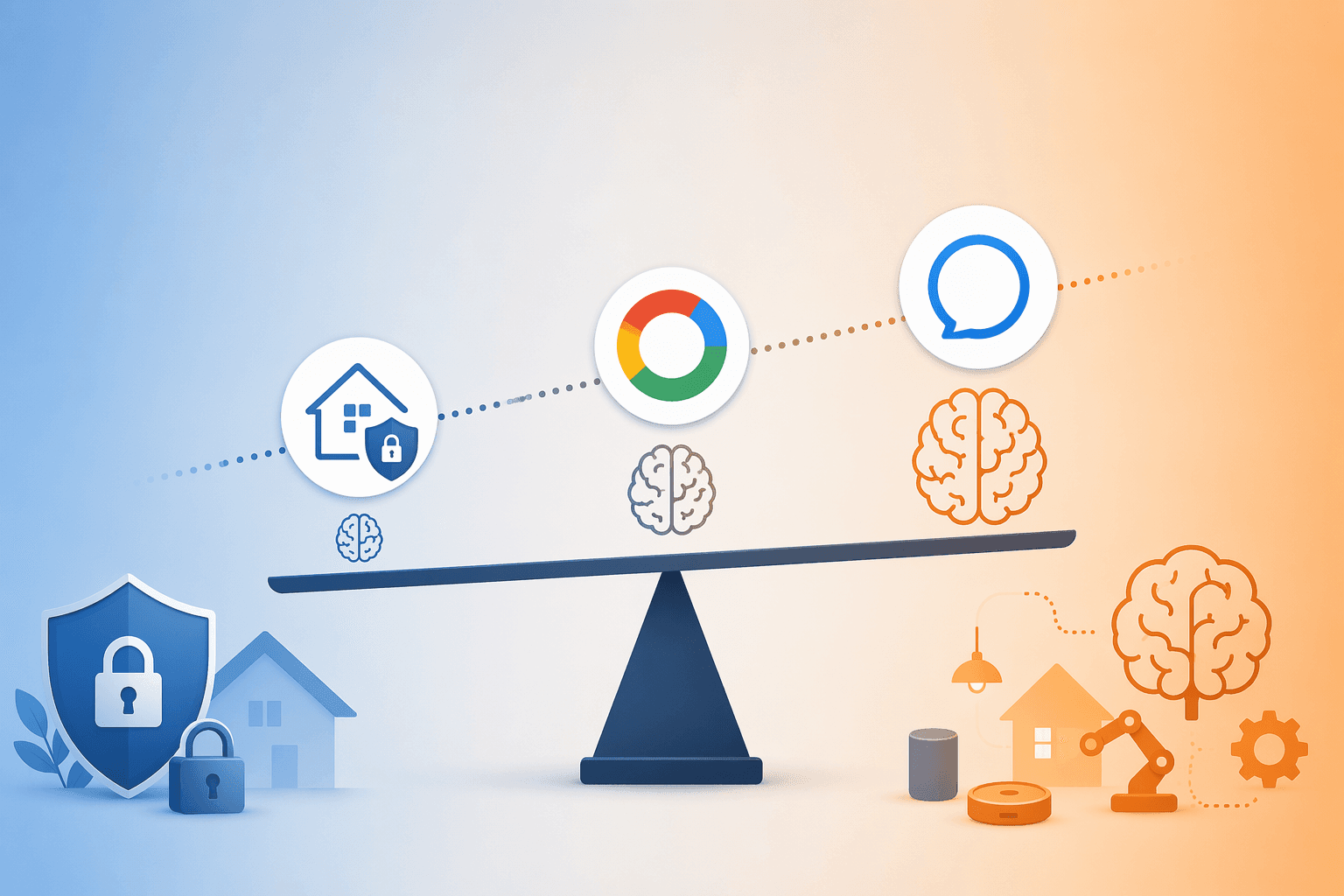
Apple’s on-device approach prevents it from doing what Gemini does with 'Ask Home' — that query needs a central cloud brain to aggregate sensor data across devices. Google’s cloud advantage enables rich NLU but means your voice commands are processed outside the home. Alexa+ sits in the middle: its proactive automation uses cloud pattern detection, but its privacy is rated 'Fair' rather than 'Poor' because you can opt out of certain data collection. The choice is not a single slider. It is a set of specific trade-offs: can you accept that your voice commands are processed in the cloud in exchange for the ability to ask 'are any windows open?' Will you trade predictive automation for a system that never stores your voice recordings? Those are the real questions.
Which trade-off you can live with
- The 'ask again' user — you value privacy above all else. You do not mind repeating yourself or manually creating routines. Apple Intelligence is your platform. You accept that Siri cannot yet handle cross-device queries, and you are willing to wait for the HomePad (if it delivers). The privacy score (9.5/10) is the anchor.
- The 'wait for a fix' user — you want your home to feel proactive, but you want to stay inside the Amazon ecosystem and can accept cloud processing. Alexa+ gives you Hunches, pattern learning, and a huge device ecosystem you may already own. The privacy score (4.5/10) is 'Fair' — not great, but you are comfortable with the Amazon data practices you already use.
- The 'invite cloud processing' user — you want the smartest conversational assistant, full stop. You do not mind voice data leaving the home for better NLU and cross-device awareness. Google Gemini delivers the most natural interaction today, and the $10–20/mo subscription feels reasonable for the capability. Privacy is rated 'Poor', but you have decided the gain is worth the cost.
Bottom line
No platform wins this comparison on every dimension. Matter has made device compatibility a non-issue for the typical home. The decision now comes down to a single question: which intelligence gap bothers you most?
Do you want a system that learns your routines and acts without being asked, even if it means the cloud knows when you go to bed? That is Alexa+. Do you want to talk to your house like a person, even if your questions are processed on Google’s servers? That is Gemini. Do you want the assurance that not a single voice command leaves your home, even if that means the assistant feels a generation behind? That is Apple Intelligence.
For a broader platform overview — subscription costs, device compatibility, and hub requirements — see The Smart Home Ecosystem Trap guide.
Discussion
Share your experience with the compared products, flag outdated pricing or specs, or ask clarifying questions about the comparison verdict.
Comments
Join the discussion with an anonymous comment.