Why Your Platform Choice Matters More Than Any Single Device
It is tempting to start a smart home by picking the most popular thermostat, the best-reviewed lock, or the cheapest smart plug. But that approach often leads to a painful discovery a year later: the devices you bought don't talk to each other the way you expected, or the voice assistant you chose can't do what you need, or — worst of all — you realize you have to replace half your setup to switch ecosystems.
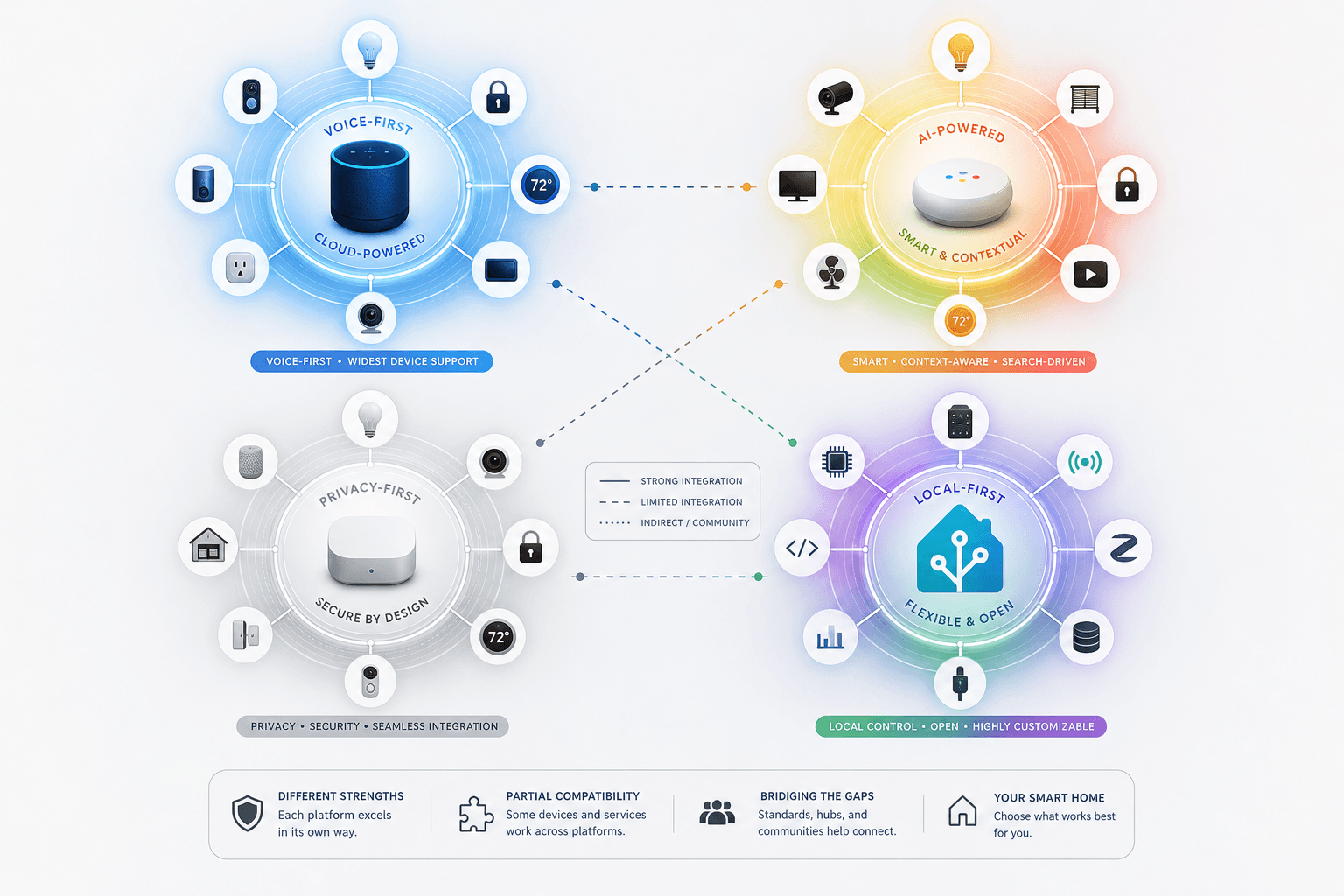
The single most important buying decision in 2026 is not which individual device you pick. It is which ecosystem — Amazon Alexa, Google Home, Apple HomeKit, or Home Assistant — you build around. That choice determines your automation ceiling, your privacy posture, and your upgrade path for the next three to five years. As The Gadgeteer put it in its mid-2026 hub roundup, "The platform you pick in 2026 is the one you live with through at least 2028, and the cost of switching later is real."
Matter, the universal connectivity standard, has made device pairing across ecosystems easier — but it does not eliminate the trade-offs between platforms. Your hub still determines how automations run, whether your voice commands stay local or hit the cloud, and how much you pay each month for features that used to be free. This guide walks through each major platform's strengths and weaknesses so you can make an informed choice before you start buying hardware.
Ecosystem Comparison at a Glance
Before diving into each platform, here is a side-by-side look at the four major ecosystems across the dimensions that matter most for a long-term commitment. Data is drawn from Security.org's June 2026 smart home platform comparison, CNET's May 2026 update, and ZDNET's December 2025 roundup.
| Dimension | Amazon Alexa | Google Home | Apple HomeKit | Home Assistant |
|---|---|---|---|---|
| Compatible devices | 140,000+ | 50,000+ | 1,000+ (curated) | 2,500+ integrations |
| Voice AI accuracy | Good (broad skills) | 93% correct (best tested) | Siri (limited) | N/A (no built-in voice) |
| Privacy posture | Cloud-dependent; data used for ad targeting | Cloud-dependent; Google collects usage data | End-to-end encryption; local processing | 100% local; no cloud dependency |
| Local control support | Limited (mostly cloud) | Limited (mostly cloud) | Strong (HomeKit Secure Video, local automations) | Full (all processing on-device) |
| Monthly subscription cost | $19.99 (Alexa+, non-Prime); free tier available | Free (no premium tier) | Free (iCloud+ for HomeKit Secure Video) | $6.50 (Nabu Casa cloud backup, optional) |
| Best for | Maximum device choice; heavy Amazon shoppers | Best voice AI; Google ecosystem users | Privacy-first; existing Apple households | Power users; maximum control; privacy purists |
Amazon Alexa: The Broadest Compatibility, But at a Cost
Alexa remains the 800-pound gorilla of smart home ecosystems. With support for over 140,000 devices — more than any other platform — it is the safest bet if you want the widest possible selection of lights, locks, cameras, plugs, and sensors. Brands that skip Alexa compatibility are rare, and the Alexa Skills Kit means third-party developers can add almost any functionality.
The trade-off is that Alexa's best features are increasingly locked behind a subscription. In 2025, Amazon introduced Alexa+, a premium tier that costs $19.99 per month for non-Prime subscribers. While the free tier still handles basic voice commands and routines, advanced capabilities — like multi-step automations, proactive suggestions, and enhanced voice recognition — now require the paid plan. CNET's May 2026 update flagged this as a significant shift in Alexa's value proposition.
Another persistent weakness is Alexa's reliance on cloud processing. Most voice commands are sent to Amazon's servers for interpretation, which means a temporary internet outage can render your smart home nearly mute. Local control is limited to a handful of Echo devices that support on-device processing for basic commands, but the ecosystem is fundamentally cloud-dependent.
- Strengths: Largest device ecosystem; best third-party skill support; wide range of Echo hardware at every price point; strong integration with Ring security products.
- Weaknesses: Increasingly subscription-gated features; cloud-dependent processing; cluttered app experience (noted by ZDNET); privacy concerns around voice data collection.
- Best for: Households that want maximum device choice, already shop heavily on Amazon, and are comfortable with a subscription model for advanced features.
Google Home: The Smartest Voice Assistant, Still Finding Its Footing
Google's smart home platform has undergone a major transformation in 2026. The company replaced Google Assistant with Gemini for Home, a new AI layer that brings significantly improved natural language understanding. In head-to-head testing conducted by Security.org, Google Assistant (the predecessor) correctly answered 93% of questions — the highest accuracy of any voice AI tested. Early reports suggest Gemini for Home maintains or improves on that performance.
The Google Home app, which ZDNET praised as intuitive and well-designed, makes it relatively easy to set up routines and manage devices. Google's ecosystem supports over 50,000 devices — a smaller pool than Alexa, but still broad enough to cover most major brands. The platform also benefits from Google's deep integration with its own services: Nest thermostats, Nest cameras, and Google Nest speakers work seamlessly together.
Privacy remains the biggest question mark for Google's platform. Like Alexa, most voice processing happens in the cloud, and Google's business model relies on usage data to improve its services and target advertising. For users who are comfortable with that trade-off, Google Home offers the best voice experience and a clean, modern app. For privacy-conscious buyers, it is a harder sell.
- Strengths: Best-in-class voice AI accuracy; intuitive app experience; strong Nest hardware integration; no premium subscription required.
- Weaknesses: Smaller device ecosystem than Alexa; cloud-dependent processing; privacy concerns around data collection; slower adoption of Matter features compared to competitors.
- Best for: Users who prioritize voice control quality, are already in the Google ecosystem (Android phones, Nest products), and are comfortable with Google's data practices.
Apple HomeKit: Privacy-First, But at a Premium
Apple HomeKit takes the opposite approach from Alexa and Google: instead of maximizing device count, it prioritizes privacy and security. Every HomeKit command is processed locally on an Apple hub — a HomePod mini ($99) or Apple TV 4K ($129) — and communication with smart home devices is encrypted end-to-end. Security.org gave HomeKit a 7.9/10 privacy score, the highest of any commercial platform, noting that "Apple HomeKit processes commands locally with end-to-end encryption — strongest privacy posture."
The cost of that privacy is choice. HomeKit's curated ecosystem includes roughly 1,000 devices — a fraction of what Alexa offers. Every device must pass Apple's certification process, which ensures reliability and security but also limits selection and often comes with a price premium. HomeKit-compatible smart locks, for example, typically cost $30–$50 more than their Alexa-only counterparts.
HomeKit also requires Apple hardware to act as a hub. Without a HomePod mini or Apple TV 4K, you cannot access your devices remotely or set up automations. For households already invested in the Apple ecosystem — iPhones, iPads, Macs — this is a natural fit. For Android users, it is a non-starter.
- Strengths: Best privacy posture of any commercial platform; local processing and end-to-end encryption; curated device ecosystem ensures reliability; no subscription required for core features.
- Weaknesses: Smallest device ecosystem; requires Apple hub hardware; devices often cost more; Siri is less capable than Alexa or Google Assistant; no Android support.
- Best for: Privacy-focused households already using Apple devices; users who value security over device choice; those willing to pay a premium for a curated experience.
Home Assistant: Maximum Control, Maximum Effort
Home Assistant occupies a category of its own. It is not a commercial platform like Alexa or Google Home — it is an open-source home automation platform that runs entirely on your own hardware. Every command, every automation, every bit of data stays on your local network. There is no cloud dependency, no data collection, and no subscription required for core functionality. Security.org, ZDNET, and The Gadgeteer all rank it as the most powerful and private option available.
The platform supports over 2,500 official integrations — more than any commercial ecosystem — covering everything from obscure Zigbee sensors to high-end security systems. Community-contributed add-ons push that number even higher. If a device has an API, someone has probably built a Home Assistant integration for it.
The catch is that Home Assistant requires technical comfort. Setting it up involves installing the software on a dedicated device (like the Home Assistant Green at $159 or the Home Assistant Yellow at $135 for the PoE kit), configuring integrations, and writing YAML-based automations. While the platform has become more user-friendly in recent years — with a web-based dashboard and visual automation editor — it still demands a willingness to troubleshoot and learn.
For users who want remote access without exposing their home network, Home Assistant offers Nabu Casa, a cloud service that costs $6.50 per month. It is entirely optional — you can set up remote access yourself for free — but it supports the development of the open-source project.
- Strengths: 100% local operation; 2,500+ integrations; unmatched flexibility and customization; no subscription required; best privacy posture of any option.
- Weaknesses: Steep learning curve; requires dedicated hardware; no built-in voice assistant (can integrate with Alexa or Google for voice); automations require YAML or visual editor; less polished out-of-box experience.
- Best for: Power users, tinkerers, and privacy purists who want maximum control and are comfortable with technical setup. Also ideal for households with a mix of devices from different ecosystems that need a single automation layer.
The Matter Layer: What It Solves and What It Doesn't
Matter has been widely promoted as the solution to smart home fragmentation. The protocol, backed by Apple, Google, Amazon, and Samsung, allows devices from different manufacturers to communicate directly without requiring platform-specific bridges. As of mid-2026, there are over 850 Matter-certified devices, and the number is growing steadily.
Matter genuinely simplifies device pairing. A Matter-certified smart bulb, for example, can be set up with a single QR code scan and will work with any Matter-compatible hub — whether that is an Echo Hub, a HomePod mini, or a Home Assistant Yellow. This is a meaningful improvement over the old model where each device required its own app and account.
However, Matter does not unify the platform experience. Your choice of hub still determines:
- Which voice assistant you use (Alexa, Google Assistant, or Siri)
- How automations are processed (locally or in the cloud)
- What privacy policies apply to your data
- Which advanced features require a subscription
- How well devices from different ecosystems work together in routines
In short, Matter makes it easier to move devices between ecosystems, but it does not make the ecosystems themselves interchangeable. The platform you choose still defines your day-to-day experience. For a deeper dive into how Matter works and what it means for your buying decisions, see our Matter Protocol Explained guide.
Hub Buying Guide: Matching a Controller to Your Platform Choice
Once you have chosen your ecosystem, the next decision is which hub to buy. The hub is the brain of your smart home — it processes commands, runs automations, and connects devices across protocols. Here are the best options for each platform path, based on The Gadgeteer's June 2026 hub roundup and our own testing.
| Hub | Price (Q2 2026) | Best For | Key Protocols | Platform Compatibility |
|---|---|---|---|---|
| Aqara Hub M3 | $159.99 | Universal Matter controller; works across all platforms | Matter, Thread, Zigbee, Wi-Fi | Alexa, Google Home, HomeKit, Home Assistant |
| Apple HomePod mini | $99 | Apple households; local HomeKit processing | Matter, Thread, Wi-Fi | HomeKit only |
| Amazon Echo Hub | $179 | Alexa and Ring homes; voice-first control | Matter, Thread, Zigbee, Wi-Fi | Alexa only |
| Aeotec SmartThings Hub v3 | $170–$220 | Zigbee and Z-Wave device support; SmartThings ecosystem | Matter, Thread, Zigbee, Z-Wave, Wi-Fi | Alexa, Google Home, HomeKit (limited), SmartThings |
| Home Assistant Yellow | $135 (PoE kit) | Power users; maximum local control | Matter, Thread, Zigbee, Z-Wave, Wi-Fi | All platforms via integrations |
Reader Feedback
Share your purchase experience, flag outdated picks, or ask clarifying questions about the checklist items.
Comments
Join the discussion with an anonymous comment.