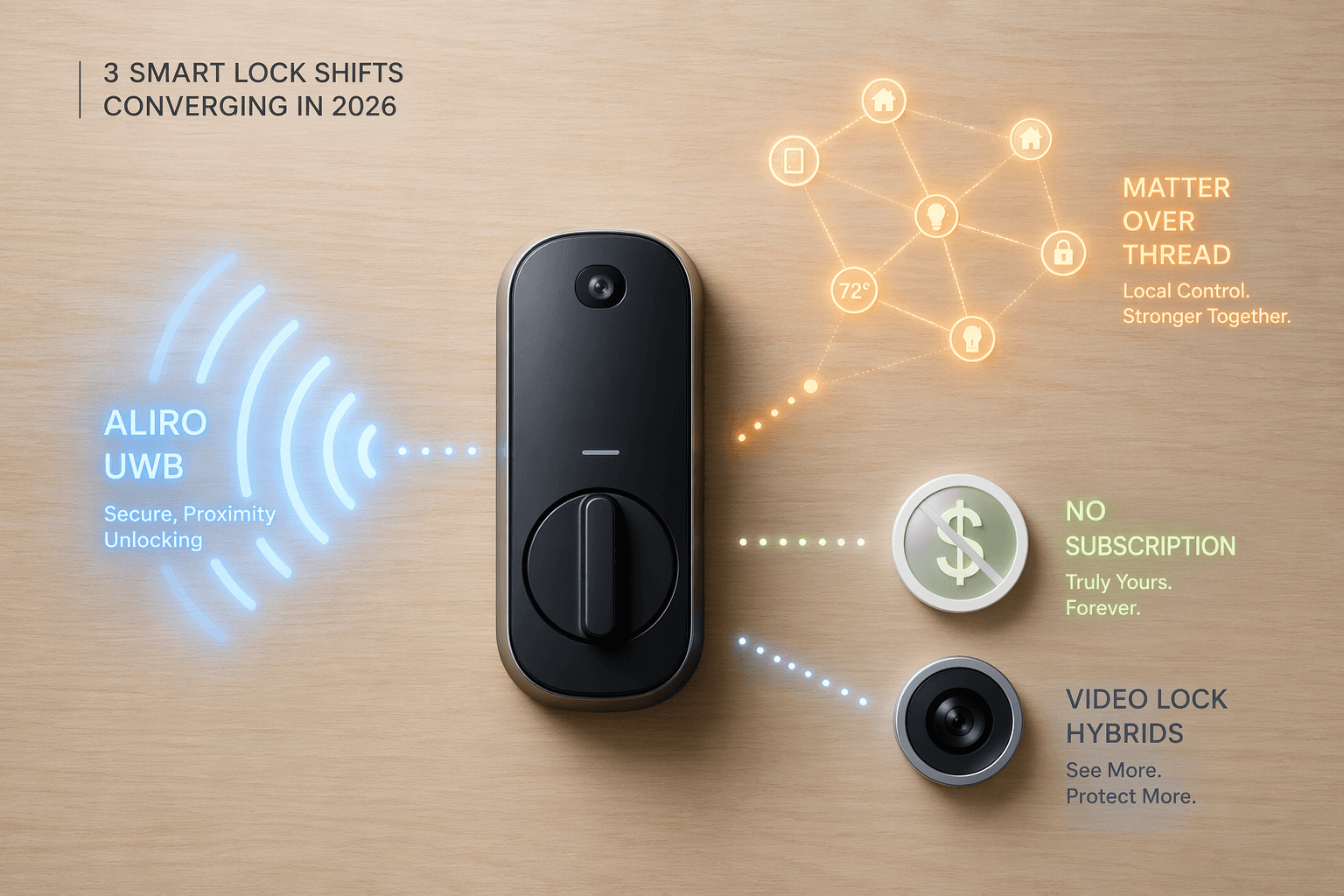
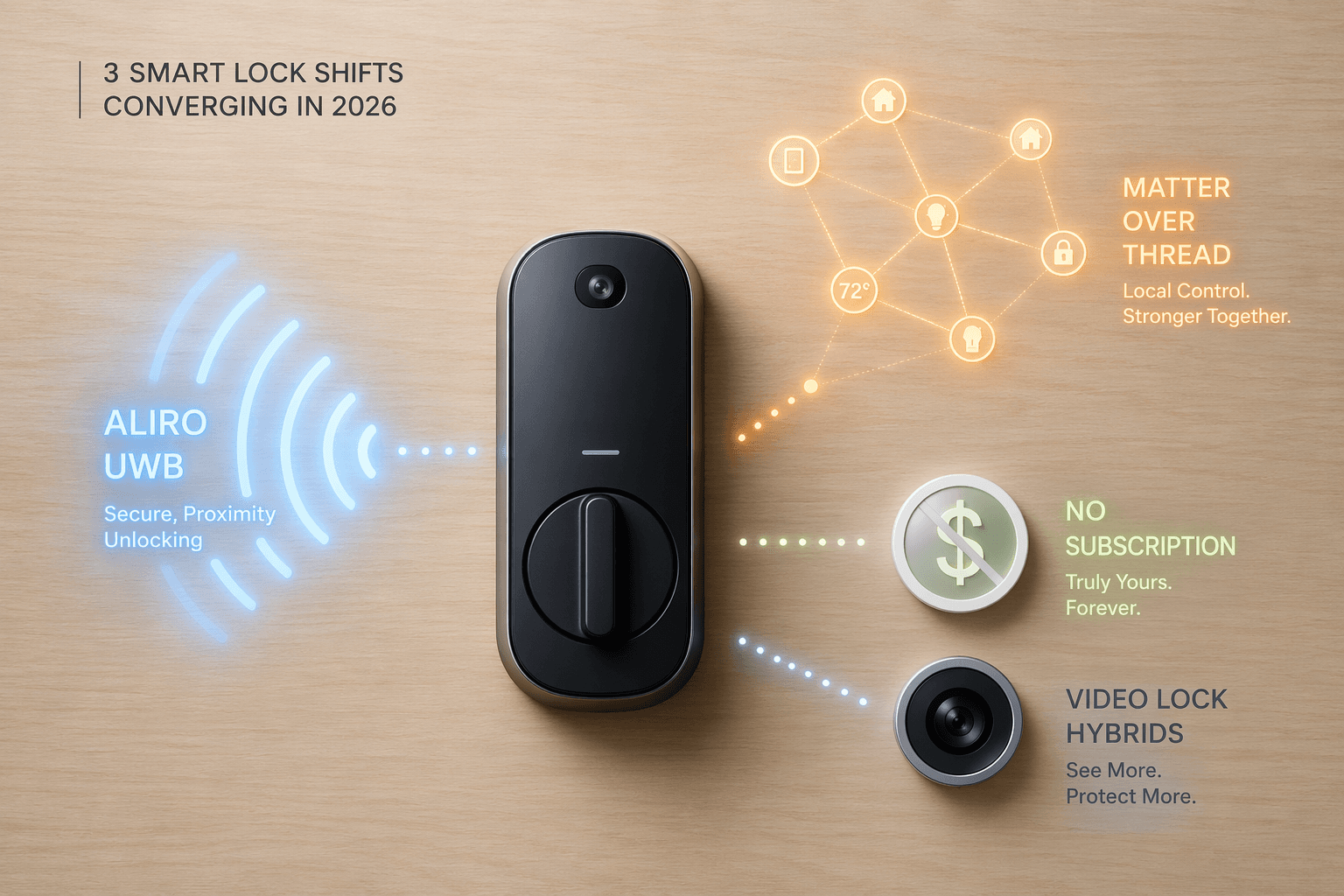
An $80 smart lock that locks and unlocks from your phone will still work next year. That is not the question. The question is whether it will feel like a 2026 lock in 2027 or like the 2019 lock you were finally ready to replace. Three things have happened in the first half of 2026 that collectively shift what a smart lock should be: a new digital credential standard called Aliro, the arrival of Matter over Thread in shipping products, and a sudden critical mass of subscription-free models. If you buy a lock that ignores these three shifts, you are not buying a future-proof device. You are buying a lock that a year from now will feel locked into a past you already know is wrong.
The global smart lock market is valued at roughly $3.5 billion in 2025–2026 and projected to hit $9.4 billion by 2036, according to one research firm. That figure measures market growth, not whether the individual buyer makes a smart choice. The more useful figure is how fast the installed base of older locks will feel outdated. That timeline is tighter than you think.
Aliro is real, but is it ready?
The Aliro 1.0 specification was released on February 26, 2026, by the Connectivity Standards Alliance. It standardizes digital credential access using NFC, Bluetooth Low Energy, and Ultra Wideband. In plain English: it means your smart lock could work with a digital key in Google Wallet, Apple Wallet, or any other compliant wallet, and you could tap your phone or just walk up and have it unlock automatically – without a separate app, without a bridge, without worrying which platform your visitor uses.
That sounds like the smart lock future we were promised. But as of June 2026, exactly one lock has confirmed Aliro readiness: the Aqara Smart Lock U400 (around $250), and that readiness comes via a future firmware update. I do not treat a firmware promise the same as a shipping feature. The UWB auto-unlock on the U400 works today – and it is excellent, more precise than Bluetooth geofencing – but the Aliro credential sharing across platforms? That is a checkbox for 2027, not for this purchase.
Consider the counterexample: Schlage announced the Sense Pro with UWB in January 2025. It still has not shipped, eighteen months later. That kind of delay should temper enthusiasm for any standard that depends on hardware that has not yet arrived in boxes. Aliro is real. It is not yet ready for the buyer buying today.
Aliro is a future-proofing checkmark, not a deciding factor. If a lock claims Aliro readiness via firmware update, count it as a bonus, not a feature. The lock should still earn its place on every other dimension.
Matter over Thread: the upgrade that actually affects daily life
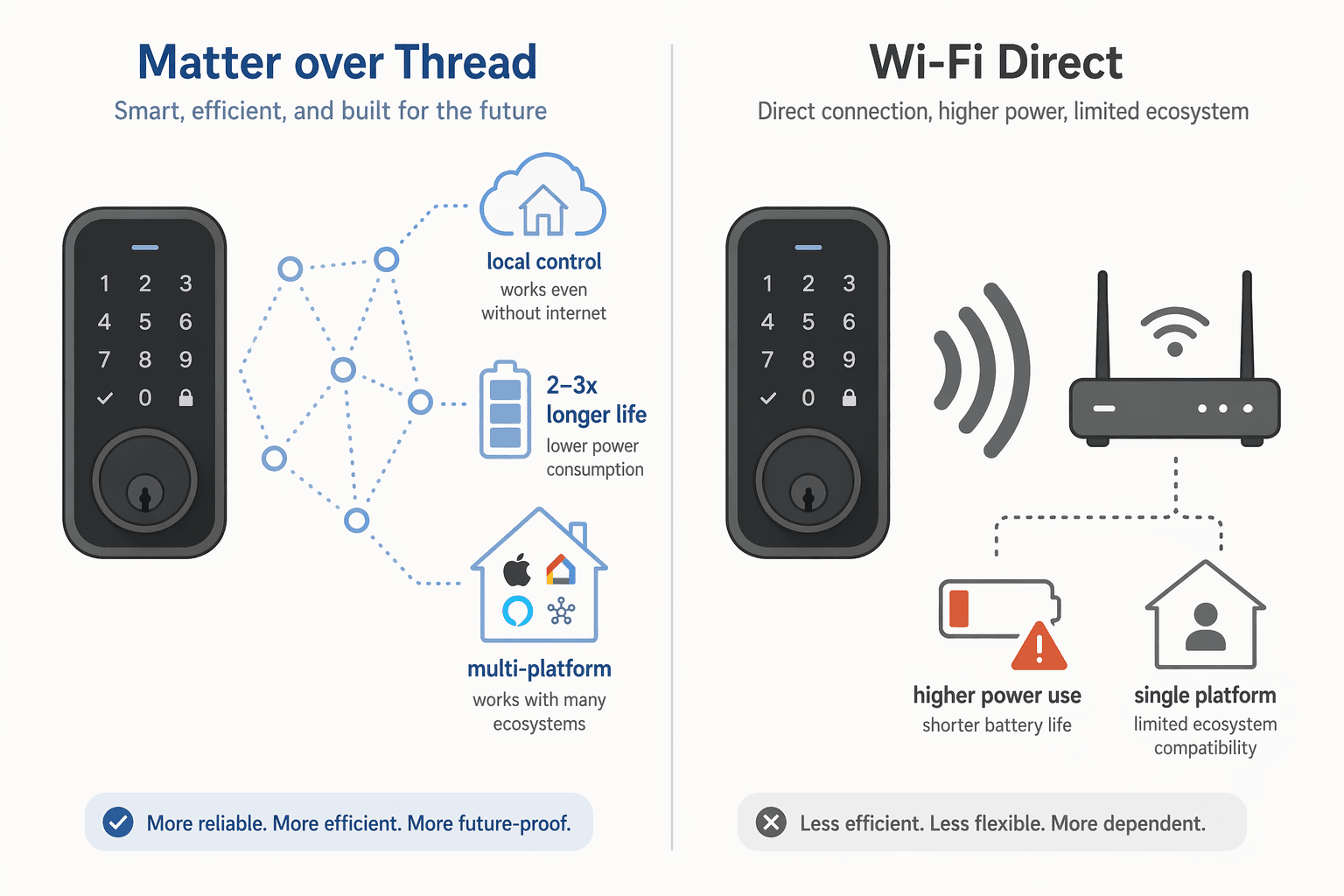
While Aliro is a future benefit, Matter over Thread is a present-day advantage that changes how a smart lock behaves. Matter is the interoperability standard that lets a lock work with any platform – Alexa, Google Home, Apple Home, SmartThings – without a separate bridge. Thread is the low-power mesh network that makes that communication local, fast, and battery-efficient. Put them together and you get a lock that works with everything, never touches the cloud for a lock command, and runs on batteries for months instead of weeks.
The battery-life gap is not subtle. The Yale Assure Lock 2 lasts three months on Wi-Fi and up to twelve months on a Z-Wave or Thread module. The Schlage Encode Plus, a Wi-Fi lock, gets about six months. Those are tested, reported figures – not lab extrapolations. A Thread-based lock should comfortably outperform both.
Which locks ship with Matter over Thread today? The Aqara U400 (Matter, Thread, UWB), the Lockin Veno Pro (Matter, Thread, video doorbell, local storage), and the Eufy FamiLock S3 Max (Matter, Thread, 2K doorbell, palm-vein scanner). These are real products you can buy now. They require a Thread Border Router – already built into most modern smart speakers and hubs – and a Matter controller, but you likely already own one.
UWB auto-unlock: impressive, but it costs battery and is rare
The hands-free experience of a UWB smart lock is genuinely better than Bluetooth geofencing. With the Aqara U400, the lock unlocks as you approach the door – no tap, no phone out – and it is consistent enough that you stop thinking about it. That is a real quality-of-life improvement.
But UWB draws power. A lock with both UWB and Thread will not achieve the same battery life as a simpler Thread-only lock. The U400 runs on eight AA batteries; no one has published real-world battery life for the UWB + Thread combination yet. The trade-off is clear: convenience for battery changes. I would only recommend UWB if hands-free unlocking is a priority you have explicitly decided to pay for – not just because it sounds futuristic.
Today, exactly two shipping locks offer UWB: the Aqara U400 and the Ultraloq Bolt Mission (which also uses UWB but lacks Matter and Thread). The list is short. By 2027 it will be longer, but for now UWB is a mark of a premium, early-adopter product, not a mainstream necessity.
Subscription-free locks now hit every price tier – but watch the platform trade-offs
One of the best developments in 2026 is that you no longer have to pay a monthly fee just to use your smart lock from your phone. Subscription-free models now stretch from $80 to $300. The Wyze Lock Bolt v2 ($79.98) has fingerprint, keypad, app control, and no subscription. But it lacks Apple Home and Matter support, so it works only with Wyze’s own app, Alexa, and Google Home (via Wyze bridge). If you are in the Apple ecosystem, this lock is not for you.
At the other end, the Yale Smart Lock with Matter ($189.99) works with any Matter hub, has no subscription for basic features, and supports all major platforms. The Aqara U300 ($229.99) is a lever-style lock with Matter over Thread and no subscription. The Eufy FamiLock ($229.99) stores entry logs locally and runs on a 10,000 mAh battery that the manufacturer claims lasts up to eight months – also subscription-free.
| Model | Price | Matter/Thread | Platform support | Subscription catch |
|---|---|---|---|---|
| Wyze Lock Bolt v2 | $79.98 | No | Wyze app, Alexa, Google via bridge | Limited platform support |
| Yale Smart Lock with Matter | $189.99 | Matter (no Thread) | All Matter platforms | None for basic features |
| Aqara U300 | $229.99 | Matter over Thread | All Matter platforms | None |
| Eufy FamiLock | $229.99 | No Thread | Wi-Fi, app, no Matter | None (local storage) |
| Aqara U400 | ~$250 | Matter over Thread + UWB | All Matter platforms | None |
The catch with every subscription-free lock is that “free” is conditional. The Wyze lock is free because it is locked into its own ecosystem. The Eufy locks store video locally – but if you want cloud storage for longer history or AI alerts, you pay. The Yale and Aqara Matter locks are genuinely free for what they do, but they do nothing beyond lock/unlock and logs. That is probably enough for most people.
Video-lock hybrids: useful, but know the subscription hook
One of the biggest trends in 2026 is the video-lock hybrid – a single device that combines a smart lock with a doorbell camera. The Eufy Video Smart Lock E330 ($299.99) records 2K video to 8 GB of onboard storage, no cloud subscription required for basic recording. The Lockin Veno Pro ($349) adds Matter over Thread and free local video storage. The Eufy FamiLock S3 Max has a 2K doorbell and an interior video screen – again, free local storage.
This category is genuinely useful: one device, one installation, one app. But the “subscription-free” label is accurate only if you accept local-only storage and no cloud features (extended history, AI person detection, package alerts). The minute you want any of those, you are back to a monthly plan. That is not a bait-and-switch – it is honest – but it means you should evaluate the cost of the subscription you will actually end up wanting.
If you are comfortable reviewing footage only when someone rings the doorbell, and you do not need a cloud backup, then a video-hybrid with local storage is a clean no-subscription solution. If you want continuous recording or cloud backup, budget $5–$15/month in addition to the lock price.
What to skip in 2026
A few categories are worth avoiding entirely this year:
- Wi-Fi-only locks that lack a Thread upgrade path. They consume batteries quickly and tie you to a single platform. The August Wi-Fi Smart Lock, for example, still does not have full Matter compatibility as of June 2026.
- Locks that require a subscription to unlock basic features like app control, activity logs, or remote access. Any lock that paywalls those is a 2023 product dressed in 2026 packaging.
- Locks announced but not shipped. The Schlage Sense Pro is a caution: it sounded promising in January 2025, but you cannot buy it today. If a lock is not on store shelves, do not plan your security around it.
- Locks that lock you into a single ecosystem (only works with Alexa, only works with HomeKit, only works with a proprietary app). The whole point of 2026 is that you should be able to switch platforms without replacing every lock in your home.
For deeper context on why Matter and Thread change the security and compatibility game, this article covers the privacy and interoperability benefits in detail.
Three checks before you buy
Run any candidate through these three questions:
- Does it support Matter over Thread? If yes, you get local control, multi-platform compatibility, and long battery life. If it is Wi-Fi-only or Bluetooth-only without Thread, ask yourself why you are accepting last-generation connectivity.
- Is it Aliro-ready or upgradeable? Not a dealbreaker today, but if you plan to keep the lock for more than two years, you want a path to Aliro (firmware update or hardware support). Without it, your lock will miss the digital-credential ecosystem that is coming.
- Does it require a subscription for core lock/unlock functionality? If yes, reject it. The market has enough good subscription-free locks that you should not accept a paywall for basic remote access or logging.
The safest choice for a 2026 buyer: a lock with Matter over Thread, no mandatory subscription, and a path to Aliro (even if only via firmware update). Verify that the platforms you use today are supported – not just listed on a roadmap. The Yale Assure Lock 2 with Thread module, the Aqara U300, and the Aqara U400 all fit that profile.
Buying a smart lock in 2026 is not about picking the best brand. It is about deciding which set of standards you want to live with for the next five years. The good news is that the right choice – Matter over Thread, no subscription, Aliro forward – is already available and affordable. You just have to look for the standard on the box, not the logo.
Discussion
Share your experience with the compared products, flag outdated pricing or specs, or ask clarifying questions about the comparison verdict.
Comments
Join the discussion with an anonymous comment.