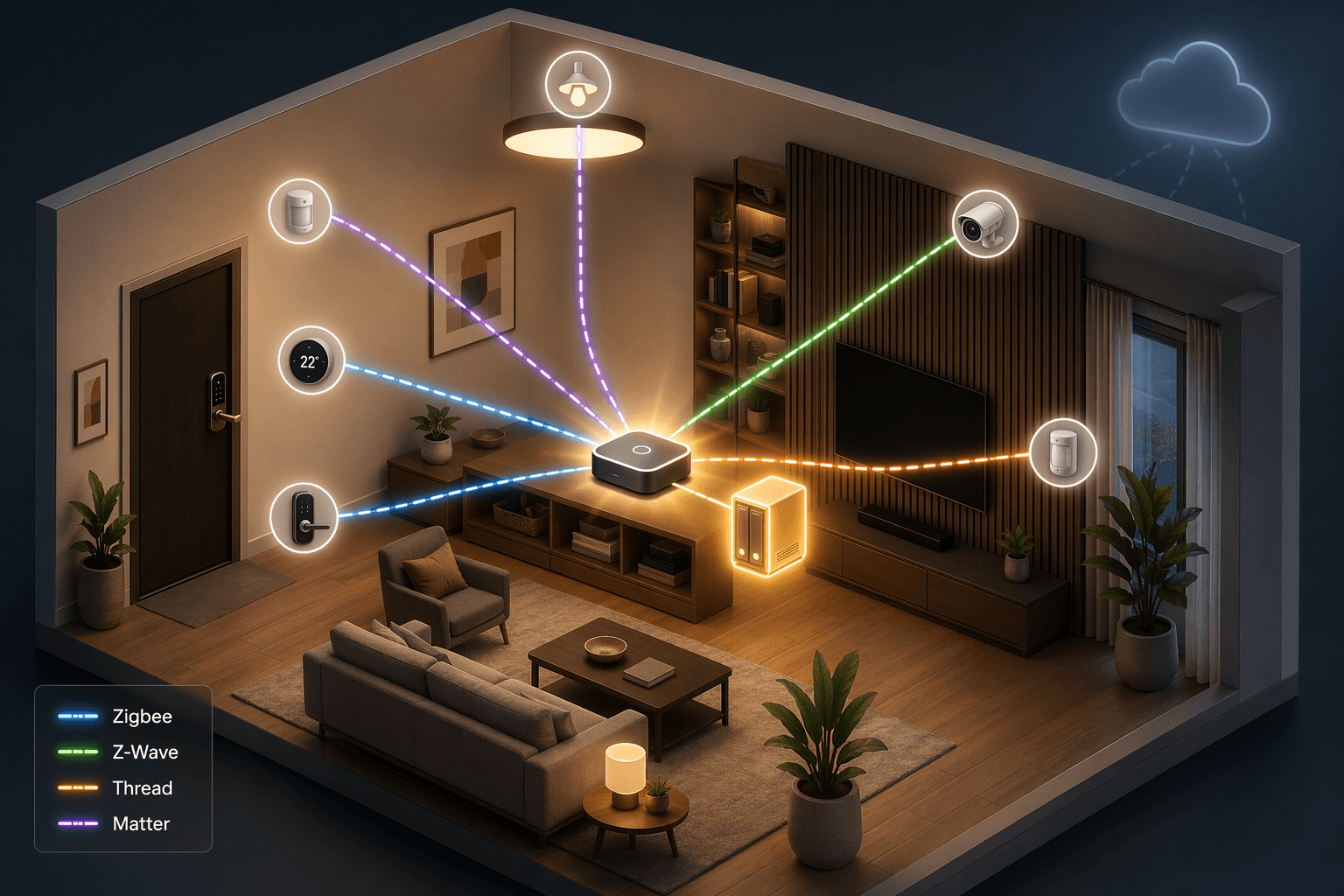
The 7 Leading Smart Home Controllers in 2026 at a Glance
If you already own a few smart lights, a thermostat, and maybe a lock, you have likely hit the wall that every intermediate smart home owner eventually runs into: your devices do not talk to each other, or they only work inside their own app. A smart home controller — sometimes called a hub — is the piece of hardware that bridges those gaps. It lets you build automations across brands and protocols from a single dashboard.
But in 2026, no single controller is the right answer for everyone. The market has split into distinct camps: fully local privacy-first boxes, multi-protocol Swiss Army knives, cloud-hybrid convenience platforms, and ecosystem-specific hubs that lock you into one brand. The controller you choose determines which devices you can use, whether your automations survive an internet outage, and how much of your data leaves your home.
Here are the seven controllers that dominate the 2026 landscape, each with a clear reason to consider it:
- Home Assistant Green — 100% local processing, 3,000+ integrations, no subscription required. The privacy champion, but expects you to learn the system.
- Homey Pro — Supports 8 protocols out of the box including infrared and 433 MHz. No coding needed. The broadest device compatibility of any consumer hub.
- Hubitat Elevation C-8 Pro — Z-Wave 800 Long Range chip reaches up to 1,300 feet. Fully local, no subscription. Built for large homes and Z-Wave-heavy setups.
- Samsung SmartThings Station — QR code pairing, 15-minute setup. Cloud-hybrid architecture with no Z-Wave radio. Best for Samsung phone users who want simplicity.
- Apple HomePod Mini — Thread border router and Matter controller. End-to-end encryption and local processing. Only works with Thread and Matter devices.
- Amazon Echo Hub — 140,000+ compatible devices. Deep Alexa integration. All voice commands are cloud-dependent after Amazon removed local voice processing in March 2025.
- Aqara Hub M3 — Zigbee radio is Aqara-only. Includes an IR blaster for legacy devices. Acts as a Thread border router. A specialized choice for Aqara-centric builds.
If you are still deciding whether you need a controller at all, the How to Choose a Home Automation Controller guide walks through the decision framework before you compare specific products.
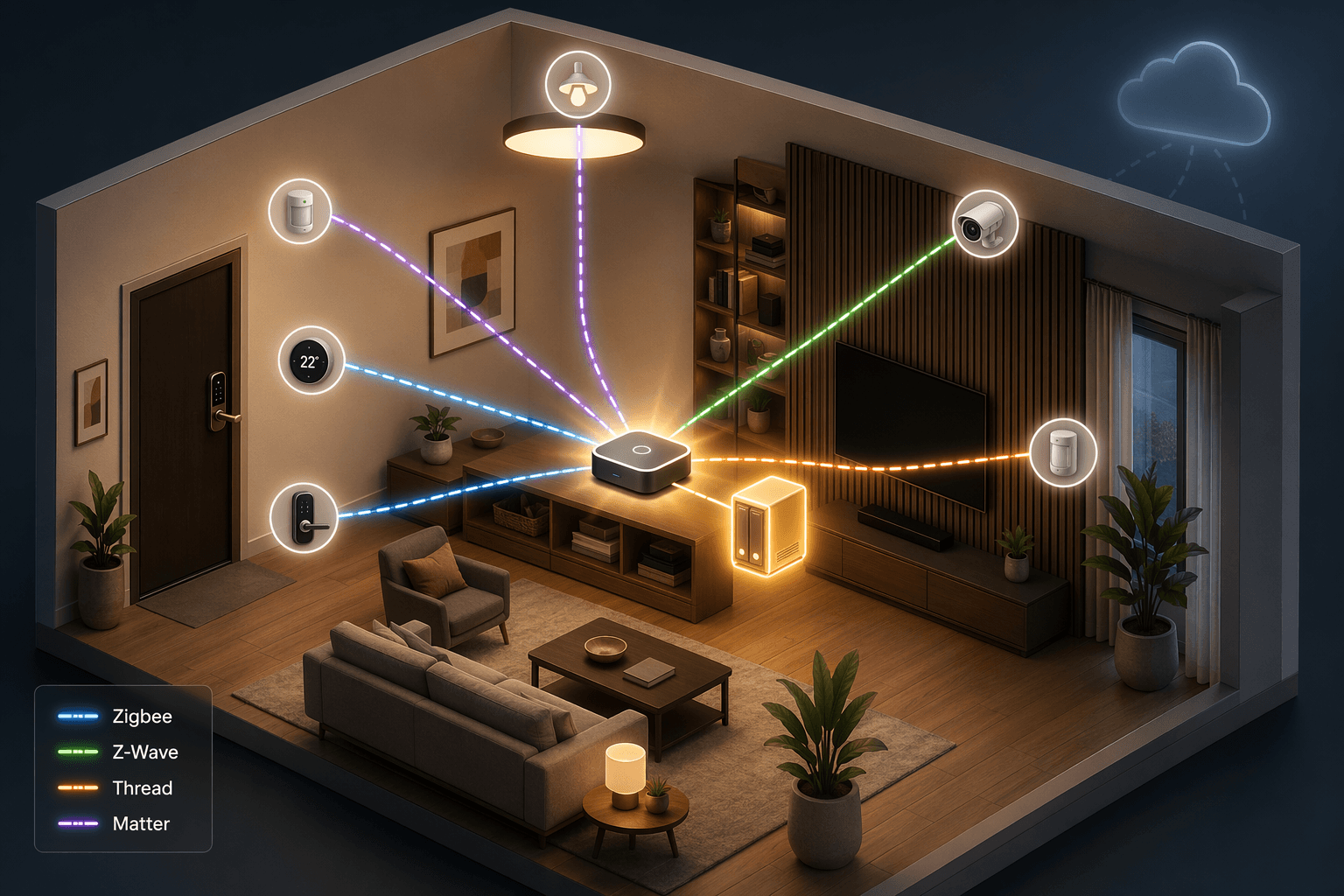
Comparison Table: Protocols, Local Processing, Price, and Setup Difficulty
The table below distills the seven controllers into the four dimensions that matter most at purchase time: which wireless protocols each one supports, whether automations run locally or require the cloud, the approximate retail price, and how difficult the initial setup is for an intermediate user.
| Controller | Zigbee | Z-Wave | Thread | Matter | IR / 433 MHz | Local Processing | Price (USD) | Setup Difficulty |
|---|---|---|---|---|---|---|---|---|
| Home Assistant Green | Yes (via USB dongle) | Yes (via USB dongle) | Yes (via USB dongle) | Yes (via USB dongle) | No | 100% local | ~$219 | Advanced |
| Homey Pro | Built-in | Built-in | Built-in | Built-in | Yes (IR + 433 MHz) | Primarily local | ~$349 | Intermediate |
| Hubitat C-8 Pro | Built-in | Built-in (800 LR) | No | No | No | 100% local | ~$180 | Intermediate |
| SmartThings Station | Built-in | No | Yes | Yes | No | Cloud-hybrid | ~$60 | Beginner |
| Apple HomePod Mini | No | No | Yes (border router) | Yes | No | Local (Apple HomeKit) | ~$99 | Beginner |
| Amazon Echo Hub | Built-in | No | Yes | Yes | No | Cloud (voice), local (routines) | ~$110 | Beginner |
| Aqara Hub M3 | Built-in (Aqara only) | No | Yes (border router) | Yes | Yes (IR) | Local (Aqara ecosystem) | ~$160 | Beginner |
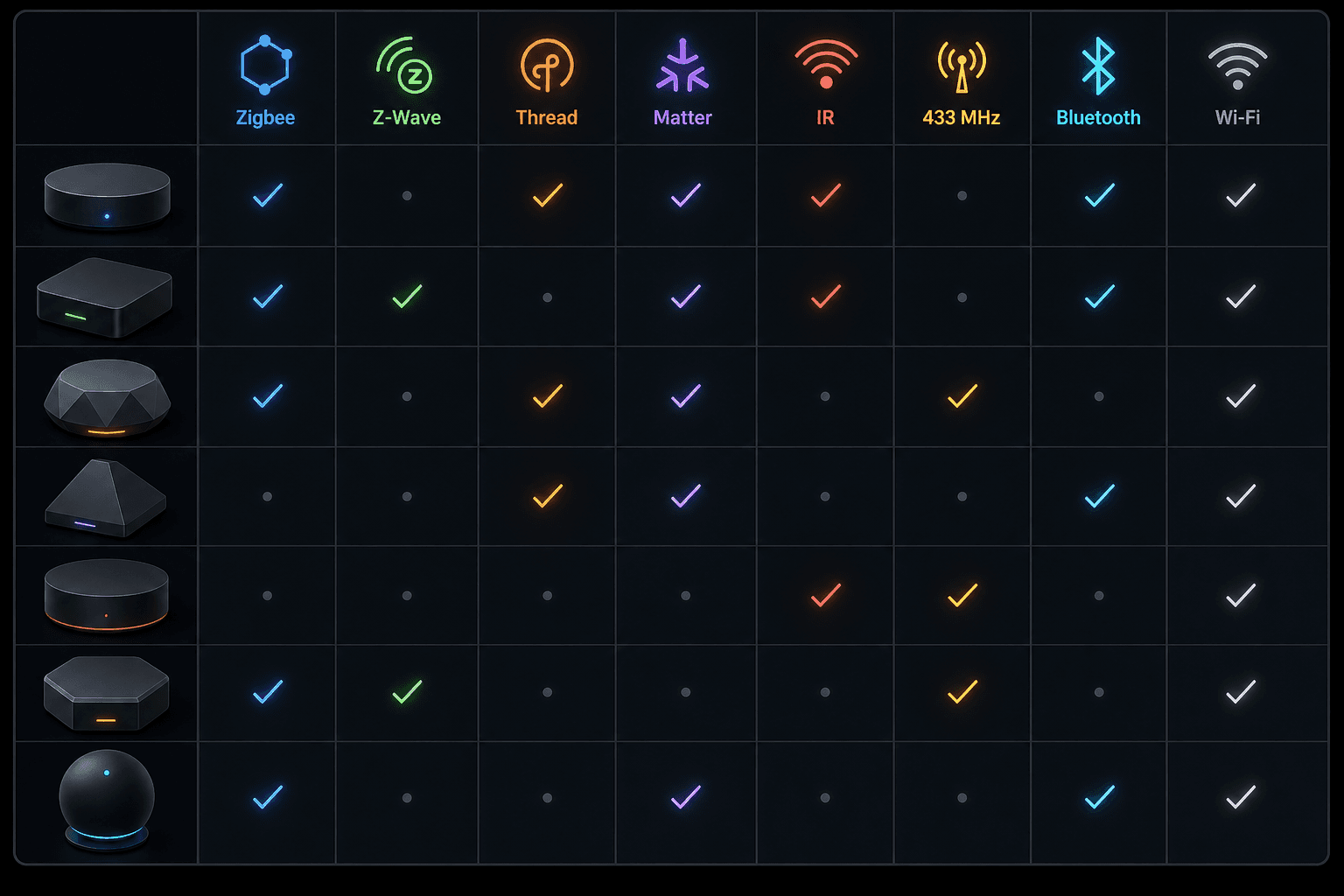
Home Assistant Green: Best for Local Control and Privacy
Home Assistant Green is the clearest statement yet that local-first smart home control has gone mainstream. The device processes 100% of automations on the hardware itself — no data touches a cloud server unless you explicitly enable remote access through the optional Nabu Casa subscription ($6.50/month). With over 3,000 official integrations, it can connect to more device types than any other controller on this list, from obscure Z-Wave locks to ESP32 DIY sensors.
The trade-off is upfront effort. Home Assistant Green ships without built-in Zigbee or Z-Wave radios — you need to add a USB dongle for each protocol you want to use. The interface, while much improved since the 2023-era dashboard, still expects you to understand concepts like entities, automations in YAML, and add-on containers. This is not a hub you hand to a non-technical household member and walk away.
- 100% local processing — automations run during internet outages
- 3,000+ integrations covering nearly every consumer smart home brand
- No mandatory subscription; optional Nabu Casa cloud for remote access at $6.50/month
- Open-source ecosystem with active community and weekly updates
- Requires separate USB dongles for Zigbee and Z-Wave — adds ~$30–$50 to total cost
- Steeper learning curve than any other controller in this comparison
For readers who want a deeper look at why local processing matters for privacy and reliability, the Local vs. Cloud Home Automation article covers the full trade-off analysis.
Homey Pro: Widest Protocol Support, No Coding Required
Homey Pro solves a problem that most other hubs ignore: what do you do with the devices that do not speak Zigbee, Z-Wave, or Matter? The Homey Pro supports 8 communication protocols out of the box, including infrared and 433 MHz. That means it can control your TV, air conditioner, or RF ceiling fan — devices that a Home Assistant Green or Hubitat simply cannot reach without additional hardware bridges.
According to Homey's own documentation, the hub works with over 50,000 smart home devices from more than 1,000 brands. The automation engine uses a visual flow builder — drag, drop, set conditions — so you never need to write a line of code. Advanced Flows support multiple triggers, conditions, and actions in a single rule, which puts it on par with Home Assistant's automation capabilities for most real-world use cases.
- 8 built-in protocols: Zigbee, Z-Wave, Thread, Matter, Bluetooth, Wi-Fi, Infrared, and 433 MHz
- 50,000+ compatible devices from 1,000+ brands
- Visual flow builder — no coding required for complex automations
- Primarily local operation; cloud connectivity used for voice assistants and remote access
- Higher price point (~$349) compared to most competitors
- Some advanced features (e.g., energy monitoring, camera integration) require a subscription
Hubitat Elevation C-8 Pro: Best for Large Properties and Z-Wave Power
Hubitat Elevation has always been the Z-Wave specialist, and the C-8 Pro takes that specialization further. It is the first consumer hub to ship with a certified Z-Wave 800 Long Range chip, which can reach up to 1,300 feet line-of-sight according to EverydayHomeComfort's testing. For a 4,000-square-foot home with a detached garage or workshop, that range eliminates the need for Z-Wave repeaters in most layouts.
Like Home Assistant Green, the C-8 Pro runs 100% of automations locally with no cloud dependency and no subscription fee. The trade-off is a less polished user interface. Hubitat's dashboard and rule engine are functional but dated compared to the visual polish of Homey or SmartThings. It also lacks Thread and Matter support, which means it cannot natively control the growing number of Matter-certified devices entering the market in 2026.
- Z-Wave 800 Long Range — up to 1,300 feet line-of-sight, the longest Z-Wave range of any consumer hub
- 100% local processing — no cloud dependency, no subscription
- Built-in Zigbee and Z-Wave radios (no USB dongles needed)
- No Thread or Matter support — cannot natively control Matter devices
- Interface is less intuitive than Homey or SmartThings; steeper learning curve for automation rules
- Priced at ~$180, making it the most affordable fully local controller with built-in dual radios
Samsung SmartThings Station: Best for Beginners in the Samsung Ecosystem
The SmartThings Station is the easiest controller to set up in this comparison. Pairing a device involves scanning a QR code with your phone — the entire installation can be completed in about 15 minutes. It supports Zigbee, Thread, and Matter out of the box, and it integrates deeply with Samsung phones, TVs, and appliances.
The catch is that the SmartThings Station is a cloud-hybrid device. Automations are processed partly on the hub and partly in Samsung's cloud. If your internet goes down, some routines may stop working. It also lacks a Z-Wave radio entirely, which rules out a large catalog of locks, sensors, and switches that still rely on the Z-Wave protocol.
- QR code pairing — 15-minute setup, no technical knowledge required
- Built-in Zigbee, Thread, and Matter support
- Deep Samsung ecosystem integration (phones, TVs, Family Hub appliances)
- Cloud-hybrid architecture — some automations depend on internet connectivity
- No Z-Wave radio — incompatible with Z-Wave locks, sensors, and switches
- Lowest price point (~$60) among the 7 controllers
The SmartThings Station is a solid entry point for someone who owns a Samsung phone and wants to start building a smart home without learning a new platform. But if you already own Z-Wave devices or plan to buy them, this hub will not work for you.
Apple HomePod Mini: Best for Apple Households
The Apple HomePod mini is not a traditional smart home controller — it is a smart speaker that also functions as a Thread border router and Matter controller. For households already invested in the Apple ecosystem (iPhones, iPads, Macs), it provides the most privacy-respecting smart home experience available. Apple HomeKit processes most commands locally, and all communication between devices and the Home app is end-to-end encrypted.
The limitation is stark: the HomePod mini has no Zigbee or Z-Wave radios. It can only control devices that speak Thread or Matter. That means most of the existing smart home device catalog — Zigbee bulbs, Z-Wave locks, RF sensors — is inaccessible without a separate bridge. If you are building a home from scratch with Matter-certified devices, the HomePod mini is a clean, private choice. If you already own a mix of protocols, it is not enough on its own.
- Thread border router — enables fast, local Thread mesh networks
- Matter controller — supports Matter-certified devices from any brand
- End-to-end encryption and local processing — strongest privacy posture of any major platform
- No Zigbee or Z-Wave — incompatible with the vast majority of existing smart home devices
- Requires an Apple device (iPhone or iPad) for setup and ongoing management
- Priced at ~$99 — affordable entry point for Apple users
Amazon Echo Hub: Best for Alexa-First Homes
The Amazon Echo Hub is the most ecosystem-convenient controller for households that already use Alexa for daily routines, shopping lists, and music. Amazon claims compatibility with over 140,000 smart home devices — the largest device catalog of any platform. The Echo Hub includes a built-in Zigbee radio, supports Thread and Matter, and costs roughly $110.
A critical change happened in March 2025: Amazon removed local voice processing from all Echo devices. Every voice command now routes to Amazon's cloud for processing, even if the device it controls is local. This means that if your internet goes down, you cannot use voice to turn off a light — even though the light itself might still be controllable through the Alexa app on your local network. Routine-based automations (scheduled or sensor-triggered) still run locally on the Echo Hub, but voice is fully cloud-dependent.
- 140,000+ compatible devices — the largest device catalog of any platform
- Built-in Zigbee, Thread, and Matter support
- Deep Alexa integration — voice routines, shopping lists, music, and multi-room audio
- All voice commands are cloud-dependent after Amazon's March 2025 policy change
- No Z-Wave radio — incompatible with Z-Wave devices
- Priced at ~$110 — affordable for the device catalog size
Aqara Hub M3: Best for Aqara Ecosystem Builders
The Aqara Hub M3 is the most specialized controller in this comparison. It is designed for users who are building a smart home primarily around Aqara's ecosystem of sensors, switches, and cameras. The hub includes a Zigbee radio, but that radio only pairs with Aqara-brand Zigbee devices — it will not connect IKEA Tradfri bulbs, Sonoff sensors, or any other third-party Zigbee hardware.
What makes the M3 interesting is its IR blaster, which can control TVs, air conditioners, and set-top boxes that use infrared remotes. It also functions as a Thread border router, so it can manage Thread-based sensors and Matter devices. For someone who wants Aqara's excellent motion sensors, door/window sensors, and leak detectors — and also wants to control their TV and AC from the same app — the M3 is a tidy all-in-one solution.
- Zigbee radio (Aqara-only) — will not pair with third-party Zigbee devices
- Built-in IR blaster — controls TVs, ACs, and other infrared devices
- Thread border router — supports Thread sensors and Matter devices
- Local processing within the Aqara ecosystem — automations run without cloud dependency
- No Z-Wave support — incompatible with Z-Wave locks and sensors
- Priced at ~$160 — mid-range for a specialized hub
The Aqara Hub M3 is not a general-purpose controller. If you want to mix brands freely, choose Homey Pro or Home Assistant Green. But if you are committed to Aqara's hardware — which offers some of the best price-to-performance ratios in the sensor market — the M3 is the most integrated way to run that ecosystem.
Decision Guide: Which Controller Fits Your Profile?
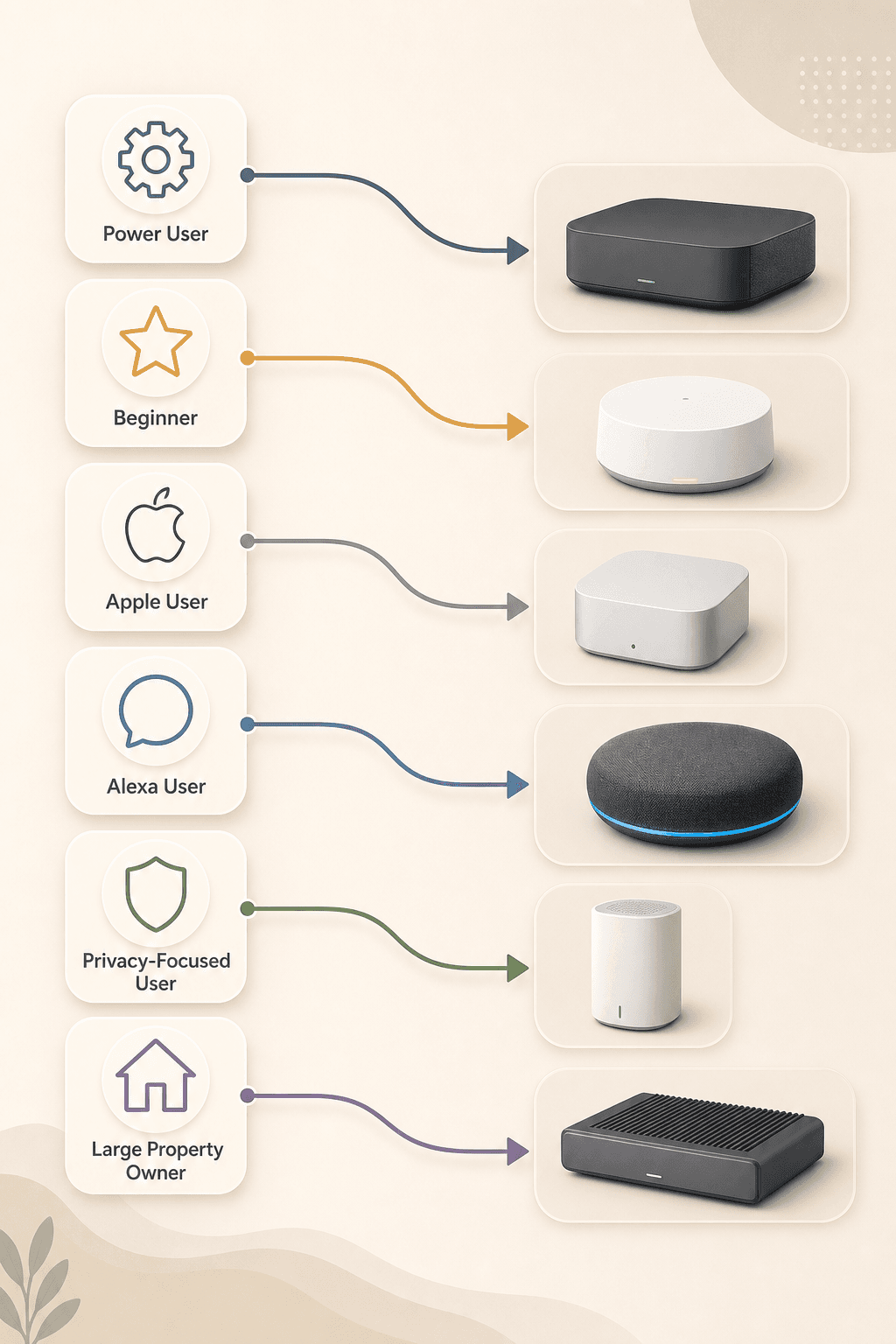
The right controller depends on three things: the devices you already own, your tolerance for setup complexity, and whether you want your smart home to work when the internet is down. The table below maps each user profile to the best controller choice, along with the single most important trade-off to consider.
| Your Profile | Best Controller | Key Trade-Off |
|---|---|---|
| Privacy-focused power user with mixed-brand devices | Home Assistant Green | Steep learning curve; requires USB dongles for Zigbee/Z-Wave |
| Multi-protocol household with legacy IR/433 MHz devices | Homey Pro | Highest price ($349); some features require subscription |
| Large property owner with Z-Wave locks and sensors | Hubitat C-8 Pro | No Thread or Matter support — limited future-proofing |
| Samsung phone user who wants the simplest possible setup | SmartThings Station | Cloud-hybrid; no Z-Wave; some automations fail during outages |
| Apple household with iPhones and iPads | Apple HomePod Mini | No Zigbee or Z-Wave — only works with Thread/Matter devices |
| Existing Alexa user with 140,000+ device options | Amazon Echo Hub | All voice commands are cloud-dependent after March 2025 change |
| Aqara ecosystem builder with IR-controlled AV gear | Aqara Hub M3 | Zigbee is Aqara-only — cannot mix third-party Zigbee devices |
If you are still unsure, consider this: the controller you choose today will shape your device buying decisions for the next several years. The Smart Home Hub Ecosystem Lock-In 2026 article explains why platform commitment matters more than hardware specs when you are planning a multi-year build. And for a deeper look at how Matter is evolving across platforms, the Matter in 2026 status review covers which platforms support which Matter versions and where the standard still falls short.
Updates & Corrections
Protocol specifications and platform features change rapidly — especially with Matter version evolution. Report version changes, certification count updates, or platform policy changes that have occurred since the last editorial review.
Comments
Join the discussion with an anonymous comment.