The Interoperability Problem That Matter Solves
For years, building a smart home security system meant making a series of uncomfortable compromises. Want a Ring doorbell for its package detection? You are locked into the Ring ecosystem for cameras and alarms. Prefer a Yale smart lock? It might work with Alexa but not with your Abode hub. The result was a desk full of hub dongles, a phone screen crowded with apps, and automations that broke every time a firmware update changed a device's pairing behavior.
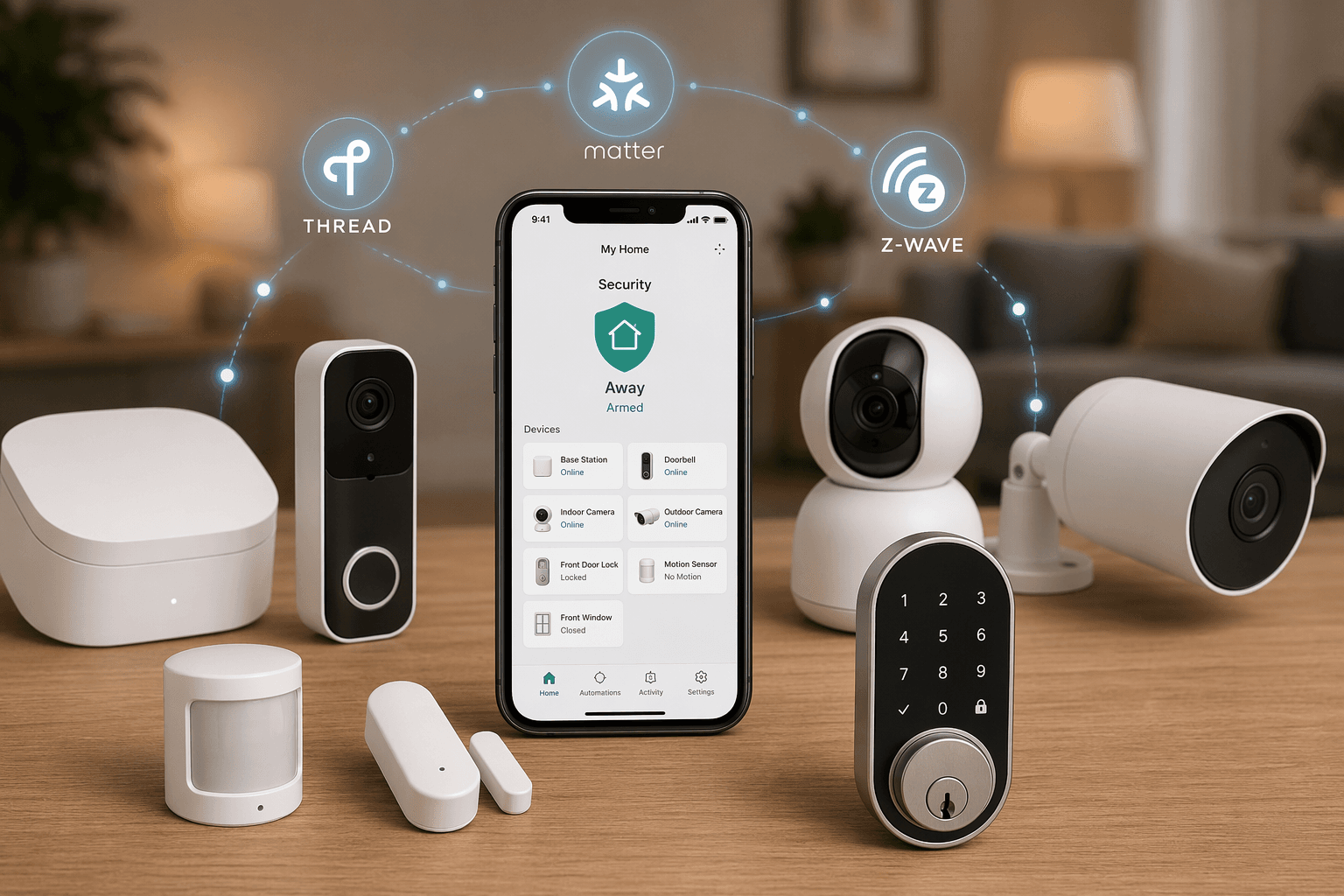
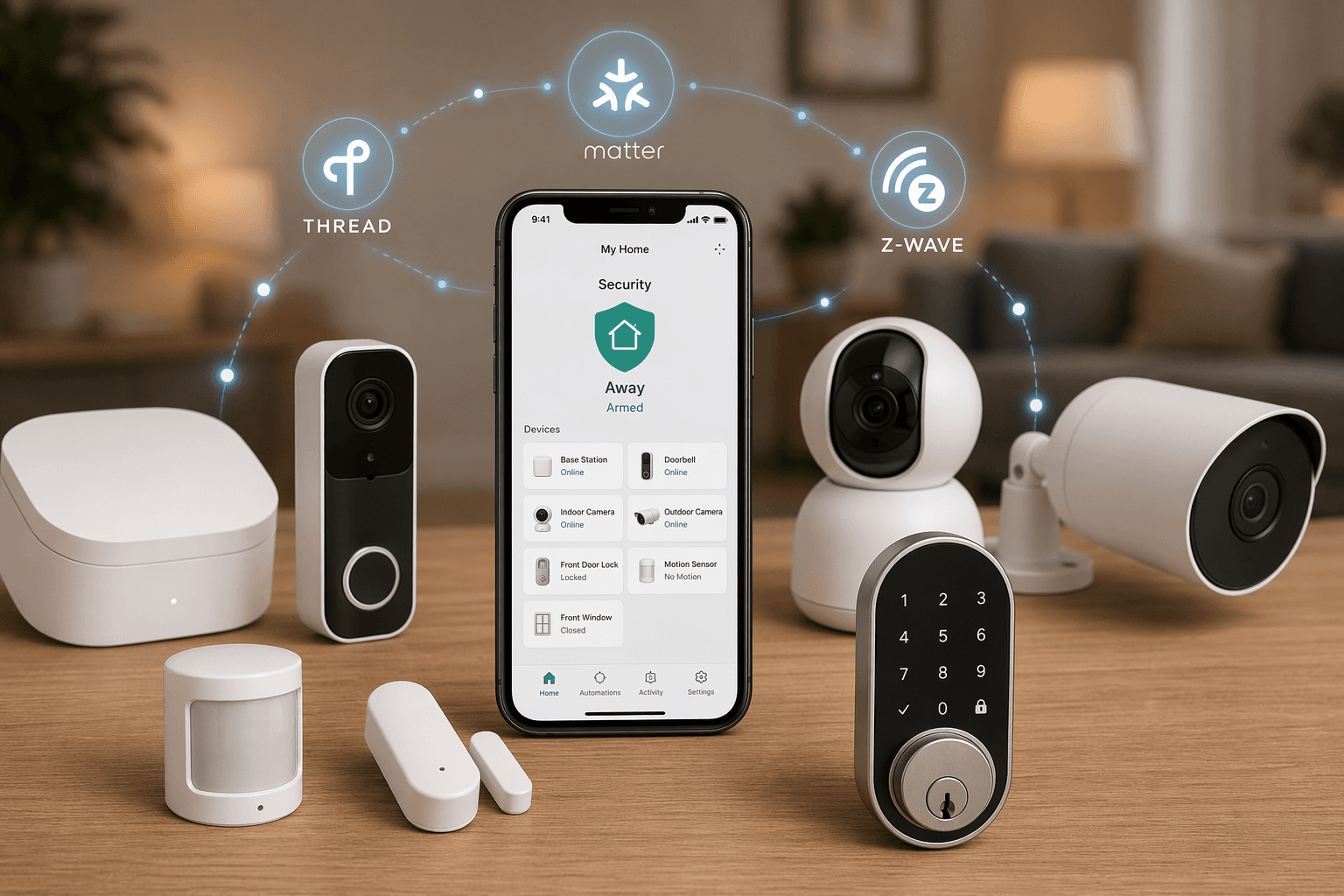
Matter 2.3.0, the latest iteration of the universal smart home standard backed by Apple, Google, Amazon, and Samsung, directly targets this fragmentation. Instead of requiring each device to speak a proprietary language, Matter defines a single application-layer protocol that runs over Thread, Wi-Fi, and Ethernet. For a security system, this means a single onboarding flow, a shared encryption layer, and multi-radio routing that lets a door lock talk to a motion sensor even if they were made by different manufacturers.
The practical effect is a shift from ecosystem-first to device-first purchasing. You no longer need to ask "Does this camera work with Alexa?" before buying. If it carries the Matter badge, the answer is yes — and it will also work with Google Home, Apple HomeKit, and Samsung SmartThings out of the box. For security buyers, that changes the decision calculus fundamentally.
Where Matter and Thread Stand in 2026
The adoption numbers confirm that 2026 is the inflection point. According to Security.org, over 3,300 Matter-certified products are now available on the market. That is more than triple the count from early 2024, and the certification pipeline shows no sign of slowing. The standard has moved from early-adopter curiosity to a legitimate purchasing criterion.
The protocol-level data from Mordor Intelligence (last updated January 15, 2026) tells a more nuanced story. Wi-Fi still dominates the smart home security market, accounting for 40.90% of protocol revenue in 2025. But Thread-Matter devices are the fastest-growing segment, projected to expand at a compound annual growth rate (CAGR) of 13.74% through 2031. That growth rate reflects both new product launches and the retrofitting of existing product lines with Thread radios.
- 3,300+ Matter-certified products currently available (Security.org)
- Thread-Matter devices growing at 13.74% CAGR through 2031 (Mordor Intelligence)
- Wi-Fi still holds 40.9% of protocol revenue share (Mordor Intelligence)
- Smart home security market valued at $41.95 billion in 2026 (Mordor Intelligence)
For buyers, the takeaway is clear: Matter and Thread are not speculative future standards. They are here, they are growing, and they are increasingly the deciding factor between a system that works seamlessly with your existing devices and one that requires a separate hub and app for every component.
Security Systems Leading on Interoperability
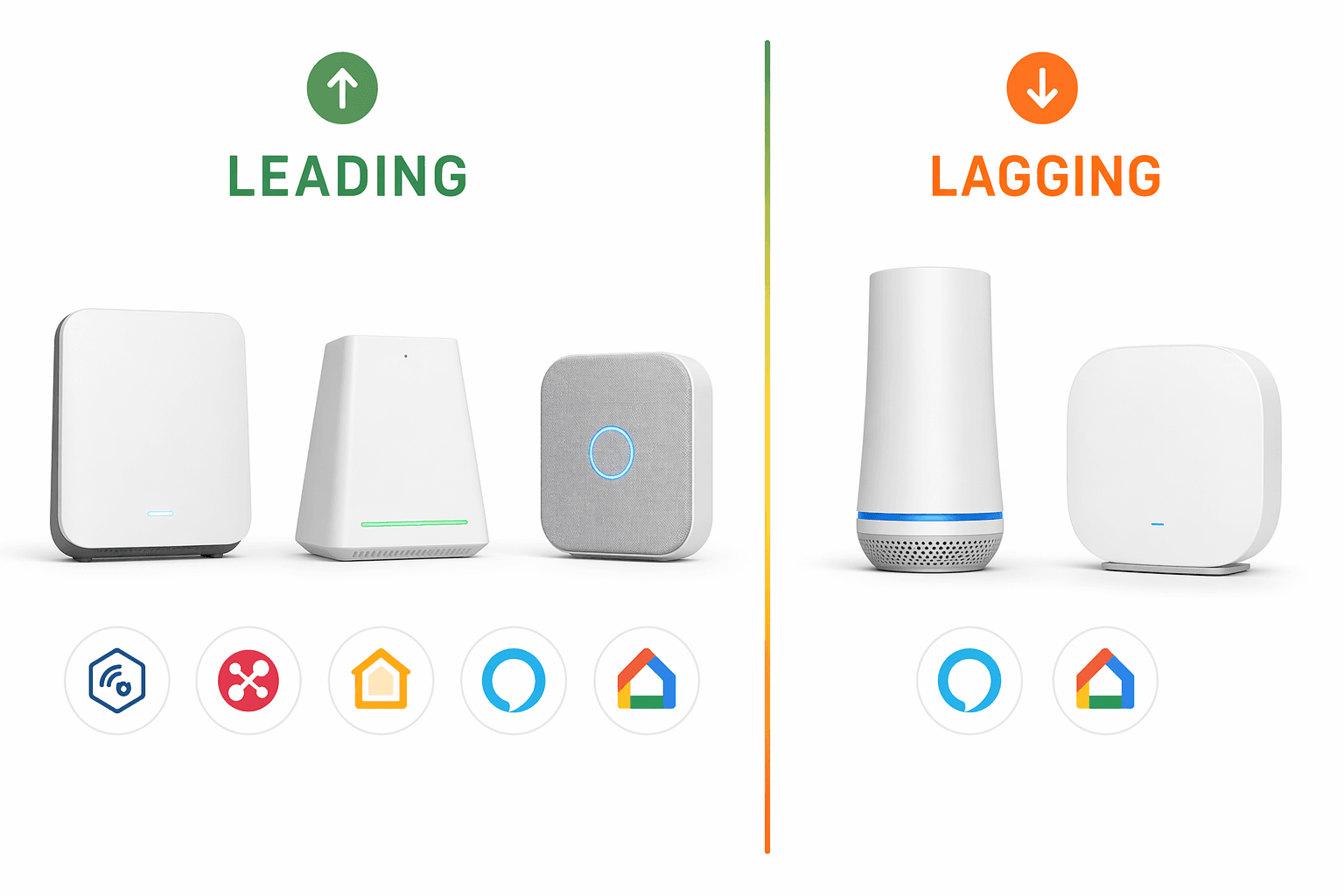
Not all security brands have embraced multi-protocol flexibility equally. A handful of systems stand out for supporting multiple ecosystems and connectivity standards, giving users genuine freedom to mix and match devices.
| Brand | Protocols Supported | Ecosystem Compatibility | Hub Requirement |
|---|---|---|---|
| Abode | Z-Wave, Zigbee, Wi-Fi | HomeKit (native), Alexa, Google, SmartThings | Hub included; no proprietary lock-in |
| Vivint | Z-Wave, Wi-Fi | Alexa, Google, Z-Wave devices | Proprietary hub; Z-Wave expandable |
| Ring | Z-Wave, Zigbee, Wi-Fi | Alexa (deep), Google (limited) | Ring Alarm hub; select third-party sensors |
Abode is the standout in this group. It is one of the few systems on the market with full native Apple HomeKit support, meaning all data processing happens locally on the hub rather than being sent to remote servers. Security.org notes that this makes Abode the most privacy-forward option among major systems. Combined with native Z-Wave and Zigbee radios, Abode users can pair sensors from Aeotec, locks from Schlage, and lights from Philips Hue without any additional bridges.
Vivint takes a different approach. Its proprietary hub uses Z-Wave as its primary expansion protocol, which means any Z-Wave-certified device — locks, thermostats, water sensors — can be added to the system. The trade-off is that Vivint's professional installation and monitoring model means less DIY flexibility, but for homeowners who want a managed system with room to grow, the Z-Wave backbone provides a clear upgrade path.
Ring, the dominant brand identified by 43% of users in SafeHome.org's 2026 survey of 2,435 U.S. adults, supports both Z-Wave and Zigbee through its Alarm hub. This allows Ring users to add third-party sensors and locks, though deep integration is strongest within the Alexa ecosystem. For households already invested in Amazon's platform, Ring offers the most seamless multi-device experience.
Systems That Still Lag Behind
On the other side of the spectrum are systems that prioritize simplicity and ease of use over expandability. These are not bad products — they serve a real market of users who want a turnkey solution. But for the buyer who values future flexibility, the limitations are worth understanding upfront.
| Brand | Third-Party Device Support | Ecosystem Compatibility | Key Limitation |
|---|---|---|---|
| SimpliSafe | Very limited (proprietary sensors only) | Alexa, Google (voice control only) | Cannot add third-party locks, cameras, or sensors |
| Cove | None (proprietary hardware only) | Alexa, Google (voice control only) | No Z-Wave, Zigbee, or Matter support |
SimpliSafe, identified by 5% of SafeHome.org survey respondents, offers a clean, no-contract monitoring experience that appeals to budget-conscious buyers. But its sensors and devices use a proprietary radio protocol that cannot communicate with third-party hardware. You cannot add a Yale lock to a SimpliSafe system or pair its motion sensors with a SmartThings automation. The trade-off is reliability — SimpliSafe's closed ecosystem means fewer compatibility headaches, but it also means you are locked into their hardware catalog for the life of the system.
Cove takes an even more restrictive approach. Its hardware is entirely proprietary, and the only smart home integrations are voice control through Alexa and Google Assistant. There is no Z-Wave, no Zigbee, and no Matter support on the horizon. For a user who just wants a monitored alarm system with app control, Cove works fine. For anyone who envisions adding a smart lock, a video doorbell, or a thermostat down the line, it is a dead end.
What This Means for Buyers: Future-Proofing Your Setup
The SafeHome.org survey reveals that ease of use (50%) and monthly cost (46%) are the top factors driving security system purchases, while integration with smart devices ranks at just 14%. That gap represents an opportunity — and a risk. Buyers who prioritize short-term simplicity over protocol flexibility may find themselves locked into a system that cannot grow with their smart home.
Here is how to evaluate a security system through the lens of future-proofing:
- Check for Matter certification. If a system's hub or sensors carry the Matter badge, they will work with any Matter-compatible controller — regardless of brand. This is the strongest future-proofing signal available.
- Look for native Z-Wave or Zigbee support. Even without Matter, a hub that speaks Z-Wave or Zigbee gives you access to hundreds of third-party sensors, locks, and lights. Abode and Ring both offer this; SimpliSafe and Cove do not.
- Verify ecosystem compatibility beyond voice control. Many systems claim "Works with Alexa" but only support voice commands, not full automation triggers. Native HomeKit support (as with Abode) or deep SmartThings integration is a stronger signal.
- Consider the hub's radio stack. A hub with Thread, Wi-Fi, and Ethernet gives you the most flexibility for future Matter devices. Dual-stack Wi-Fi options are particularly important given early Matter network instability (covered below).
The DIY installation trend reinforces this advice. SafeHome.org reports that for the first time, self-installation (49%) has overtaken professional installation (42%) among alarm system users. DIY buyers are more likely to add devices incrementally over time, making protocol flexibility a critical consideration from day one.
The Catch: Early Matter Network Instability
No technology transition is seamless, and Matter's early rollout has had its share of growing pains. Mordor Intelligence identifies IPv6 multicast instability in early Matter 1.4 networks as a known restraint. The issue arises when consumer-grade gateways and border routers mishandle multicast forwarding, causing devices to lose contact with the network. The result can be orphaned sensors — a motion detector that stops reporting, a door lock that does not receive the "unlock" command — even though the hub itself appears online.
Manufacturers are responding in two ways. First, firmware updates are actively resolving the multicast handling issues; most major hubs have received at least one stability patch since Matter 1.4's release. Second, many brands hedge by shipping dual-stack Wi-Fi options alongside Thread radios. If the Thread connection drops, the device falls back to Wi-Fi, maintaining basic functionality until the Thread mesh stabilizes.
For buyers, the practical implication is not to avoid Matter — it is to choose a hub with a robust radio stack. A hub that supports both Thread and Wi-Fi (and ideally Z-Wave or Zigbee as well) gives you fallback paths if the Matter mesh has a bad day. Single-radio Matter devices that rely exclusively on Thread are the ones most vulnerable to early-network instability.
The Bottom Line: Interoperability Is Now a Buying Criterion
In 2026, the smart home security market is large enough — $41.95 billion per Mordor Intelligence — and the Matter ecosystem is mature enough — 3,300+ certified products per Security.org — that protocol support and ecosystem flexibility deserve a place alongside camera resolution, monitoring price, and ease of use in the buying decision.
The brands that lead on interoperability — Abode, Vivint, Ring — offer a clear path for buyers who want to mix brands, add devices over time, and avoid vendor lock-in. The brands that lag — SimpliSafe, Cove — serve a legitimate market for simplicity, but their closed ecosystems carry a long-term cost that is easy to overlook at purchase time.
- If you already own smart home devices from multiple ecosystems, prioritize a system with native Z-Wave, Zigbee, or Matter support. Abode is the strongest option for multi-ecosystem households.
- If you are starting from scratch and value simplicity over expandability, SimpliSafe or Cove may serve you well — but be prepared to replace the entire system if your needs change.
- If Matter is your priority, verify that the hub supports both Thread and Wi-Fi fallback. Single-radio Thread devices carry more risk in the current network stability landscape.
- If privacy is a concern, look for native HomeKit support (Abode) or systems that process data locally rather than sending it to cloud servers.
The era of the single-ecosystem smart home is ending. Matter and Thread are not just new protocols — they are the foundation of a device-first purchasing model where compatibility is assumed rather than negotiated. For security system buyers in 2026, the smartest investment is not the system with the best camera or the lowest monthly fee. It is the system that will still talk to your devices five years from now.
Policy Updates & Reader Notes
Privacy policies, monitoring plan prices, and security disclosures change frequently. Report new data retention terms, updated plan pricing, or new vulnerability disclosures below. For formal editorial corrections, use the contact page.
Comments
Join the discussion with an anonymous comment.