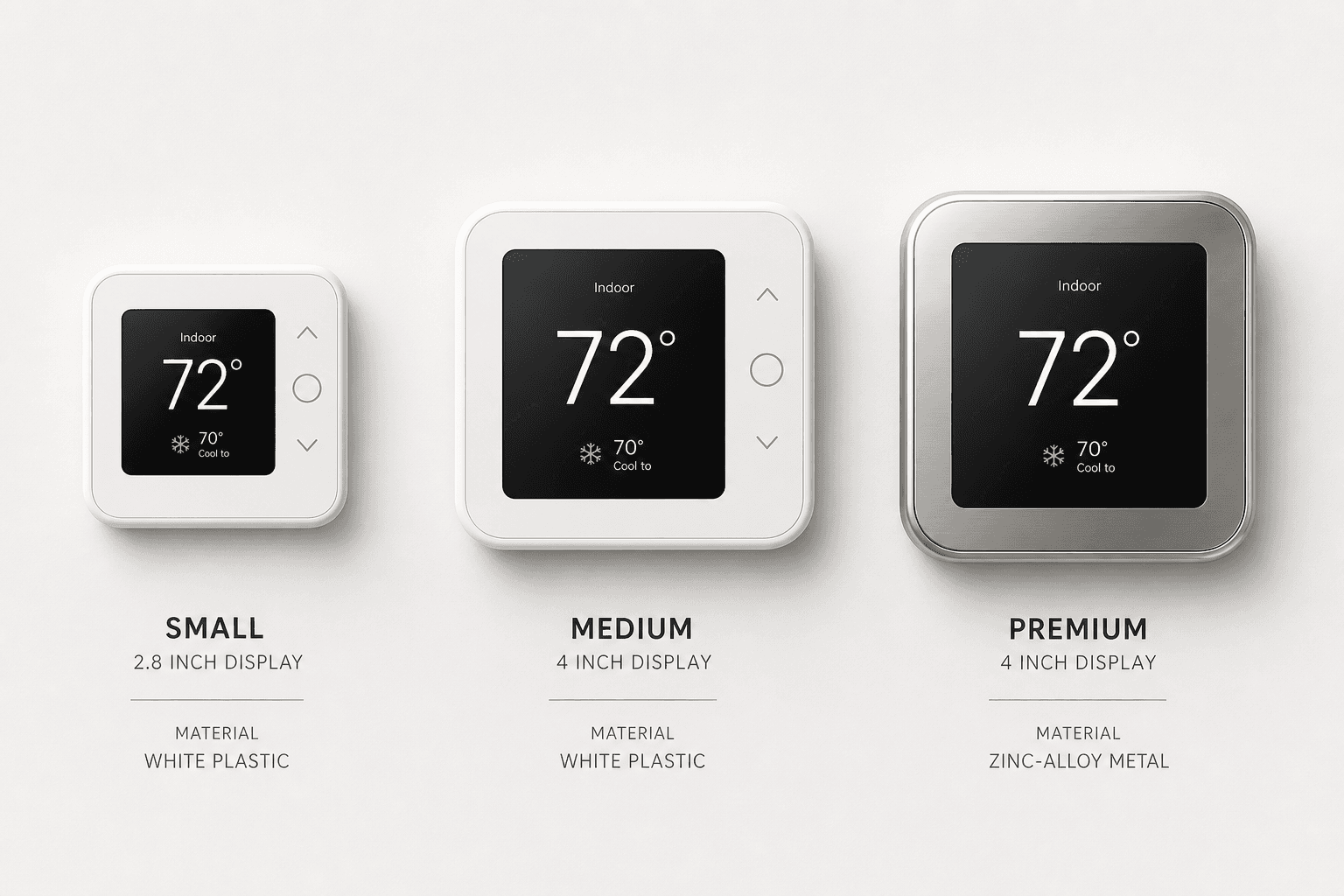
Ecobee currently sells three thermostat models under its own brand: the Smart Thermostat Premium ($259.99), the Smart Thermostat Enhanced ($199.99), and the Smart Thermostat Essential ($139.99). All three connect to Wi-Fi, work with Alexa, Google Assistant, and Apple HomeKit, and carry a 3-year warranty. But the price spread — $120 from top to bottom — raises an obvious question: what exactly are you paying for at each tier, and where does the law of diminishing returns kick in?
This guide walks through every meaningful difference between the three models — display size, body materials, built-in sensors, voice assistant support, included accessories, and HVAC compatibility — so you can pick the right one without spending extra on features that won't matter in your home.
Side-by-Side Spec Comparison: What Each Model Offers
The table below captures the key specifications for all three models. Use it as a quick reference to identify which features matter most to you before reading the detailed breakdowns.
| Feature | Premium ($259.99) | Enhanced ($199.99) | Essential ($139.99) |
|---|---|---|---|
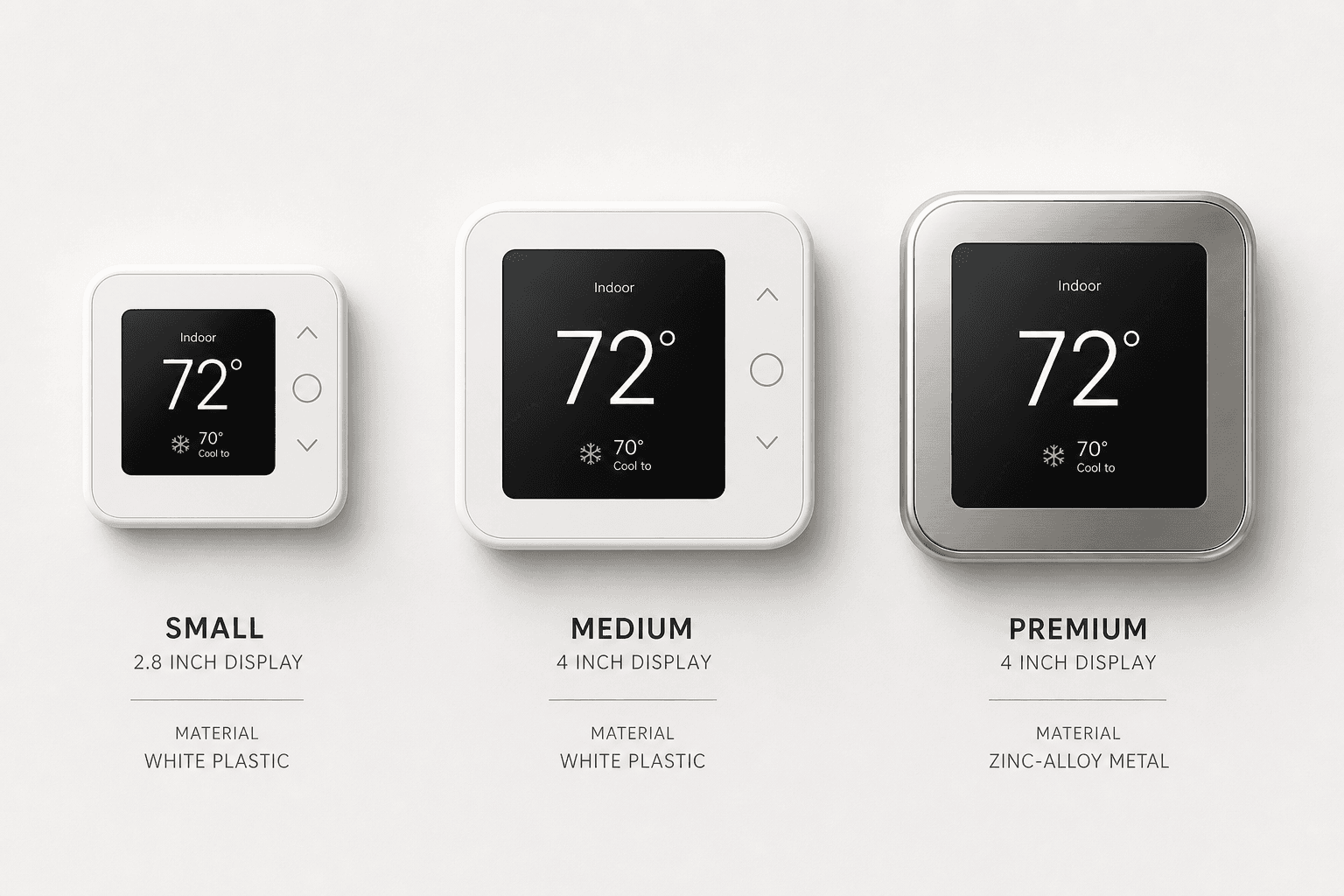
| Display size | 4-inch (540×540) | 4-inch (540×540) | 2.8-inch (240×320) |
| Body material | Zinc alloy / metal frame | Plastic | Plastic |
| Built-in voice assistant | Alexa or Siri (choose at setup) | None | None |
| Radar occupancy sensor | Yes | Yes | No |
| Air quality monitor | Yes (VOC, CO₂) | No | No |
| SmartSensor included | Yes (1 included) | No | No |
| ACC+ terminals (humidifier/dehumidifier/HRV/ERV) | Yes | No (1-wire accessory only) | No |
| PEK (Power Extender Kit) | Included in box | Included in box | Sold separately ($24.99) |
| HVAC compatibility | Conv 2H/2C, HP 2H/2C+2AUX | Conv 2H/2C, HP 2H/2C+2AUX | Conv 2H/1C or 1H/2C, HP 2H/1C |
| Max remote sensors | Up to 32 | Up to 32 | Up to 32 |
| Warranty | 3 years | 3 years | 3 years |
| Energy savings (claimed) | Up to 26% | Up to 26% | Up to 23% |
Ecobee Smart Thermostat Premium ($259.99): The Full-Featured Flagship
The Premium is Ecobee's most complete thermostat. It packs a 4-inch color LCD touchscreen (540×540 pixels) into a zinc-alloy body with a die-cast metal frame — a noticeably more substantial feel than the plastic-bodied Enhanced and Essential. Beyond the build quality, the Premium adds four capabilities that the other models lack entirely:
- Built-in voice assistant. You choose Alexa or Siri during setup. The thermostat has a speaker and microphone, so you can set temperatures, ask for weather, control other smart home devices, or stream music via Spotify and Bluetooth without needing a separate smart speaker nearby.
- Air quality monitor. The Premium continuously tracks volatile organic compounds (VOCs) and estimated CO₂ levels. When readings cross a threshold, the thermostat displays a warning and can trigger ventilation equipment if your system supports it.
- Included SmartSensor. One SmartSensor (temperature and occupancy) ships in the box. Additional sensors cost about $35 each and can be added up to a total of 32.
- ACC+ terminals. The Premium is the only Ecobee model with ACC+/- screw terminals for controlling whole-home humidifiers, dehumidifiers, HRVs, and ERVs. If your HVAC system includes any of these accessories, the Premium is your only Ecobee option.
The Premium also includes the radar occupancy sensor found in the Enhanced — it detects motion in the room and adjusts the display brightness and scheduling accordingly. The claimed energy savings are up to 26% on annual heating and cooling costs, which Ecobee's internal April 2021 analysis translates to roughly $284 per year based on a $1,091 average annual energy bill.
Who should buy the Premium? If you want a voice assistant on the thermostat itself (and don't already have an Echo or HomePod in the same room), if you need air quality monitoring, or if your HVAC system includes whole-home humidification or ventilation equipment that requires ACC+ terminals, the Premium is the right choice. For everyone else, the question is whether those features justify the $60 premium over the Enhanced.
For detailed setup instructions covering HomeKit, Alexa, Google Assistant, and SmartThings, see our Ecobee SmartThermostat Premium setup guide.
Ecobee Smart Thermostat Enhanced ($199.99): The Smart Middle Ground
The Enhanced shares the Premium's most practically important hardware: the 4-inch display and the radar occupancy sensor. It also claims the same 26% energy savings. What it omits are the Premium's premium touches — the zinc-alloy body (it uses plastic), the built-in voice assistant, the air quality monitor, and the included SmartSensor.
For most households, those omissions are easy to live with. If you already own an Amazon Echo, Google Nest Hub, or Apple HomePod, the thermostat's built-in speaker is redundant — you can control the Enhanced through your existing smart speaker via Alexa, Google Assistant, or Siri. The air quality monitor is a nice-to-have but not essential for basic comfort and savings. And the SmartSensor can be purchased separately ($35) if you later decide you need remote room monitoring.
- Same radar occupancy sensor as the Premium — the thermostat knows when you are home and adjusts the display and schedule accordingly.
- Same 4-inch display — easier to read from across the room than the Essential's 2.8-inch screen.
- Same 26% savings claim and ENERGY STAR certification.
- Supports one-wire accessories (e.g., a basic humidifier) but lacks the Premium's ACC+ terminals for whole-home systems.
- PEK included in the box — no extra purchase needed if your system lacks a C-wire.
The Enhanced is the best value in Ecobee's lineup for the majority of buyers. It gives you the same core smart thermostat experience — large display, occupancy-based scheduling, multi-platform compatibility, and maximum energy savings — without the cost of features you may never use. The $60 savings over the Premium can be put toward an extra SmartSensor or two, which arguably delivers more comfort value than a voice assistant on the wall.
Ecobee Smart Thermostat Essential ($139.99): Budget-Friendly Basics
The Essential is Ecobee's entry-level model, and the cuts are more significant than the price suggests. The display drops to 2.8 inches (240×320 pixels), which is noticeably smaller and lower-resolution than the 4-inch screens on the Premium and Enhanced. There is no radar occupancy sensor — the Essential uses basic temperature and humidity sensors only, so it cannot detect whether someone is in the room to adjust the display or schedule.
Other omissions: no built-in voice assistant, no air quality monitor, no SmartSensor included, and the Power Extender Kit (PEK) is sold separately for $24.99. The HVAC compatibility is also more limited — the Essential supports conventional systems up to 2H/1C or 1H/2C and heat pumps up to 2H/1C. It cannot handle two-stage heating and cooling simultaneously, and it lacks any accessory terminals.
On the positive side, the Essential still saves up to 23% on heating and cooling (Ecobee's estimate: up to $250 per year), works with Alexa, Google Assistant, and Apple HomeKit, and supports up to 32 remote SmartSensors if you buy them separately. It also includes Wi-Fi 6 (2.4 GHz) and Bluetooth BLE 5.4, which is actually a newer wireless chipset than the other two models.
The Essential makes sense for budget-focused buyers with simple single-stage HVAC systems who primarily want basic scheduling and energy savings without spending $200+. It is also a reasonable choice for rental properties or secondary homes where the thermostat does not need to be a smart home hub.
Energy Savings: 26% vs. 23% — What the Numbers Really Mean
Ecobee claims the Premium and Enhanced save up to 26% on annual heating and cooling costs, while the Essential saves up to 23%. These figures come from the same internal analysis (April 2021) and are based on a $1,091 average annual energy bill across North America. The dollar equivalents work out to roughly $284 per year for the Premium and Enhanced, and $250 per year for the Essential.
The 3-percentage-point gap between the Premium/Enhanced and the Essential is almost certainly driven by the Essential's lack of a radar occupancy sensor. Without occupancy detection, the thermostat relies entirely on its schedule and the optional remote sensors to determine when to switch to an energy-saving mode. The radar sensor in the Premium and Enhanced can detect occupancy in the thermostat's immediate area and trigger eco+ modes more responsively.
| Model | Claimed Savings | Estimated Annual Savings (Ecobee) | ENERGY STAR Average |
|---|---|---|---|
| Premium | Up to 26% | ~$284 | ~$50 |
| Enhanced | Up to 26% | ~$284 | ~$50 |
| Essential | Up to 23% | ~$250 | ~$50 |
For many buyers, the savings difference between models is not the deciding factor — the payback period for any of these thermostats is relatively short. Even at the conservative $50/year ENERGY STAR figure, the Essential pays for itself in under three years. At Ecobee's upper-bound estimates, the Premium could pay for itself in under a year. The more important question is which features you need day-to-day.
If you are interested in utility rebates that could reduce the upfront cost of any Ecobee model, see our guide to Smart Thermostat Energy Savings and ENERGY STAR Rebates in 2026.
Upgrade Path and Compatibility Considerations
Before making a final decision, consider these practical upgrade and compatibility factors:
- SmartSensors are add-on for all three models. The Premium includes one in the box; the Enhanced and Essential do not. All three support up to 32 SmartSensors (temperature and occupancy), so you can expand coverage later regardless of which model you buy. A single SmartSensor costs about $35.
- ACC+ terminals are Premium-only. If you have or plan to install a whole-home humidifier, dehumidifier, HRV, or ERV, the Enhanced and Essential cannot control them. The Enhanced supports one-wire accessories (e.g., a basic humidifier connected via a single ACC wire), but the Premium's ACC+/- terminals are required for two-wire whole-home systems.
- No Matter support on any model. As of mid-2026, none of Ecobee's thermostats support the Matter smart home standard. This means they cannot be controlled natively through Matter-compatible hubs or platforms without going through Ecobee's cloud. If long-term ecosystem flexibility is a priority, this is a notable limitation to consider.
- PEK availability. The Premium and Enhanced include the Power Extender Kit in the box, which is needed if your existing thermostat wiring lacks a C-wire. The Essential requires a separate $24.99 purchase for the PEK, which effectively raises its entry price to $164.98.
- HVAC system compatibility. The Premium and Enhanced support conventional 2H/2C and heat pumps up to 2H/2C+2AUX. The Essential supports conventional 2H/1C or 1H/2C and heat pumps up to 2H/1C. If you have a multi-stage system, verify compatibility before buying the Essential.
Verdict: Which Ecobee Model Should You Buy in 2026?
The right Ecobee thermostat depends on your HVAC system, your existing smart home setup, and whether the Premium-specific features matter to you. The table below summarizes the recommendation for each common scenario.
| Buy this model... | If you... |
|---|---|
| Premium ($259.99) | Want a voice assistant on the thermostat itself (no separate smart speaker needed), need air quality monitoring, or have whole-home humidification/ventilation equipment that requires ACC+ terminals. |
| Enhanced ($199.99) | Already own a smart speaker (Echo, Nest Hub, HomePod), want the large display and radar occupancy sensor, and don't need air quality monitoring or whole-home accessory control. Best value for most households. |
| Essential ($139.99) | Have a simple single-stage HVAC system, are on a tight budget, and primarily want basic scheduling and energy savings. Factor in the $24.99 PEK cost if your wiring lacks a C-wire. |
For most buyers, the Enhanced hits the sweet spot. It delivers the same energy savings, the same large display, and the same radar occupancy sensor as the Premium — the features that actually drive comfort and efficiency — for $60 less. The Premium is worth the upgrade only if you specifically need the built-in voice assistant, air quality monitoring, or ACC+ terminals. The Essential is a solid budget pick for simple systems, but its smaller display and lack of occupancy sensing make it a noticeable step down in day-to-day usability.
Discussion
Share your experience with the compared products, flag outdated pricing or specs, or ask clarifying questions about the comparison verdict.
Comments
Join the discussion with an anonymous comment.