
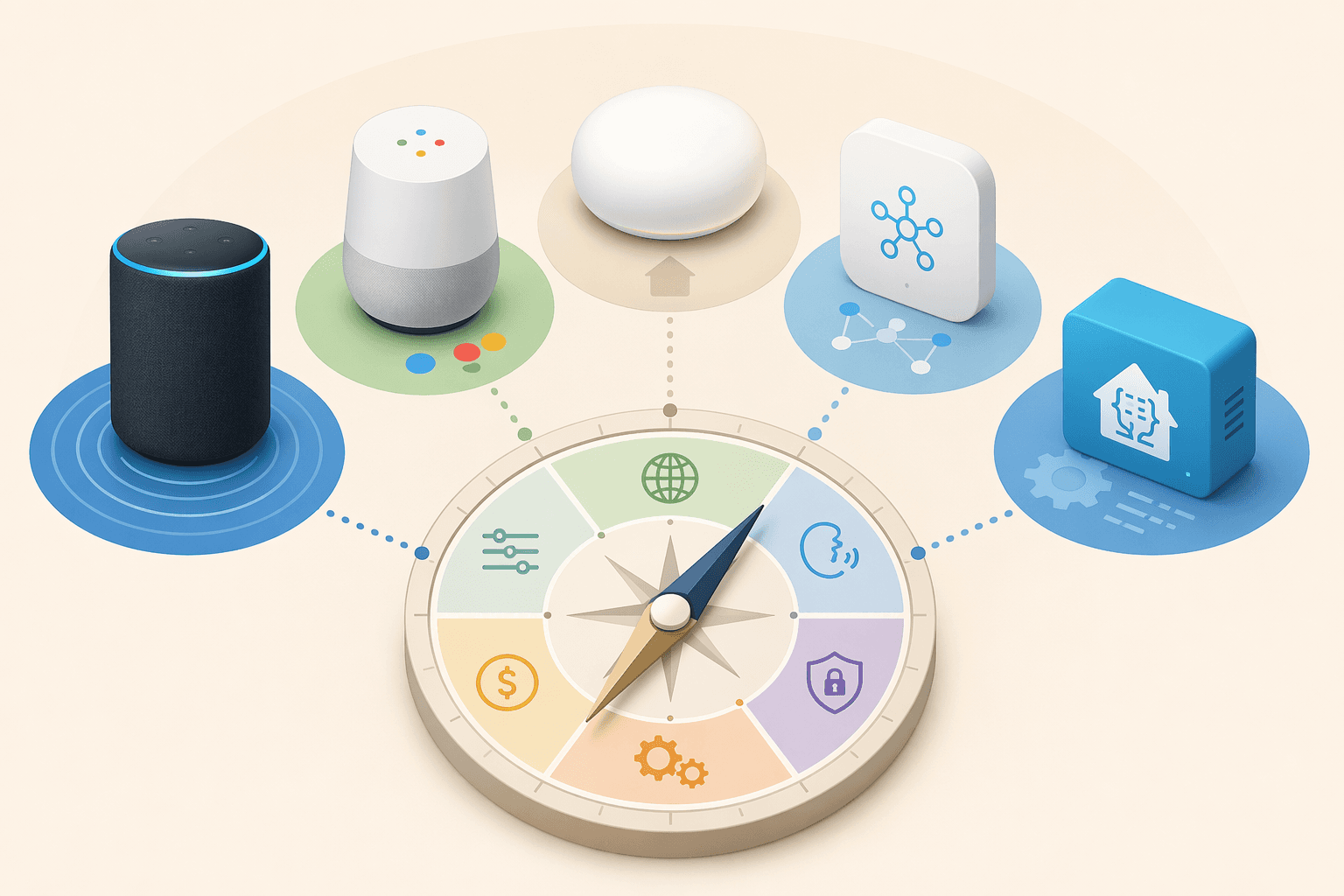
The uneasy question behind most smart home platforms in 2026 is not “Which one is best?” It is “If I choose this one now, will I be replacing bulbs, bridges, locks, or cameras in two years because I picked the wrong camp?”
The short answer is more forgiving than it used to be. Alexa still has the broadest compatibility story, with 140,000+ compatible devices reported in platform testing, but that no longer settles the decision by itself.[1] Matter has made the choice less permanent, and the five ecosystems that matter most now serve different priorities: Alexa for maximum device breadth, Google Home for voice-first households, Apple HomeKit for privacy-centered Apple homes, Samsung SmartThings for hub and radio flexibility, and Home Assistant for deep automation and local-control ambition.
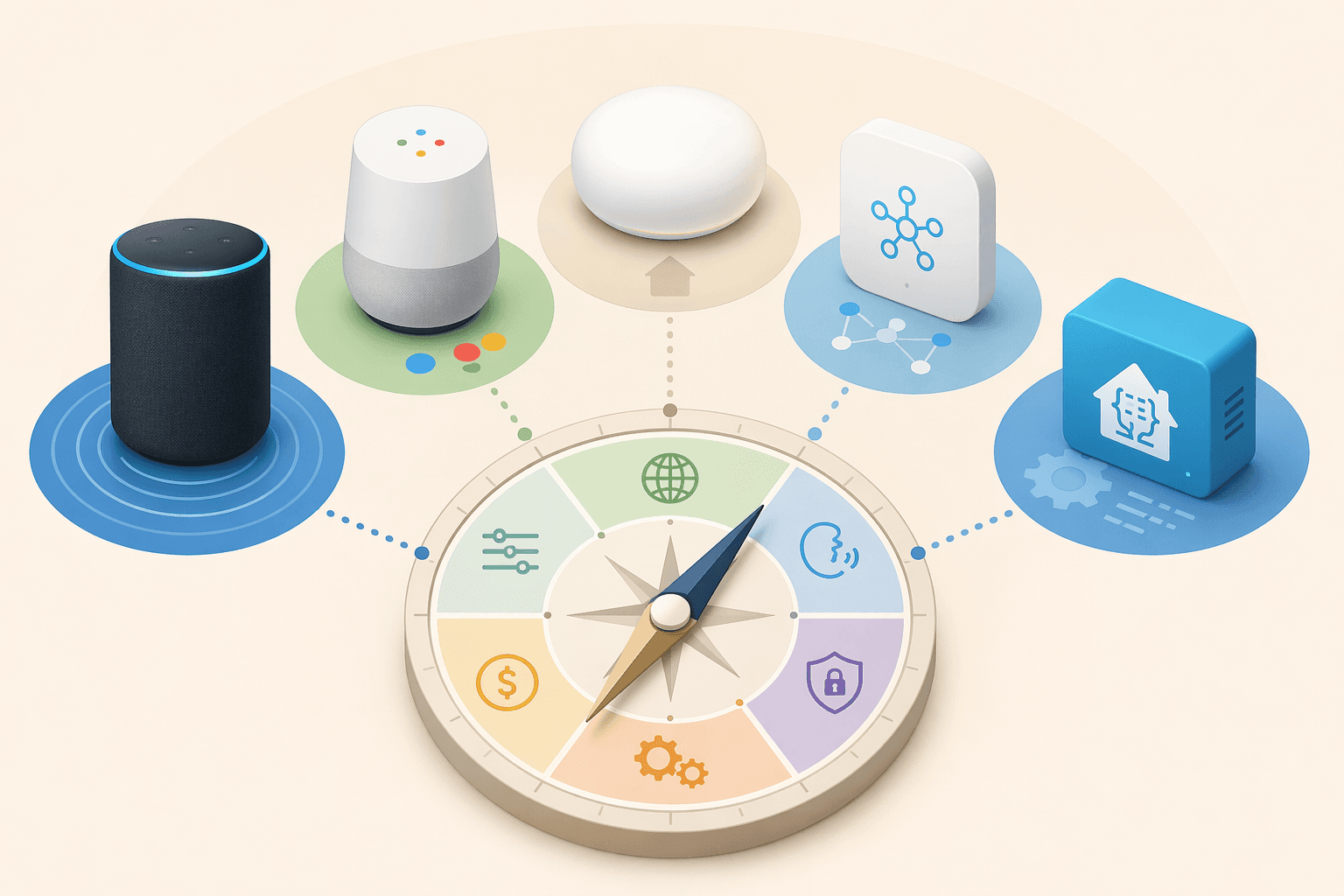
Start With The Priority You Actually Care About
A household with two smart bulbs, a video doorbell, and a thermostat does not need the same answer as someone building a local-only system with custom automations. Treating those buyers as if they are shopping for the same platform is how people end up with three apps for lights, a bridge they did not know they needed, and a lock that only exposes half its features outside the manufacturer’s app.
| Your strongest priority | Best-fit platform to consider first | Why it fits |
|---|---|---|
| The widest device choice | Amazon Alexa | It has the largest reported compatible-device universe, which is useful when buying from many brands. |
| The best voice-first experience | Google Home | It pairs broad device support with the strongest reported voice accuracy among the compared platforms. |
| Privacy inside an Apple household | Apple HomeKit | Its security model emphasizes end-to-end encryption and local processing, but device choice is narrower. |
| Mixed protocols and hub flexibility | Samsung SmartThings | Its hub approach can handle Matter, Thread, Wi-Fi, Zigbee, and, depending on hardware generation, Z-Wave. |
| Advanced automation and local control | Home Assistant | It offers the deepest integration and automation ceiling, with more setup responsibility. |
That table is the more useful starting point than a brand-loyalty quiz. Most regret in small smart homes does not come from choosing a “bad” ecosystem. It comes from choosing a platform for a feature you do not actually use, then discovering the feature you do care about lives behind another hub, another app, or a vendor-specific integration.
How The Major Smart Home Platforms Compare In 2026
Amazon Alexa: Choose It For Device Breadth
Alexa remains the easiest recommendation for buyers who want to walk into a store, buy a smart plug, bulb, fan controller, or inexpensive accessory, and have a good chance that it will connect. The 140,000+ compatible-device figure is still the headline advantage, and for mixed-brand homes that number has practical value.[1]
Breadth matters most when you are not trying to curate every device. If you rent, buy discounted accessories, or already own a scattered mix of gadgets, Alexa gives you the least fussy path to basic control. Lights, plugs, thermostats, robot vacuums, switches, and many third-party gadgets are more likely to advertise Alexa support than support for a narrower ecosystem.
The compromise is that compatibility is not the same as a consistent experience. A device can “work with Alexa” and still keep its best settings, history, calibration tools, or camera features inside the manufacturer’s app. Alexa is strongest as a broad control layer, not as a guarantee that every feature from every device will appear in one clean place.
Google Home: Choose It If Voice Control Is The Front Door
Google Home is the better first stop for households where people actually speak to the system all day. Its compatible-device count is reported at 50,000+, and head-to-head testing cited a 93% voice accuracy result, the highest among the compared platforms.[1]
That matters in normal rooms, not lab demos. Voice control is unforgiving because one failed command at the wrong moment makes everyone in the house stop using it. A system that understands “turn off the kitchen lights,” “set the hall thermostat,” or “show the camera” reliably is easier to live with than one that technically supports more devices but makes people repeat themselves.
Google Home also makes sense when the household is already built around Android phones, Nest speakers, Chromecast, or Nest displays. A device like a Google Nest camera can feel more natural there than it does when pushed through a neutral control layer. The caution is the same one that applies to every camera-heavy smart home: camera features often remain more ecosystem-specific than lights, plugs, and switches.
Apple HomeKit: Choose It For Privacy, If You Accept The Smaller Catalog
HomeKit is not the platform to pick if your main goal is the biggest shelf of compatible gadgets. Its certified-device universe is reported at 1,000+, far below Alexa and Google Home.[1] That smaller catalog is real, and it can still affect locks, switches, cameras, and specialty sensors.
Its appeal is different. HomeKit earns attention because its security model emphasizes end-to-end encryption and local processing, with testing assigning it a 7.9/10 security score.[1] For an Apple household that wants a restrained, privacy-centered smart home, that can matter more than having ten versions of the same bargain plug.
There is also a practical 2026 hub detail buyers should not miss: Apple’s February 2026 architecture transition means an iPad is no longer eligible as a Home hub.[1] If your plan depends on remote access, automations, or reliable presence-based behavior, you should budget for a proper Home hub rather than assuming an old iPad will quietly do the job. For readers comparing the Apple-specific pieces, a deeper Apple HomeKit Platform Overview 2026 or Apple HomeKit Hub vs Bridge guide is worth reading before buying hardware.
Samsung SmartThings: Choose It For Mixed Protocols And Hub Decisions
SmartThings is often the right answer when the home already has devices that do not all speak the same language. Its hub model supports a mix of Zigbee, Z-Wave, Thread, Matter, and Wi-Fi, which matters when you are trying to preserve older sensors or switches instead of rebuilding the whole house around one new standard.[2]
The hub generation matters more than casual buyers expect. The Aeotec Smart Home Hub V3 versus V4 decision is a good example: V3 includes Z-Wave, while V4 drops it.[2] If you already own Z-Wave locks, switches, or sensors, that is not a footnote. It can decide whether your existing devices come with you or become another drawer of abandoned hardware. A Z-Wave Protocol Explainer or an Aeotec Smart Home Hub V3 vs V4 comparison is useful before buying the hub, not after the return window closes.
SmartThings is less tidy than a purely voice-first setup and less private-by-design than a local-only build, but it remains one of the better practical bridges between old and new smart home gear. That makes it especially relevant for homes that grew device by device instead of from a single plan.
Home Assistant: Choose It For Control, Not Convenience
Home Assistant is the platform to consider when the standard app-and-speaker model starts to feel too limiting. It supports 2,500+ integrations, and the open-source platform category is reported as growing at an 18.05% CAGR, the fastest-growing platform category in the cited market analysis.[2]
The draw is not just the integration count. It is the ability to build automations that look at multiple conditions, run locally, and avoid depending on a cloud service for every decision. A hallway motion sensor can behave differently by time of day, occupancy, light level, and alarm state. A thermostat routine can coordinate with window sensors. A wall button can trigger several devices across brands without waiting for one vendor to expose the exact shortcut you wanted.
That freedom has a cost. Home Assistant’s 2,500+ integrations include community-built integrations with varying quality and maintenance, so the number should not be read the same way as a certified-device catalog.[2] The $159 Home Assistant Green lowers the entry barrier, but it does not turn Home Assistant into the easiest platform for a household that simply wants a lock, thermostat, and lights to behave without weekend tuning.[2]
The Six Criteria That Actually Change The Choice
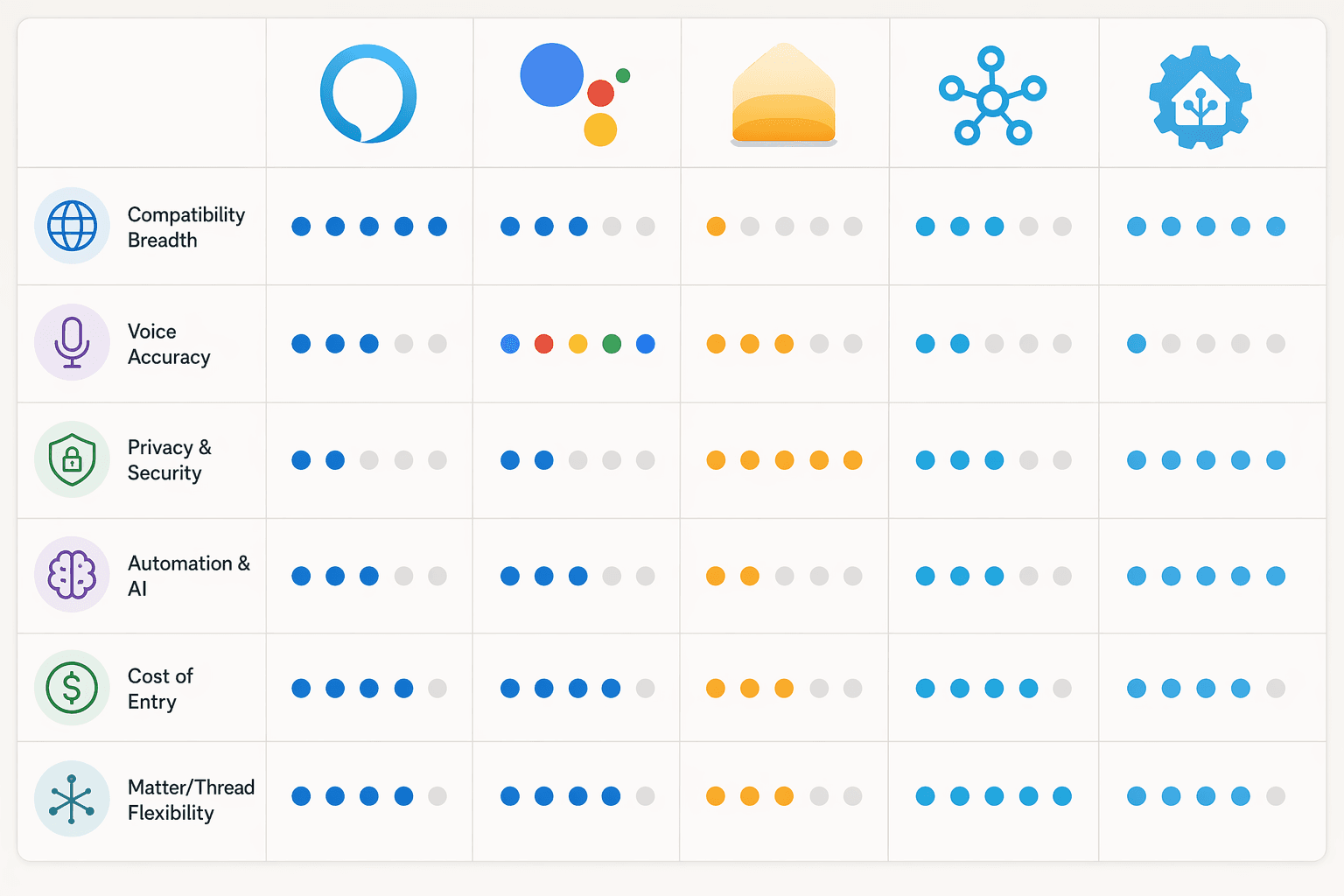
The platform comparison becomes clearer when the criteria stay separate. Device compatibility, voice accuracy, privacy, automation power, cost, and future flexibility are not interchangeable. A platform can be excellent on one and merely tolerable on another.
- Compatibility breadth: Alexa leads when the goal is the widest range of devices; Google Home is also broad; HomeKit is more selective; SmartThings depends partly on hub radios; Home Assistant is wide but uneven because integrations vary.
- Voice assistant accuracy: Google Home deserves the first look in voice-first households because of its reported 93% voice accuracy result; Alexa remains strong for common device commands; HomeKit works best inside Apple routines.
- Privacy and security model: HomeKit and Home Assistant are the cleaner choices for buyers who want more local processing or tighter privacy assumptions; Alexa and Google Home trade more heavily on cloud convenience.
- Automation and AI power: Home Assistant has the highest ceiling; SmartThings sits in the practical middle; Alexa, Google Home, and HomeKit cover common routines well but can become limiting for complex conditions.
- Cost of entry: Alexa and Google Home can start cheaply with a speaker and a few Wi-Fi devices; HomeKit may require a current Apple hub; SmartThings may require careful hub selection; Home Assistant Green lowers the hardware cost but not the learning curve.
- Matter and Thread flexibility: Matter-certified devices reduce the risk of choosing wrong, but they do not make every platform behave identically.
That last point is where 2026 feels different from the early Matter years. Matter no longer feels like a promise scribbled on a product roadmap. There are 850+ Matter-certified devices by mid-2026, and Thread plus Matter adoption is reported as the fastest-growing protocol segment at a 23.10% CAGR.[3][2]
Matter Reduces Lock-In, But It Does Not Erase Ecosystems
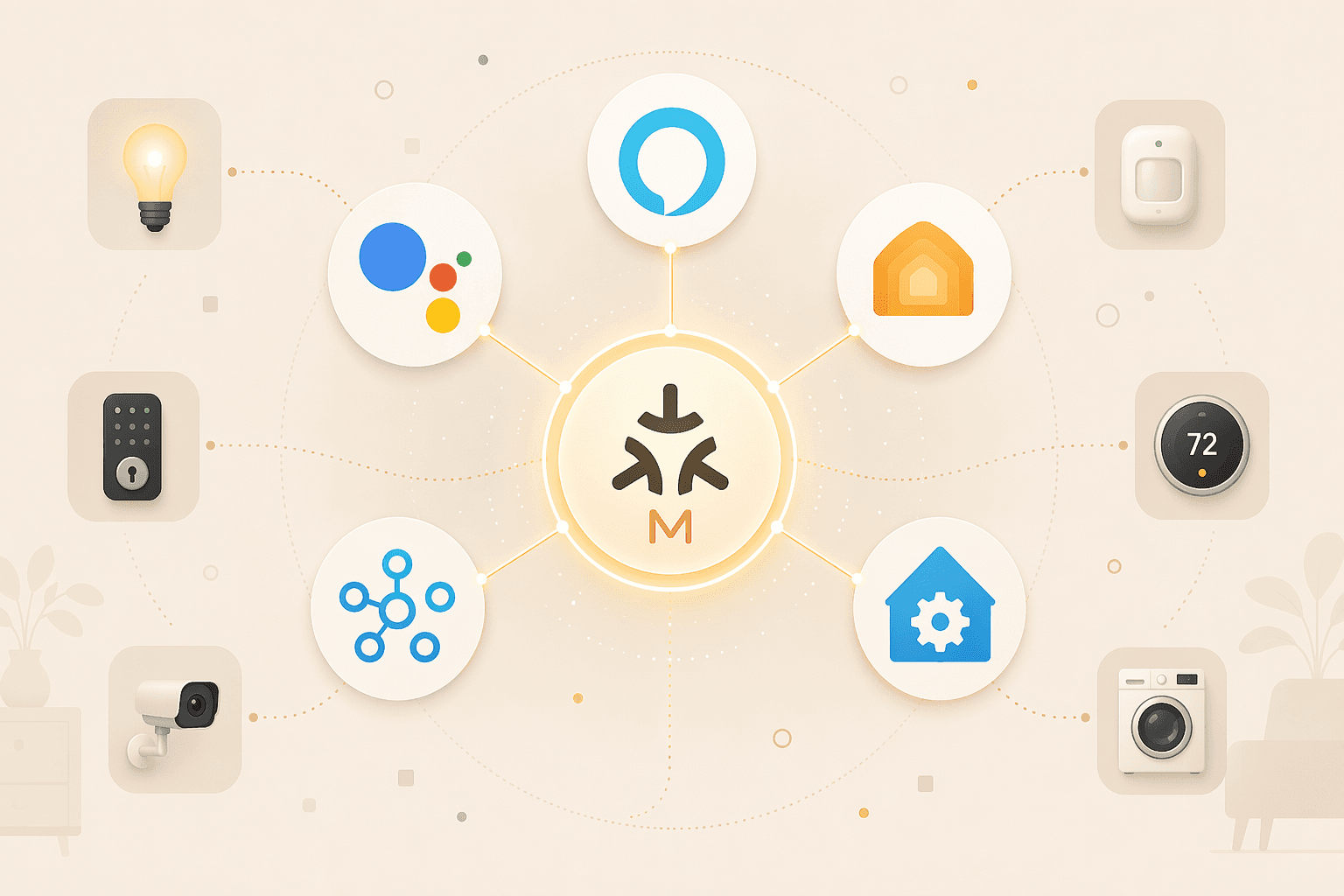
Matter is the reason buyers can be calmer about smart home platforms in 2026. A Matter-certified light, plug, lock, thermostat, sensor, or other supported device is more likely to move between Alexa, Google Home, HomeKit, SmartThings, and Home Assistant than the same purchase would have been in 2023. If you later change your main control app, a Matter device gives you a better chance of bringing the hardware with you.
The standard has also expanded. Matter 1.5, published in November 2025, added cameras, sensors, and energy management, while Matter 1.6, published in June 2026, extended into appliances and additional energy categories.[3] That expansion matters because the smart home is moving beyond bulbs and plugs into the devices people actually hesitate to replace.
Still, a standard being published is not the same as a feature arriving in the product you can buy today. Vendors have to implement those Matter versions in shipping devices, platforms have to expose the controls well, and some categories remain uneven. Security cameras are the obvious caution zone: the experience around recording, familiar-face alerts, event history, package detection, and storage plans can still be heavily tied to the camera maker or platform.
Advanced automations are another boundary. Matter can help a device join multiple ecosystems, but it does not make Alexa routines, Google Home automations, HomeKit scenes, SmartThings flows, and Home Assistant automations equivalent. Native app features also remain sticky. A thermostat, lock, or camera may connect through Matter while still reserving calibration, logs, firmware settings, or premium features for its own app.
The better buying habit is simple: favor Matter-certified devices where the category and feature set are mature enough, but still check whether the exact feature you care about works in your chosen platform. For a smart lock, that may mean checking guest codes and auto-lock controls. For a camera, it may mean checking recording history and notifications. For a thermostat, it may mean checking scheduling, sensors, and energy features. A Best Smart Lock Buyer Guide 2026 is the kind of place where platform support should be treated as a purchase requirement, not an afterthought.
Security Is Not A Side Feature
Smart homes are not just convenience projects anymore. The platform market is estimated at $27.31 billion in 2026 for software and subscription revenue, and telecom bundling is growing at a reported 22.30% CAGR, which means more buyers will encounter smart home platforms through service packages rather than careful component shopping.[2]
That wider distribution raises the cost of sloppy decisions. NETGEAR and Bitdefender telemetry reported that connected households face about 29 IoT attacks per day across a 22-device surface.[4] That figure does not mean every smart bulb is dangerous or every cloud platform is careless. It does mean the platform’s update model, account security, local-processing options, and device hygiene deserve a place in the buying decision.
HomeKit and Home Assistant become more compelling when privacy and local control are high priorities. Google Home and Alexa become easier to justify when voice convenience and broad compatibility matter more than minimizing cloud dependence. SmartThings sits between those poles, especially for homes preserving older devices through hub radios. None of those choices is automatically irresponsible; they just place the burden in different places.
Which Platform Should You Choose?
Choose Alexa if your main fear is buying devices that will not connect. It is the safest first look for bargain hunting, mixed brands, and broad accessory choice. Just assume some advanced features may still live in manufacturer apps.
Choose Google Home if voice control is how your household will actually use the system. It is a strong fit for Android, Nest, Chromecast, and smart display households, especially when natural voice commands matter more than the absolute largest device catalog.
Choose Apple HomeKit if your home is already Apple-centered and you value privacy, clean everyday control, and a more restrained device list. Budget for the right hub and check device certification carefully, because HomeKit’s smaller universe still affects real purchases.
Choose SmartThings if you are joining old and new devices, especially where Zigbee, Z-Wave, Thread, Matter, and Wi-Fi all appear in the same home. Check the exact hub model before buying; radio support is not a detail you can safely ignore.
Choose Home Assistant if you want local control, custom automations, and the ability to make devices cooperate beyond their official app limits. It is the most powerful option here, but it is not the kindest default for someone who wants the fewest decisions.
For most first-time buyers, the practical 2026 rule is this: pick the platform that matches your strongest current priority, buy Matter-certified devices when they meet your feature needs, and do not assume Matter carries every camera feature, automation, subscription service, or native-app setting across ecosystems. That is enough to avoid most expensive regrets without pretending there is one universal winner.
References
- Smart Home Automation Guide, Security.org.
- Smart Homes Market Size & Share Analysis - Growth Trends & Forecasts, Mordor Intelligence.
- Matter, Connectivity Standards Alliance.
- IoT Security Landscape Report, NETGEAR and Bitdefender, 2025.
Discussion
Share your experience with the compared products, flag outdated pricing or specs, or ask clarifying questions about the comparison verdict.
Comments
Join the discussion with an anonymous comment.