
Sensi vs Nest vs Ecobee: Privacy, Value, and What Makes Them Different
A side-by-side comparison of Sensi, Nest, and Ecobee smart thermostats focused on data privacy, installation flexibility, energy savings claims, and total cost — including the trade-offs each brand makes.
Last updated
The Sensi smart thermostat is not just the “budget” option in a three-way race with Nest and Ecobee. That shortcut misses the two things that can decide the purchase before anyone starts comparing app screens: what the company says it will do with thermostat data, and whether the thermostat can go on the wall without turning a simple Saturday install into a C-wire project.
In plain terms: Sensi is the privacy-and-installation value pick, Nest is the convenience-and-learning pick, and Ecobee is the fuller-featured ecosystem-and-sensor pick. Sensi’s strongest claims are unusually specific for this category, especially around data use. The trade-off is just as real: no Nest-style learning schedule, less premium hardware, limited Apple Home support, and fewer high-end extras.
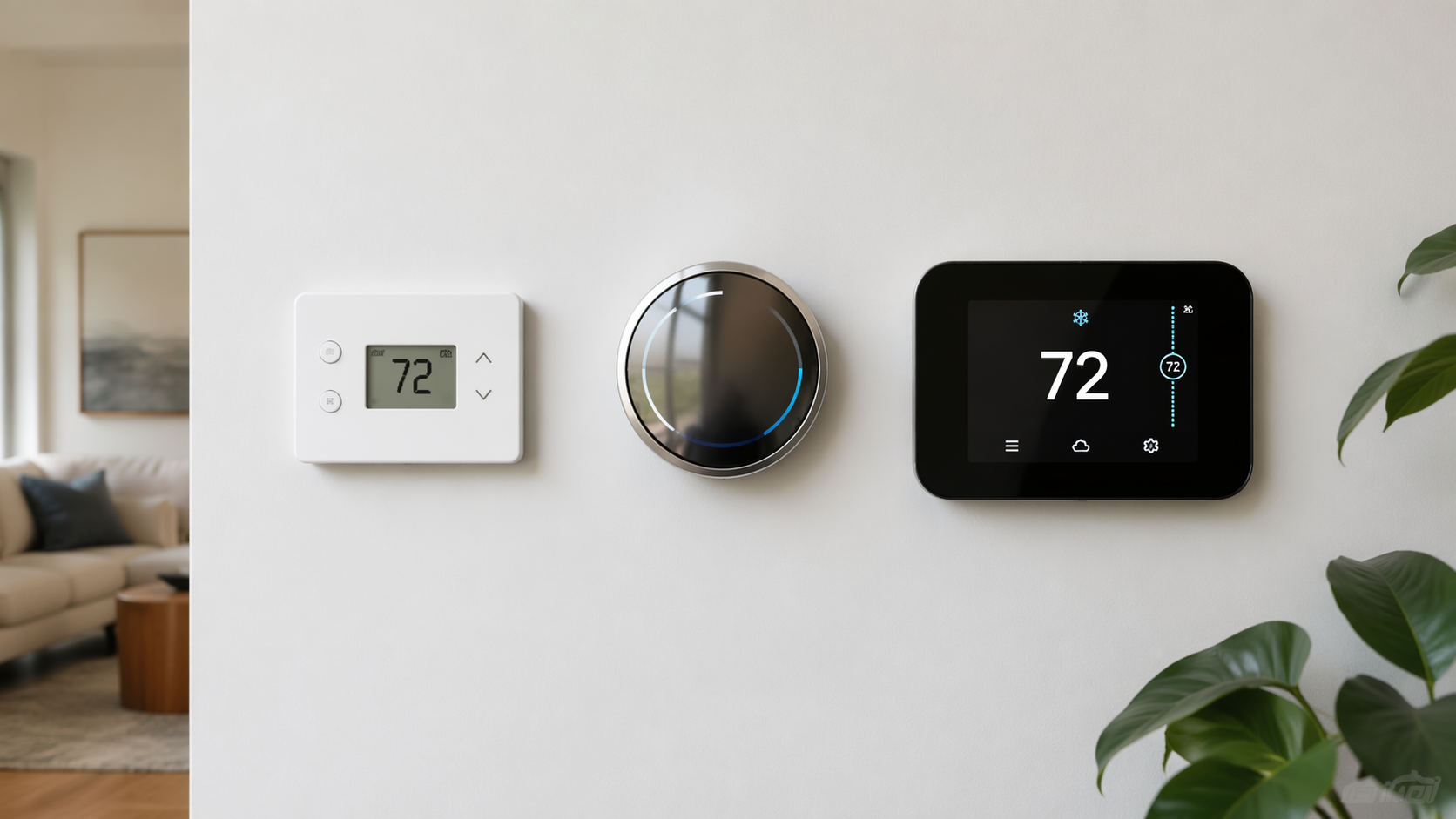
The comparison that actually changes the buying decision
| Category | Sensi | Nest | Ecobee |
|---|---|---|---|
| Best fit | Homeowners who want clearer privacy commitments, lower upfront cost, and easier installation on many conventional systems | Homeowners who want learning behavior, Google integration, and Matter support | Homeowners who want room sensors, broader premium features, and strong multi-platform support |
| Privacy position | Copeland says it does not sell personal data, does not use thermostat activity for advertising, and does not share data with third parties for marketing [1] | Privacy depends on Google’s broader account and device ecosystem; Nest is the more convenient choice for many Google homes, but its privacy pitch is not as thermostat-specific as Sensi’s | Privacy policy is not framed around the same explicit thermostat-activity advertising commitments highlighted by Sensi |
| C-wire requirement | Sensi Lite and ST55 can run without a C-wire on most conventional 4-wire systems; Sensi Touch and Touch 2 require a C-wire [2] | Requires a C-wire or a power accessory / workaround where power is insufficient | Requires a C-wire or power-extender kit |
| MSRP range | $89.99–$209.99 across the Sensi lineup [3] | $129.99–$279.99, depending on model and retailer pricing cited in thermostat roundups [4] | $139.99–$259.99, depending on model and retailer pricing cited in thermostat roundups [4][5] |
| Smart home platforms | All Sensi models support Alexa, Google Assistant, and SmartThings; only the ST55 supports Apple HomeKit [3] | Supports Alexa, Google, and Matter | Supports Alexa, Google, Apple HomeKit, and SmartThings |
| Apple HomeKit note | ST55 is the standout value; Touch 2 drops HomeKit while adding room-sensor support [6][7] | HomeKit support is not the reason to buy Nest | HomeKit is part of Ecobee’s broader appeal |
| Energy savings claim | Sensi cites about 23% HVAC energy savings from customer data tied to average 4°F setbacks [8] | Nest claims 10–12% heating savings and about 15% cooling savings [8] | Ecobee claims up to 26% savings [8] |
| Feature depth | Scheduling, app control, geofencing, basic smart-home integration; no learning algorithm | Learning behavior and Google ecosystem convenience are the draw | Room sensors, premium models, richer comfort controls, and broader smart-home depth |
That table explains why the answer is rarely “buy the cheapest one.” If your existing thermostat has no C-wire behind it, a lower Sensi model may avoid an extra adapter or a contractor visit. If your household already lives in Google Home and likes devices that quietly automate themselves, Nest’s value is not captured by MSRP alone. If the upstairs bedrooms run hot while the hallway thermostat thinks everything is fine, Ecobee’s sensor ecosystem can matter more than saving money on the thermostat body.
Why Sensi’s privacy language is more than a nice-sounding paragraph
Thermostat data is not just a number on a screen. It can reveal when a home is occupied, when the system is set back, how often someone overrides a schedule, and how a household behaves through heat waves, cold snaps, vacations, and work-from-home routines. That does not make every connected thermostat dangerous. It does mean vague privacy language deserves less credit than a concrete operating promise.

Sensi’s owner, Copeland, makes three unusually direct claims: it does not sell personal data, does not use thermostat activity for advertising, and does not share data with third parties for marketing [1]. Those are the kinds of sentences that matter in a buying decision because they answer a practical homeowner question: “Will my heating and cooling behavior become ad targeting material?”
That does not automatically make Nest or Ecobee bad choices. Nest’s advantage is that it fits naturally into Google’s broader smart-home system, and for many households that convenience is the point. Ecobee’s appeal is also not mainly about being a minimalist data product; it is about room sensing, comfort features, and platform breadth. The issue is narrower: among these three brands, Sensi gives the clearest thermostat-specific promise about not monetizing thermostat activity through advertising or marketing data sharing.
That distinction should not be inflated into a moral ranking of homeowners. Some people are comfortable trading more account integration for better automation. Others would rather keep a thermostat closer to an appliance: connected enough to control from a phone, schedule remotely, and receive alerts, but not treated as another behavioral data surface. Sensi is built for that second buyer more cleanly than Nest or Ecobee.
The C-wire question can erase the price gap
A smart thermostat comparison gets very real when the old wall plate comes off. If there is a spare C-wire tucked behind the thermostat, most modern models become easier to recommend. If there is not, the real price may include an adapter, a power-extender kit, extra troubleshooting, or a professional HVAC visit.
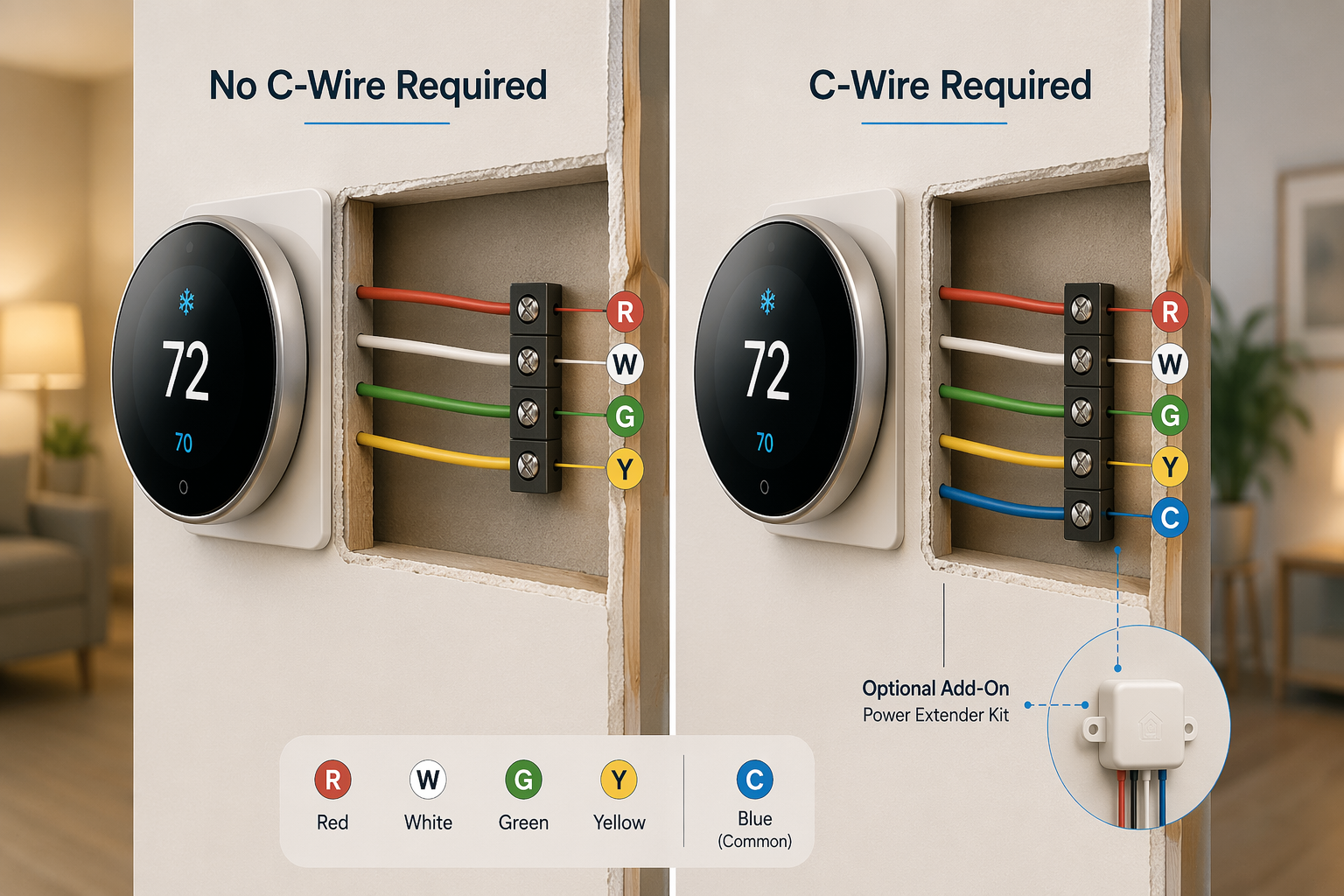
This is one of Sensi’s most practical advantages. Sensi Lite and the classic Sensi ST55 can work without a C-wire on most conventional 4-wire systems, while Sensi Touch and Sensi Touch 2 require a C-wire [2]. PCMag’s ST55 review also highlights the model’s no-C-wire installation advantage for many conventional systems [9].
That advantage has two important boundaries. First, “most conventional systems” does not mean every HVAC system. Heat pumps, dual-fuel setups, line-voltage systems, proprietary communicating systems, and unusual older wiring can still complicate the job. Second, the advantage belongs to the lower Sensi models, not the entire lineup. If you are looking at Sensi Touch or Touch 2, you are back in C-wire territory.
Nest and Ecobee can still be installed in homes without a convenient C-wire, but the path usually involves a power accessory, power-extender kit, or compatibility workaround. That may be perfectly manageable for a confident DIYer. It may also be the moment a $129 thermostat stops feeling like a $129 thermostat.
Before buying any of them, check the actual wires at the thermostat and the control board, not just the color of the wire jacket. If the wiring is unclear, use a compatibility guide before ordering; this is exactly where a broader HVAC fit resource like Which Smart Thermostat Fits Your HVAC System? is more useful than another feature chart.
Price: Sensi starts lower, but rebates and missing features matter
Sensi’s official lineup runs from $89.99 to $209.99 MSRP, while Nest models commonly occupy a $129.99 to $279.99 range and Ecobee models a $139.99 to $259.99 range in major smart-thermostat roundups [3][4][5]. Street prices move around constantly, especially during utility promotions, holiday sales, and retailer-specific discounts, so MSRP is only the starting point.
The most interesting Sensi price point is the ST55. At about $90 street pricing, it is unusually cheap for a smart thermostat that can support Apple HomeKit, and it undercuts the cheapest HomeKit-capable alternatives from Nest and Ecobee by roughly $40 and $50 respectively. For an Apple household that wants HomeKit without paying premium thermostat prices, that is not a small footnote.
The trap is assuming every newer Sensi model is a straight upgrade. Sensi Touch 2 adds support for up to 15 room sensors, with sensors priced at $40 each in the reviewed materials, but it drops HomeKit support [6]. That makes it a better fit for someone who wants room-by-room temperature awareness inside the Sensi app, and a worse fit for someone building around Apple Home.
Rebates can also scramble the ranking. Sensi’s rebate page points homeowners to utility incentives that vary by region, with examples ranging from $20 to $125 or more depending on location [10]. A discounted Ecobee from a local utility could beat a full-price Sensi. A no-C-wire Sensi install could beat a rebated Nest once installation extras are counted. The clean comparison is total installed cost, not the number on the product tile.
Platform support: do not assume the Sensi touchscreen models are the Apple-friendly ones
Sensi’s platform story is easy to get slightly wrong. All Sensi models support Alexa, Google Assistant, and SmartThings, but only the ST55 supports Apple HomeKit [3]. The sleeker Touch and Touch 2 models are not the Apple Home choices in the lineup.
Nest is the natural pick for Google-first homes and adds Matter support, which makes it more attractive for buyers who want a thermostat that participates in the newer cross-platform smart-home layer. Ecobee remains the broader ecosystem play: Alexa, Google, HomeKit, and SmartThings support give it a wide surface area for mixed-platform homes.
This is where Sensi’s simplicity cuts both ways. If the thermostat only needs to respond to an app, a voice assistant, and a schedule, Sensi covers the common ground. If the thermostat is supposed to be part of a larger automation plan with room sensors, occupancy behavior, voice features, and multi-platform routines, Ecobee and Nest give you more to work with. For a deeper platform-first comparison, see The Best Smart Thermostat for Your Ecosystem.
Energy savings claims are useful, but they should not carry the whole purchase
Sensi cites about 23% HVAC energy savings from customer data associated with average 4°F setbacks. Ecobee claims up to 26%. Nest claims 10–12% savings on heating and about 15% on cooling [8]. Those numbers are worth noting, but they are manufacturer estimates, not guarantees for your house.
The reason is simple: thermostats do not save energy by existing. Savings depend on climate, insulation, equipment efficiency, occupancy patterns, comfort tolerance, and how aggressively the schedule actually changes the system’s runtime. A household that already uses disciplined setbacks may see less change. A household that leaves the HVAC running at one comfortable setting all day may have more room to improve.
Nest’s learning behavior can help people who will not build a schedule themselves. Sensi’s manual scheduling and geofencing can work well for people who prefer setting rules directly. Ecobee’s sensors can reduce comfort complaints in homes where the thermostat location does a poor job representing occupied rooms. Those are different routes to better control; none of them guarantees a specific payback period.
If savings are the deciding factor, it is better to treat brand claims as a starting range and then look at your own rates, HVAC runtime, and available rebates. The deeper breakdown in Smart Thermostat Energy Savings Decoded is the better place to test whether the math works for your home.
Where Nest and Ecobee still earn their higher price
Sensi’s value case is strongest when the homeowner wants fewer demands: fewer wiring surprises, less data monetization ambiguity, and a lower entry price. But there are good reasons someone should still pay more for Nest or Ecobee.
Nest is the better fit for people who want the thermostat to learn patterns instead of waiting for a carefully built schedule. That convenience is easy to underrate if you enjoy configuring devices, and easy to appreciate if nobody in the house wants to think about weekday setbacks, weekend exceptions, and seasonal changes. Google and Matter support also make Nest the cleaner choice for some smart-home setups.
Ecobee’s advantage is different. It is the brand to look at when the thermostat location is the problem. A hallway thermostat may be satisfied while the nursery is cold or the upstairs office is roasting. Ecobee’s room-sensor ecosystem and premium feature set give it more tools for that kind of house. If you are already leaning that way, the model-level trade-offs are worth comparing in Ecobee Smart Thermostat Premium vs. Enhanced vs. Essential.
Which one should you buy?
Choose Sensi if the privacy language matters to you, your home may benefit from a no-C-wire install, and you would rather have a straightforward thermostat than a more polished automation device. The strongest Sensi picks are not necessarily the newest-looking ones: Sensi Lite and ST55 have the installation advantage, and ST55 is the key model for Apple HomeKit. If you want to stay inside the brand, the model-by-model breakdown in the Sensi thermostat lineup is the next stop.
Choose Nest if learning behavior, Google Home convenience, and Matter support are more important than Sensi’s privacy framing or C-wire flexibility. It is the better match for the buyer who wants the thermostat to adapt with less manual programming and who is already comfortable with Google’s connected-device ecosystem. The Google Nest Thermostat profile is useful if you are comparing the entry-level Nest option against Sensi.
Choose Ecobee if room sensors, HomeKit support across the brand, and a richer premium feature set justify the added cost. It asks more from the budget, but it also gives more back in homes where one thermostat reading cannot represent the rooms people actually use.
There is no universal winner here. The Sensi smart thermostat makes the most sense when privacy commitments, low total installed cost, and wiring flexibility are the compromise you want. Nest and Ecobee make more sense when the compromise you accept is more data/account integration or a higher price in exchange for stronger automation, sensors, and ecosystem depth.
References
- Sensi Data Privacy — Copeland
- Sensi Compatibility Checker — Copeland
- Sensi Wi-Fi Thermostat — Copeland
- The Best Smart Thermostats — PCMag
- The Best Smart Thermostats — Reviewed
- Sensi Touch 2 Smart Thermostat Review — TechHive
- Sensi Touch 2 Thermostat Review — Pro Tool Reviews
- Thermostat Programming — Copeland
- Sensi Smart Thermostat ST55 Review — PCMag
- Sensi Rebates — Copeland
Known issues with this device / protocol
Spec-version history
For active regressions on this protocol, see Update Watch.
No linked Update Watch entries yet.