
Google Nest Thermostat — An Entry-Level Smart Thermostat for Basic HVAC Systems
The Google Nest Thermostat is a $130 smart thermostat that works with most 24V systems but is limited to single-stage heating and cooling. This profile covers specs, platform compatibility, energy savings estimates, and key trade-offs to help you decide if it fits your home.
Last updated
The Google Nest Thermostat is the $129.99 Nest, not the Nest Learning Thermostat with the stainless ring and self-learning pitch.[1] That distinction matters more than the shape on the wall. This model is Google’s entry-level smart thermostat: remote control, schedules, geofencing, HVAC monitoring, Google Home integration, Alexa support, and Matter support at a price that makes sense for a basic 24V system. It is also the model that asks you to do more of the thinking yourself.
If your house has a straightforward single-stage furnace and central air conditioner, the Google Nest Thermostat can be a tidy, inexpensive upgrade. If your system has multiple heating or cooling stages, needs room-by-room temperature control, or you want the classic Nest behavior where the thermostat learns your routine automatically, the cheaper Nest starts to look like the wrong part in the right-looking box.
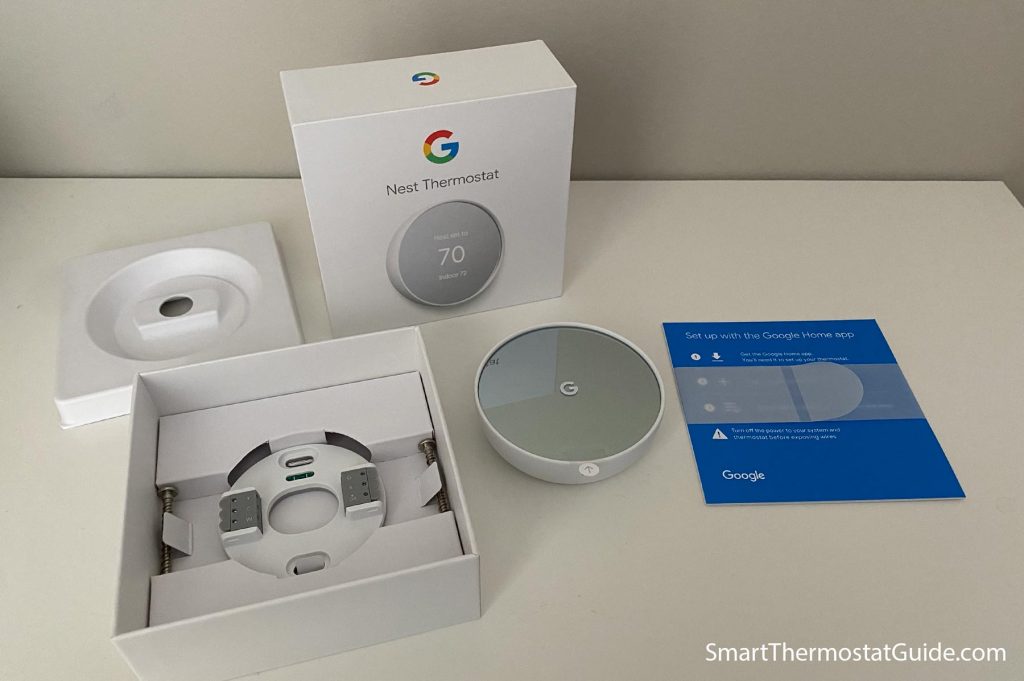
The $130 Nest, In Plain Terms
Google released this entry-level Nest Thermostat in 2020 as model G4CVZ, and its job is still simple in 2026: bring core smart thermostat controls to homes that do not need the more expensive Learning model. The current Google Store listing puts it at $129.99, while the Nest Learning Thermostat sits in a higher price class; the gap is about $150.[1]
That lower price buys a real thermostat, not just a Wi-Fi remote. You can change temperature from the Google Home app, build schedules, use presence-based routines, receive HVAC alerts, and connect it to compatible smart-home platforms. What it does not buy is Nest’s automatic schedule learning, Nest Temperature Sensor support, or broad multi-stage HVAC handling.
| Question | Entry-Level Google Nest Thermostat Answer |
|---|---|
| Price | $129.99 MSRP |
| Best fit | Basic compatible 24V systems with single-stage heating and cooling |
| Main limit | 1-stage heating and 1-stage cooling ceiling, or second stage of either |
| Learning behavior | No automatic learning; schedules are manual |
| Remote sensors | No Nest Temperature Sensor support |
| Ecosystems | Google Home, Alexa, and Matter-compatible platforms |
Compatibility Is The Purchase Gate
Start at the wall, not the app. Google says the Nest Thermostat works with about 85% of 24V heating and cooling systems, including gas, electric, oil, forced air, heat pump systems with auxiliary heat, and radiant systems.[2] That sounds broad, and for many homes it is. But the stage limit is where the deal either holds or collapses.
The entry-level Nest Thermostat supports 1-stage heating and 1-stage cooling, or a second stage of either heating or cooling, according to Google’s technical specifications.[3] A simple furnace plus one air conditioner stage is the kind of setup this thermostat was built around. A more complicated system with multiple stages, more elaborate heat-pump wiring, or zoning hardware deserves a careful compatibility check before purchase.
| Home System Situation | Practical Verdict |
|---|---|
| Conventional 24V gas furnace and central AC with one heat stage and one cool stage | Likely the strongest fit, assuming wiring checks out |
| Heat pump with auxiliary heat | Potentially compatible, but confirm the exact wires before buying |
| Radiant or oil system using compatible 24V controls | Possible fit within Google’s supported system list |
| Multi-stage heating and multi-stage cooling | Usually a reason to look beyond this entry-level model |
| Room-by-room comfort goals using Nest Temperature Sensors | Wrong model; this thermostat does not support those sensors |
This is also where the Nest Learning Thermostat comparison matters. The Learning model is not just the shinier Nest. It is the one buyers usually mean when they talk about Nest’s more advanced comfort behavior and broader premium positioning. If your HVAC wiring already looks like a small telephone switchboard, saving money on the thermostat can turn into paying for troubleshooting later.
For a broader wiring primer before you buy, the site’s smart thermostat compatibility guide is the better place to sort out C-wire, heat pump, and staging terminology. This profile’s narrower point is simpler: the $130 Nest is a bargain only if the system behind it is basic enough.
The C-Wire Question
Google does not make a C-wire an absolute requirement for every Nest Thermostat installation. The device can use Power Sharing, and Google sells the Nest Power Connector as an accessory for some homes without a C-wire.[2] That is useful, but it is not the same as saying every no-C-wire install is painless.
The practical version is this: if you open the old thermostat and see a connected C terminal, the install is less likely to become a power puzzle. If there is no C-wire, run Google’s compatibility checker before buying, and budget for the possibility of a separately purchased Power Connector. The connector is not a bonus feature in the box; it is the part that can make an otherwise marginal installation behave.
What It Actually Does Day To Day
Once the wiring is right, the Nest Thermostat covers the basic smart-thermostat jobs well. You can adjust temperature remotely, make a schedule in the Google Home app, use geofencing and home/away routines, and receive HVAC monitoring alerts. It also supports Wi-Fi 802.11 a/b/g/n at 2.4 GHz, 802.15.4, and Bluetooth, according to Google’s specifications.[3]
The scheduling part is the biggest behavioral difference from the Nest people remember from early smart-home ads. This thermostat does not automatically learn your routine and build a schedule for you. PCMag’s review and Google’s own positioning both treat this as the lower-cost Nest with manual scheduling rather than the Learning Thermostat’s auto-schedule experience.[4]
Manual scheduling is not a flaw if you know what you want. A household with a regular weekday rhythm can set temperatures once, adjust seasonally, and leave it alone. It becomes a disappointment only when someone buys this model expecting the thermostat to watch their habits and handle the schedule on its own.
No Remote Nest Temperature Sensors
The other important missing feature is Nest Temperature Sensor support. Google’s technical materials distinguish this entry-level thermostat from models that can use Nest’s remote sensors.[3] If the baby’s room runs cold, the upstairs office bakes in the afternoon, or the main hallway is a bad temperature reference point, this thermostat cannot use remote Nest sensors to steer comfort around those rooms.
That does not make it useless in uneven homes, but it keeps the thermostat honest. It controls from its own location. If the old thermostat’s hallway placement has always been a problem, replacing the faceplate with a smarter-looking one will not fix the thermal layout of the house.
Google Home, Alexa, And Matter Support
Google Home is the natural home base for this thermostat. Setup, scheduling, and remote control run through the Google Home app, and voice control fits neatly if the house already has Google speakers or displays. Google also lists Alexa compatibility, which keeps the thermostat from being a Google-only island.[2]
Matter support is the more interesting platform note. Google says the Nest Thermostat supports Matter, allowing control through compatible platforms beyond Google Home, including Apple Home, Amazon Alexa, Samsung SmartThings, and other Matter ecosystems.[5] For a budget thermostat, that matters because it gives the device a better chance of surviving a future platform change.
Matter does not turn this into a more advanced HVAC controller. It broadens control. It does not add learning, remote sensors, or multi-stage capacity. Still, for a $129.99 device, cross-platform control is one of the better arguments in its favor.
Energy Savings: Useful Estimates, Not A Promise
The Nest Thermostat is ENERGY STAR certified, and Google estimates that Nest thermostats can save 10% to 12% on heating and about 15% on cooling.[6][7] Those numbers are worth paying attention to at a $130 purchase price, because even modest HVAC savings can matter over several seasons.
They are still estimates, not guarantees. Climate, insulation, HVAC type, occupancy, and the schedule you actually set will change the result. A thermostat cannot save much if the old schedule was already disciplined. It can save more if the old routine left the system conditioning an empty house for hours.
There is also a model-specific caution. Some stronger historical Nest savings claims come from research around the Nest Learning Thermostat, including a 2015 white paper discussed by Utility Dive that focused on the Learning model rather than this entry-level 2020 thermostat.[8] It is safer to treat this model’s savings as the result of better scheduling, home/away behavior, and reminders, not as proof that it will reproduce Learning Thermostat study results.
If you want the broader math on payback and rebates, the site’s smart thermostat energy savings guide goes deeper into what savings percentages can and cannot tell you.
Installation, Build, And Small Details
This is meant to be a DIY thermostat for ordinary low-voltage systems. PCMag describes installation as a roughly 30-minute job, and the basic requirements are what most homeowners would expect: a Phillips screwdriver, Wi-Fi, the Google Home app, and enough patience to label wires before removing the old backplate.[4]
The housing is plastic, with 49% post-consumer recycled material, and Google has offered it in Snow, Sand, Fog, and Charcoal.[7] The mirrored face looks cleaner than the price suggests, though the body is not pretending to be the metal Learning model. At this price, plastic is not the problem. Buying it for the wrong HVAC system is.
Google lists a 1-year warranty for the Nest Thermostat.[1] That is another reminder of where this product sits: accessible, capable, and basic. If you are comparing across simple smart thermostats rather than premium models, the Sensi thermostat lineup and Honeywell Home X8S profile are more useful comparisons than jumping straight to every flagship thermostat.
Who Should Buy It
Buy the Google Nest Thermostat if your home has a compatible basic 24V system, especially a single-stage heating and cooling setup, and you want remote control, manual schedules, geofencing, HVAC alerts, and smart-home integration without paying for the Learning model. It is a particularly sensible pick for a Google Home household, and Matter support makes it less boxed in than older ecosystem-specific devices.
Skip it if your system is multi-stage, if your comfort problem is really room-to-room temperature imbalance, or if you want the thermostat to learn your routine automatically. In those homes, the $130 price is less important than buying the model that actually matches the wiring and the expectation.
References
- Nest Thermostat, Google Store
- Nest thermostat compatibility, Google Nest Help
- Nest thermostat technical specifications, Google Nest Help
- Google Nest Thermostat Review, PCMag
- Control Google Nest products with Amazon Alexa, Google Nest Help
- ENERGY STAR Certified Smart Thermostats, ENERGY STAR
- The new Nest Thermostat: more energy savings for more people, Google Blog, October 12, 2020
- Nest thermostat savings study verified by utilities, Utility Dive, February 3, 2015
Known issues with this device / protocol
Spec-version history
For active regressions on this protocol, see Update Watch.
No linked Update Watch entries yet.