
Ecobee Smart Thermostat Lineup: Comparing the Premium, Enhanced, and Essential
This article breaks down the differences between the three ecobee smart thermostat models — Premium, Enhanced, and Essential — to help you decide which one fits your home and budget. It covers specs, platform compatibility, energy savings, and installation requirements.
Last updated
The ecobee smart thermostat choice is simpler than the spec sheets make it look. Essential is the value pick if you want app control, occupancy-aware scheduling, and the lowest upfront price. Enhanced is the cleaner middle step, with the nicer thermostat hardware and dual-band wireless but no room sensor in the box. Premium is the only one that really becomes more than a thermostat: it includes a SmartSensor, adds built-in voice control, monitors indoor air quality, and can act as a hub for ecobee’s Smart Security features.
The catch is that the right answer is often decided before the thermostat is mounted. A no-C-wire wall, a weak 2.4GHz network, or a bedroom that runs five degrees different from the hallway can matter more than the glass on the front. As of Q2 2026, these are the practical differences worth checking first.
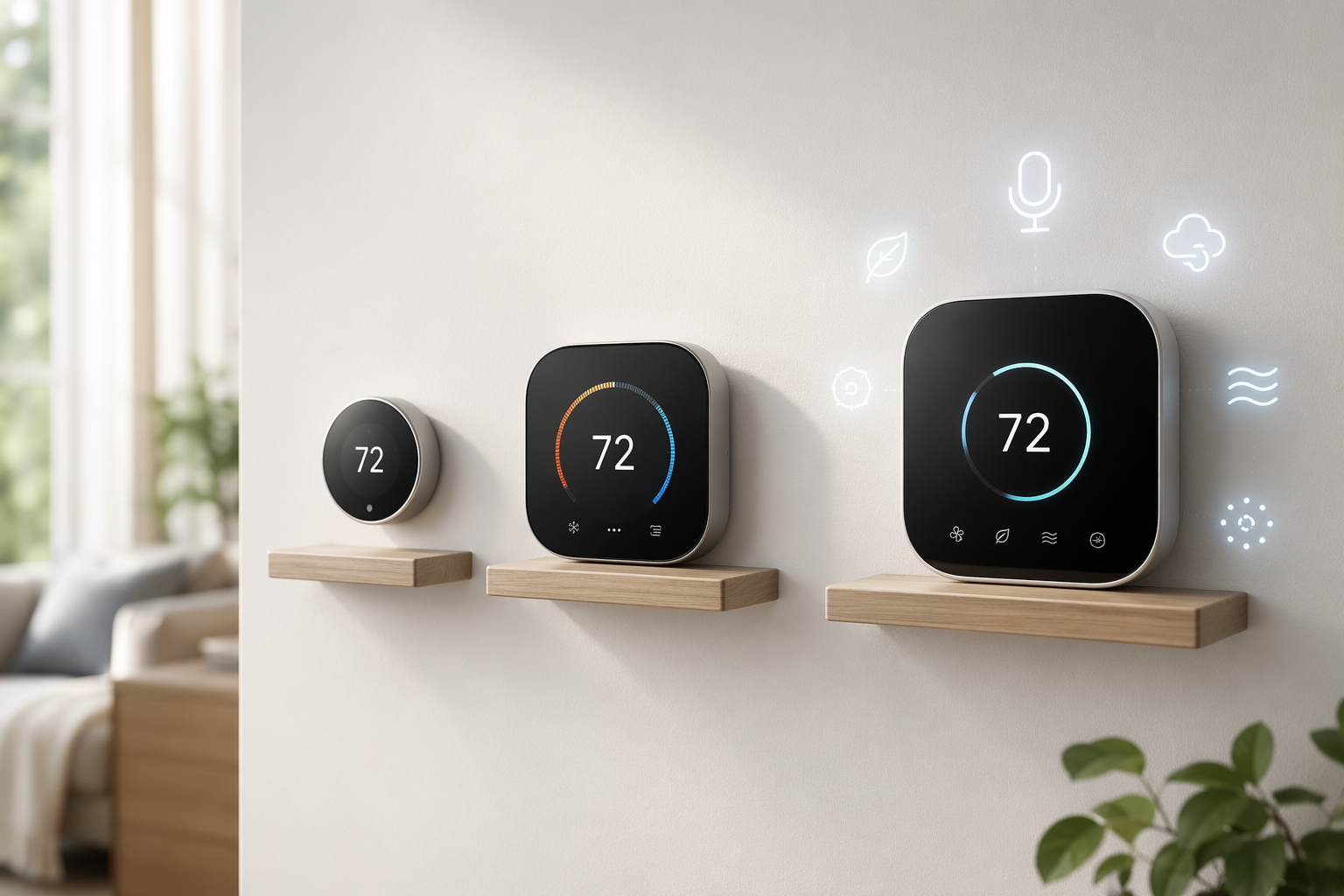
| Feature | Smart Thermostat Premium | Smart Thermostat Enhanced | Smart Thermostat Essential |
|---|---|---|---|
| MSRP from ecobee.com | $249.99 [1][2] | $199.99 [1][3] | $139.99 [1][4] |
| Best fit | Buyer who wants thermostat, room sensor, voice endpoint, air quality monitor, and smart security hub in one device | Buyer who wants the better thermostat interface and dual-band wireless without Premium’s extra hardware | Buyer who wants the lowest-cost ecobee with app control and occupancy-aware scheduling |
| SmartSensor in box | Yes, 1 included [2] | No; compatible with SmartSensor 2-pack sold separately [3][5] | No; compatible with SmartSensor 2-pack sold separately [4][5] |
| Voice control | Built-in Alexa and Siri voice support [6] | Works with external Alexa, Siri/HomeKit, Google Assistant, SmartThings, and IFTTT integrations [6] | Works with external Alexa, Siri/HomeKit, Google Assistant, SmartThings, and IFTTT integrations [6] |
| Air quality sensor | Yes [2] | No [3] | No [4] |
| Wi-Fi and protocols | Dual-band Wi-Fi 2.4/5GHz and Bluetooth 5.0; no Thread, Zigbee, or Z-Wave support cited for this model [2] | Dual-band Wi-Fi 2.4/5GHz and Bluetooth 5.0; no Thread, Zigbee, or Z-Wave support cited for this model [3] | 2.4GHz Wi-Fi 6 only, per PCMag review; no Thread, Zigbee, or Z-Wave support cited for this model [7] |
| Power Extender Kit for no-C-wire installs | Included [2] | Included [3] | Sold separately; PEK listed at $24.99 in cited pricing [4][7] |
| Smart home platforms | Apple HomeKit, Amazon Alexa, Google Assistant, SmartThings, IFTTT; plus built-in Alexa and Siri voice [6] | Apple HomeKit, Amazon Alexa, Google Assistant, SmartThings, IFTTT [6] | Apple HomeKit, Amazon Alexa, Google Assistant, SmartThings, IFTTT [6] |
| Energy savings claim | Up to 26%, or about $284/year, based on ecobee’s April 2021 internal analysis versus a 72°F/22°C hold [8] | Up to 26%, or about $284/year, based on ecobee’s April 2021 internal analysis versus a 72°F/22°C hold [8] | Up to 23%, or about $250/year, based on ecobee’s April 2021 internal analysis versus a 72°F/22°C hold [8] |
| Warranty | 3 years [2] | 3 years [3] | 3 years [4] |
Premium: the only model that behaves like a small smart-home hub
Premium is the easiest ecobee model to overbuy and the easiest one to justify, depending on the home. Its thermostat functions are not magic compared with Enhanced or Essential; the real difference is the hardware around those functions. You get the included SmartSensor, built-in Alexa and Siri voice control, an air quality sensor, and Smart Security hub capability in the thermostat itself [2][6].
The included SmartSensor is the part I would give the most weight. Hallway thermostats are often mounted where the wiring was convenient, not where people actually complain. If the upstairs bedroom runs warm, the nursery cools off first, or the living room gets afternoon sun, a remote sensor can let the system pay attention to the room that matters. Ecobee’s SmartSensor detects temperature and occupancy, supports Follow Me behavior, and ecobee says an account can support up to 32 sensors [5].

That included sensor changes the price conversation. Premium lists at $249.99, while Enhanced lists at $199.99 and Essential at $139.99 [1][2][3][4]. But if an Enhanced or Essential buyer already knows they need room sensing, the separate SmartSensor 2-pack is listed at $99 [5]. At that point, Premium is no longer just “the expensive one”; it may be the package that avoids buying the add-on later.
Built-in voice control is more household-dependent. Premium can serve as an Alexa or Siri voice endpoint, while the other two models only integrate with voice assistants through external speakers or platform apps [6]. That is useful in a kitchen, hallway, or main living area where someone wants to change the temperature, ask for the weather, or trigger a routine without another device on the counter. It matters much less in a house that already has smart speakers in every room.
The air quality sensor belongs in the same category: valuable if you will actually look at it and respond to it. Premium can monitor indoor air quality, but the available sources do not support treating that as a replacement for a dedicated air purifier sensor, a full environmental monitor, or professional testing [2]. It is best understood as a useful built-in prompt, not as the main reason every buyer should move up.
Premium also has the broadest role in ecobee’s Smart Security system. The thermostat can serve as a hub, and ecobee’s security service can add features such as smoke alarm listening, entry and motion detection, and optional professional monitoring, with subscription pricing described as $5–$10 per month [2]. The subscription caveat is important: the thermostat hardware does not automatically turn all of those security functions into free features.
If you are deciding whether Premium is worth the top price, the clean test is whether at least one of its extras would replace something else you would otherwise buy or install. A buyer who wants one sensor, voice at the thermostat location, and air quality visibility has a much stronger case than someone who simply likes the word “Premium.” For a deeper price breakdown, see the separate ecobee Premium value analysis.
Essential: the value pick, if the house cooperates
Essential is the model that deserves more careful reading than its price suggests. At $139.99 MSRP, it is the least expensive way into the current ecobee lineup [1][4]. It still gives you the core thermostat experience: app-based control, scheduling, occupancy-aware operation, broad smart-home platform compatibility, and support for ecobee SmartSensors if you buy them separately [4][5][6].
The first catch is wiring. Premium and Enhanced include the Power Extender Kit for homes without a C-wire, while Essential requires the PEK as a separate purchase; cited pricing lists that add-on at $24.99 [2][3][4][7]. That does not ruin Essential’s value, but it does change the real checkout price for many older systems. If the wall has no C-wire and the buyer did not budget for the PEK, the bargain thermostat starts the install day with an extra errand.
The second catch is wireless. PCMag’s review identifies Essential as using 2.4GHz Wi-Fi 6 only [7]. For many homes, that is fine. For some, especially apartments or dense neighborhoods with crowded 2.4GHz bands, dual-band support on Premium and Enhanced is a practical advantage. A thermostat does not need huge bandwidth, but it does need to stay connected quietly for years.
The third catch is sensors. Essential is compatible with ecobee SmartSensors, but none are included [4][5]. If the thermostat location already represents the house well, that is no problem. If the comfort complaint is really about a bedroom, office, or finished basement, a separate SmartSensor pack may be the purchase that turns Essential from “cheap enough” into “close enough to Enhanced or Premium that we should recalculate.”
Essential makes the most sense when the home has compatible wiring or the buyer is comfortable adding the PEK, the Wi-Fi situation is stable on 2.4GHz, and remote sensors are optional rather than inevitable. In that lane, it is not a stripped-down mistake; it is the clean value model.
Enhanced: the middle choice is mostly about the thermostat itself
Enhanced is the model for people who want the better thermostat hardware but do not want Premium’s multi-function stack. It lists at $199.99, includes the Power Extender Kit, supports dual-band Wi-Fi and Bluetooth 5.0, and works with the same major smart-home platforms as the other two models [1][3][6].
Its advantage over Essential is not that it unlocks a different smart-home ecosystem. It is the nicer interface, stronger wireless flexibility, and included PEK. That makes it easier to recommend for a home where the thermostat is used directly by several people or where a 2.4GHz-only device would be a concern.
Its disadvantage is just as plain: no included SmartSensor, no built-in voice endpoint, and no air quality sensor [3]. If you are going to add SmartSensors immediately, Enhanced starts to compete less against Essential and more against Premium. If you will never use voice or air quality monitoring, Enhanced may be the more sensible stop.
Installation and sensor math can change the ranking
Before choosing among the three, check the wall plate and the rooms. Ecobee’s product materials describe DIY installation as taking about 45 minutes, and all three models are positioned for homeowner installation, but the C-wire question still decides how simple that hour will be [2][3][4]. Premium and Enhanced include the PEK for homes without a C-wire; Essential does not [2][3][4][7].
- If the existing thermostat has a C-wire and the hallway temperature matches the rooms people use, Essential has the cleanest value case.
- If there is no C-wire, add the PEK cost to Essential before comparing it with Enhanced.
- If one or two rooms routinely miss the target temperature, price the thermostat and sensors together rather than treating sensors as an afterthought.
- If the thermostat location is also a good spot for voice commands or air quality visibility, Premium’s extra hardware has a more credible job.
All three models support common residential HVAC configurations described in the cited product materials, including up to 2H/2C systems, heat pumps, and accessories, with Premium adding additional accessory support [2][3][4][9]. That is still not the same as saying every system is safe to buy for without checking. Heat pump aux wiring, humidifiers, dehumidifiers, multi-stage equipment, and older control boards are where a few minutes of compatibility checking beats a Saturday return trip.
For a more system-specific pass, use the smart thermostat HVAC compatibility guide before buying.
Energy savings: useful claims, not guaranteed payback
Ecobee’s savings story is shared across the lineup, so it should not be the main reason to choose Premium over Enhanced or Essential. Ecobee claims Premium and Enhanced can save up to 26%, or about $284 per year, while Essential can save up to 23%, or about $250 per year [8].
Those numbers come from ecobee’s April 2021 internal analysis comparing thermostat use against a constant 72°F/22°C hold [8]. That comparison matters. A household that already uses careful schedules, mild set points, or low HVAC runtime will not necessarily see the same savings as a household replacing a thermostat that was held at one temperature all day. The cited sources do not provide third-party verification for the claimed savings, so they are best treated as manufacturer “up to” figures rather than promised household returns.
Savings can still be real. Occupancy sensing, better schedules, vacation modes, and utility rebates can all affect the final cost picture. They just should not be used to pretend the $249.99 model automatically pays for itself faster than the $139.99 model. For rebate and payback context, see Smart Thermostat Savings in 2026.
Platform support is not the deciding split
If the household is built around Apple HomeKit, Amazon Alexa, Google Assistant, SmartThings, or IFTTT, all three ecobee models remain in play [6]. That is one reason the lineup is easier to compare than some thermostat families: the platform decision does not force most buyers into a specific price tier.
The meaningful exception is built-in voice. Premium adds Alexa and Siri voice at the thermostat itself; Enhanced and Essential can still participate in those ecosystems, but they rely on external devices for voice interaction [6]. If you need a platform-by-platform comparison against Nest, Honeywell, and other thermostats, use the smart thermostats for HomeKit, Alexa, and Google Home guide.
How outside reviewers have treated the lineup
The lineup’s strongest outside support is not for a flashy touchscreen; it is for temperature performance and remote sensors. Wirecutter named the ecobee Smart Thermostat Premium its top smart thermostat pick for 2026 and identified the Essential as a runner-up, citing consistent temperature performance and ecobee’s room sensors among the reasons [10].
That matches the practical reason ecobee tends to work well in homes where the hallway is a poor stand-in for the rest of the house. A thermostat can have a beautiful display and still leave someone cold in the office. Sensors are the feature that most directly addresses that complaint. For a broader look at when remote sensors are worth buying, see the smart thermostat remote sensor guide.
Which ecobee smart thermostat should you buy?
Buy Essential if price is the main concern and the home fits its constraints: stable 2.4GHz Wi-Fi, either a C-wire or willingness to buy the separate PEK, and no immediate need for an included room sensor. It is the value model, not the best model for every low-budget install.
Buy Enhanced if you want the better thermostat interface, dual-band wireless, and included PEK, but you do not need built-in voice control, air quality monitoring, or a sensor in the box. It is the middle option for people who still think of the device mainly as a thermostat.
Buy Premium if the thermostat is going to do more than change the temperature. The included SmartSensor, built-in Alexa and Siri voice support, air quality monitoring, and Smart Security hub role are the reasons to pay the top price. If those features solve real problems in the house, Premium is the most complete ecobee. If they do not, Enhanced or Essential will probably make more sense.
If you are still comparing outside ecobee, the closest Device Library alternatives are the Google Nest Thermostat and the Honeywell smart thermostat comparison.
References
- Smart Thermostats, ecobee, https://www.ecobee.com/en-us/smart-thermostats/
- Smart Thermostat Premium, ecobee, https://www.ecobee.com/en-us/smart-thermostats/smart-thermostat-premium/
- Smart Thermostat Enhanced, ecobee, https://www.ecobee.com/en-us/smart-thermostats/smart-thermostat-enhanced/
- Smart Thermostat Essential, ecobee, https://www.ecobee.com/en-us/smart-thermostats/smart-thermostat-essential/
- SmartSensor, ecobee, https://www.ecobee.com/en-us/accessories/smart-temperature-occupancy-sensor/
- Smart Home Integrations, ecobee, https://www.ecobee.com/en-us/smart-home/
- Ecobee Smart Thermostat Essential Review, PCMag, https://www.pcmag.com/reviews/ecobee-smart-thermostat-essential
- Savings, ecobee, April 2021, https://www.ecobee.com/en-us/savings/
- Ecobee Smart Thermostat Premium vs. Ecobee Smart Thermostat Enhanced, CNET, https://www.cnet.com/home/energy-and-utilities/ecobee-smart-thermostat-premium-vs-ecobee-smart-thermostat-enhanced/
- The 4 Best Smart Thermostats of 2026, Wirecutter, 2026, https://www.nytimes.com/wirecutter/reviews/the-best-thermostat/
Known issues with this device / protocol
Spec-version history
For active regressions on this protocol, see Update Watch.
No linked Update Watch entries yet.