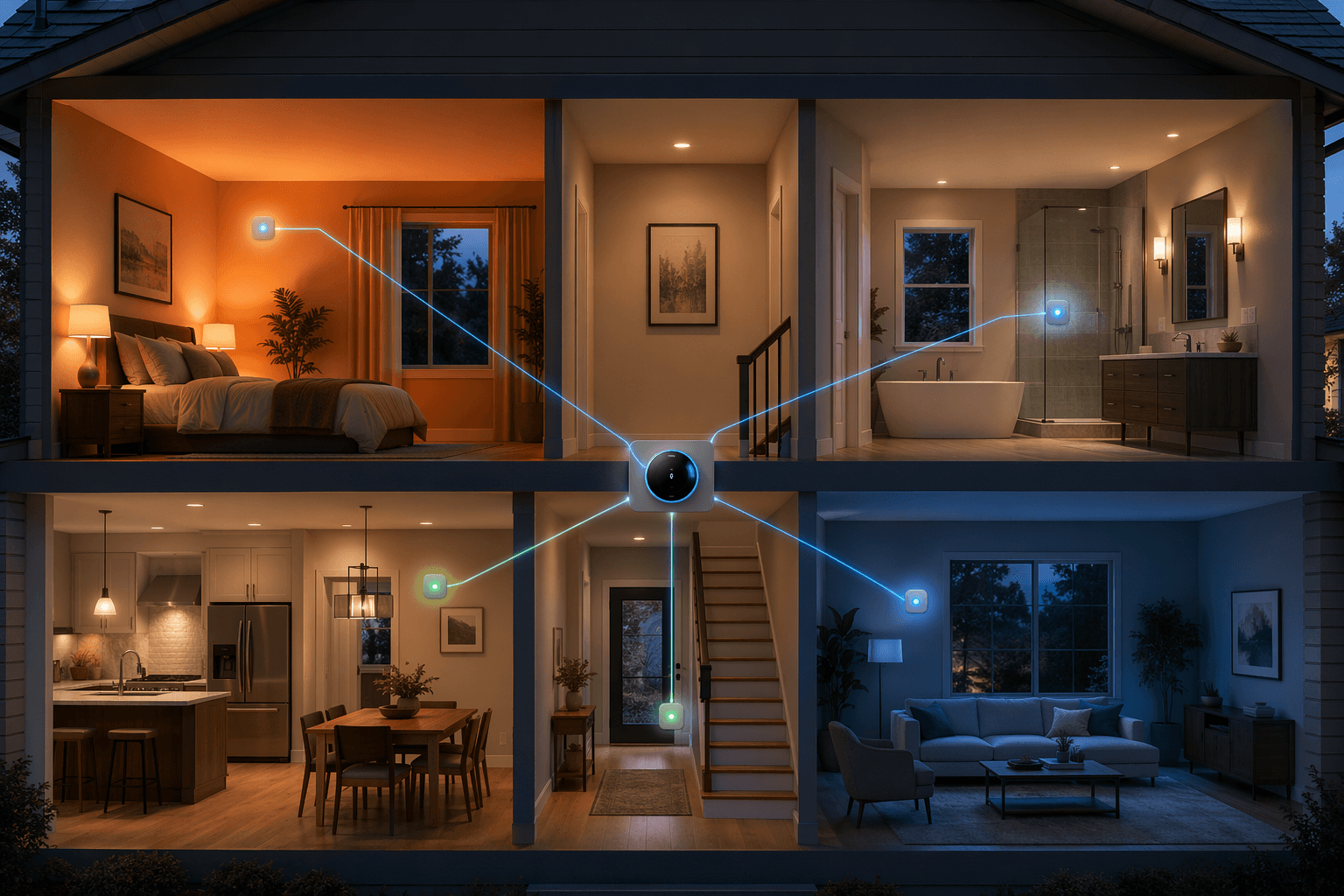
If your thermostat lives in the hallway, there is a decent chance it is controlling the least interesting room in the house. The upstairs bedroom may be roasting at 10 p.m., the nursery may be colder than the rest of the floor, and the home office may be occupied all afternoon while the hallway reports that everything is fine.
That is why a smart thermostat with remote sensor support is not a minor accessory choice in 2026. It is often the difference between a thermostat that measures more places and a thermostat that can actually respond to where comfort is failing.
The key distinction is simple: remote temperature measurement is not the same as remote comfort control. A sensor that only reports temperature can help the system target a bedroom at night or average several rooms. A sensor that also detects occupancy can help the thermostat understand where people are now, and that changes how useful the whole system feels in a real house.
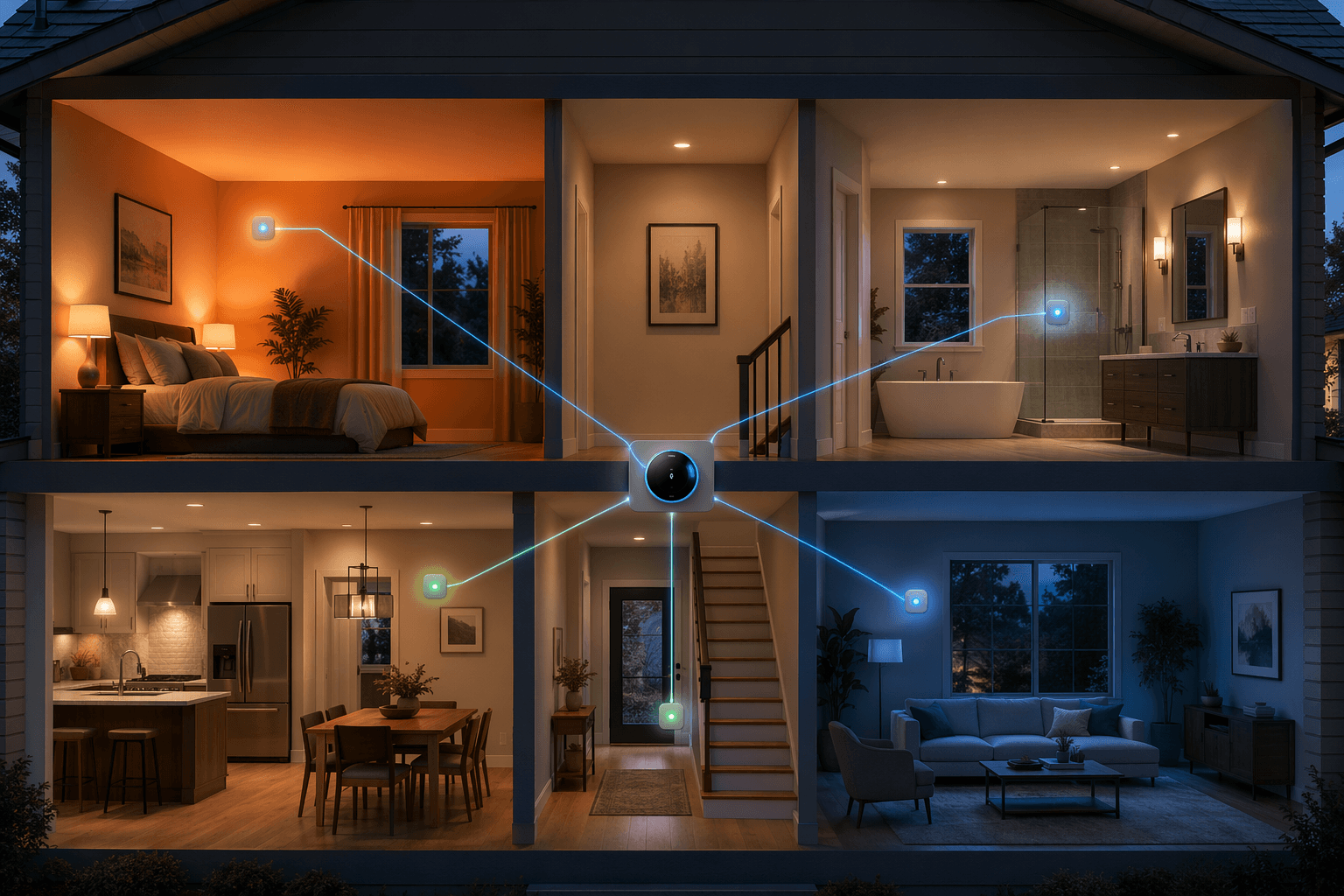
The short version: which sensor system is best?
| Thermostat ecosystem | What the remote sensor detects | Sensor limit | How it behaves in real life | Best fit |
|---|---|---|---|---|
| Ecobee | Temperature + occupancy | Up to 32 sensors | Can average sensors, use Follow Me, and apply Smart Home/Away behavior based on occupancy | Uneven homes where people move between rooms and comfort needs change during the day |
| Nest 4th Gen | Temperature only | Up to 6 sensors | Can use scheduled temperature targets and, with 4th-gen sensors, averaging; cannot tell whether a sensor room is occupied | Homes with predictable room problems, such as a bedroom that needs priority at night |
| Honeywell T9 | Temperature + humidity | Up to 20 sensors | Strong sensor count and useful humidity context, with availability caveats because the model is discontinued on Honeywell’s site but still sold by retailers | Larger homes where many rooms need monitoring and current retail availability checks are acceptable |
| Sensi Touch 2 | Temperature only | Up to 15 sensors | Viable multi-room sensing, but no sensor is included in the box, so real system cost rises quickly | Sensi buyers who want room sensors and have priced the full setup, not just the thermostat |
| Amazon Smart Thermostat | No dedicated remote sensor ecosystem | No dedicated sensor support | Some Echo devices can act as a limited temperature workaround, but this is not a proper remote sensor system | Low-cost smart thermostat buyers who do not need serious remote sensor control |
For most people shopping specifically around remote sensors, Ecobee is the strongest answer. Not because it has the longest spec sheet in every category, but because its sensors feed the thermostat the two pieces of information that matter most: what temperature a room is, and whether someone is actually in it.
Ecobee: the remote sensor system to beat
Ecobee’s SmartSensors detect both temperature and occupancy. The occupancy sensing uses infrared detection with a 140-degree horizontal field of view, a 100-degree vertical field of view, and a range of up to 20 feet. Ecobee supports up to 32 sensors, and its thermostat features include sensor averaging, Follow Me, and Smart Home/Away behavior.[1]
Those details matter because the thermostat is not just collecting room temperatures for the app. In an occupied home office, Follow Me can bias comfort toward the room being used. In a living room that fills up after dinner, occupancy can become a useful signal. If the house is unexpectedly empty, Smart Home/Away can respond without asking the owner to keep perfect schedules.
This is the difference between a remote sensor as a thermometer and a remote sensor as an input to the heating and cooling decision. A hallway thermostat cannot know that a bedroom is occupied. A temperature-only bedroom sensor cannot know that either. Ecobee’s system can, which is why it is usually the best match for the person who is tired of manually correcting comfort room by room.
Wirecutter’s thermostat testing also singled out Ecobee’s sensor, calling it “the best remote sensor we’ve tested.”[2] That is a useful outside check on what the feature list already suggests: Ecobee has spent years treating the remote sensor as part of the thermostat’s brain, not as an optional room display.
There is still a boundary to keep in mind. Remote sensors do not create true room-by-room zoning unless the HVAC system has dampers or separate zones to match. A central forced-air system is still moving conditioned air through the ducts it has. What Ecobee can do well is decide which rooms should influence the thermostat’s call for heating or cooling. That can make an uneven home feel much less arbitrary, but it does not turn one HVAC zone into several independent systems.
If you are already leaning this direction and need to sort out model differences, the site’s Ecobee model breakdown is the better place to compare Ecobee Premium, Enhanced, and Essential details. The sensor-system point is already clear: among mainstream smart thermostats, Ecobee has the most complete comfort logic.
Nest: better than before, but still temperature-only
Nest’s 4th-generation Temperature Sensors are a meaningful improvement over the older Nest sensor approach because they add averaging capability. They also have practical specs that will work for many homes: support for up to 6 sensors, about 50 feet of Bluetooth Low Energy range, and roughly 2 years of battery life.[3]
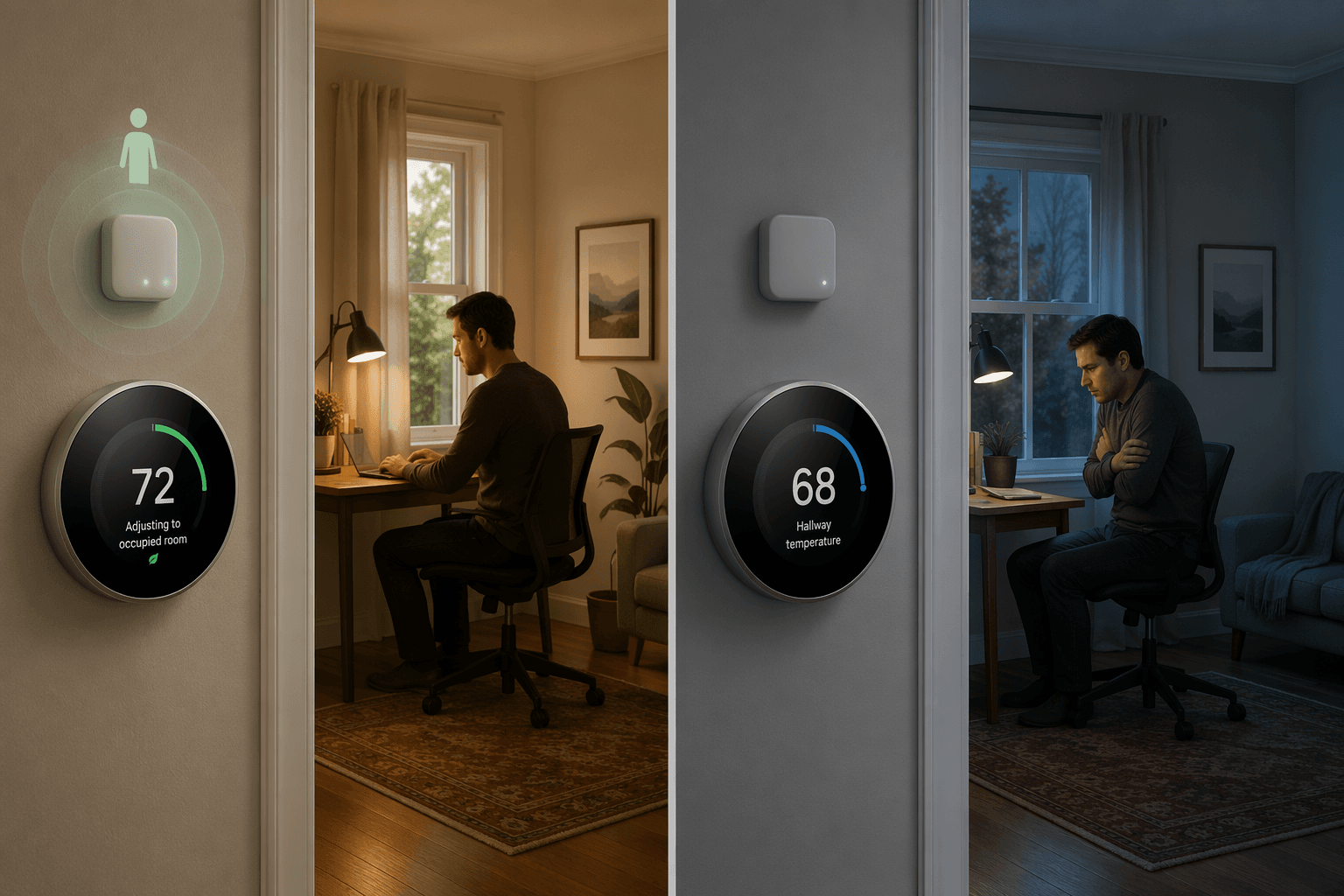
The limitation is just as important: Nest’s remote sensors detect temperature only. They do not include motion or occupancy detection, so the thermostat cannot know whether the room attached to that reading is being used.[3]
That does not make Nest a bad choice. It makes Nest a more scheduled choice. If the problem is predictable — the primary bedroom should be the target overnight, the living room should matter in the evening, the kitchen should not dominate after cooking — Nest’s sensor scheduling and averaging may be enough. It can move the thermostat’s attention away from the hallway.
Where it feels less convincing is in homes where occupancy is irregular. A guest room may be cold, but empty. A home office may be occupied on Tuesday and ignored on Wednesday. A playroom may matter intensely for two hours and then not at all. Nest can use temperature information from those rooms, but it needs time-block logic rather than room-use awareness to decide what matters.
For a household already invested in Google’s thermostat ecosystem, that may be a trade-off worth accepting. For a buyer starting from the specific complaint “my thermostat does not know where we actually are,” Nest is less satisfying than Ecobee.
If the decision narrows to these two brands, also check installation and wiring requirements before buying; the Ecobee vs. Nest installation guide is the more useful next stop than another app-feature comparison.
Honeywell T9: high sensor count, humidity data, and an availability pause
Honeywell’s T9 deserves attention because its remote sensor system is more capable than many people assume. It supports up to 20 remote sensors, and those sensors report both temperature and humidity. Honeywell lists sensors at about $40 each or $75 for a 2-pack.[4]
The sensor count is the immediate draw. A larger home can burn through six sensors quickly: bedrooms, office, nursery, basement, den, and main living area. Honeywell’s limit gives more room to cover the awkward spaces without deciding which comfort problem to ignore.
Humidity is also not a throwaway metric. Two rooms at the same temperature can feel different if one is humid and the other is dry. A system that includes humidity readings gives the thermostat more context than temperature alone, especially in climates where cooling comfort is as much about moisture as degrees.
The careful wording is around availability. The RCHT9610WFSW2003/U is listed as discontinued on Honeywell’s own site, while still being widely available at retailers as of mid-2026.[4] That does not automatically make it a bad buy, but it changes the checklist: verify current stock, return policy, app support expectations, and sensor availability before building a multi-room plan around it.
Honeywell is especially interesting if the main problem is coverage across many rooms rather than occupancy-led automation. It can be a strong practical choice for larger houses, but I would not treat it as a set-and-forget recommendation until the buyer has checked the exact model and sensor supply at the retailer they plan to use.
Sensi Touch 2: workable, but price the sensors before calling it budget-friendly
Sensi Touch 2 supports up to 15 room sensors. The sensors are temperature-only, and Sensi does not include one in the thermostat box. The base ST76 thermostat is about $148, while room sensors are listed at $39.99 each.[5]
That last detail is where the math changes. A thermostat can look inexpensive on the shelf and stop looking inexpensive once the buyer adds three or four sensors. For one problem room, Sensi may still be easy to justify. For a multi-room system, the real comparison should be thermostat plus sensors, not thermostat alone.
Sensi’s 15-sensor ceiling is respectable. The constraint is less about quantity and more about intelligence: temperature-only sensors can help the thermostat see more rooms, but they do not tell it which rooms are occupied. If you like Sensi’s interface, HVAC compatibility, or broader lineup, that trade-off may be fine. If the purchase is mainly about automatic room-aware comfort, Ecobee still has the better sensor logic.
For model-by-model details, use the Sensi thermostat lineup rather than assuming every Sensi thermostat has the same sensor story.
Amazon Smart Thermostat: not a serious remote-sensor pick
The Amazon Smart Thermostat is inexpensive, typically around $58 to $80, but it does not have dedicated remote sensor support. PCMag identifies that as its biggest feature gap against similarly priced competitors.[6]
Fourth-generation and newer Echo Dots can function as a limited temperature workaround, but that is not the same as a real thermostat sensor ecosystem.[6] If the priority is simply a low-cost smart thermostat, Amazon may still belong in the conversation. If the priority is a smart thermostat with remote sensor capability, it should not be on the serious shortlist.
Match the sensor system to the room problem
The best remote sensor system depends less on the prettiest app and more on which room keeps making you intervene. Start there.
Hot upstairs bedroom at night
If the problem is predictable and tied to a schedule, Nest becomes more defensible. A bedroom sensor can tell the thermostat to care about that room overnight, and 4th-generation averaging helps when more than one room should count. Ecobee still does more, but Nest is not disqualified if the room priority rarely changes.
Home office occupied away from the thermostat
This is Ecobee territory. The issue is not merely that the office has a different temperature. It is that the office matters when someone is in it. Occupancy detection gives the thermostat a way to weight comfort toward the used room without requiring the homeowner to rewrite the day every time work shifts from the kitchen table to the upstairs desk.
Nursery or bedroom that must stay within a tighter comfort band
A remote sensor can be genuinely useful here, but expectations need to stay honest. The thermostat can prioritize that room’s reading; it cannot guarantee perfect room temperature if the ductwork, insulation, or HVAC capacity cannot deliver it. Ecobee’s occupancy features may matter less for a sleeping room than its ability to include that sensor in comfort settings and averaging. Nest may also work if the schedule is consistent.
Large home with many rooms to monitor
Sensor limits start to matter in larger homes. Ecobee’s support for up to 32 sensors gives it the highest ceiling in this comparison, while Honeywell T9’s support for up to 20 sensors is also substantial.[1][4] Nest’s 6-sensor limit may be enough for a typical targeted setup, but it can feel tight if you want broad coverage.
Budget setup with one or two problem rooms
Do not compare only thermostat prices. Compare the full system: thermostat, number of sensors needed, whether a sensor is included, and whether additional sensors are easy to buy. Sensi is the clearest caution here because its thermostat price can look attractive before the room sensors are added. Honeywell’s sensor pricing and discontinued-on-manufacturer-site status also deserve a current-cart check before purchase.
What remote sensors can and cannot promise on energy savings
Smart thermostats can save energy, but remote sensors do not have a clean, independent savings number of their own. ENERGY STAR estimates certified smart thermostats save at least 8% annually on heating and cooling.[7] The U.S. Department of Energy says homeowners can save up to 10% a year on heating and cooling by setting the thermostat back 7 to 10 degrees Fahrenheit for 8 hours a day.[8]
Ecobee also claims savings of up to 26% with eco+ enabled compared with a constant 72°F hold, but that is a manufacturer claim and actual savings vary by geography, climate, insulation, and other home conditions.[1]
The missing evidence is important: there is no independent A/B bill study in the provided research comparing otherwise similar homes with remote sensors versus no remote sensors. So the honest claim is narrower. A good remote sensor system can improve comfort targeting and may make setback and occupancy behavior smarter. It should not be sold as a guaranteed lower-bill upgrade by itself.
If ROI is the main question, read the broader smart thermostat energy savings guide or the explainer on why thermostat savings estimates vary. For this buying decision, comfort control is the stronger reason to care about sensors.
So which one should you buy?
Buy Ecobee if you want the strongest remote sensor system for correcting uneven comfort. Its combination of temperature sensing, occupancy detection, averaging, Follow Me, Smart Home/Away, and a high sensor ceiling makes it the most complete choice for homes where the problem room changes with real life.
Buy Nest if you already like the Google thermostat ecosystem and your comfort problems are predictable enough for scheduled temperature targeting. The 4th-generation averaging improvement matters, but Nest’s sensors still cannot detect occupancy.
Consider Honeywell T9 if you need many sensors and value humidity readings, but verify current model availability and sensor supply before committing. Consider Sensi Touch 2 if you want Sensi specifically and have priced the full sensor setup. Skip Amazon for this particular buying goal; it is not a true remote-sensor thermostat system.
Before purchasing, confirm HVAC compatibility, C-wire requirements, current pricing, and platform fit. The general smart thermostat buyer’s guide and the smart thermostat compatibility guide are the right places to do that final check.
References
- SmartSensor for doors and windows, SmartSensor for rooms, Ecobee
- The Best Smart Thermostat, Wirecutter
- Nest Temperature Sensor, Google Nest Help
- T9 Smart Thermostat, Honeywell Home
- Room Sensors, Sensi
- The Best Smart Thermostats, PCMag
- Smart Thermostats, ENERGY STAR
- Thermostats, U.S. Department of Energy
Reader Feedback
Share your purchase experience, flag outdated picks, or ask clarifying questions about the checklist items.
Comments
Join the discussion with an anonymous comment.