
Honeywell Home T9 Smart Thermostat: Specs, Compatibility, and 2026 Status
A complete spec-by-spec breakdown of the Honeywell Home T9 Smart Thermostat, covering its discontinued status, HVAC compatibility, sensor system, and whether it is still worth buying in 2026.
Last updated
Device Library status: last verified in Q2 2026. The Honeywell Home T9 Smart Thermostat is no longer a straightforward retail recommendation: Honeywell Home’s official product page lists the T9 SKUs as discontinued and sold out, while HoneywellStore still shows a backorder listing with a July 2026 ETA.[1][2] That conflict matters more than the usual smart-thermostat feature list. A discontinued connected thermostat can still be useful hardware, but it is not the same buying decision as an active model with a clear product path.
The short version: the T9 can still make sense if you find it at true clearance pricing, confirm your 24V HVAC wiring before buying, and specifically want Honeywell’s long-range room sensors. Most new buyers should start with actively supported alternatives instead, because the T9’s best qualities do not erase the support and inventory uncertainty around it.
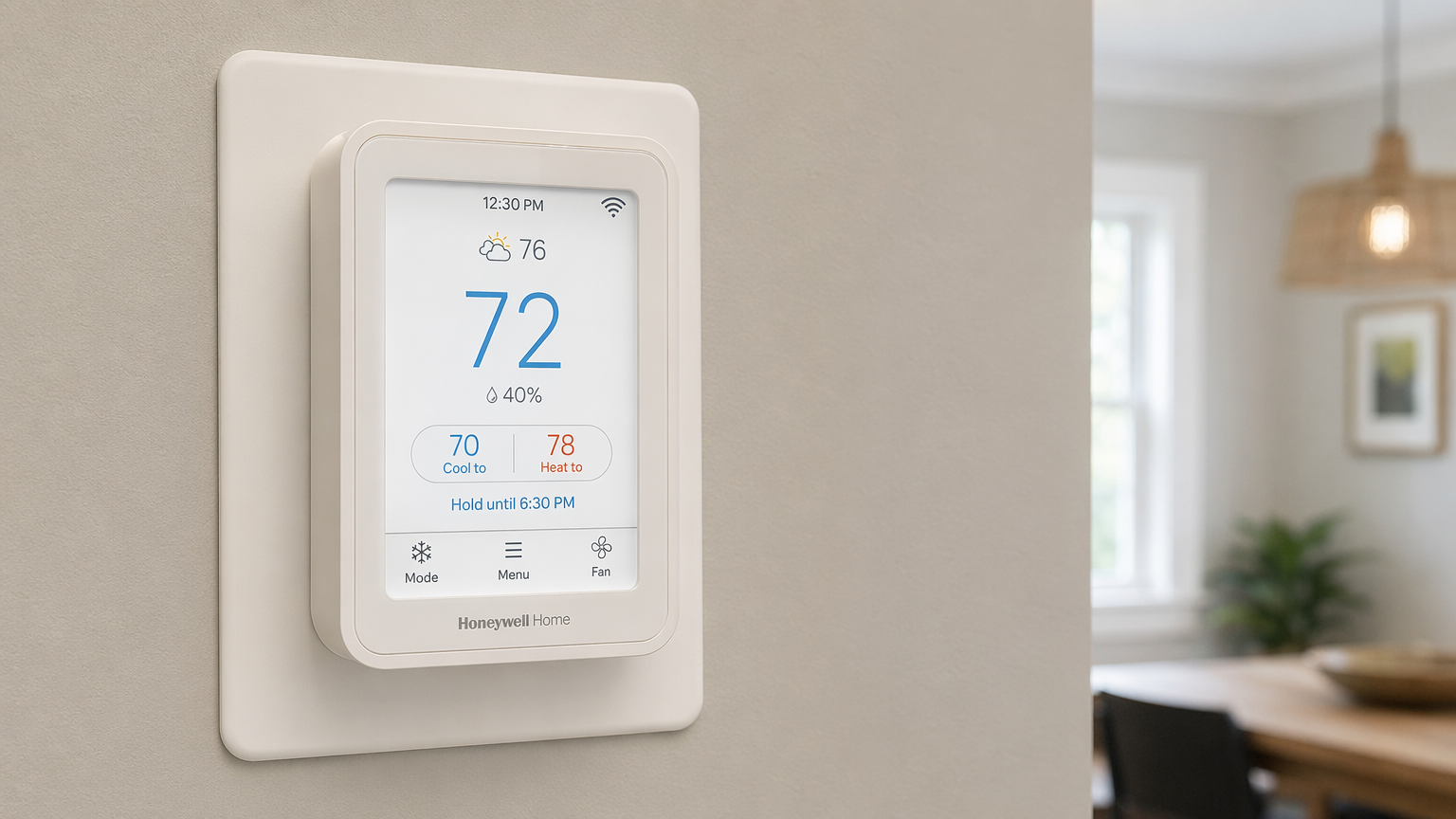
Quick spec panel
| Item | Honeywell Home T9 Smart Thermostat |
|---|---|
| 2026 availability | Official Honeywell Home page: discontinued and sold out; HoneywellStore: backordered with July 2026 ETA |
| System type | 24V low-voltage HVAC systems only |
| Maximum heat pump support | Up to 3H/2C |
| Maximum conventional support | Up to 2H/2C |
| Not compatible with | Line-voltage systems, millivolt systems, and electric baseboard heat |
| C-wire | Common wire required, with a C-wire adapter included for compatible systems without a C wire |
| Wi-Fi | Dual-band 2.4 GHz and 5 GHz |
| Room sensors | Supports up to 20 Smart Room Sensors |
| Sensor radio | 900 MHz RedLINK |
| Sensor range | Up to 200 ft. |
| Sensor measurements | Temperature, humidity, and motion/occupancy |
| Smart-home platforms | Amazon Alexa, Google Assistant, Apple HomeKit, Samsung SmartThings, IFTTT, and Ring |
| Hub requirement | No hub required |
| Subscription requirement | No subscription required |
| Energy certification | ENERGY STAR certified; certification program cites 8% average heating/cooling savings |
| Historical pricing | About $149 for the base unit and about $210 with sensor before discontinuation; later clearance listings commonly around $100–$140 where available |
| Direct successor | Honeywell Home T10 Pro, sold through the professional channel |
Those specs explain why the T9 stayed interesting after newer thermostats arrived. They also show why the first question should be wiring, not app preference. If the wall plate is hiding incompatible voltage or missing conductors that the adapter cannot solve cleanly, a clearance price is just a cheaper way to buy a return.
Availability in 2026: discontinued, but not completely gone
Honeywell Home’s official T9 product page is the cleanest status signal: the product is marked discontinued and sold out.[1] HoneywellStore, meanwhile, still presents a T9 with sensor listing as backordered with a July 2026 ETA.[2] The Front Desk Review’s June 2026 device profile describes the T9 as previously widely available around $150–$210 before discontinuation, with current clearance pricing around $100–$140 where units still appear.[3]
That does not mean every listing is suspicious. It means the buyer takes on more verification work. Check whether the listing is new, open-box, refurbished, or marketplace inventory; whether the seller accepts thermostat returns after installation attempts; and whether the package includes the sensor and C-wire adapter promised by the SKU.
The T9 should be priced like discontinued inventory, not like a current flagship. If a seller is asking active-model money, the burden shifts the wrong way: you are paying full price while accepting lifecycle ambiguity.
HVAC compatibility is the make-or-break check
The T9 is built for 24V low-voltage HVAC systems. It supports up to 3H/2C heat pump systems and up to 2H/2C conventional systems, but it is not for line-voltage, millivolt, or electric baseboard setups.[3] Resideo’s wiring compatibility resource is the right kind of boring page to visit before buying, because thermostat compatibility lives in terminal labels and equipment type rather than in product photos.[4]
- Likely T9 territory: many forced-air gas furnaces, central air systems, and compatible heat pumps using 24V control wiring.
- Stop and verify: dual-fuel systems, multi-stage heat pumps, accessory-controlled systems, or any wiring that does not match standard thermostat terminal labels.
- Do not buy for: line-voltage electric baseboard, millivolt fireplace-style systems, or other non-24V controls.
The included C-wire adapter is helpful, but it is not a magic compatibility pass. It can solve a common missing-C-wire problem on compatible equipment; it does not convert the T9 into a thermostat for every furnace, boiler, baseboard, or high-voltage installation. It also adds work at the equipment board, which is a different task from snapping wires onto a wall plate.
Before buying, remove the existing thermostat faceplate and photograph the terminal labels. Do not rely only on wire colors. A blue wire is not proof of C, and an unused wire tucked behind the wall is only useful if it can be connected correctly at the HVAC control board. For a broader walk-through by home type, see which smart thermostat fits your HVAC system.
The room sensors are still the T9’s best argument
The T9’s remote sensor system is the part that still feels unusually strong. It supports up to 20 Smart Room Sensors, uses Honeywell’s 900 MHz RedLINK connection, and is rated for up to 200 ft. of range.[3] TechHive called the T9’s remote sensors “the best remote sensors we’ve tested,” specifically praising the range and performance.[5]
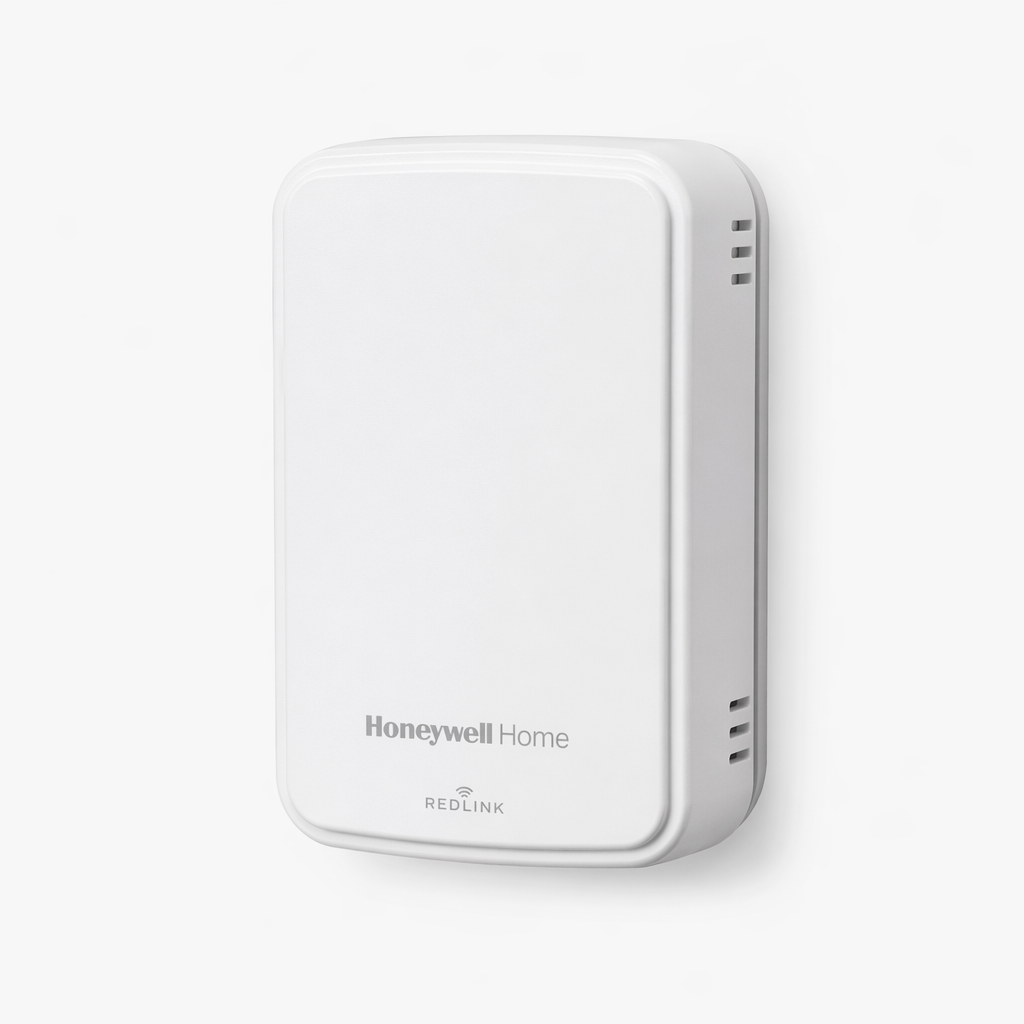
Each Smart Room Sensor can report temperature, humidity, and motion/occupancy.[3] In a house where the thermostat is mounted in a hallway that runs cooler than the bedrooms, or where a sunny office overheats before the rest of the floor, that changes what the thermostat is allowed to know. The T9 can make comfort decisions from occupied rooms instead of treating the hallway as the whole house.
The catch is placement. The sensors are wall-mounted rather than free-standing, so they are less flexible than sensor systems that can simply sit on a shelf. Wall mounting is tidy once settled, but it raises the cost of experimentation. If the first location catches afternoon sun, sits above a draft, or misses the actual seating area, moving it is more annoying than relocating a puck on a bookcase.
The thermostat itself also does not have a built-in motion sensor; occupancy behavior depends on the remote sensors.[3] That is not automatically a flaw, because the remote rooms are often the rooms that matter. It does mean a buyer interested in occupancy-based comfort should budget for sensors, not just the base thermostat.
For a deeper comparison of sensor ecosystems across brands, see the smart thermostat remote sensor guide.
Wi-Fi, platforms, hubs, and subscriptions
The T9 uses dual-band Wi-Fi, supporting both 2.4 GHz and 5 GHz networks.[3] The room sensors do not ride on home Wi-Fi; they communicate with the thermostat over 900 MHz RedLINK.[3] That split is one reason the sensor range is part of the T9’s appeal.
Platform support was broad for its class. PCMag’s review lists compatibility with Amazon Alexa, Google Assistant, Apple HomeKit, Samsung SmartThings, IFTTT, and Ring, and rated the T9 4.0 out of 5.[6] For mixed-platform homes, that matters. A thermostat that can live with HomeKit in one room, Alexa routines in another, and Google Assistant voice control elsewhere is easier to recommend than a device that asks the household to standardize around one ecosystem.
No separate hub is required, and there is no subscription requirement for the core T9 feature set.[3] That is one of the cleaner parts of the product. The less clean part is that connected features still depend on app and cloud support remaining healthy over time, and discontinued hardware gives buyers fewer assurances than an active model.
One operating limitation that should be on the box
The T9 cannot use scheduling and geofencing at the same time; Smart Thermostat Guide confirmed in hands-on testing that buyers must choose one mode or the other.[7] That is easy to miss when reading a feature list, because both features exist. The limitation is in how they can be used together.
This matters most in households with irregular routines. A fixed schedule is fine for predictable weekdays. Geofencing is useful when arrivals and departures change. Having to choose one can make the thermostat feel less automatic than expected, especially for a buyer coming from a model that blends schedule, presence, and occupancy more fluidly.
Energy savings: useful certification, not a personal guarantee
The T9 is ENERGY STAR certified, and the certification context cites 8% average savings on heating and cooling.[3] Treat that as a program-level average, not a promise that one home will save exactly that amount. Savings depend on climate, equipment, insulation, occupancy patterns, setpoints, and whether the thermostat is allowed to make meaningful setbacks.
The T9’s sensors can help comfort and may help avoid heating or cooling around the wrong room, but a sensor system is not a savings guarantee by itself. If the sensors encourage tighter comfort in occupied rooms, runtime can go up as well as down. For broader context, see smart thermostat savings in 2026 and demand-response earnings for thermostat owners.
Support risk is the real 2026 drawback
Discontinuation does not make the T9 stop working on the wall. It does change the risk profile. App features, integrations, replacement sensors, warranty handling, documentation, and cloud-dependent functions all become more important to verify when the official retail page has moved to discontinued and sold out.[1]
There are also anecdotal early-2026 forum reports of feature degradation affecting some discontinued Honeywell-connected thermostat models, including complaints about outdoor temperature display and app or web behavior. Those reports are not confirmed in the official T9 documentation provided here, so they should not be treated as established T9 facts. They are still a fair warning about the category: discontinued connected devices can lose value in ways that a traditional non-connected thermostat would not.
T9 vs. T10 Pro and active alternatives
The closest Honeywell-family successor is the T10 Pro. Honeywell’s support article describes the T10 Pro as adding humidifier, dehumidifier, and ventilator control, professional commissioning, and a 5-year trade warranty compared with the T9’s 2-year retail warranty.[8] That makes the T10 Pro the cleaner choice for more complex HVAC systems, provided the buyer is comfortable with the professional-install channel.
Sensor continuity may soften the move for existing owners: T9 and T10 Pro sensors are widely treated as cross-compatible, but that point is not the same as a clearly featured retail promise on the T9 product page. If sensor reuse is central to the plan, verify the exact sensor model numbers before buying more hardware.
For most new buyers, the better comparison set is active-market thermostats from Ecobee, Nest, Amazon, and current Honeywell models. Ecobee is usually the first stop for buyers who care most about remote sensors and active consumer support. Nest remains a common choice for buyers already invested in Google’s ecosystem; see the Google Nest Thermostat device profile. Amazon’s model can make sense for cost-focused Alexa households. For wider ecosystem routing, see the Sensi, Nest, and Ecobee comparison or the Honeywell smart thermostat comparison.
2026 verdict
Buy the Honeywell Home T9 only under a narrow set of conditions: the price is clearly clearance-level, your HVAC system is confirmed compatible, the package includes the parts you need, the room sensors are the main reason you want it, and you accept the support risk that comes with discontinued connected hardware.
Skip it if the listing is near current-model pricing, if your wiring is uncertain, if you need accessory control such as humidification or ventilation, or if long-term app and integration support matters more than a one-time deal. The T9 was a capable thermostat with unusually good sensors. In 2026, that is enough to keep it worth documenting, but not enough to make it the default buy.
References
- Honeywell Home T9 Smart Thermostat — Honeywell Home
- Honeywell Home T9 WiFi Smart Thermostat with Sensor RCHT9610WFSW2003 — Honeywell Store
- Honeywell Home T9 — The Front Desk Review, June 2026
- Thermostat Wiring Compatibility — Resideo
- Honeywell Home T9 Smart Thermostat review — TechHive
- Honeywell Home T9 Smart Thermostat With Sensor Review — PCMag
- Review: Honeywell T9 thermostat — Smart Thermostat Guide
- What's the difference between the T9 Smart Thermostat and the T10 Pro Smart Thermostat? — Honeywell Home Support, September 2025
Known issues with this device / protocol
Spec-version history
For active regressions on this protocol, see Update Watch.
No linked Update Watch entries yet.