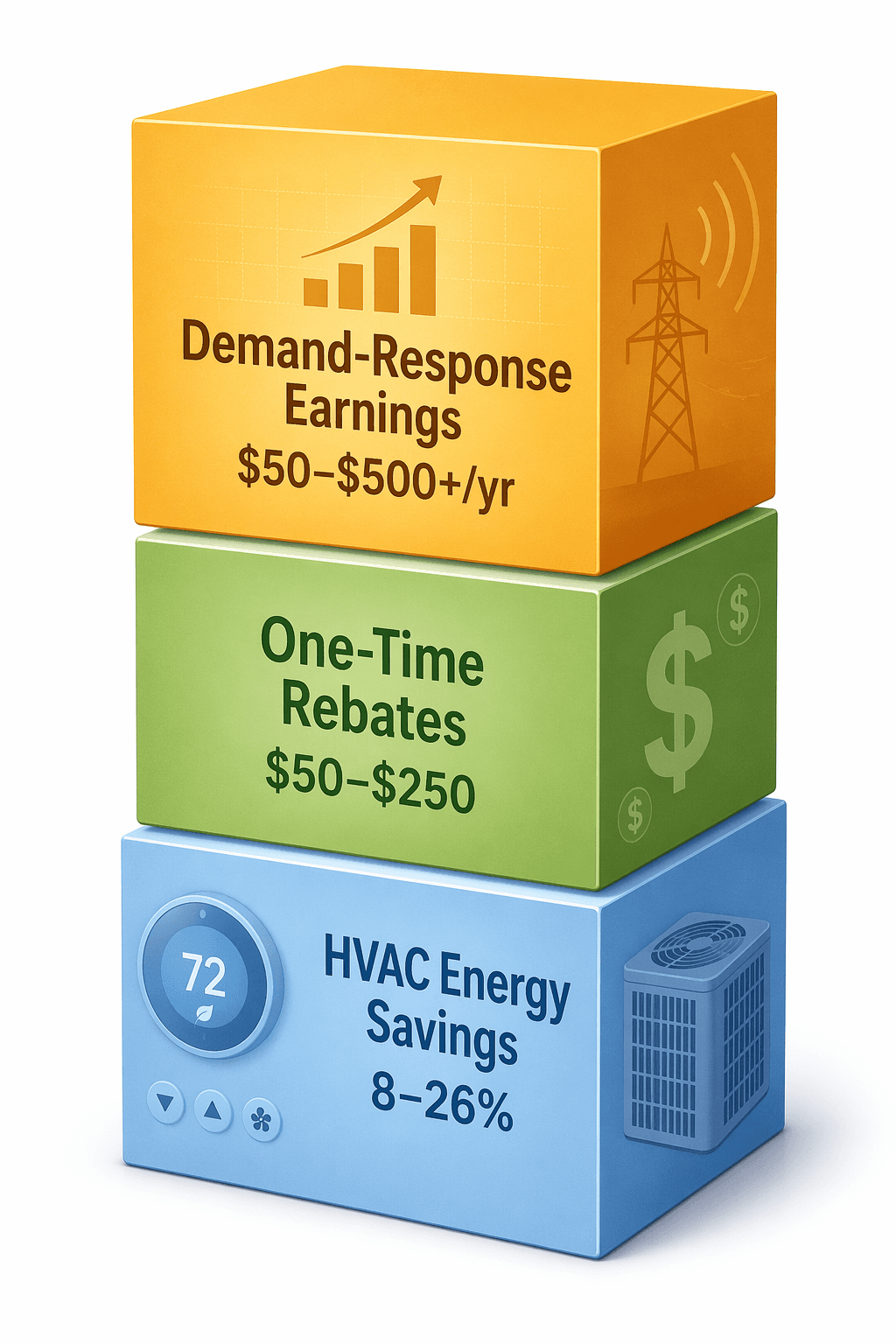
A smart home thermostat has three separate ways to earn its keep: lower HVAC use, a one-time purchase rebate, and demand-response payments. Those should stay in separate buckets. If a utility gives you a $75 enrollment credit, that is not the same thing as saving $75 on your heating bill. If a manufacturer study says users cut heating or cooling use, that does not mean your utility will send a check. And if a program pays an annual bill credit, it should not be counted again as an upfront rebate.
As of Q2 2026, the demand-response money is real, but it is local. In the programs below, the first-year value can be as modest as a $40 annual credit or as high as a few hundred dollars when enrollment bonuses, recurring credits, and active participation rewards line up. The catch is that the payer, payout method, and eligibility rules change by utility.
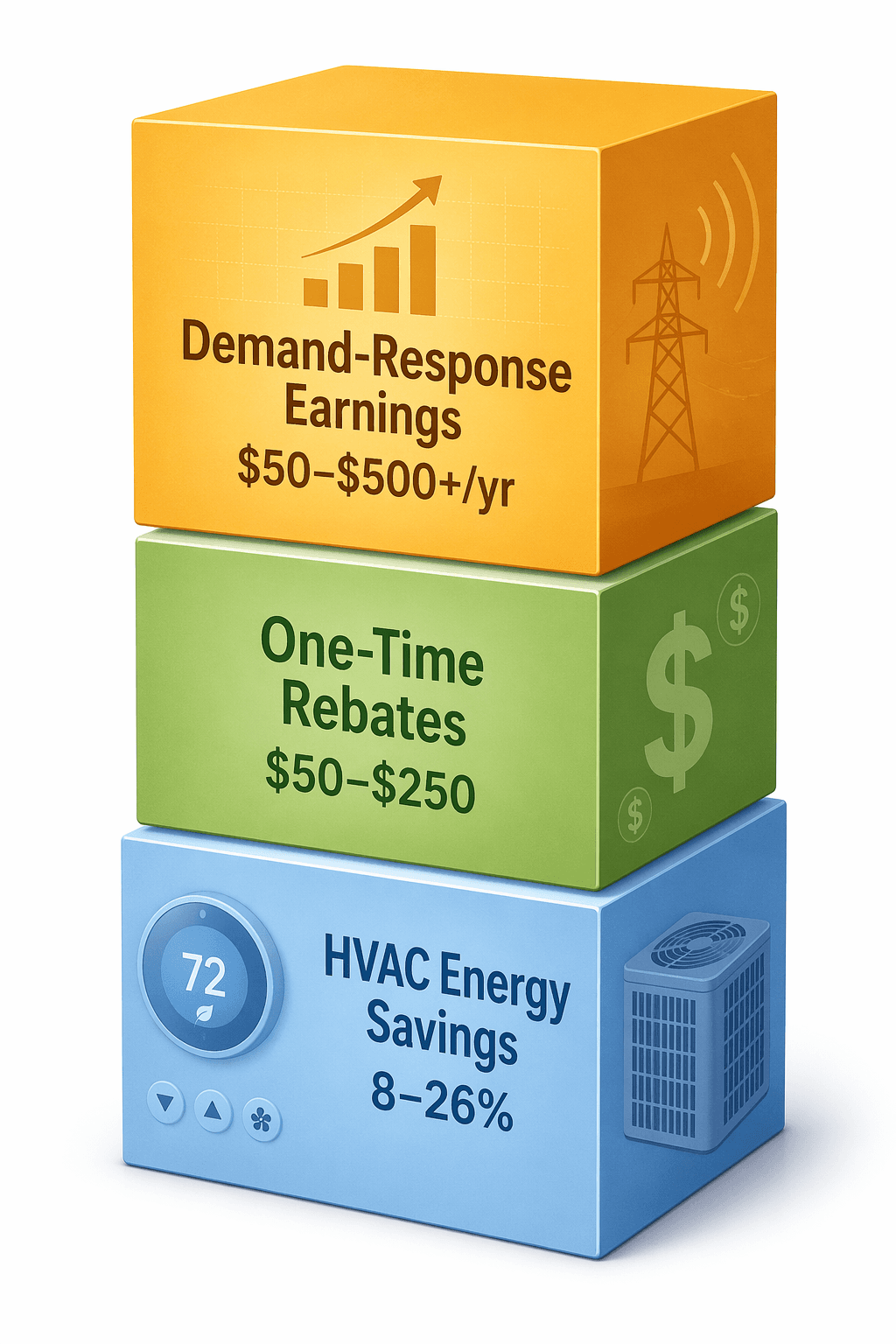
Demand-response payout breakdown, grouped by how the money arrives
| Payout shape | Program example | What a smart thermostat owner can receive | What to verify before counting it |
|---|---|---|---|
| Sign-up bonus plus annual bill credits | Southern California Edison Smart Energy Program | $75 for signing up, plus up to $50 in annual bill credits [1] | Eligible SCE service territory, compatible thermostat, event rules, and whether the full annual credit requires event participation |
| Enrollment credit plus recurring yearly payment | Austin Energy Power Partner Thermostat program | $75 enrollment incentive, $30 per year recurring incentive, and a $50 thermostat rebate; Austin Energy says the 2026 program boosted these incentives from prior years [2] | Austin Energy customer status, thermostat eligibility, program enrollment timing, and whether the rebate applies to your purchase |
| Prepaid card plus annual participation incentive | LADWP Power Savers | Up to $145 total: a $55 prepaid card and up to $90 annual participation incentive [3] | LADWP account eligibility, thermostat model, how the prepaid card is issued, and what participation level is needed for the annual amount |
| First-year bill credit plus recurring annual credit | GVEC Rush Hour Rewards | One-time $85 bill credit, then $30 for each year enrolled [4] | GVEC electric service, compatible thermostat, enrollment approval, and annual participation requirements |
| Lower flat annual payment | CoServ PeakTime Perks / Rush Hour Rewards | $40 per year [5] | Whether your CoServ account and thermostat qualify, and whether the annual payment depends on staying enrolled through the season |
| Enrollment incentive plus annual per-thermostat incentive | ConnectedSolutions-style smart thermostat programs | $50 enrollment incentive; income-eligible customers may receive $100; $20 annual incentive per thermostat [6] | Your utility sponsor, income-eligible qualification if claimed, per-thermostat limits, and seasonal event rules |
| Smaller enrollment plus recurring annual credit | National Grid New York ConnectedSolutions | $25 enrollment incentive plus $25 per year [7] | Whether you are in the correct National Grid service area and whether the program is electric cooling, gas heating, or another seasonal version |
| Aggregator-style earnings, historically higher but more variable | OhmConnect | A 2021 Canary Media report described average customer earnings of $250–$300 per year and $400–$500 per year for active users [8] | Current OhmConnect rates, market rules, eligible territory, device connection, and the effect of marketplace changes after the Ohm Store closure in November 2025 |
The cleanest programs to underwrite in a household budget are the utility-run ones. SCE, Austin Energy, LADWP, GVEC, CoServ, Eversource/ConnectedSolutions, and National Grid state a recognizable structure: enroll, allow limited thermostat adjustments during events, stay eligible, and receive a credit, card, or recurring incentive. The exact event rules still matter, but at least the money has a named payer and a published schedule.
OhmConnect belongs in the table because it explains why some demand-response earnings claims climb above ordinary utility bill-credit levels. It should not be read the same way as a 2026 utility tariff page. The $250–$300 average and $400–$500 active-user figures come from a 2021 report, and the model has changed since then, including the Ohm Store closure in November 2025 [8]. That makes it useful evidence for the high end of the category, not a number to paste into a 2026 payback spreadsheet without checking current terms.
Keep the three money buckets separate
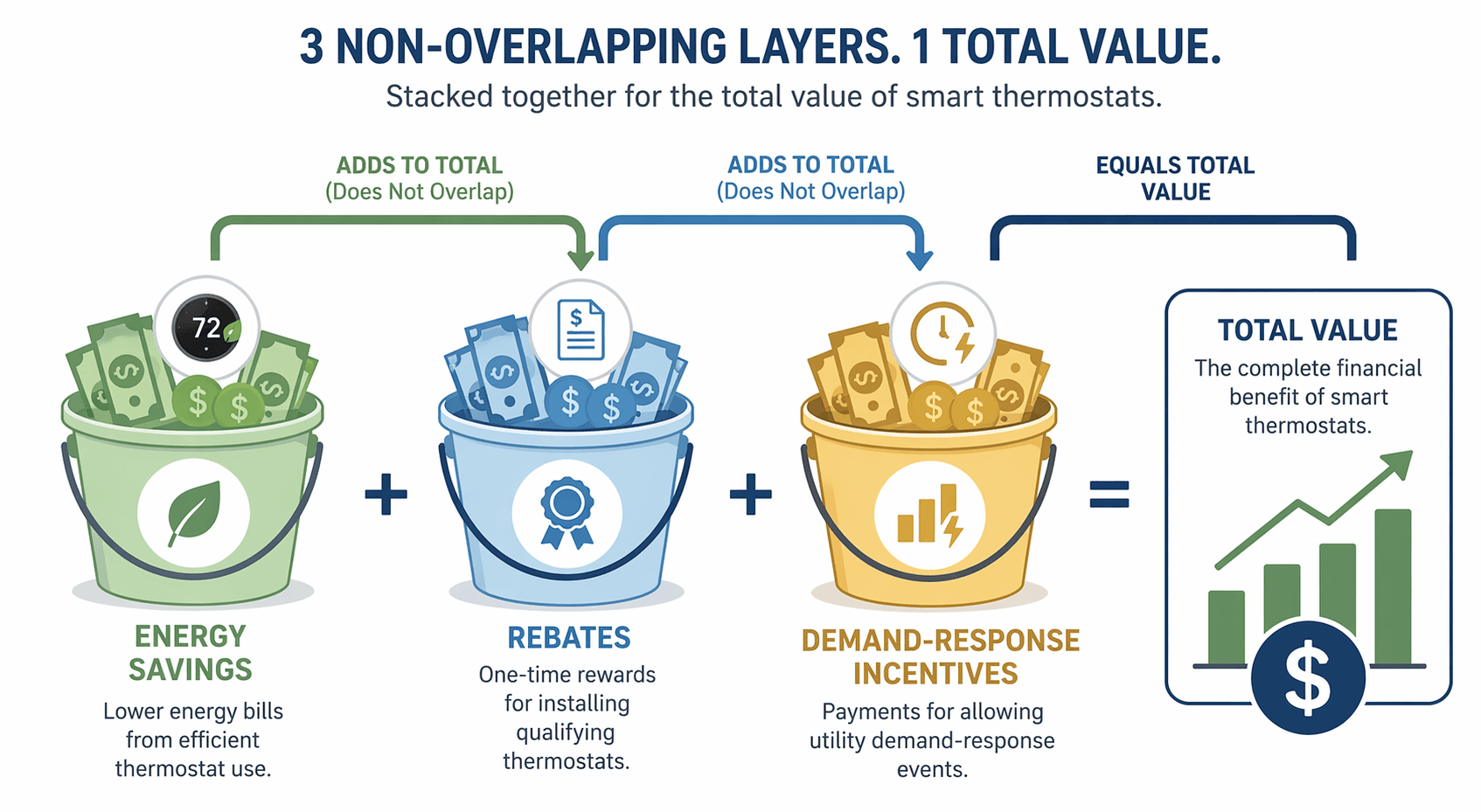
The easiest way to overstate smart thermostat payback is to mix avoided energy use, rebates, and demand-response incentives into one vague “savings” number. A better calculation starts with three lines:
- HVAC energy savings: the reduction in heating and cooling energy use after the thermostat is installed and scheduled properly.
- One-time rebate: a purchase or installation incentive, usually paid once by a utility, state program, or marketplace.
- Demand-response incentive: a payment, bill credit, prepaid card, or points-based reward for allowing the thermostat to participate in peak-demand events.
For baseline energy savings, NestGrid’s deeper explanations are the better place to spend time: Smart Thermostat Savings in 2026 and Smart Thermostat Energy Savings Decoded cover the 8–26% range in more detail. One useful anchor from the available research is Resideo’s study of about 6,000 Honeywell Home smart thermostat users, which reported 22% heating savings and 17% cooling savings [9].
Purchase rebates sit on a different line. The rebate may reduce your upfront cost, but it does not necessarily repeat next year. A 2026 rebate guide from HomeTreasur reports that 37 states allow stacking multiple rebates, with one-time thermostat rebates commonly discussed in the $50–$250 range [10]. For the broader rebate search, use NestGrid’s Smart Thermostat Energy Savings and ENERGY STAR Rebates in 2026 rather than assuming the demand-response enrollment credit is also your purchase rebate.
Demand-response earnings are the third line. They usually require enrollment after the thermostat is connected to Wi-Fi and linked to the utility or program administrator. During peak events, the program may adjust the temperature setpoint for a limited period. Many programs allow opt-outs, but the rules, effect on incentives, and data-sharing terms vary. That is why the demand-response line should be treated as conditional until the account is approved.
What first-year stacking can look like
A simple first-year calculation uses purchase price, minus confirmed one-time rebate, minus confirmed enrollment incentive, minus first-year demand-response credit, then separately estimates avoided HVAC costs. That last part should stay separate because it depends on home size, climate, insulation, rates, and how the old thermostat was used.
| Scenario | What is counted | Why it matters |
|---|---|---|
| Austin Energy-style stack | $50 thermostat rebate + $75 enrollment incentive + $30 annual recurring incentive [2] | A homeowner could see $155 in identifiable first-year program value before counting avoided HVAC energy use. |
| SCE-style stack | $75 sign-up incentive + up to $50 annual bill credits [1] | The demand-response side alone can reach up to $125 in first-year value if the account qualifies and earns the annual credit. |
| GVEC-style stack | $85 one-time bill credit + $30 annual enrolled credit [4] | The first year is heavier than later years, so year-one payback and long-term annual value should be modeled separately. |
| CoServ-style flat annual credit | $40 per year [5] | Lower payout, but easy to understand: the thermostat earns only if the household values a recurring, predictable credit. |
| Aggregator-style upside | Historical OhmConnect reporting showed $250–$300 average annual earnings and $400–$500 for active users [8] | The upside may be higher, but current earnings should be verified because the cited figures are older and the program model has changed. |
This is also where an expensive smart thermostat can begin to look less expensive. A buyer comparing models in the Best Smart Thermostat Buyer Guide 2026 may be tempted to choose only by retail price. But if one compatible model qualifies for a local rebate and demand-response program while another does not, the cheaper shelf price may not be the cheaper owned cost.
Why two owners with the same thermostat earn different amounts
The thermostat model matters, but the utility account matters more. Two households can install the same Nest, Ecobee, Honeywell Home, or Sensi thermostat and end up with completely different economics because only one utility offers a compatible program.
State and utility coverage is uneven
The payout table is not a national price sheet. It is a set of visible examples from utilities and program operators that publish terms clearly enough to use in a homeowner calculation. California, Texas, Massachusetts-style ConnectedSolutions territories, and New York appear in the available materials, but that does not mean every nearby city or co-op has the same offer.
Even inside one region, details split quickly. National Grid’s ConnectedSolutions page is for New York customers and lists a $25 enrollment incentive plus $25 per year [7]. New England ConnectedSolutions-style programs may use different administrators, seasons, and incentive levels. The name can sound familiar while the payout is not identical.
Eligibility is more than owning a compatible device
Most programs require an active residential electric account, a qualifying Wi-Fi thermostat, central air conditioning or electric heating equipment relevant to the season, and permission to make small temperature adjustments during events. Some programs pay per thermostat; others limit incentives by account. Some pay a prepaid card, while others issue a bill credit. That difference matters if the goal is household cash flow rather than abstract savings.
The annual amount may also depend on staying enrolled, not overriding too many events, or remaining connected through the season. A $50 annual credit is only worth $50 in the spreadsheet if the household is comfortable with the event rules attached to it.
Awareness is still the bottleneck
The strangest part of the demand-response story is not that incentives vary. It is that many eligible owners never check. Parks Associates reported that only about 20% of smart thermostat households participate in any demand-response program, and that 54% of non-participants do not know their utility offers one [11].
That finding changes the shopping order. Before deciding that one smart home thermostat has a better return than another, the homeowner should open the utility’s demand-response page and search for the supported-device list. If the program supports only certain thermostat platforms, eligibility can become a model-selection factor.
Utility programs and aggregators do not behave the same way
Utility-run programs usually read like a contract with a narrower range of outcomes: one sign-up credit, one annual credit, defined event seasons, and stated eligibility. Aggregator-style programs can be more dynamic because they may translate reductions into points, market-based rewards, or other earnings mechanisms. That can create higher upside, but also makes the current earning rate harder to infer from older articles.
Data-sharing terms deserve a real read in either case. A 2026 Copeland-sponsored study warned that U.S. homeowner trust in smart-home data practices had reached a low point, which is useful context but should be read with the source in mind because Copeland is a manufacturer in the thermostat market [12]. The practical question is simpler than the privacy debate: which data is shared, with whom, for what program purpose, and what happens if you leave?
A practical check before buying, and again after installation
The most useful pre-purchase search is not “best smart thermostat rebate.” It is your utility name plus “smart thermostat demand response,” “rush hour rewards,” “connected solutions,” “power savers,” or “peak time perks.” That search tells you whether the demand-response line in your payback calculation is $0, $25, $40, $125, or potentially more.
- Find the current utility page, not a cached marketplace listing.
- Confirm the thermostat brands and exact models supported.
- Separate the purchase rebate from the enrollment incentive.
- Check whether the recurring payment is annual, seasonal, per thermostat, or per account.
- Read the event opt-out rule before assigning full value to the annual credit.
- Look for income-eligible adders, but count them only if your household qualifies.
After installation, check again from inside the thermostat app and from the utility account portal. Some programs enroll through the utility, some through the thermostat manufacturer’s app, and some require both account authorization and device connection. A thermostat sitting on the wall but not enrolled in the program earns only the ordinary energy-saving side of the return.
For a broader ROI model, NestGrid’s Is a Smart Thermostat Worth It? Real Energy Savings, Payback, and ROI in 2026 can carry the purchase-cost math. The demand-response layer simply makes that math more local and, in some utility territories, much more favorable.
A smart thermostat can pay back faster when HVAC savings, one-time rebates, and demand-response incentives are layered correctly. In the best visible cases, first-year program value alone can cover a meaningful share of the device cost. In other territories, the demand-response line may be only a modest annual credit or unavailable altogether. The next step is not choosing a brand first; it is checking the current demand-response page for your utility before buying, or immediately after the thermostat is installed.
References
- SCE Demand Response, sce.com
- Austin Energy Power Partner boost, Austin Energy, 2026
- LADWP Power Savers, LADWP
- GVEC Rush Hour Rewards, GVEC
- CoServ PeakTime Perks, CoServ
- Eversource Smart Thermostat DR, Eversource
- National Grid ConnectedSolutions, National Grid
- OhmConnect $100M bet, Canary Media
- Utility Dive (Resideo/Parks report), Utility Dive
- HomeTreasur rebate guide, HomeTreasur, 2026
- Parks Associates DR report, Parks Associates
- Copeland privacy study, Copeland
Data Updates
Know about updated rebate programs, changed subscription prices, or new ENERGY STAR certifications? Submit a note below to help keep this content current. For formal data corrections, use the contact page.
Comments
Join the discussion with an anonymous comment.