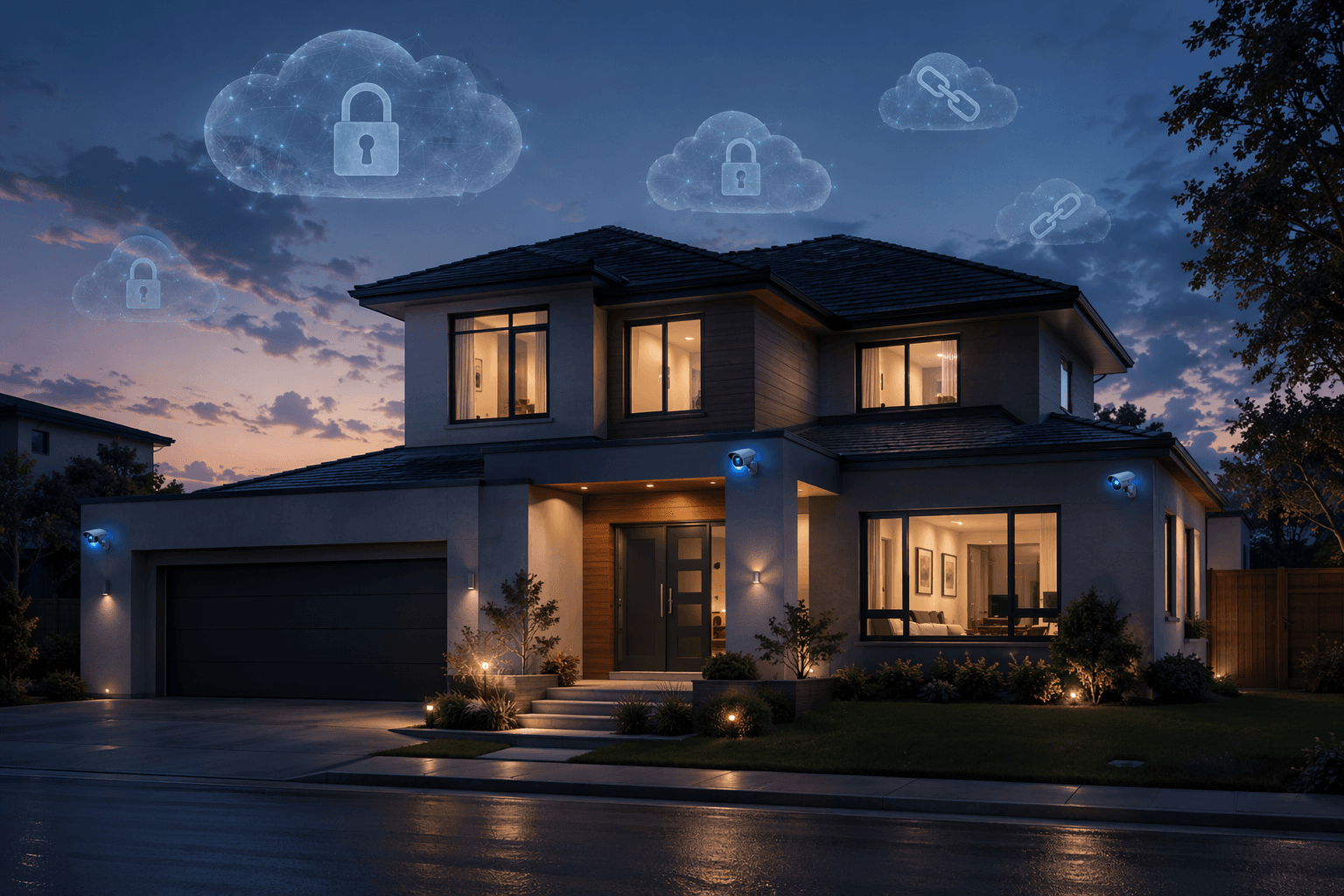
Smart home security crossed a practical threshold in 2026: security cameras are no longer a niche upgrade, and DIY installation is no longer the secondary path. In SafeHome.org’s January-February 2026 survey of 2,435 U.S. adults, 61% of U.S. households reported having security cameras, up from 52% in 2024, and the site estimates that 74.9 million homes now have cameras installed. DIY installation reached 49%, ahead of professional installation at 42%, which SafeHome.org describes as the first time DIY has led in its survey data.[1]
That is the 2026 smart home security market. The category is not waiting for mass adoption anymore. It has already moved into ordinary homes, apartments, duplexes, and rental properties. The more useful question is whether the systems people are buying still work well when life gets less tidy than the setup screen: the Wi-Fi drops, the app changes, the card on file expires, the subscription lapses, or someone needs footage after the fact.
What Changed in 2026
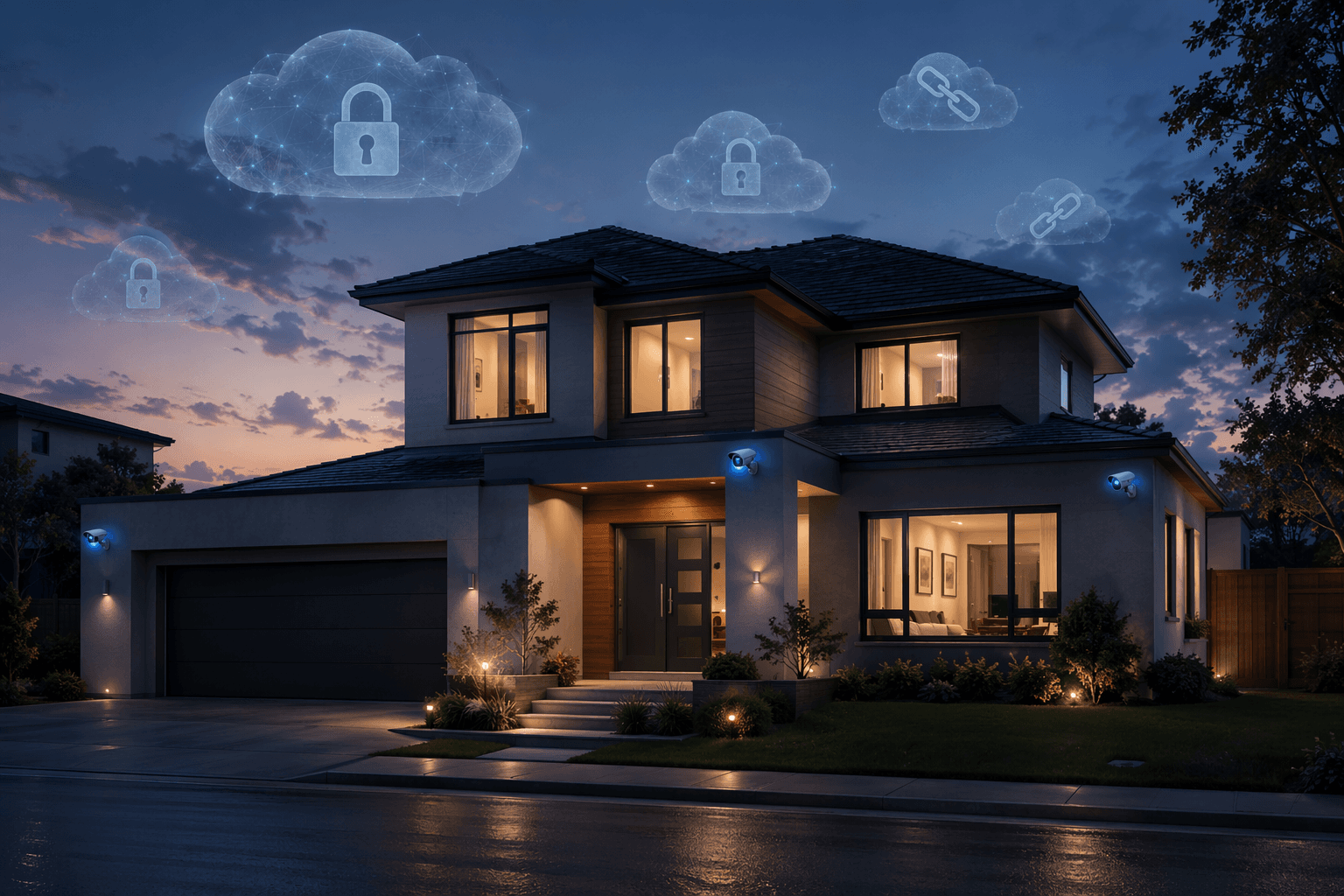
The camera boom is not only about homeowners adding more hardware to houses they already own. Renters are adopting cameras faster. SafeHome.org found renter camera adoption at 54% after a 12-point one-year jump, the sharpest single-year gain in the survey.[1] That matters because renters usually have fewer options: no rewiring the front entry without permission, no drilling into masonry, no replacing a door frame just to make a system look cleaner. Battery doorbells, peel-and-stick sensors, indoor cameras, and Wi-Fi chimes made security more portable.
Doorbell cameras also make more sense against the daily annoyance they were built to catch. SafeHome.org reported 48% doorbell camera adoption in 2026.[1] USPS Office of Inspector General data estimated 58 million packages were stolen in 2024, which helps explain why a camera pointed at the porch or driveway now feels less like a gadget and more like a normal fixture.[2]
Households with children are more likely to use outdoor cameras too: 66% compared with 49% of households without children in the SafeHome.org survey.[1] That number does not need to be inflated into a fear story. A driveway camera can be about checking whether a child got home, seeing who rang the bell, or confirming whether a delivery actually landed where it was supposed to. Ordinary visibility is the product now.
The survey has limits worth keeping in view. It is one survey from a home security review site, with a reported sample of 2,435 U.S. adults and a margin of error of plus or minus 2 percentage points.[1] A security-focused publication may attract a more security-interested audience than the general population. Still, the direction is hard to ignore: more cameras, more renters, more DIY installation, and more expectations that a phone can tell the household what just happened.
DIY Won the Installation Race, but It Did Not Remove the Work
DIY leading professional installation is a real change, and it fits the hardware. A modern system can be assembled from a doorbell camera, a few contact sensors, a keypad, a hub, and an app. Many buyers can get useful coverage without scheduling a technician or committing to a traditional alarm contract. For readers weighing that trade-off directly, the installation question is covered in more detail in DIY vs. Professional Home Security in 2026.
But “DIY” should not be read as “maintenance-free.” Parks Associates reported that 52% of DIY security system users experienced setup or connectivity issues.[3] That figure is useful because it describes the part of smart home security that does not show up in product photography: pairing failures, weak Wi-Fi at the front door, firmware updates, offline devices, dead batteries, and the special frustration of discovering a camera stopped recording before the incident anyone cares about.
The practical difference between DIY and professional installation is not only who mounts the camera. It is who notices when the system stops behaving. In a professionally installed system, monitoring and support may be part of the contract, though not always cheaply. In a DIY system, the homeowner or renter often becomes the installer, network admin, battery checker, permission manager, and evidence custodian. That can be fine. It just needs to be an explicit choice.
The Cloud Storage Gap Is the Part Buyers Should Slow Down For
The strongest warning in the 2026 data is not that people are buying cameras. It is how many of those cameras depend on a cloud account when the footage matters most. SafeHome.org found that 32% of users rely on cloud-only storage, while 6% canceled a security subscription in the past year.[1] Those are not the same group by definition, and the survey does not prove how many people lost footage. But together they describe a failure mode every buyer should understand: recorded video can become unreachable when storage depends entirely on an active service relationship.
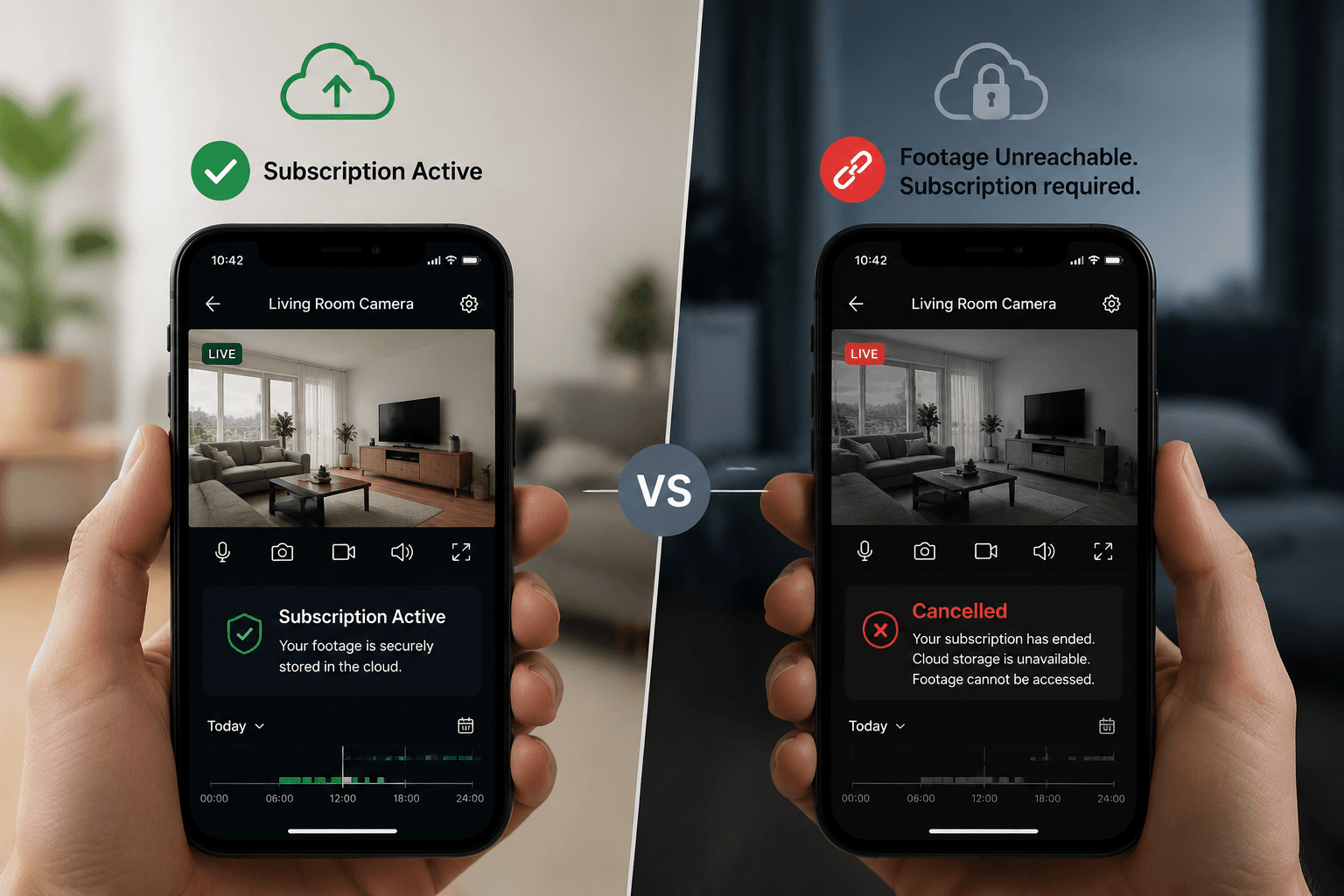
SafeHome.org points to an Arizona missing-person case as the concrete version of that risk: footage was lost after a subscription lapsed.[1] A single case is not a frequency estimate. It does not show that cloud-only systems usually fail, or that local storage is always better. What it does show is the exact moment most buyers do not imagine when they approve a monthly plan: someone needs the evidence after something has gone wrong, and the answer depends on billing status.
That distinction matters because camera companies often sell the emotional result, not the evidence chain. “Recorded video” can mean event clips stored in the cloud for a limited period. It can mean 24/7 recording only on a higher tier. It can mean thumbnails without retrievable footage after cancellation. It can mean local recording to a base station, a microSD card, or network storage, with cloud backup as an add-on. The buyer does not need to reject subscriptions; subscriptions can be useful. The buyer does need to know what survives when the subscription does not.
A resilient setup answers a few plain questions before anything happens. Can the system record locally? Can old clips be exported before cancellation? Does cancellation stop new recording only, or does it also limit access to stored clips? How long are events retained? If the internet goes down, does the camera keep recording to a device in the home? For a deeper cost and architecture breakdown, see the Smart Security Camera Subscription Showdown.
Brand Share Helps Explain the Market, Not Whom to Trust
Ring remains the dominant brand in SafeHome.org’s 2026 survey, with 43% share among reported camera users. ADT followed at 10%, Google Nest at 7%, Wyze at 6%, and SimpliSafe at 5%.[1] That spread is useful for understanding the market: one brand has enormous installed reach, while several others compete across professional monitoring, DIY packages, budget cameras, and ecosystem tie-ins.
Dominance is not the same thing as trust. In 2023, the Federal Trade Commission said Ring employees had illegally surveilled customers and that the company had failed to stop hackers from taking control of customer cameras; Ring agreed to a $5.8 million refund settlement.[4] That case should not be stretched into a claim that every Ring camera is unsafe or that every cloud camera is abusive. It is enough to make one point: buyers should read privacy controls, account-security requirements, storage rules, and law-enforcement request policies as part of the product, not as paperwork outside the product.
For shoppers at the brand-comparison stage, the better move is to separate the questions. One comparison should cover equipment, monitoring, pricing, and installation. Another should cover storage, privacy, and export options. The broader system comparison is handled in Smart Home Security Systems in 2026: A Head-to-Head Comparison, with a brand-by-brand buyer view in Smart Home Security Systems in 2026: A Buyer’s Comparison.
AI Detection Is Becoming Expected, but the Data Shows Demand More Than Results
AI features are now part of the buying checklist. SafeHome.org found that 28% of users report using person or package detection, and 39% say they want facial recognition.[1] Those are self-reported survey responses, not measured improvements in crime prevention, emergency response, or false-alarm reduction. They show feature adoption and buyer interest.
That is still important. Person detection can reduce useless motion alerts from trees, headlights, and passing cars. Package detection can make a doorbell camera more useful for deliveries. Facial recognition, where offered, raises a different set of expectations: who gets labeled, where that data is processed, how mistakes are corrected, and whether familiar-face alerts are worth the privacy trade.
A buyer does not need the longest AI feature list. A buyer needs features that match the job. A driveway camera may need reliable vehicle and person alerts. A front-door camera may need package detection and fast clip access. Indoor cameras may need stricter privacy controls, physical shutters, or simpler rules about when they are allowed to record. Hardware security also still matters; for connected locks, ANSI/BHMA grading is a separate question from whether the lock appears neatly inside the same app, and it is covered in The Best Smart Lock for Security: ANSI/BHMA Grades Explained and Compared.
Alerts Are Only as Useful as the Response Path
The last piece of the 2026 picture sits outside the camera itself. Some cities have moved toward verified response policies, with Seattle as one example, meaning police response may depend on confirmation that an alarm event is real rather than an unverified automated alert.[5] This does not make cameras pointless. It changes what buyers should design for.
If a system is meant mainly to document porch theft, fast clip retrieval may matter more than siren volume. If it is meant to support emergency response, monitoring rules, verification steps, camera placement, and contact lists become part of the system. If the user is a renter, portability and clean removal may outrank hardwired coverage. If the household travels often, battery life, offline recording, and remote account recovery deserve more attention than another alert category.
That is where smart home security in 2026 lands: mainstream enough to be a reasonable default, but mature enough that buyers should stop treating the purchase as a camera choice alone. The three questions that matter most are who installs and maintains it, where footage is stored when payments or internet access fail, and what response path exists when an alert actually matters. For a broader buying framework, see How to Choose a Smart Home Security System: Four Key Decisions for 2026.
References
- Home Security Industry Annual Report, SafeHome.org.
- Mail Theft Mitigation and Response, USPS Office of Inspector General.
- DIY Home Security Tracker, Parks Associates.
- FTC Says Ring Employees Illegally Surveilled Customers, Failed to Stop Hackers from Taking Control of Users’ Cameras, Federal Trade Commission, May 31, 2023.
- Verified Response, Seattle Police Department.
Policy Updates & Reader Notes
Privacy policies, monitoring plan prices, and security disclosures change frequently. Report new data retention terms, updated plan pricing, or new vulnerability disclosures below. For formal editorial corrections, use the contact page.
Comments
Join the discussion with an anonymous comment.