The smart home security systems worth comparing in 2026 are not just alarm panels with nicer apps. The buying decision has moved into a messier place: more households already have cameras, more buyers are installing systems themselves, and the biggest brand in the category is not the same thing as the right brand for every home. In SafeHome.org’s 2026 survey of 2,435 U.S. adults, 61% of households had security cameras, up from 52% in 2024; 49% of alarm users said they self-installed, compared with 42% who used professional installation; and Ring held 43% market share, far ahead of ADT at 10%, Google Nest at 7%, SimpliSafe at 5% to 6%, and Wyze at 5% to 6%.[1]
That shift changes how a comparison should work. A first-time buyer does not need a trophy handed to one brand. They need to know which system will fit the platform already running the house, what happens after the discounted starter kit arrives, and whether the monthly fee comes with a real service advantage or just another subscription.
The 2026 Comparison At A Glance
The table below uses public buyer-guide pricing and feature ranges from Security.org, PCMag, CNET, NerdWallet, and Surety Home, with the usual warning that promotional equipment prices and installation offers change often.[2][3][4][5][6]
| System | Best fit | Typical upfront cost | Monthly monitoring | Contract posture | Installation | Smart platform fit | AI and camera notes |
|---|---|---|---|---|---|---|---|
| Ring Alarm | Alexa households and cost-conscious DIY buyers | Often starts around a few hundred dollars; larger camera-heavy setups can rise meaningfully | Generally lower than traditional pro-installed systems; plan level depends on monitoring and video needs | Low-commitment compared with traditional dealer contracts | DIY | Strongest with Amazon Alexa | Person and package-style camera features depend on camera model and subscription tier |
| ADT | Buyers who want professional monitoring, installation options, and a Google/Nest-aligned path | Quote-dependent; starting prices may not reflect a full home buildout | Commonly in the higher monitored-service range | May involve multi-year terms depending on package and financing | Professional and self-setup options vary by offer | Official Google Nest partner | Nest camera features may be attractive for Google households, but plan details matter |
| SimpliSafe | Renters, small homes, and buyers who want DIY security without deep ecosystem lock-in | Usually accessible starter-kit pricing, with cost rising as sensors and cameras are added | Midrange monitoring options | Generally low-commitment | DIY | Works with major assistants, but is less of a full smart-home ecosystem bet | Useful camera and verification features, not the most platform-native option |
| Abode | Apple HomeKit households and buyers who want a flexible DIY hub | Often starts in the DIY range; total cost depends on sensors, cameras, and automations | Self-monitoring and professional-monitoring options vary by plan | Generally low-commitment | DIY | The standout for native Apple HomeKit support | Better for mixed-device automations than for buyers who only want a simple alarm |
| Vivint | Premium shoppers who want a professionally designed, camera-heavy system | Can move into the high end once equipment, installation, and financing are included | Often higher than DIY-first systems | Quote-dependent and commonly contract-shaped | Professional | Broad smart-home device support, but less ecosystem-neutral in practice | Strong camera and automation story, with contract and quote caveats |
The first sorting question is not “Which brand is biggest?” It is “Which app and voice assistant will this household actually use?” The second is “Do you want a system you can change or cancel easily, or do you want a professionally monitored service where the contract is part of the model?”
Cost Is More Than The Starter Kit Price
The cheapest-looking system at checkout is not always the cheapest system to own. A starter kit may cover a front door, a motion sensor, and a keypad. It may not cover the side door, basement windows, garage entry, second-floor balcony door, video doorbell, indoor camera, outdoor floodlight camera, extra siren, smart lock, or enough cloud video history to make the cameras useful.
NerdWallet’s 2026 cost guide places home security system costs across a broad range, with equipment, installation, monitoring, and add-ons all changing the final bill.[5] That matters because the buyer sees one number on the product page and then lives with a different number after the system is expanded to match the house.
The order of operations should be simple: price the equipment you actually need, then add installation if you are not doing it yourself, then add the monitoring plan that gives you the response and video features you expect, then look at the contract or cancellation terms. If a system needs a sales call before it can give a firm quote, treat any public starting price as a doorway, not an estimate.
ADT and Vivint deserve that caveat in large print. Both can be legitimate choices for buyers who want a professionally designed system, stronger monitoring handoff, and fewer do-it-yourself decisions. But quote-based pricing makes them harder to compare against Ring, SimpliSafe, or Abode from a web page alone. The number that matters is the installed, monitored, contract-adjusted price for your home, not the lowest package shown in an ad.
Surety Home’s 2026 cost guide gives a useful ownership lens: its examples put a DIY-oriented three-year total cost around $1,456 to $1,753, compared with traditional dealer examples around $1,620 to $3,160 or more.[6] That comparison is worth reading, but not as a neutral law of the market. Surety Home is itself a monitoring provider, so its examples naturally frame DIY in a favorable way. The more durable lesson is that three-year cost exposes fees that a starter-kit comparison hides.
| Cost layer | What to check before buying |
|---|---|
| Equipment | Count every sensor, camera, keypad, siren, range extender, smart lock, and video doorbell you expect to use. |
| Installation | DIY saves labor cost but makes you responsible for placement, Wi-Fi coverage, testing, and explaining the system to everyone in the home. |
| Monitoring | Compare professional dispatch, cellular backup, video storage, camera detection features, and whether the plan is required for core functions. |
| Contract | Separate month-to-month monitoring from financed equipment, promotional discounts, and multi-year service terms. |
| Three-year cost | Add the equipment, installation, monthly fees, and required add-ons over 36 months before deciding which system is cheaper. |
Ecosystem Fit Changes The Recommendation
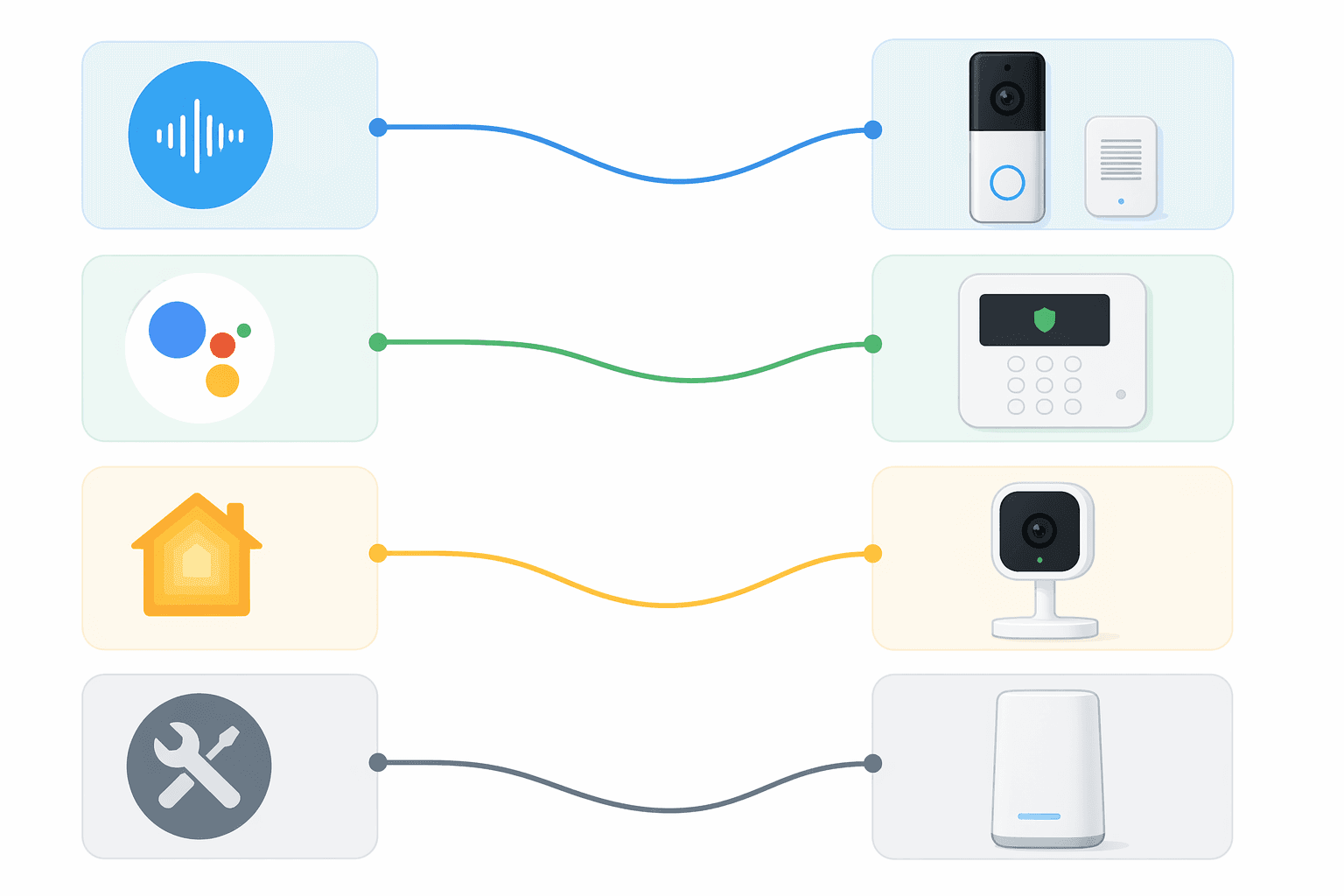
Smart home compatibility is one of the easiest phrases to overtrust. A system can “work with” a voice assistant and still feel clumsy in daily use. The important question is narrower: can the people in the house arm it, view cameras, get useful alerts, and connect locks or lights without maintaining a private compatibility spreadsheet?
Ring is the obvious fit for Alexa households. Its 43% market share says something real about default buyer behavior: it is easy to find, easy to understand, and often easy to install.[1] For a home already using Echo speakers, Fire TV devices, and Alexa routines, Ring usually creates the least friction. The same dominance can also make recommendations lazy. A Ring system is not automatically the best choice for someone who has built the rest of the house around Google Home or Apple HomeKit.
ADT is more compelling when the household is already leaning into Google Nest. ADT has been positioned as the official Google Nest partner, which gives it a clearer story for buyers who want Nest cameras and Google Home to sit near the center of the system.[2] That does not erase the pricing and contract questions. It means ADT should be judged as a monitored-service choice with a Google-friendly device path, not as a cheap DIY alternative.
Abode is the system to look at first if Apple HomeKit is non-negotiable. Among the major systems in this comparison, Abode stands out for native HomeKit support.[2][3] That matters for Apple households because a “compatible” device that lives mostly outside the Home app can become another island to manage. Abode is also more appealing to people who like automations and mixed-device control than to someone who wants the simplest possible alarm setup.
SimpliSafe is the cleaner middle path for many renters and small-home buyers. It does not ask the household to reorganize around one tech giant’s ecosystem, and it does not carry the same quote-and-contract feel as traditional pro-installed systems. That makes it easier to recommend when the buyer wants monitored security, sensors, and a few cameras, without turning the purchase into a whole-home platform decision.
Matter support and firmware updates can shift some of these boundaries over time, especially for individual devices. For a security system, though, future compatibility is not a substitute for current daily behavior. Buy for the app, devices, and integrations that work cleanly now.
DIY Has Overtaken Professional Installation, But That Does Not End The Debate
The 49% self-installation figure is the clearest sign that DIY systems are no longer a niche workaround.[1] For apartments, townhomes, and straightforward single-family layouts, DIY can be the better default. You can place sensors on your schedule, avoid an installation appointment, move the system when you move, and usually avoid the kind of long service commitment that makes a simple alarm feel like a utility contract.
There is a cost to that control. Someone has to decide whether the motion sensor sees the hallway or the dog, whether the side gate camera has enough Wi-Fi, whether the siren is audible upstairs, and whether the person who hates phone apps can still disarm the system quickly. DIY is easier than it used to be, but it still transfers design responsibility from the installer to the household.
Professional installation still earns its place in larger homes, homes with detached garages or multiple exterior zones, households with less tolerance for troubleshooting, and buyers who want a monitored-service company to own more of the setup. Professional monitoring also deserves more weight than survey behavior alone might suggest. SafeHome.org found ease of use at 50% and monthly cost at 46% among purchase decision factors, while professional monitoring ranked ninth at 14%.[1] That shows what buyers prioritize, not necessarily what matters most during an actual alarm event.
How The Major Systems Sort By Buyer
Alexa household: Ring
Ring is the easiest recommendation for a household already using Alexa every day. Doorbell alerts, camera viewing, voice routines, and familiar app behavior all work in its favor. It is also easier to expand gradually than many traditional systems: start with an alarm kit and doorbell, then add outdoor cameras or extra sensors as weak spots become obvious.
The caution is platform gravity. Ring is comfortable inside Amazon’s orbit. If the household is undecided about its broader smart home direction, it is worth reading a broader 2026 smart home ecosystem guide before buying cameras, locks, speakers, and alarm hardware that all assume Alexa will remain the center.
Google or Nest household: ADT
ADT makes the most sense when the buyer wants a more traditional monitored-service model and already likes the Google Nest direction. The appeal is not just hardware. It is the combination of monitoring, installation help, brand infrastructure, and a Google-aligned device path.
This is also where the sales call matters. ADT may be the right choice for a larger home or a household that wants someone else to design the system, but the buyer should ask for the full equipment list, installation cost, monitoring fee, contract term, cancellation terms, and what happens if equipment is financed. A polished consultation is not the same as a comparable written price.
Apple HomeKit household: Abode
Abode is the practical first stop for HomeKit buyers because native Apple support is scarce in full security systems. It is a better match for someone who already thinks in scenes, automations, and multi-brand devices than for someone who wants the fewest settings possible.
The buying discipline with Abode is to decide how much security you want versus how much automation you want. A hub that can do more also gives you more to configure. For some homes, that flexibility is the point. For others, SimpliSafe’s narrower approach will feel calmer.
Renter or small home: SimpliSafe
SimpliSafe is strongest when the home is not complicated. A renter, condo owner, or small-house buyer can usually cover the main entry points without a professional design visit. The system is also easier to explain to someone who only wants to know how to arm it at night, disarm it in the morning, and answer an alert when a sensor trips.
It is not the most ambitious smart-home platform in this group. That is a feature for the right buyer. If the goal is security first and ecosystem experimentation second, SimpliSafe keeps the decision from spreading into every light switch and thermostat in the house.
Larger home or premium installation: ADT or Vivint
For a larger home, the best system may be the one whose installer notices the boring problems: weak signal near the garage, too many glass doors for the starter kit, poor camera angle at the driveway, or a keypad location that works for guests but not for the family. ADT belongs in that conversation because monitoring and professional service are central to its value.
Vivint belongs there too, especially for buyers who want a premium, camera-heavy smart home security system and are comfortable evaluating a quote. It should be treated as a bigger purchase, not a casual alternative to a DIY kit. Readers comparing that route should use a dedicated Vivint smart home security buyer’s guide before signing anything.
Budget-sensitive buyer: Start With Ring, SimpliSafe, Or Abode
A budget-sensitive buyer should not start by asking which brand has the lowest advertised kit. Start with a floor plan. Count doors, accessible windows, motion zones, cameras, and any smart locks you want tied into arming routines. Then price Ring, SimpliSafe, and Abode with the same device count and the monitoring plan you would actually keep.
Smart locks are a good example of the hidden second purchase. A system may be easier to live with when the front door lock can trigger an arm or disarm routine, but that adds hardware cost and compatibility questions. If lock integration is part of the plan, compare models through a dedicated smart lock buyer guide instead of assuming every lock works equally well with every alarm platform.
AI-camera-focused buyer: Useful, But Not Magic
AI matters most when it reduces bad alerts. Person detection, package detection, familiar-face features, and smarter camera zones can make a system easier to live with because fewer useless notifications reach the person holding the phone. SafeHome.org found that 28% of users with capable cameras already had AI person or package detection, and 39% wanted facial recognition.[1]
Those numbers show direction, not a requirement for every buyer. The 28% figure applies to users who already have capable cameras, not to every household. Facial recognition interest is an attitude, not adoption. If a brand says “AI security” without explaining which detection features are included, which cameras support them, whether cloud processing is required, and which plan unlocks them, treat the phrase as unfinished.
Where Market Growth Helps, And Where It Does Not
The broader smart home security market is still growing, and analyst forecasts such as Fortune Business Insights point to continued expansion.[7] That context explains why every brand is pushing cameras, subscriptions, and platform integrations harder. It does not tell a buyer whether a three-year contract is worth signing or whether a spouse will actually use the app.
The more useful market signal is buyer behavior. Cameras are mainstream. DIY installation has overtaken professional installation. Ring has become the default for a large share of shoppers. Each fact is useful; none of them should make the decision for you.
Scenario-Based Verdict
- Choose Ring if your home already runs on Alexa, you want a DIY-first system, and you care about broad availability, easy expansion, and relatively low friction.
- Choose ADT if you want professional monitoring and service to carry more of the burden, especially in a Google or Nest-leaning household, and you are willing to scrutinize the quote and contract.
- Choose SimpliSafe if you want a lower-friction DIY security setup for a rental, condo, or smaller home without committing the whole household to one smart-home ecosystem.
- Choose Abode if Apple HomeKit support is a real requirement or if you want a flexible DIY hub that can support more automation than a basic alarm kit.
- Consider Vivint if you are shopping in the premium, professionally installed category and want a camera-heavy system, but compare total cost and contract terms before treating it as equivalent to DIY brands.
The best smart home security system in 2026 is the one whose tradeoffs match the home after the first month: the app people will answer, the monitoring plan they will keep paying for, the cameras that reduce rather than multiply alerts, and the ecosystem that does not fight the rest of the house.
References
- SafeHome.org 2026 Market Report — SafeHome.org
- Security.org Best Smart Home Security Systems 2026 — Security.org
- PCMag Best Smart Home Security Systems 2026 — PCMag
- CNET Best Home Security Systems 2026 — CNET
- NerdWallet Cost Guide 2026 — NerdWallet
- Surety Home Cost Guide 2026 — Surety Home
- Fortune Business Insights Market Report — Fortune Business Insights
Policy Updates & Reader Notes
Privacy policies, monitoring plan prices, and security disclosures change frequently. Report new data retention terms, updated plan pricing, or new vulnerability disclosures below. For formal editorial corrections, use the contact page.
Comments
Join the discussion with an anonymous comment.