
Shopping for smart home security systems in 2026 gets easier once you stop treating it as a brand contest. Ring, SimpliSafe, ADT, Vivint, Arlo, Eufy, Abode, and Cove are not trying to solve the same household problem in the same way. Some are built for renters who need peel-and-stick sensors and no contract. Some are built for homeowners who want a technician, cameras, locks, smoke detection, and one bill. Some work best if Alexa is already running the house. Some become irritating the minute you ask them to play nicely with Apple Home.
The category is now too ordinary to shop like a gadget splurge. In SafeHome.org's 2026 survey of 2,435 US adults, 61% of households reported having security cameras, up from 42% in 2024. DIY installation reached 49%, ahead of professional installation at 42%. The top decision factors were ease of use at 50% and monthly cost at 46%, ahead of brand reputation.[1] Those numbers say something useful: people are not mainly asking which system has the most impressive spec sheet. They are asking which one they can install, afford, and live with.
Ring's lead is real, with an important caveat. SafeHome.org found Ring at 43% brand share, nearly as much as the rest of the field combined, while ADT was around 10% and SimpliSafe and Vivint were each in single digits.[1] But that is self-reported survey data about a primary system or camera brand, not unit-shipment data or proof that Ring is the best fit for every house. It mostly explains why so many comparisons start there: Ring is easy to find, easy to buy, and easy enough for many homes.
The 2026 Comparison Map
Prices change with promotions, bundles, and monitoring tiers, so the cost figures below should be read as June 2026 shopping ranges rather than permanent labels. The useful question is not whether one starter kit is $40 cheaper this week. It is whether the system's ecosystem, installation model, storage plan, and monitoring bill match the way the home will actually be used.
| System | Best fit | Ecosystem fit | Installation | Equipment cost as of June 2026 | Monthly cost as of June 2026 | Storage dependence | AI features to notice |
|---|---|---|---|---|---|---|---|
| Ring Alarm | Alexa households, budget-conscious DIY buyers, renters who want broad accessory availability | Strong Alexa fit; limited Apple Home fit; broader Matter camera benefits remain uneven | DIY, with optional professional help through third parties | Ring Alarm 5-piece kit around $199 | Professional monitoring around $20/mo | Many camera features depend on cloud subscription | Person and package detection on supported cameras; broader AI features raise data-sharing questions |
| SimpliSafe | DIY buyers who want a straightforward alarm system without a long contract | Works with voice assistants and August locks; lacks broad Z-Wave/Zigbee-style device control | DIY, with optional professional installation | Essentials kit around $265 | Professional monitoring around $27.99/mo | Cloud features and monitoring tiers matter for full functionality | Useful camera detection features, but the main appeal is simplicity rather than deep automation |
| ADT | Homeowners who want a long-running professional monitoring brand and technician-led setup | Varies by package and partner integrations; check the exact equipment bundle | Primarily professional installation, with some self-setup options depending on product line | Often higher than DIY starter kits; quote-dependent | Typically paid professional monitoring | Plan and equipment dependent | More about monitored protection and service model than flashy AI differentiation |
| Vivint | Homeowners who want a premium professionally installed system with cameras, locks, sensors, and smart-home control | Strong integrated smart-home package; less appealing if you want a piecemeal DIY setup | Professional installation | Roughly $600-$1,200 equipment, often contract-based | Around $49.99/mo | Cloud and service plan dependence is central to the model | Advanced camera and detection features, with the cost and contract structure to match |
| Eufy | Buyers who care about local storage options and lower recurring costs | Works with major platforms depending on device; exact compatibility varies by camera and hub | Mostly DIY | Varies by camera, hub, and kit | Can be lower-subscription or no-subscription depending on setup | Local storage options are a major attraction | Person, face, and object detection vary by model and hub |
| Arlo | Camera-first households that want polished outdoor and indoor video coverage | Works with multiple ecosystems depending on device generation and plan | DIY | Example: Arlo Pro 6 hardware around $200 | Example subscription around $8/mo | Subscription can become central to alerts and stored video | Person, vehicle, animal, and package detection depending on model and plan |
| Abode | Smart-home tinkerers who want more automation flexibility than basic DIY alarms | Broader smart-home compatibility than many simple alarm kits | DIY | Varies by kit and sensors | Self-monitoring and paid monitoring options | Depends on plan and device mix | Less about headline AI, more about flexible automation |
That table is a starting point, not a verdict. A renter in an Alexa apartment and a homeowner planning cameras, smart locks, and monitored smoke detection should not be forced into the same answer. The better comparison runs through four axes: ecosystem compatibility, installation tolerance, three-year cost, and the AI features you will actually use.
Start With the Ecosystem You Already Live In
A security system touches the parts of a smart home people notice quickly: doorbells, cameras, locks, voice assistants, lights, routines, and phone notifications. If the system fights the ecosystem already in the house, the annoyance shows up every day. The wrong choice is not always broken. Sometimes it just means the front-door camera will not appear where you expect it, the lock cannot join the routine you already use, or the person who normally answers the doorbell has to open a separate app.
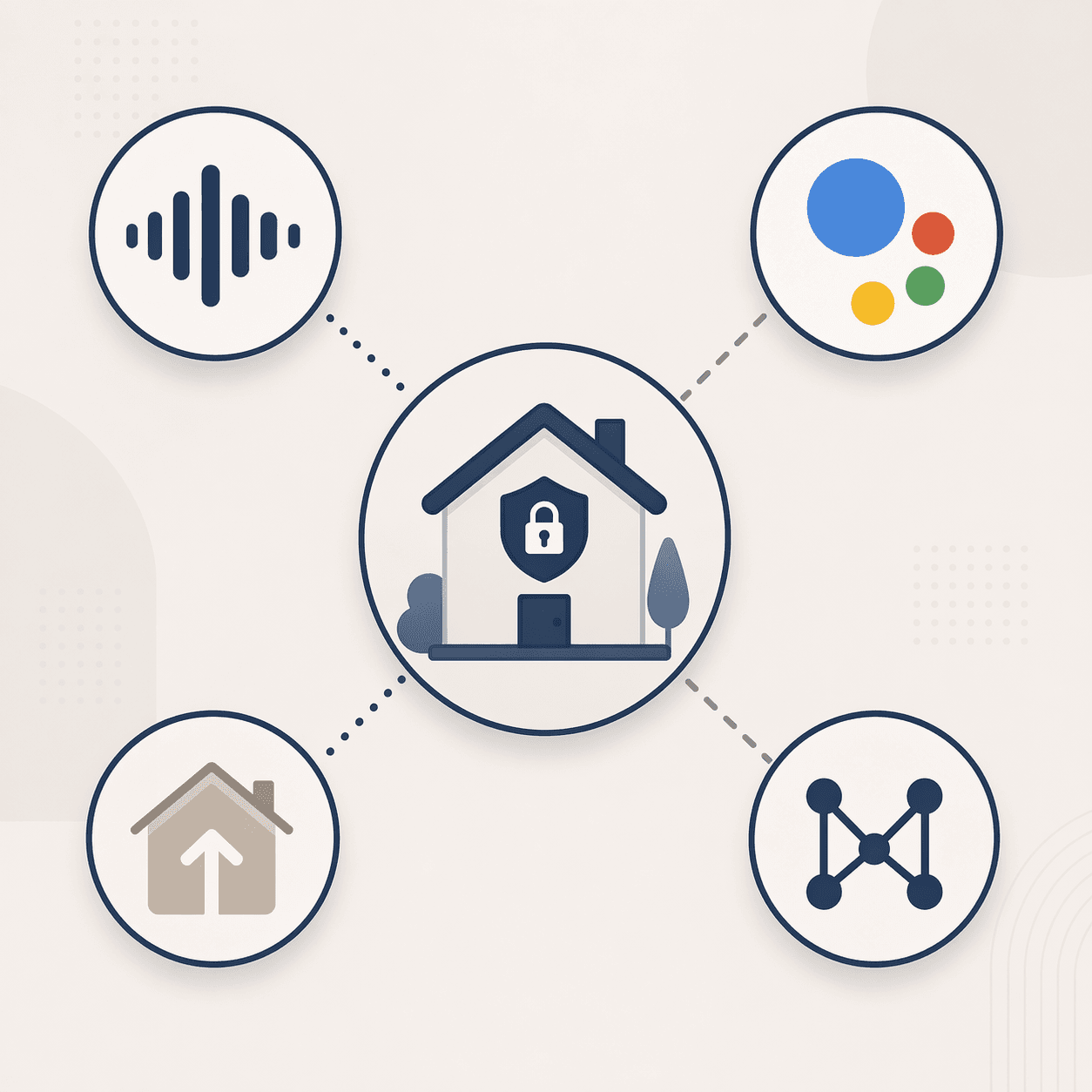
Alexa households have the cleanest reason to start with Ring. Ring's cameras, doorbells, and alarm gear fit naturally into Amazon's smart-home orbit, and that matters if Echo devices are already being used as screens, speakers, or voice controls. This does not make Ring universally better. It makes Ring easier to justify when the home is already organized around Alexa.
Google households have a different calculation. Nest cameras and doorbells may feel more native, but many buyers comparing full security systems still end up looking at Ring, SimpliSafe, ADT, Arlo, or Eufy because the camera, sensor, monitoring, and cost mix matters more than a single app preference. Before buying, check the exact devices you plan to use, not just the brand logo on the box. Camera support, lock support, voice control, and automations can differ inside the same brand family.
Apple Home users need to be more careful. A system can work well as a security product and still feel second-class in an Apple-centered home. If HomeKit access, Apple TV viewing, Home app control, or privacy posture are deal breakers, treat that as a buying constraint from the beginning. Do not assume a security system will become Apple-friendly later because the camera has Wi-Fi or the lock has Bluetooth.
Matter helps with some smart-home confusion, but it does not erase the security-camera problem yet. The Matter ecosystem has more than 3,300 certified products, but camera support is still emerging through firmware updates rather than being a settled, native expectation across the category.[2] That distinction matters. Matter can be a future-proofing point for lights, plugs, sensors, and some locks, while still leaving camera buyers stuck checking individual device support. For a deeper platform-by-platform breakdown, see the site's smart home security ecosystem guide and the 2026 Matter status update.
DIY Has Become the Default Question
The old shortcut was simple: professional systems were serious, DIY systems were lighter-duty. That split is less useful in 2026. SafeHome.org's survey found DIY installation at 49%, ahead of professional installation at 42%, the first time DIY passed professional installation in its data.[1] Some of that is cost. Some of it is renter demand. A lot of it is that ordinary buyers have learned they can place a hub, stick sensors on doors, mount a video doorbell, and manage alerts without scheduling an installer.
DIY is strongest when the system is modest: a base station, keypad, contact sensors, motion sensor, doorbell camera, and maybe an indoor or outdoor camera. Ring and SimpliSafe are built around that kind of buyer. Eufy and Arlo also make sense when the camera plan is more important than a full monitored alarm. The trade-off is that someone in the household becomes the installer, tester, battery checker, Wi-Fi troubleshooter, and app administrator.
Professional installation earns its cost when the project has more moving parts: multiple outdoor cameras, hardwired doorbells, smart locks, garage control, glass-break sensors, smoke and CO monitoring, or equipment that has to work around an older house. ADT and Vivint live closer to that side of the market. Vivint in particular is easier to understand as a premium installed smart-home security package than as a cheap alarm kit. Readers considering that route should compare the full contract and equipment structure, not only the monthly monitoring line; the site's Vivint buyer's guide is the better place for that deep dive.
Renters should be especially strict about installation. A system that looks affordable but requires drilling, hardwiring, long contracts, or landlord approval can become a bad fit before the first alert arrives. Removable sensors, battery cameras, no-contract monitoring, and equipment that can move to the next apartment usually matter more than owning the most complete system on the block.
Homeowners have a different risk: underbuying because DIY looks cheaper on day one. A few adhesive sensors may be enough for a small house. They are less convincing if the real goal is camera coverage across detached garages, gates, side doors, and packages left outside. That is where a broader camera selection framework and a separate smart lock buying guide can prevent a mismatched cart.
The Starter Kit Is Not the Price
Monthly cost being a top decision factor is not a sign that buyers are cheap. It is a sign that they have been trained by subscriptions. A $199 or $265 starter kit is simple to compare. The monitoring plan, cloud video plan, warranty plan, cellular backup, extra cameras, extra sensors, and contract term are where the real comparison lives. SafeHome.org found monthly cost at 46% as a top decision factor, just behind ease of use at 50%.[1]
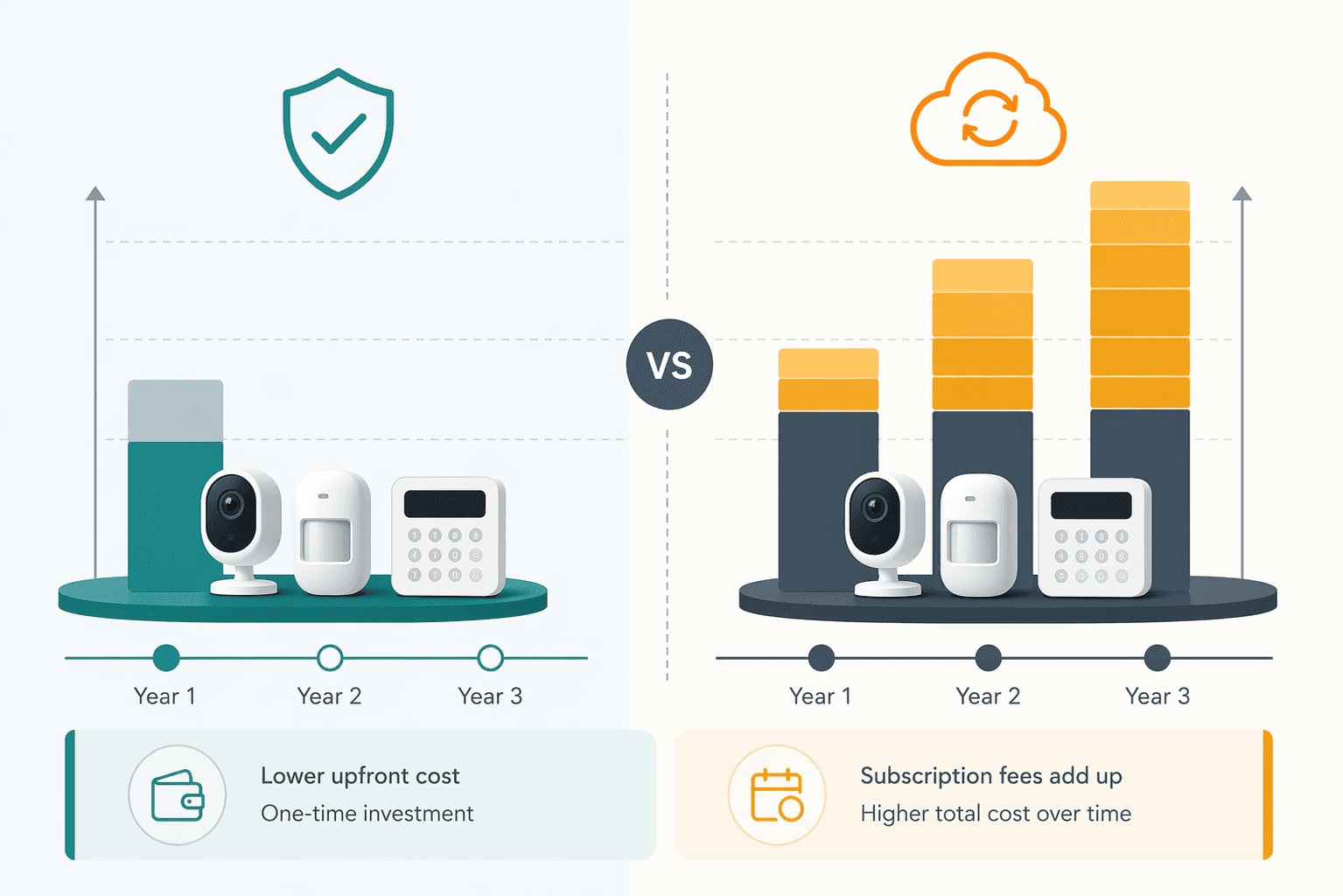
As of June 2026, monitoring can run from $0 for self-monitoring to roughly $80 per month for higher-service professional plans, depending on brand, features, and equipment mix.[3] That range is too wide to treat as a footnote. A household choosing between Ring at about $20 per month for professional monitoring, SimpliSafe around $27.99 per month, and Vivint around $49.99 per month is not just comparing sirens. It is comparing what happens every month after the installation excitement is gone.[3]
| Cost item | What to check before buying | Why it changes the decision |
|---|---|---|
| Starter kit | Base station, keypad, number of sensors, included camera, siren, range limits | A cheaper kit may need immediate add-ons to cover the same doors and rooms |
| Extra sensors | Door/window sensors, motion sensors, glass-break sensors, water sensors, smoke/CO monitoring | The real home may need more coverage than the advertised bundle |
| Cameras | Indoor, outdoor, doorbell, floodlight, battery life, power source, field of view | Camera-heavy systems often become subscription-heavy systems |
| Monitoring | Self-monitoring, professional dispatch, cellular backup, emergency response features | This is the monthly bill most likely to outlast the hardware comparison |
| Video storage | Cloud-only, local-only, hybrid cloud-local, retention period | A lapsed subscription may reduce access to recorded footage |
| Contract | Length, cancellation terms, equipment financing, transfer rules | The lowest installation friction can hide the highest exit cost |
Storage deserves its own line in the budget. SafeHome.org found 32% of users relying on cloud-only storage, while 49% preferred a hybrid cloud-local model.[1] That preference is sensible. Cloud storage is convenient until a subscription lapses, a card expires, or a buyer realizes that the footage they assumed was part of the device is actually part of the plan.
A simple three-year calculation catches problems that a product page can hide. Take a $200 Arlo camera with an $8 monthly subscription: after 36 months, the subscription adds $288, more than the hardware cost. That does not make the camera a bad purchase. It means the real price is not $200. It is the device plus the plan you are likely to keep.
Use the same math for every system before comparing features. Ring's lower monthly monitoring cost can matter over three years. SimpliSafe's no-contract posture can matter if you may move. Vivint's higher monthly bill may be acceptable if professional installation, integrated equipment, and service reduce the work you would otherwise do yourself. ADT's value depends heavily on the package and terms in front of you. For a broader view of recurring smart-home spending, use the site's smart-home products cost guide.
AI Features: Useful Alerts First, Identity Claims Second
The AI label is doing too much work in security marketing. Person detection and package detection are useful, but they are no longer exotic. In 2026, they are mid-range expectations on many camera-centered systems, especially where subscription plans are involved. The practical value is not that the system sounds intelligent. It is that the phone buzzes less often for branches, headlights, and passing shadows, and more often for people, vehicles, animals, or packages that actually matter.
Facial recognition sits in a different category. SafeHome.org found facial recognition adoption at 13%, while interest reached 39%.[1] That gap is the story. Plenty of buyers can imagine the convenience of knowing whether a camera saw a family member, a neighbor, or an unknown person. Fewer have decided they want that identity layer running around their doors, driveways, and stored clips.
Ring's Search Party feature, introduced in February 2026, showed why a security feature and a data-sharing concern can arrive in the same update. The feature drew a privacy inquiry from Senator Ed Markey, turning a product capability into a public question about how neighborhood security data may be searched, shared, or expanded beyond the original buyer's expectation.[4] The lesson for shoppers is narrow and practical: before enabling advanced AI or community-search features, read what data leaves your home, who can request it, whether participation is opt-in, and how to turn it off.
Privacy concerns are also a market issue, not just a personal preference. Forbes reported in May 2026 that privacy concerns remain a bottleneck to broader smart-home scaling.[5] That should make buyers cautious about any feature sold as effortless protection without a clear explanation of storage, sharing, retention, and account control.
How the Major Systems Sort by Buyer
Ring is the easy starting point for many households, especially renters, Alexa users, and buyers who want a large accessory ecosystem without a high upfront bill. Wirecutter named Ring its top pick among standalone home security systems, with SimpliSafe as runner-up, and that tracks with Ring's broad practical appeal.[6] The caution is that Ring's convenience is tied to Amazon's ecosystem, cloud services, and a privacy posture each household should be willing to accept.
SimpliSafe is the cleaner choice for buyers who want an understandable alarm system more than a sprawling smart-home platform. It works with voice assistants and August locks, but it does not offer the broad Z-Wave or Zigbee device-control flexibility that some automation-heavy households expect. That limitation is not a flaw for everyone. It can be the reason the system stays manageable.
ADT belongs on the list when professional monitoring, brand familiarity, and service infrastructure matter. It is less compelling as a pure bargain comparison against DIY starter kits. A buyer considering ADT should compare the exact package, installation requirements, contract terms, and monthly bill against the work they are trying to avoid doing themselves.
Vivint makes the most sense for homeowners who want the system designed and installed as a larger smart-home security package. Security.org, PCMag, CNET, and other testing-focused comparisons consistently treat the premium/professional category differently from basic DIY alarms, which is the right frame.[7][8][9] Vivint can be a good answer when the buyer values integration, service, and installed equipment enough to accept higher equipment costs, monthly fees, and contract scrutiny.
Eufy is worth attention for buyers who dislike the idea that every useful clip or alert must live behind a cloud plan. The appeal is strongest when local storage, lower recurring cost, and camera control matter more than professional monitoring. The trade-off is that model-by-model compatibility and feature differences need close reading.
Arlo is a camera-first option. It can be a strong fit when video quality, outdoor coverage, and detection categories matter more than a full alarm ecosystem. It is also a good example of why the subscription line cannot be skipped: cloud recording and advanced detection can become part of the real operating cost.
Abode sits closer to the smart-home enthusiast than the buyer who wants the simplest possible alarm. Its appeal is flexibility: more room to connect devices and build automations than many stripped-down DIY systems. That flexibility is useful only if someone in the household wants to manage it.
A Practical Buying Rule
Choose the system that clears four tests in this order. First, it must fit the ecosystem already in the house closely enough that cameras, locks, voice controls, and routines will not become a daily annoyance. Second, its installation model must match the person who will actually mount, test, troubleshoot, and maintain it. Third, the three-year cost must still look reasonable after monitoring, cloud storage, extra sensors, camera plans, and contract terms are included. Fourth, its AI features should reduce noise and improve useful alerts without asking for a level of identity tracking or data sharing you would not knowingly accept.
That rule will not produce one universal winner. It will produce fewer second purchases. A Ring kit can be the sensible answer for an Alexa renter. SimpliSafe can be the better answer for a household that wants no drama. Vivint or ADT can earn their cost when professional installation and service are the point. Eufy or Arlo can make more sense when cameras and storage control drive the purchase. The system with the most brand recognition is only the right system when the home, budget, platform, and privacy trade-off agree.
For the fuller decision framework, see four key decisions before buying a smart home security system. For the protection gaps that show up when storage or monitoring is canceled, see DIY and professional security protection gaps. Buyers who are expanding beyond security into the whole connected home should also use the broader smart home 2026 buyer's guide.
References
- The State of Home Security in America 2026, SafeHome.org, 2026.
- Matter Smart Home Standard: Certified Products and Camera Support Status, Connectivity Standards Alliance, 2026.
- How Much Does a Home Security System Cost?, NerdWallet, 2026.
- Senator Markey Raises Privacy Concerns About Ring Search Party, Office of Senator Edward J. Markey, February 2026.
- Privacy Concerns Are The Bottleneck To Smart Home Scaling, Forbes, May 2026.
- The Best Home Security System, Wirecutter, 2026.
- Best Smart Home Security Systems of 2026, Security.org, 2026.
- The Best Smart Home Security Systems for 2026, PCMag, 2026.
- Best Home Security Systems of 2026, CNET, 2026.
Policy Updates & Reader Notes
Privacy policies, monitoring plan prices, and security disclosures change frequently. Report new data retention terms, updated plan pricing, or new vulnerability disclosures below. For formal editorial corrections, use the contact page.
Comments
Join the discussion with an anonymous comment.