Vivint may be the most advanced smart home security system a homeowner can buy in 2026. Its best equipment is genuinely more ambitious than the usual camera-and-keypad package: the Outdoor Camera Pro 3 uses RADAR-based detection and Smart Deter responses, while the Smart Hub Pro 2 is built as a serious Z-Wave and Zigbee automation controller rather than a basic alarm panel [1][2]. That is the reason to look at Vivint. It is also the reason to slow down before calling.
The Vivint smart home security system makes the most sense for a settled homeowner who wants professional installation, strong cameras, integrated locks and sensors, and monitored service they are comfortable paying for over several years. It is much harder to recommend for renters, frequent movers, bargain hunters, or anyone who wants the option to self-monitor, because Vivint’s monitoring is mandatory and financing can put the buyer into a 36- to 60-month contract [3][4][5].
The short verdict before the sales call
Vivint is worth considering if you want the premium version of professionally installed home security: smart cameras that try to deter activity before a break-in, centralized automation, in-home installation support, and monitoring tied into the whole system. The hardware and service experience can justify the higher price for the right household.
The same package becomes a poor fit when the buyer needs flexibility. There is no self-monitoring plan, monthly monitoring commonly falls in the roughly $24.99 to $49.99 range depending on plan and contract status, and the full video-and-automation tier is commonly cited at $49.99 per month [3][4]. If equipment is financed, the commitment can run 36 to 60 months [5].
That means Vivint should not be judged only by whether the demo looks better than a cheaper DIY kit. It should be judged by whether the household still wants the system after the first bill, after a possible job change, after a move, and after discovering exactly how short the cancellation window is.
What Vivint does unusually well
Vivint’s strongest argument is not that it has every standard security device. Many systems have door sensors, motion sensors, indoor cameras, locks, and a mobile app. Vivint’s stronger argument is that its best devices are designed to behave as one professionally installed home system.
Outdoor Camera Pro 3 and Smart Deter
The Outdoor Camera Pro 3 is the device that most clearly separates Vivint from ordinary home security bundles. Vivint describes it as using RADAR-based motion detection, and its Smart Deter feature can respond with whistles, lights, and spoken warnings when it identifies suspicious activity [1]. In plain homeowner terms, the camera is not only recording the driveway or porch; it is meant to interrupt a person before the event becomes a claim, a police report, or a missing package.
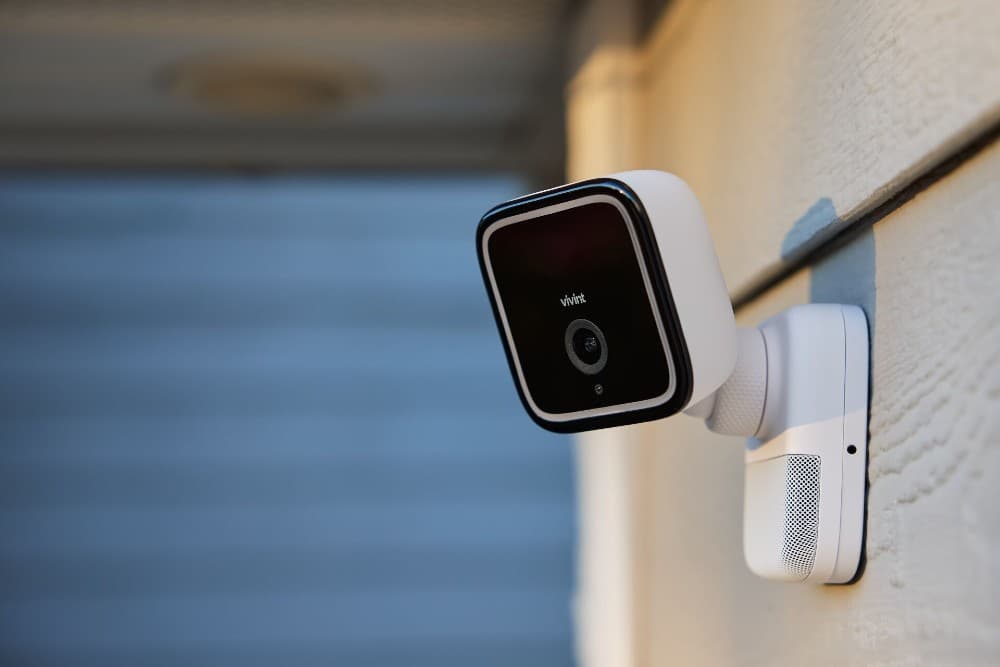
That kind of proactive behavior is where Vivint earns attention. A cheaper camera can still notify a phone, store video, or trigger a light. Vivint’s pitch is more specific: detect more intelligently, then deter more actively. For a homeowner with a long driveway, a dark side yard, or repeated porch problems, that may be more valuable than adding another passive camera.
The price matters, though. The Outdoor Camera Pro 3 is listed at $399.99 [1]. One or two cameras can turn a starter quote into a much larger purchase, especially once video-capable monitoring is included.
Smart Hub Pro 2 as the center of the home
The Smart Hub Pro 2 is another reason Vivint is better understood as a smart home platform than as a simple alarm. Vivint says the hub supports Z-Wave and Zigbee and works with Alexa and Google Assistant [2]. That gives the system room to coordinate locks, sensors, cameras, thermostats, and routines through one installed setup.
There is an ecosystem catch: Apple HomeKit support is not identified in the reviewed sources. For many households, Alexa or Google support will be enough. For an Apple-centered home that wants HomeKit-native automations, Vivint’s automation strength may still feel boxed in.
Professional installation is part of the product
Vivint’s professional installation is not a side detail. It is part of what buyers are paying for. A technician can place cameras, connect sensors, set up the hub, pair locks, and leave the household with a system that works the day it is installed. That matters for people who do not want to troubleshoot Wi-Fi cameras on a ladder or explain to every family member why the front door routine failed.
It also means the buyer gives up some of the freedom that makes DIY systems attractive. With Ring or SimpliSafe-style setups, a homeowner can often start smaller, move devices around, cancel more easily, or self-install at their own pace. Vivint is more like hiring a company to build the security layer of the house. That can be excellent when the house is stable and the buyer wants help. It is less forgiving when life changes.
The price is not one number
The easiest way to underestimate Vivint is to look at an entry package and stop there. Vivint’s HomeProtect package is listed as starting at $199.99 with a 36-month contract, or $349.99 without a contract plus $199 installation [6]. The HomeProtect Pro package is listed at $599.99 and up [6]. Those numbers are only the doorway into the purchase, not the full cost of a camera-heavy, automation-heavy home.
Third-party reviews note that full custom Vivint systems with multiple cameras can exceed $1,000, putting Vivint closer to premium professionally installed competitors than to lower-cost DIY systems [7]. That is not automatically unreasonable. It is simply the point where the buyer should stop thinking in terms of “starter package” and start thinking in terms of total ownership.
| Cost area | What to expect |
|---|---|
| Starter equipment | HomeProtect starts at $199.99 with a 36-month contract, or $349.99 without contract plus $199 installation [6] |
| Higher package | HomeProtect Pro is listed at $599.99+ [6] |
| Custom systems | Multiple-camera systems can exceed $1,000 according to SafeHome.org [7] |
| Financing | 0% APR financing may be available up to 60 months with a credit check [7] |
| Monitoring | Commonly cited at roughly $24.99–$49.99 per month, depending on tier and contract status [3][4] |
| Self-monitoring | No self-monitoring option is cited in the reviewed sources [3][4] |
| Moving | $129 for takedown only or $298 for takedown plus reinstallation [5] |
| Warranty | 120-day equipment warranty, with a $10/month Protection Plan available to extend coverage [5] |
Financing is where the monthly payment can make the system feel easier to buy than it is to leave. SafeHome.org reports 0% APR financing up to 60 months with a credit check [7]. Spreading equipment cost over time is useful if the buyer has already decided to keep the system for years. It is riskier when the buyer is using financing to make a too-large package feel manageable.
The monitoring bill deserves the same attention as the equipment quote. Security.org and SafeWise cite monitoring around $24.99 per month for basic service with a contract, $29.99 per month without a contract, and about $49.99 per month for a fuller tier with video storage and automation [3][4]. Pricing can vary by region and promotion, and Vivint’s own site may present different starting points for full monitoring. The safer assumption is that the number from a sales conversation needs to be written down with the exact tier, video features, storage terms, and contract length attached.
This is where premium security starts to behave like a household utility. A system that looks like a one-time equipment purchase becomes a recurring monthly obligation, and the higher the camera and automation ambitions, the more important that obligation becomes.
Contract terms are the part to read before getting attached to the equipment
Vivint’s contract terms are not a small-print afterthought. They are central to whether the system is a good purchase. SafeHome.org reports that financing equipment can create a 36- to 60-month contract, that the cancellation window is three days, and that early termination fees can exceed $1,000 [5]. A three-day window is especially unforgiving because it may close before a homeowner has lived with the system long enough to understand the app, the alerts, the monthly bill, and the fit with daily routines.
That cancellation window also looks strict compared with other major providers cited in the research brief: ADT is noted as offering a six-month cancellation window, SimpliSafe 60 days, and Ring 30 days. Competitor policies can change and may depend on plan details, but the comparison is still useful: Vivint gives the buyer very little time to reverse course after signing.
The moving terms are another practical test. SafeHome.org lists a $129 fee for takedown only and $298 for takedown plus reinstallation [5]. For a settled homeowner, that may be acceptable. For someone who may relocate for work, combine households, downsize, sell sooner than expected, or move into a rental, it becomes part of the real cost of owning the system.
The listed legitimate exit paths are narrow: military deployment, death, bankruptcy, and retirement home admission [5]. Those are serious life events, not ordinary “this no longer fits my budget” situations. A buyer who signs because the monthly payment seems fine today should assume they are making a long commitment, not testing a subscription.
The warranty is shorter than many buyers would expect for a premium system. SafeHome.org reports a 120-day equipment warranty and a $10-per-month Protection Plan to extend coverage [5]. Compared with one year from SimpliSafe and three years from Frontpoint, that is short. Even if the Protection Plan is worthwhile, it is another recurring cost to add before deciding that the quote is affordable.
How the equipment changes the privacy and security trade-off
Vivint’s camera intelligence is a real advantage, but smart deterrence also means the system is making more decisions at the edge of the home. Cameras that detect people, distinguish activity, speak to visitors or lurkers, and send alerts are more useful than passive recorders. They also deserve more thought about placement, household expectations, neighbor sightlines, and who can access video.
That does not make Vivint unusually suspect. It simply means a premium camera system should be treated as a security and privacy decision, not only a gadget purchase. A front-yard deterrence feature can be excellent when it warns off someone testing car doors. It can also become annoying if the camera is poorly placed, too sensitive, or aimed where normal neighborhood movement constantly triggers attention.
Professional installation can help here. A good installer should place cameras where they protect the home without turning the entire block into a notification zone. The buyer still needs to ask how alerts are configured, what video features require the higher monitoring tier, and what happens to recordings if service is downgraded or canceled.
Where reviewers agree, and where the ratings need context
Major review sources tend to rate Vivint’s technology and feature set highly. The reviewed sources put technology or feature ratings in the 9.1 to 9.4 out of 10 range across SafeHome, Security.org, SafeWise, and U.S. News, while value scores are lower, at 8.4 out of 10 or below [3][4][7][8]. That split matches the practical experience: the system is impressive, but impressive is not the same as easy to justify.
App ratings also complicate the picture. The reviewed sources list Vivint app ratings of 4.2 on Google Play and 4.6 on the Apple App Store, which suggests many active users are satisfied with day-to-day operation [3][4]. At the same time, they note more than 8,000 BBB complaints over three years, concentrated around contract disputes and cancellation fees. Complaint forums can overrepresent unhappy customers, but when the same themes appear around contracts and cancellation, they should be treated as a buying risk rather than dismissed as noise.
Who should seriously consider Vivint
Vivint is easiest to defend for a homeowner in a single-family house who expects to stay put, wants a professionally installed system, and values advanced outdoor detection enough to pay for it. It is also a stronger fit when the household wants security and automation under one roof: cameras, locks, sensors, thermostat control, hub-based routines, and monitoring handled through one provider.
It can also make sense for a buyer who has already decided against DIY. Some people do not want to compare protocols, climb ladders, manage separate apps, or wonder whether a self-installed camera is pointed correctly. For them, white-glove installation and one accountable provider have real value.
The important phrase is “already decided.” Vivint becomes a much worse purchase when professional installation is merely convenient, but not necessary; when the buyer only needs a doorbell camera and a few sensors; or when the household would be happy self-monitoring to keep monthly costs down.
Who should look elsewhere
Renters should be cautious. So should homeowners who may move during the contract term. The combination of financed equipment, mandatory monitoring, moving fees, and a short cancellation window is not friendly to uncertain housing plans [5]. A great camera on the eave does not help much if the owner is paying to remove and reinstall it sooner than expected.
Budget-conscious buyers should also compare carefully. SimpliSafe and Ring-style systems generally make more sense for people who want lower upfront costs, more control over installation, simpler cancellation, or the possibility of avoiding a full professional monitoring commitment. They may not match Vivint’s most advanced deterrence features, but they can be better financial fits.
Apple HomeKit-first households have another reason to pause. Vivint works with Alexa and Google Assistant through the Smart Hub Pro 2, but HomeKit support is not identified in the reviewed sources [2]. If the home is already built around Apple automations, the buyer should not assume Vivint will slide neatly into that system.
What to settle before requesting a quote
Vivint quotes can be customized, which is useful but also makes comparison harder. Before speaking with a sales representative, decide what problem the system must solve. A household worried about driveway activity may value the Outdoor Camera Pro 3 more than extra indoor devices. A household focused on doors and basic intrusion detection may not need the most expensive camera and automation bundle.
The quote should separate equipment cost, installation cost, financing term, monitoring tier, video storage features, warranty or Protection Plan charges, moving policy, and cancellation terms. If any of those pieces are blended into one comfortable monthly number, ask for the written breakdown before signing.
The strongest Vivint setup is still only worth buying when the buyer understands what happens after installation day. The demo shows what the system can do. The contract shows what the household has promised to keep paying for.
Final judgment: is Vivint worth the premium?
Vivint is worth considering for settled homeowners who want one of the strongest professionally installed smart security systems available, especially if outdoor camera deterrence, integrated automation, and technician setup are priorities. Its best technology is not ordinary, and for the right home, that matters.
It is not worth the premium for people who prioritize flexibility, self-monitoring, low monthly cost, renter-friendliness, or easy cancellation. Those buyers are likely to feel the contract more than the camera.
Before calling Vivint, answer four questions without hedging: how long you expect to stay in the home, whether you accept mandatory monitoring, whether you can absorb moving or cancellation costs, and whether Vivint’s advanced camera deterrence is valuable enough to justify the commitment. If those answers are not clear, the system may still be impressive, but the purchase is not ready.
References
- Vivint Outdoor Camera Pro — Vivint
- Vivint Smart Hub — Vivint
- Vivint Home Security Review — Security.org
- Vivint Home Security Review — SafeWise
- Vivint Contract — SafeHome.org
- Home Security HomeProtect — Vivint
- Vivint Home Security Review — SafeHome.org
- Vivint Home Security Review — U.S. News
Policy Updates & Reader Notes
Privacy policies, monitoring plan prices, and security disclosures change frequently. Report new data retention terms, updated plan pricing, or new vulnerability disclosures below. For formal editorial corrections, use the contact page.
Comments
Join the discussion with an anonymous comment.