The Fear Is Hacking. The Data Says Unlocked Doors.
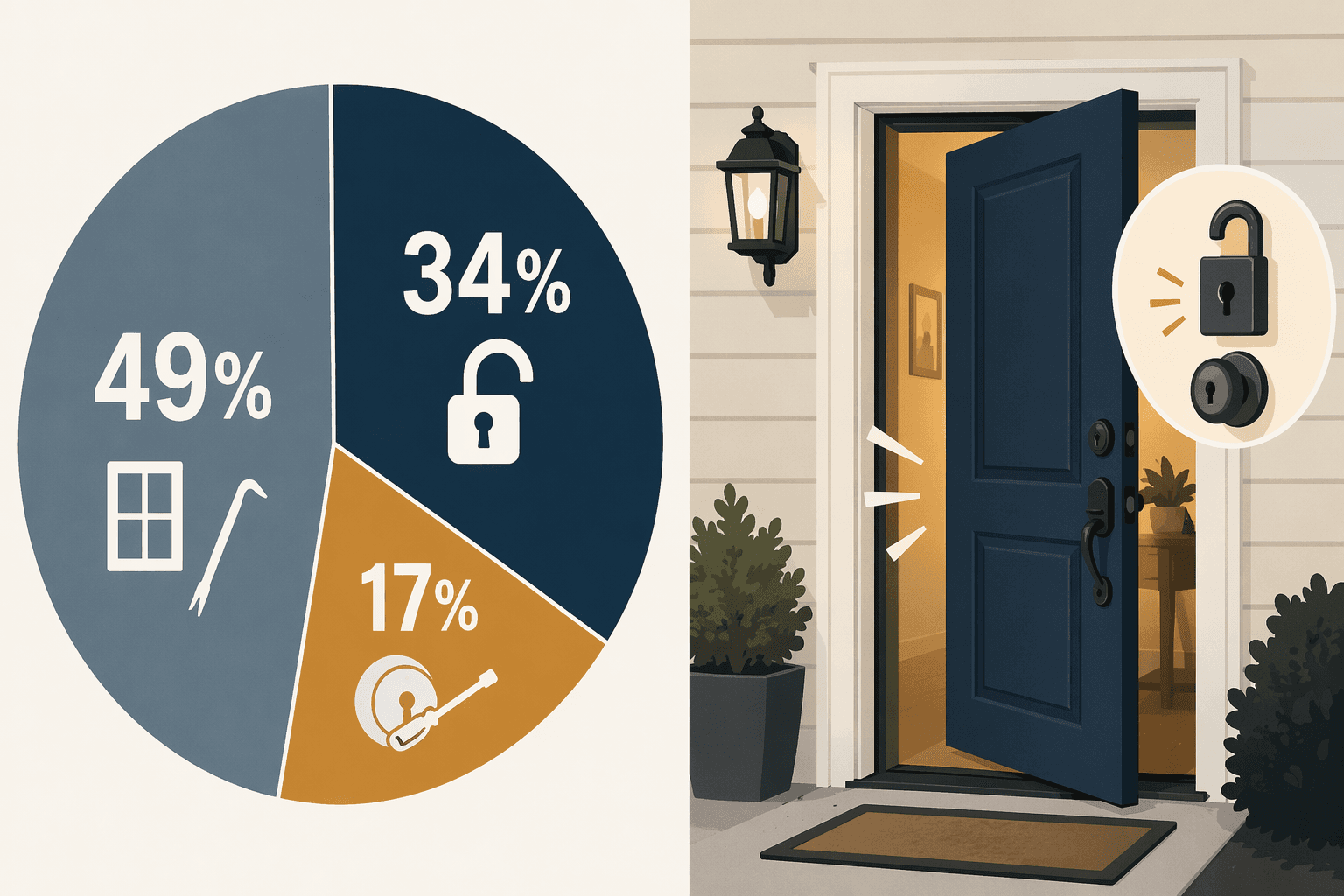
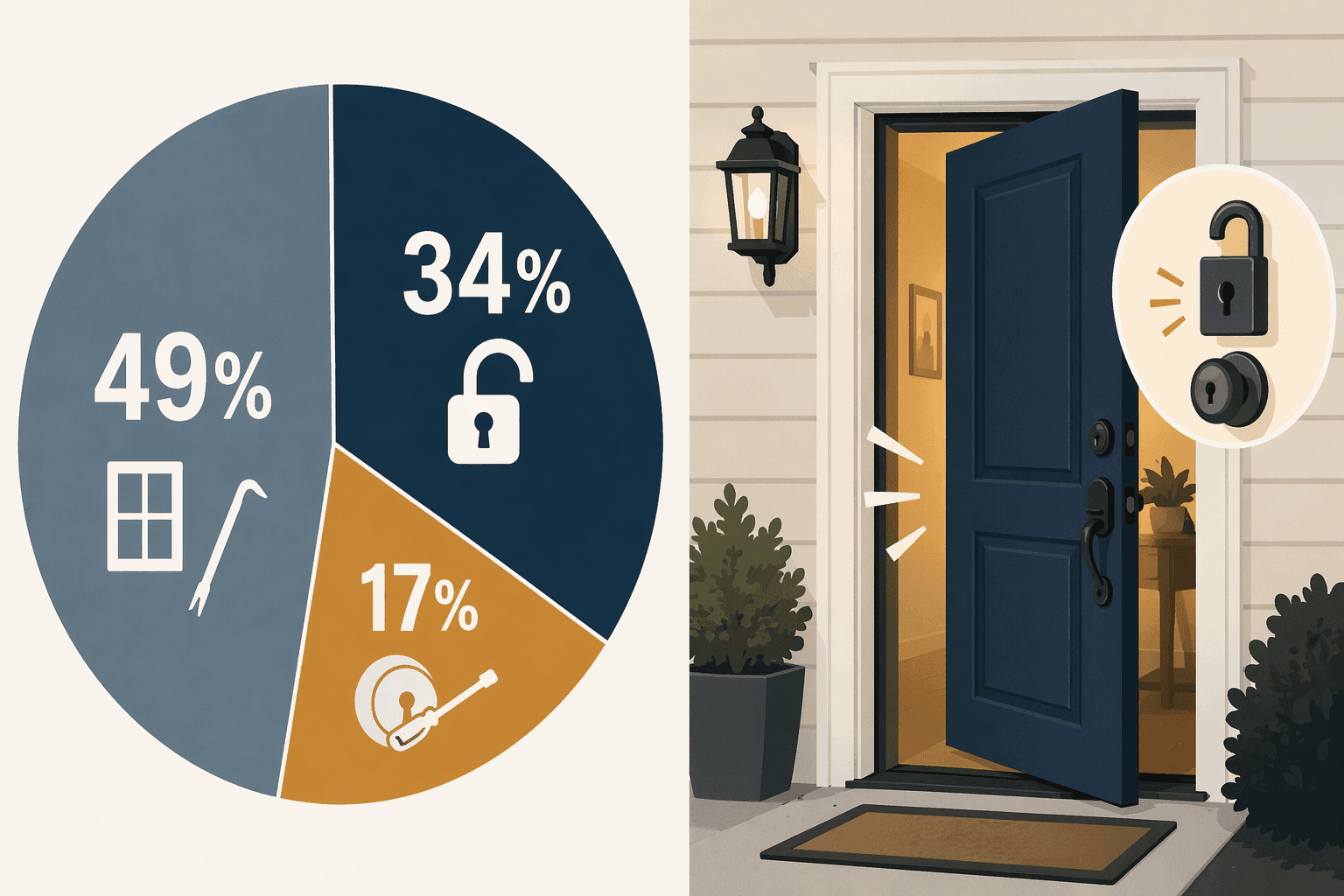
Ask someone why they haven't bought a smart lock and the answer is almost always the same: 'I don't trust the security — someone could hack it.' I've heard it a hundred times. But the data tells a different story. The FBI's Uniform Crime Reporting data for 2024 shows that 34% of residential burglaries occurred through an unlocked door. Only 17% involved forced entry through a lock. In 2019 alone, U.S. residential burglaries totaled 1,117,696 incidents, with an average loss of $2,661 per break-in. The sheer volume of unlocked‑door entries is not a side note — it is the main story.
Wirecutter, after a decade of testing smart locks, has yet to find a single case of a smart lock being electronically exploited in the real world. That is an empirical observation, not a formal security audit — it does not prove impossibility, but it shifts the burden of proof. After millions of units deployed over years, no researcher has demonstrated a remotely exploitable vulnerability that allows physical entry through a major brand lock without already having access to the user's home network. Most burglars either walk through an unlocked door or kick in a locked one. The front door you leave unlocked is a far bigger risk than the lock itself.
How Auto‑Lock Closes the Biggest Gap
If the problem is unlocked doors, the obvious countermeasure is a lock that locks itself. Smart locks do exactly that: auto‑lock after a set time, real‑time activity logs, tamper alerts, and the ability to check and lock from anywhere. These features directly close the gap that traditional deadbolts leave wide open.
A 2025 survey of 12,000 Ring smart lock owners found that users report 58% fewer instances of accidentally leaving their home unlocked. That number comes from a manufacturer‑funded, self‑reported survey — I would not treat it as independent research, but as a directional signal. What matters is the mechanism: auto‑lock removes the reliance on human memory. You cannot forget to lock a door that locks itself.
What About the Hacking Fear?
Let's address the elephant in the room: can someone hack your smart lock and walk into your home remotely? The security research community has been looking. I've seen aggregated 2024–2025 data that shows 89% of documented smart lock vulnerabilities lie in cloud infrastructure, not in the lock hardware itself. Another 7% were in firmware (patchable), and 4% in radio protocol (mitigable through encryption). I would treat these numbers as a plausible pattern, not a verified statistic — the source is not independently audited. But the pattern is consistent: none of these attack vectors let a stranger open your door without first compromising your home network or cloud account.
- 89% of vulnerabilities: cloud infrastructure – requires breaching the cloud account first.
- 7% of vulnerabilities: firmware – patched through regular updates.
- 4% of vulnerabilities: radio protocol – mitigable with encryption best practices.
The Weakest Link: Your Habits
So if the lock hardware and cloud are reasonably secure, where is the real risk? It's on the user's side. A 2025 LastPass survey (aggregated on Feocey) found that 67% of smart lock users do not enable two‑factor authentication, 41% reuse the same password for their lock app as other accounts, and 23% share access codes rather than generating unique ones. These are user‑behavior data, not lock‑security flaws, but they expose a far larger attack surface than any cryptographic break. If someone steals your password through a data breach and you have not enabled 2FA, they can unlock your door.
What about the physical lock cylinder? Many smart locks carry a Grade 2 or better mechanical core — on par with most standard residential deadbolts. A Grade 2 smart lock with a reinforced strike plate is not easier to kick in than a Grade 2 traditional lock. It is the same mechanism underneath the electronics.
| ANSI Grade | Typical Use | Common in Smart Locks? |
|---|---|---|
| Grade 1 | High‑security commercial | Rare, but exists |
| Grade 2 | Standard residential | Yes – most mid‑range models |
| Grade 3 | Light‑duty interior | Some budget models |
How to Make Your Smart Lock Truly Safe (In About Ten Minutes)
The security of your smart lock ultimately depends on you. The good news is that closing the human‑factor gap is simple and takes about ten minutes:
- Enable two‑factor authentication on your lock's app. This stops the 67% gap.
- Use a unique, strong password for your lock account. Do not reuse passwords from other sites.
- Keep firmware up to date. Those 7% of firmware vulnerabilities are fixed in updates.
- Generate unique temporary codes for guests instead of sharing your own access code.
The Verdict: Safer, With One Condition
Here is the honest bottom line: a properly configured smart lock is safer than a traditional deadbolt for most households. The 34% of burglaries that happen through unlocked doors are directly addressed by auto‑lock and activity monitoring. The remote hacking scenario that keeps people up at night has not materialized in the real world after a decade of deployment. The physical lock core is often Grade 2 or better — as robust as any standard deadbolt.
But 'properly configured' carries weight. If you skip 2FA, reuse passwords, and never update firmware, you are re‑introducing risk that the hardware alone cannot fix. The real weak link is human behavior, not the lock.
I would change my judgment the moment a credible remote exploit is demonstrated against a major brand lock. Until then, the data says: stop worrying about hackers and start worrying about whether you locked the door. A smart lock that locks itself is the best answer we have to that problem.
Policy Updates & Reader Notes
Privacy policies, monitoring plan prices, and security disclosures change frequently. Report new data retention terms, updated plan pricing, or new vulnerability disclosures below. For formal editorial corrections, use the contact page.
Comments
Join the discussion with an anonymous comment.