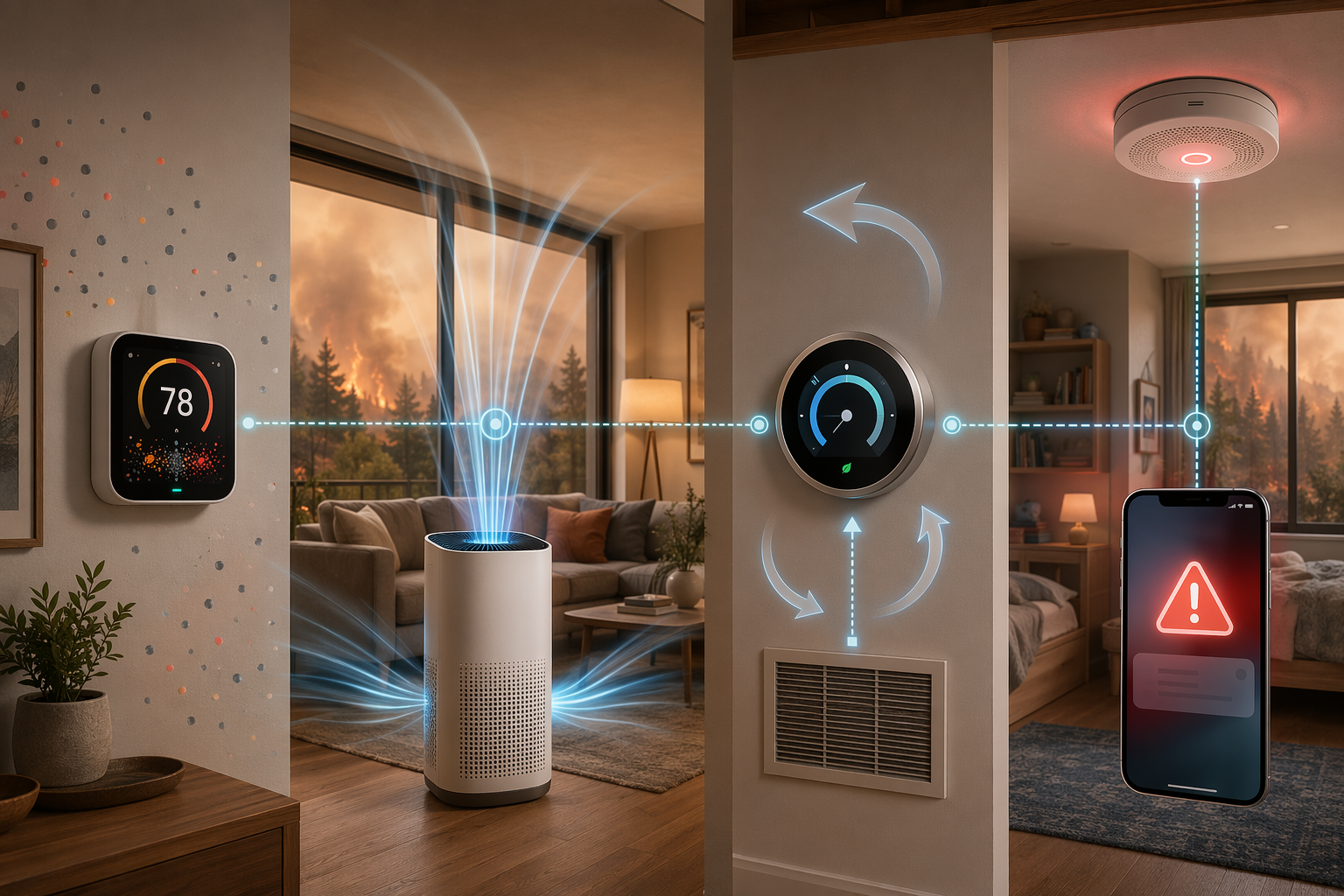
A smoke day usually fails in small, boring ways. The purifier is in the right room, but it is still on sleep mode. The thermostat is capable of running the fan, but the fan is set to auto. The indoor air monitor is showing PM2.5 climbing, but the person who knows what that means is in a meeting, driving, or checking on someone else. By the time the house feels smoky, the system has already missed the easiest window to respond.
That is the practical point behind most smart home safety tips for wildfire smoke: the safest setup is not one clever device. It is a connected chain. One device detects particle pollution, another removes it from room air, the HVAC system circulates air through a high-efficiency filter, and the alarm layer handles urgent fire and carbon monoxide alerts. The part most homes still get wrong is not ownership. It is action.
The Evidence Points to Operation, Not Just Equipment
The strongest reason to build the system around automations comes from a 2025 Lawrence Berkeley National Laboratory study of about 5,000 California homes. The researchers modeled smart-thermostat optimization during the 2020 wildfire period and found that running the HVAC fan continuously with MERV-13 filtration could reduce indoor PM2.5 exposure by up to 54±5%, and by up to 61±5% on peak smoke days, with an added energy cost of about $5 per month.[1]
Those numbers are worth attention, but they are not a guarantee that any particular house will see the same result. They are modeled estimates based on optimized fan operation, not a randomized trial in identical homes. Filter fit, duct leakage, HVAC design, home tightness, room layout, and how quickly the system starts all matter. Still, the direction is hard to ignore: central air with the right filter can do real work during smoke if it is actually running.
The same study found that a central air system with a MERV-13 filter, properly operated, could match the effectiveness of four portable air cleaners in an average home.[1] That does not make portable purifiers optional. It does mean the thermostat and HVAC filter deserve more than a passing mention in any serious smoke plan.
The irritating part is what happened in real homes. During the 2020 wildfire events, the researchers concluded that existing smart-thermostat systems were “not effectively utilized.”[1] In other words, many homes already had equipment that could have helped, but the system did not reliably shift into smoke mode when the air outside turned bad.
A Four-Layer Smoke Defense
A smoke-ready smart home needs four jobs covered. The brands matter less than whether the jobs are assigned clearly and tested before the first Red Flag Warning of the season.
| Layer | Job during smoke | What to check |
|---|---|---|
| Monitor | Detect rising indoor PM2.5 and watch outdoor AQI | PM2.5 readings, app alerts, smart-home compatibility |
| Filter | Clean the rooms where people spend the most time | Smoke-capable HEPA purifier, room size rating, auto or smart control |
| Seal and circulate | Run HVAC fan through MERV-13 filtration when outdoor air is smoky | Thermostat automation, filter support, fan mode, energy impact |
| Alert | Warn the household about fire, smoke-alarm events, and CO risk | UL 217 9th-edition alarm, app notifications, household coverage |
The fourth layer belongs here even though it is not an air cleaner. Wildfire smoke planning is still household safety planning. A purifier cannot wake you for a fire. A thermostat cannot tell an adult child that an older relative’s alarm is sounding. Smart smoke and CO alarms handle a different, urgent category of risk while the air-quality devices work on particle exposure.
Layer 1: Make PM2.5 Visible Before the House Smells Smoky
The monitor is the trigger layer. It should sit where household decisions happen: near the main living area, in a bedroom used by someone vulnerable, or near the return path if that location reflects whole-house air well. Outdoor AQI from the EPA AirNow app can tell you what is coming. An indoor monitor tells you what already got through.
For wildfire smoke, PM2.5 is the reading to care about first. A monitor that also tracks CO2, VOCs, NOx, temperature, and humidity may be useful, but those readings should not distract from the smoke automation. If PM2.5 rises indoors, the house should act.
AirGradient One is a good example of why compatibility details matter. It monitors NOx, CO2, VOCs, and three PM sizes, and it supports native Home Assistant and Homey integrations. Its native Alexa and Google Home support is weaker, with HomeKit relying on community paths. That is not a dealbreaker for a household already comfortable with Home Assistant or Homey. It is a problem if everyone else in the house expects automations to live in Alexa or Google Home.
If you want a narrower buying guide, start with which smart air quality monitor detects wildfire smoke best. If the monitor is already installed and starts reporting smoke, use this troubleshooting guide for smoke readings rather than guessing whether the spike is real.
Layer 2: Put HEPA Cleaning Where People Actually Breathe
Portable HEPA purifiers are still the most direct way to clean a bedroom, nursery, home office, or main living room. The mistake is treating one purifier in one corner as a whole-house plan. Smoke protection is local: clean the rooms where people sleep, recover, and spend long indoor stretches when windows stay shut.
EPA guidance reported through Consumer Reports and Resideo says HEPA air purifiers can reduce indoor particle concentrations by as much as 85%, while Consumer Reports’ July 2026 coverage found top models reducing smoke particle levels by roughly half to as much as 85%.[2] The spread matters. “Up to” performance usually depends on room size, airflow setting, placement, filter condition, and how much new smoke keeps entering the home.
For smoke, choose a purifier rated for the room you will actually use, then run it early and high enough to matter. Consumer Reports recommends models rated for at least 350 square feet for smoke-focused use.[2] Mid-2026 examples include the Coway Airmega Mighty2 for rooms up to 350 square feet at about $230 and the Blueair Blue Pure 311i Max at about $230, but the operational question is simpler than the shopping question: can the purifier turn on or ramp up before someone remembers to walk over and press a button?
A smart purifier earns its place when it accepts an external trigger. That trigger can come from its own sensor, but a separate indoor PM2.5 monitor is often better because it gives the rest of the house the same signal. The purifier is then one responder among several, not a closed little appliance making decisions by itself.
For feature-level shopping help, use smart air purifier features that actually help in wildfire smoke. A purifier with a polished app but no reliable automation path is still asking the household manager to babysit it.
Layer 3: Use the Thermostat and MERV-13 Filter as the Whole-House Workhorse
The thermostat layer is where many smoke plans are underbuilt. People buy portable purifiers because they can see them. The central system is quieter, more abstract, and easy to leave in its normal comfort settings. During wildfire smoke, that can mean the HVAC fan runs only when heating or cooling calls for it, even though the house needs filtration.
The LBL finding changes the priority. Running the HVAC fan continuously through MERV-13 filtration was the condition that produced the modeled 54±5% reduction in indoor PM2.5 exposure and 61±5% reduction on peak smoke days.[1] The useful distinction is not “smart thermostat versus regular thermostat.” It is whether the thermostat can reliably switch the fan to continuous operation when smoke conditions cross your threshold.
Before building that automation, confirm the HVAC system can handle the filter. MERV-13 filters capture smaller particles better than lower-rated filters, but not every system tolerates the added resistance equally. A tight filter in an undersized or poorly maintained system can reduce airflow. If the system struggles, the right answer may be an HVAC checkup, a properly fitted filter cabinet, or a filter model with lower pressure drop rather than simply forcing the fan to run harder.
This is also where the energy caveat belongs. The LBL study modeled an added energy cost of about $5 per month for the optimized fan strategy.[1] That is modest enough to make the strategy realistic for many households, but it is still a modeled average, not a utility-bill promise. In a large house, an inefficient blower, or a long smoke season, the cost may differ.
Thermostats such as ecobee Premium or Honeywell Home models can be part of this layer when they expose fan control, scheduling, and automation hooks. The exact model matters less than three capabilities: the system must support the filter you plan to use, the thermostat must allow fan-only operation, and the platform must let an outdoor AQI or indoor PM2.5 condition trigger that fan mode without manual tapping.
If you are choosing or replacing the thermostat, compare current options in the best smart thermostats in 2026. If platform lock-in is the concern, the Matter thermostat compatibility guide is the more relevant read than another generic thermostat feature list.
Layer 4: Keep Fire and CO Alerts in the Same Safety System
A smoke-ready home still needs smoke alarms that do their original job well. Wildfire particle exposure and house-fire warning are different problems, but they often land on the same person’s phone. If the person managing the smoke day is away from home, a local siren alone is not enough information.
NFPA 2024 data found hardwired smart smoke alarms succeeded in 94% of home fires, compared with 85% for battery-only models, and that 66% of fire fatalities occurred in homes with battery-only alarms.[3] That supports hardwired, interconnected, app-capable alarms where the home can support them, not because the app is glamorous, but because alarm reliability and notification reach both matter.
Look for UL 217 9th-edition smart smoke and CO alarms, app notifications, and compatibility with the platform that will actually be used in the house. Mid-2026 examples include Kidde Smart Smoke + CO at about $60 and First Alert SC5 at about $120. Wirecutter reported Kidde’s manufacturer claims that its Smart Smoke + CO Alarm detects fires 29% faster than the previous generation and is three times more precise at rejecting false alarms.[4] Treat that as a manufacturer-reported performance claim, not an independent guarantee for every home.
Some households may also want professional dispatch or monitoring features. Kidde Ring, for example, can add fire-department dispatch for about $5 per month without a full Ring system. That is a separate decision from indoor PM2.5 control. It belongs in the same plan because the failure mode is similar: an alarm that nobody hears in time is not much of a safety system.
For platform details, use the smart smoke detector compatibility guide before mixing alarms, hubs, and voice assistants.
The Automation Bridge: What Should Happen When Smoke Arrives
Manual monitoring is the weak link. It asks one person to notice the AQI shift, interpret a PM2.5 number, remember which rooms need purifiers, change the thermostat fan setting, and warn everyone else. That works on a calm Saturday morning. It fails during school pickup, work calls, power worries, and the general fog of a bad smoke week.
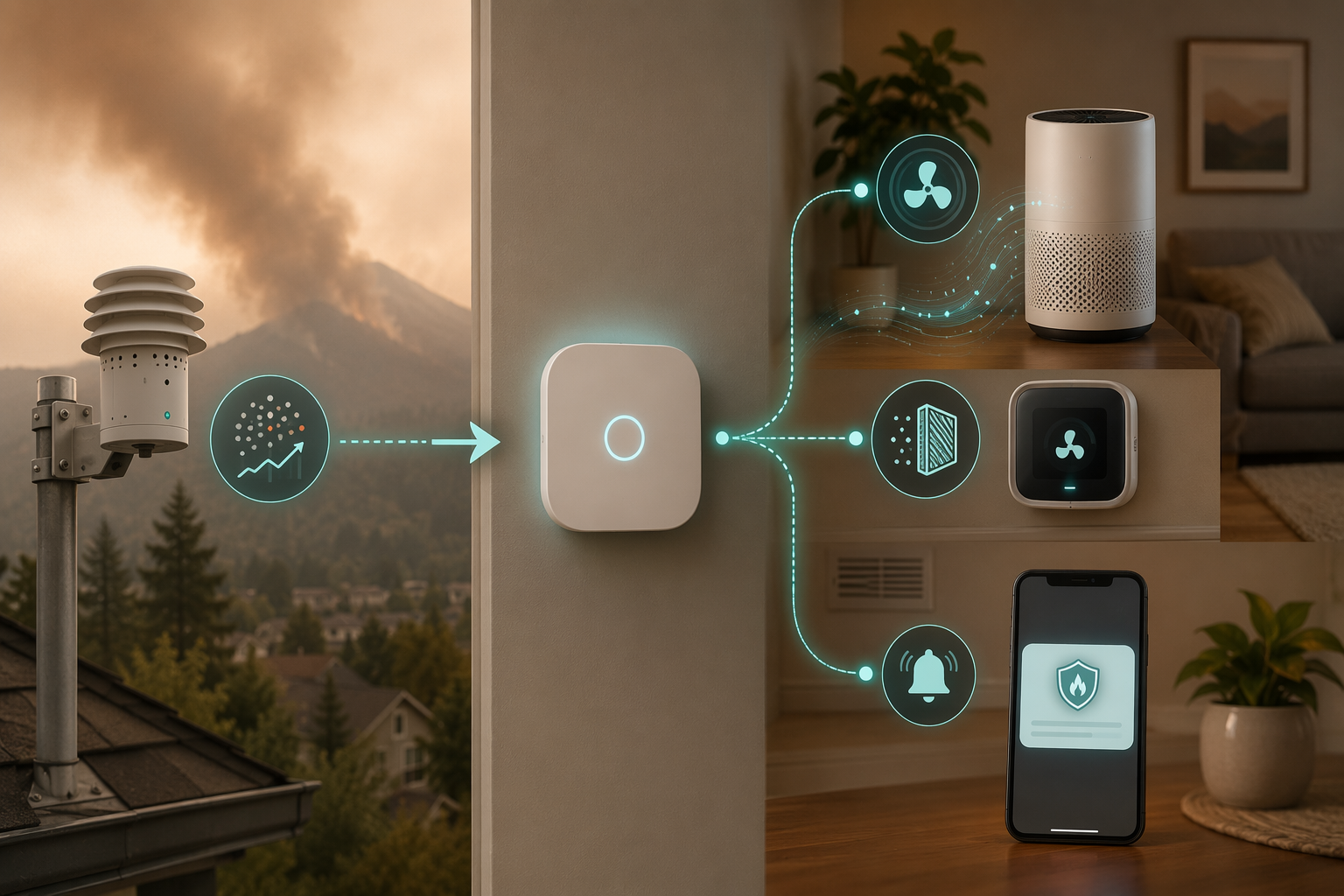
The automation does not need to be elaborate. It needs to be dependable. A practical smoke rule has one trigger and several actions:
- Trigger: indoor PM2.5 rises above your chosen threshold, or outdoor AQI reaches a level you decide should start smoke mode.
- Action: smart purifiers in occupied rooms switch to a higher fan speed.
- Action: the thermostat switches the HVAC fan from auto to continuous operation through the MERV-13 filter.
- Action: household phones receive an alert saying smoke mode is active.
- Action: a follow-up reminder checks whether windows, fireplace dampers, and obvious outdoor-air openings are closed.
A second rule should turn smoke mode off only after conditions have improved for long enough to avoid short cycling. If outdoor AQI briefly dips, then worsens again, the system should not keep relaxing and restarting every few minutes. Use a delay, a sustained threshold, or a manual confirmation depending on what your platform supports.
Home Assistant gives the most control if your monitor, purifier, thermostat, and alarms are compatible. Homey may be simpler for some mixed-device homes. Alexa, Google Home, and HomeKit can work well when the devices expose the right triggers and actions, but their limitations show up quickly with air-quality automations. A monitor that cannot pass PM2.5 as a usable trigger may become another dashboard you only check after the house is already smoky.
The cleanest version is boring in the best way: PM2.5 rises, purifiers ramp up, the thermostat fan turns on, and phones get a clear notification. Nobody has to remember the sequence. Nobody has to be the family smoke operator for the system to start doing its work.
For a step-by-step automation build, use how to automate air quality monitors for hazardous conditions. For a seasonal prep list that starts before smoke is visible, use the Red Flag Warning smart home checklist.
A Smoke Mode Worth Testing Before Fire Season
Test smoke mode on a clean-air day. Do not wait until the sky is orange and every household decision feels slightly late. Start the automation manually and confirm the visible consequences: purifiers change speed, the thermostat fan runs continuously, app alerts arrive on the right phones, and no device sits outside the automation because it was paired to the wrong account.
Then check the physical layer. Replace or inspect the HVAC filter. Confirm the purifier filters are not past due. Make sure windows close, weatherstripping is not obviously failing, and the room chosen as the clean-air room has enough purifier capacity. Smart-home automations cannot compensate for a purifier with a clogged filter or a central system running through the wrong media.
It also helps to decide who receives alerts. The right list may include both adults in the household, an adult child checking on a parent, or a nearby neighbor with access. A phone alert should say what happened and what the system already did, not merely “air quality event.” A useful notification reads more like: “Indoor PM2.5 is high. Smoke mode started: living room purifier high, HVAC fan on, bedroom purifier high.”
For readers who want the shorter device-only version, Three Smart Home Devices to Protect Against Wildfire Smoke is a simpler starting point. This four-layer version adds the part that matters most once the gear is already in the house: coordination.
What This System Cannot Promise
A connected smoke setup is not a smoke-proof home. It cannot make an evacuation zone safe. It cannot replace local fire authority instructions, National Weather Service alerts, AirNow conditions, or an emergency plan. If officials tell you to leave, the automation can keep running behind you, but it does not get a vote.
The realistic goal is narrower and still valuable: reduce indoor particle exposure while people are sheltering indoors, make the response faster than manual habit, and make urgent alarm events harder to miss. The LBL study suggests the thermostat-and-filter layer can carry a large share of that work when optimized, but its own finding about underuse is the warning label.[1]
A smoke-ready smart home is one where detection, filtration, circulation, and alerting are connected before the event, tested before the air turns bad, and treated as one layer of preparedness alongside official warnings and evacuation guidance.
References
- Using Smart Thermostats to Reduce Indoor Air Pollution from Wildfire Smoke. Lawrence Berkeley National Laboratory. 2025. https://eta-publications.lbl.gov/publications/using-smart-thermostats-reduce
- Air Purifiers for Wildfire Smoke. Consumer Reports. July 2026. https://www.consumerreports.org/
- Home Fire Alarm Performance Data. National Fire Protection Association. 2024. https://www.nfpa.org/
- The Best Smart Smoke Alarm. Wirecutter. 2026. https://www.nytimes.com/wirecutter/
Policy Updates & Reader Notes
Privacy policies, monitoring plan prices, and security disclosures change frequently. Report new data retention terms, updated plan pricing, or new vulnerability disclosures below. For formal editorial corrections, use the contact page.
Comments
Join the discussion with an anonymous comment.