A smoke-ready smart home is not a house with one expensive purifier glowing in the corner. It is a house that notices fine particles rising, cleans the room people are actually using, and tells the central air system to recirculate through a better filter before the afternoon smoke settles indoors.
That distinction matters more in 2026 than it did a few summers ago. As of June 22, the National Interagency Fire Center reported 34,038 fires and 2.7 million acres burned year to date, 162% of the 10-year acreage average for that point in the season. Those are mid-season figures, not a final annual verdict, but they are enough to make wildfire smoke planning feel less like regional edge-case prep and more like normal home maintenance.[1]
Distance from flames does not solve the indoor air problem. In a 2025 Harvard Healthy Buildings and Airthings study of 1,048 Los Angeles homes before and during the fires, indoor PM2.5 remained elevated more than two miles from burn zones.[2] That is the uncomfortable part: the home can look sealed, the sky can look merely hazy, and the fine particles that matter most for smoke exposure can still be building indoors.
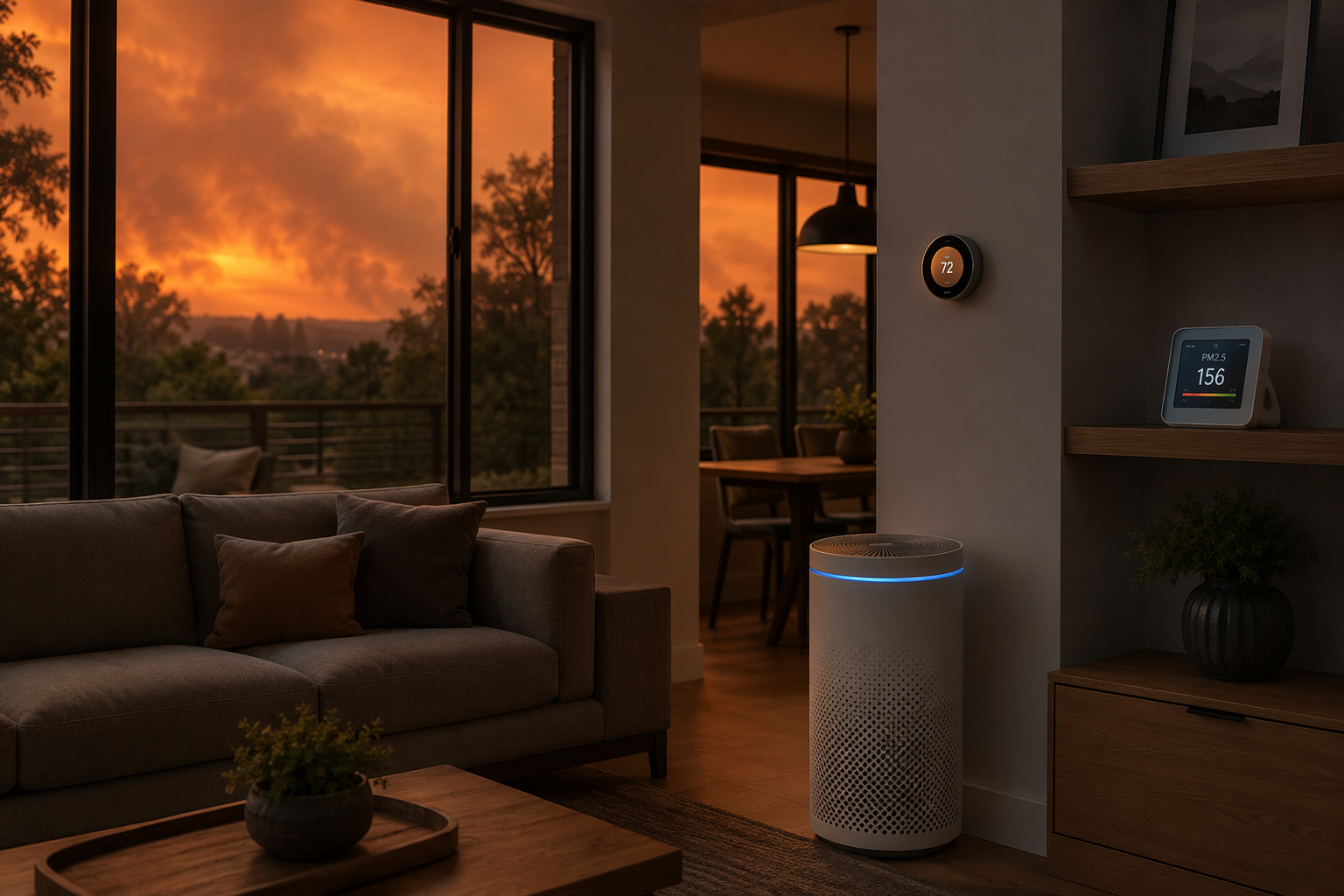
The practical answer is three layers: an air quality monitor, a smart purifier, and a smart thermostat connected to an HVAC system using a MERV 13 filter. The monitor tells the home what is happening. The purifier handles room-level cleanup. The thermostat turns the central system into a whole-home recirculation tool instead of letting it sit idle while the portable purifier does all the work.
The System Matters More Than The Gadget
During a multi-day smoke event, the fragile step is not usually buying a device. It is remembering to act at the right moment: closing up the house, changing purifier speed, switching the HVAC fan from occasional heating or cooling cycles to filtration, and then checking whether indoor PM2.5 is actually falling. A smart home setup earns its place when it removes one of those failure points.
| Layer | What It Should Do During Smoke | What To Watch For |
|---|---|---|
| Air quality monitor | Detect indoor PM2.5 changes and, ideally, trigger automations locally | Must measure PM2.5; broader sensors are useful but not a substitute for particle readings |
| Smart air purifier | Increase airflow automatically or on a routine when PM2.5 rises | CADR, room size, placement, and filter replacement decide whether performance reaches the room |
| Smart thermostat plus MERV 13 filter | Run fan-only or recirculation so central HVAC filters more indoor air | The system must support recirculation, and the filter must fit without overloading the equipment |
The strongest evidence for treating HVAC control as part of the smoke system comes from a 2025 Indoor Environments study using roughly 5,000 California homes in ecobee’s Donate Your Data program. Automated smart thermostat optimization with recirculation and MERV 13 filtration reduced indoor PM2.5 by 54±5% overall and 61±5% during peak smoke days.[3] The same finding is also a useful correction to a common homeowner habit: buying a portable purifier and leaving the larger air-moving machine in the house out of the plan.
The study has boundaries. It is based on California homes and the 2020 wildfire season, so it should not be treated as a universal guarantee for every house, region, duct system, or smoke event. But it is still unusually concrete evidence for a smart-home claim: automation did not just make a dashboard prettier; it reduced measured indoor particle exposure.
Layer One: Monitor The Pollutant That Smoke Actually Brings Indoors
For wildfire smoke, the monitor has to measure PM2.5. Temperature, humidity, carbon dioxide, radon, and volatile organic compounds can all be useful in a healthy home, but they do not replace a fine-particle reading when smoke is the threat.
The AirGradient ONE is the most interesting monitor if the goal is local smart-home automation rather than another cloud dashboard. It tracks PM1, PM2.5, PM10, CO2, NOx, and TVOC, and AirGradient says it is the first air quality monitor officially certified Works With Home Assistant, with fully local operation and open-source firmware.[4] Wirecutter also named the AirGradient ONE its top home air quality monitor pick in 2026.[5] The catch is practical: during active wildfire periods, availability can tighten, so it is not the product to start researching after the sky has already turned orange.
Airthings View Plus makes sense for homeowners who want a broader indoor-health picture. It tracks radon, PM2.5, CO2, TVOC, humidity, and temperature.[6] That broader sensor mix is valuable if the device will live in the house year-round, though the wildfire automation question is still narrower: can the PM2.5 reading reliably push the purifier or thermostat into a protective mode?
PurpleAir PA-II plays a different role. It is an outdoor PM2.5 sensor, not a broad indoor monitor, and Lawrence Berkeley National Laboratory notes its relevance to the EPA Fire and Smoke Map.[7] Outdoor visibility can be helpful when wind shifts before indoor air has caught up. Its annoyance is integration: without native HomeKit or Alexa support, automation usually means Home Assistant or API work. That is fine for people who enjoy building the bridge; it is not fine if the whole point is removing chores during a stressful week.
Layer Two: Let The Purifier React Before The Room Gets Away From You
A smart purifier is the device most people think they are buying for wildfire smoke, and it does matter. The mistake is asking one purifier to protect the whole home while doors open, smoke leaks in, and the HVAC fan stays in its normal comfort schedule.
CADR is the number to look at first because it describes clean-air delivery, not app polish. HouseFresh testing updated July 16, 2026, lists the Levoit Vital 200S at $200, with a 249 CFM CADR for PM1 and coverage of 373 square feet. It also supports the VeSync app, Alexa and Google voice control, and an auto mode that responds to its built-in sensor.[8] In a bedroom, office, or closed living space, that combination of price, airflow, and automation is more meaningful than whether the app has a pleasant animation.
For larger open rooms, Consumer Reports testing updated July 16, 2026, names the Coway Airmega ProX with a 462 CFM CADR, 693-square-foot coverage, a laser sensor with smart auto mode, and 37.4 dBA operation on low.[9] That is the kind of machine that can cover more air volume, but it is also a $900 product. The price only makes sense if the room size and smoke season justify the capacity.
Budget approaches can still move serious air. HouseFresh lists the AirFanta 3Pro at $165 with 353 CFM, E11 filters, and optional carbon, though it is app-less and needs a smart plug for basic on/off automation.[8] The same testing notes that a Corsi-Rosenthal-style box using four MERV 13 filters and a box fan achieved 462 CFM CADR, matching $800-plus commercial units.[8] That does not make it quiet, elegant, or automatically responsive. It does make the point that airflow and filter area often matter more than the logo on the shell.
Placement is where many good purifiers lose. A unit sized for a bedroom cannot protect an open downstairs plan from behind a sofa. A purifier in auto mode cannot react well if its own sensor sits in a clean air pocket while smoke accumulates down the hall. If the monitor and purifier are separate devices, put the monitor where people breathe, not where the purifier exhaust makes the number look flattering.
Layer Three: Put The HVAC Fan To Work
The thermostat layer is the part many homes are already partly equipped for. If the house has central air, a compatible smart thermostat, and a properly fitted MERV 13 filter, the system may be able to recirculate indoor air through filtration even when the home does not need heating or cooling.
Berkeley’s Center for the Built Environment summarizes the same ecobee research with a revealing adoption gap: only about 5,000 of 8,000 California homes studied used their central air system effectively during the 2020 wildfire peak.[10] In other words, a large share of homes had protection available but did not operate it in the useful mode at the useful time.
The center also reports that a single central air system with MERV 13 filtration can be as effective as four portable air cleaners, with an added energy cost of approximately $5 per month per household in the study context.[10] That does not mean a central system replaces room purifiers in every layout. Bedrooms with closed doors, leaky rooms, and areas far from return air paths can still need portable filtration. It does mean the HVAC fan should not be treated as background equipment during smoke season.
The thermostat feature to look for is not a cute weather screen. It is fan-only operation, circulate mode, or recirculation control that can run the blower through the filter without intentionally pulling in outdoor air. ecobee Premium and ecobee Enhanced, Honeywell Home T9 and T10 Pro, Nest Thermostat models, and Amazon Smart Thermostat are all relevant options for this layer. The exact choice depends on HVAC compatibility, platform preference, and whether the user wants built-in sensing or only reliable fan control.
Filter fit deserves more respect than it usually gets in smart-home conversations. The EPA minimum effective upgrade here is MERV 13, but the filter has to be compatible with the system. A restrictive filter in a system that cannot handle it can reduce airflow or stress equipment. This is a boring check compared with pairing an app, and it is also the check that decides whether the thermostat command becomes actual filtration.
How The Handoff Should Work During A Smoke Event
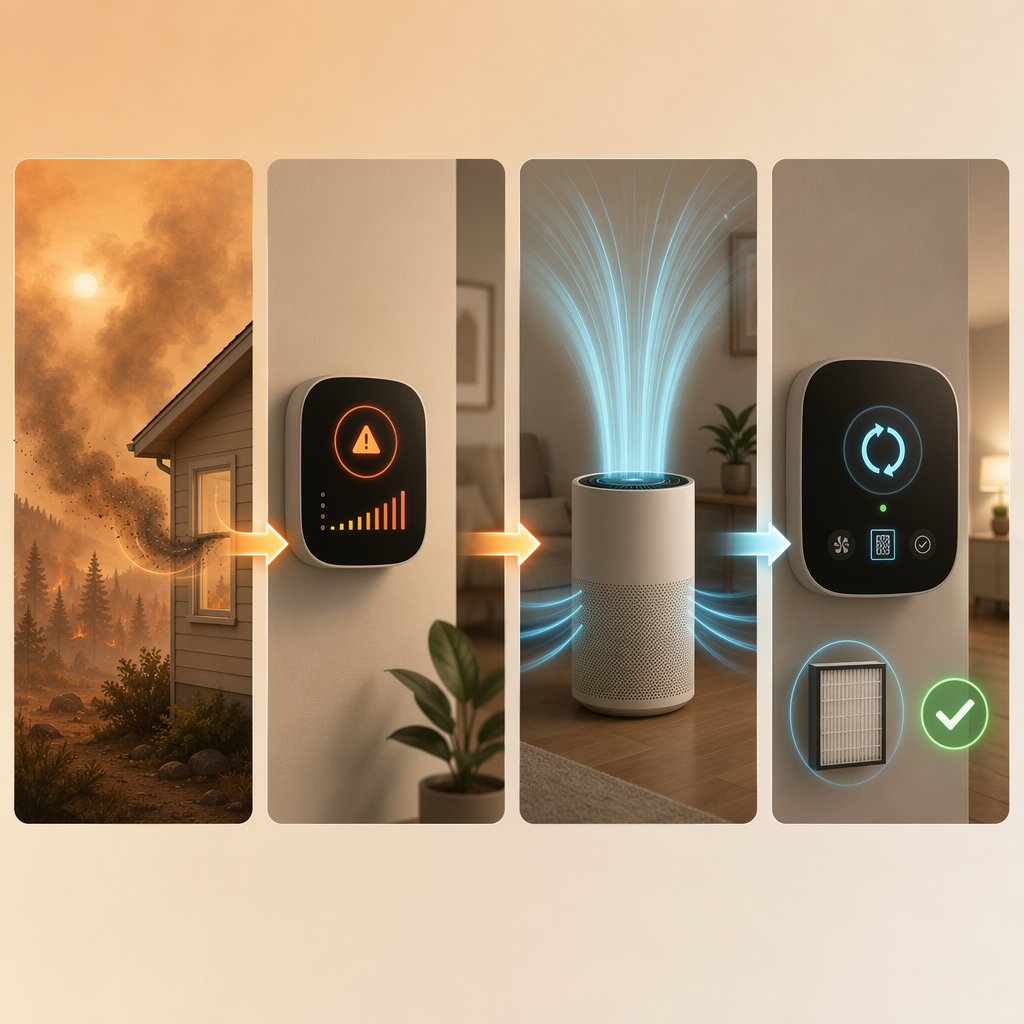
A useful smoke routine is simple enough to trust when everyone is distracted. Outdoor PM2.5 rises, or an indoor monitor detects PM2.5 climbing. The purifier shifts from quiet operation to high or auto. The thermostat starts fan-only recirculation through the MERV 13 filter. Someone checks the indoor PM2.5 trend later, not every five minutes, to confirm the number is moving in the right direction.
- Trigger: indoor PM2.5 crosses the threshold you choose, or outdoor PM2.5 rises sharply before smoke reaches the room.
- Room response: the smart purifier moves to high, turbo, or a more aggressive auto mode in the occupied room.
- Whole-home response: the thermostat runs fan-only or recirculate mode through a MERV 13 filter.
- Verification: the indoor monitor shows whether PM2.5 is falling, flattening, or still climbing.
- Human backup: if the number keeps rising, close leakage points, move the purifier, add a second room unit, or shorten door-opening trips.
That last verification step is what separates an air-quality system from a collection of optimistic purchases. A purifier running on high sounds reassuring. A thermostat fan icon looks reassuring. The PM2.5 trend tells you whether the house is actually gaining ground.
Local automation is especially valuable because wildfire smoke often arrives when nobody is standing next to the device. A wind shift during school pickup or a work meeting is exactly when a house should not be waiting for someone to open an app. Home Assistant users can build this kind of handoff with devices like AirGradient ONE and bridged PurpleAir data; people who do not want that level of tinkering should prioritize devices whose own apps can at least run dependable auto modes and schedules.
What To Buy First If You Cannot Build All Three Layers Now
Start where the current house is weakest. If you have no way to see PM2.5 indoors, buy the monitor first; otherwise you are guessing when to act and when to stop. If you already know smoke gets inside but have no room-level filtration, buy the purifier first for the bedroom or main occupied room. If you already own a decent purifier and central HVAC, the next upgrade may be the thermostat-and-filter layer, because that is where many homes leave usable filtration idle.
| Current Weak Point | First Purchase | Reason |
|---|---|---|
| No indoor PM2.5 reading | Air quality monitor | You need a measured trigger and a way to verify improvement |
| One smoky room, no portable filtration | Smart HEPA purifier sized for that room | It gives immediate clean-air delivery where people sleep or spend time |
| Central HVAC present but unmanaged | Smart thermostat plus MERV 13 filter check | It can turn existing airflow into whole-home recirculating filtration |
| Outdoor smoke arrives suddenly | Outdoor PM2.5 sensor or reliable outdoor data source | It gives earlier warning before indoor readings climb |
For many homes, the most sensible path is not the most expensive one. A capable bedroom purifier, a PM2.5 monitor in the living area, and a thermostat routine that runs the HVAC fan through a MERV 13 filter can outperform a single premium purifier asked to defend the entire house alone.
The point of smart home devices for wildfire smoke is coordination. The monitor should notice what people miss. The purifier should clean the room before the air feels bad. The thermostat should use the central system when recirculation helps. If only one device is affordable today, buy the one that fixes the weakest layer. The destination is a monitored, automated, filtered home where portable purification and HVAC recirculation reinforce each other through the long, smoky days when attention is already stretched.
References
- National Interagency Fire Center wildfire year-to-date data, National Interagency Fire Center, June 22, 2026, link
- Indoor Air Quality in 1,000 Homes in L.A. Before and During the Fires, Harvard Healthy Buildings, 2025, link
- Smart thermostat optimization for wildfire smoke exposure reduction, Indoor Environments, June 2025, link
- AirGradient is now Works With Home Assistant certified, AirGradient, link
- The Best Home Air Quality Monitor, Wirecutter, link
- Wildfire Smoke, Airthings, link
- Low-Cost Home Air Quality Monitors, Lawrence Berkeley National Laboratory, link
- Air Purifiers for Wildfire Smoke, HouseFresh, July 16, 2026, link
- Best Air Purifiers for Wildfire Smoke, Consumer Reports, July 16, 2026, link
- Smart Thermostats for Wildfire Resiliency, Center for the Built Environment, link
Corrections & Community Notes
Spotted an outdated spec, changed compatibility, or new firmware behavior? Submit a correction below to help keep this profile current. For formal editorial updates, use the contact page.
Comments
Join the discussion with an anonymous comment.