The word "smart" gets stretched too far on air purifiers. During wildfire smoke, it can mean anything from a purifier that merely lets you tap an app instead of a button to one that detects a PM2.5 spike, raises fan speed, and keeps running while everyone in the house is asleep. Those are not the same appliance in a smoke event.
For a smart home air purifier for wildfire smoke, the useful question is not whether it has Wi-Fi. It is whether the purifier can measure the particle pollution that matters, respond without being babysat, and keep that response reliable across several dirty days. HouseFresh's testing puts the most important distinction in plain view: laser-based PM sensors in models such as the Coway Airmega ProX, Coway Airmega 400S, and Levoit Core 600S-P triggered faster automatic responses than infrared sensors such as the one in the Levoit Vital 200S, which can accumulate smoke residue and drift unless cleaned during prolonged smoke exposure.[1]
The smart feature that matters first: PM2.5-driven auto mode
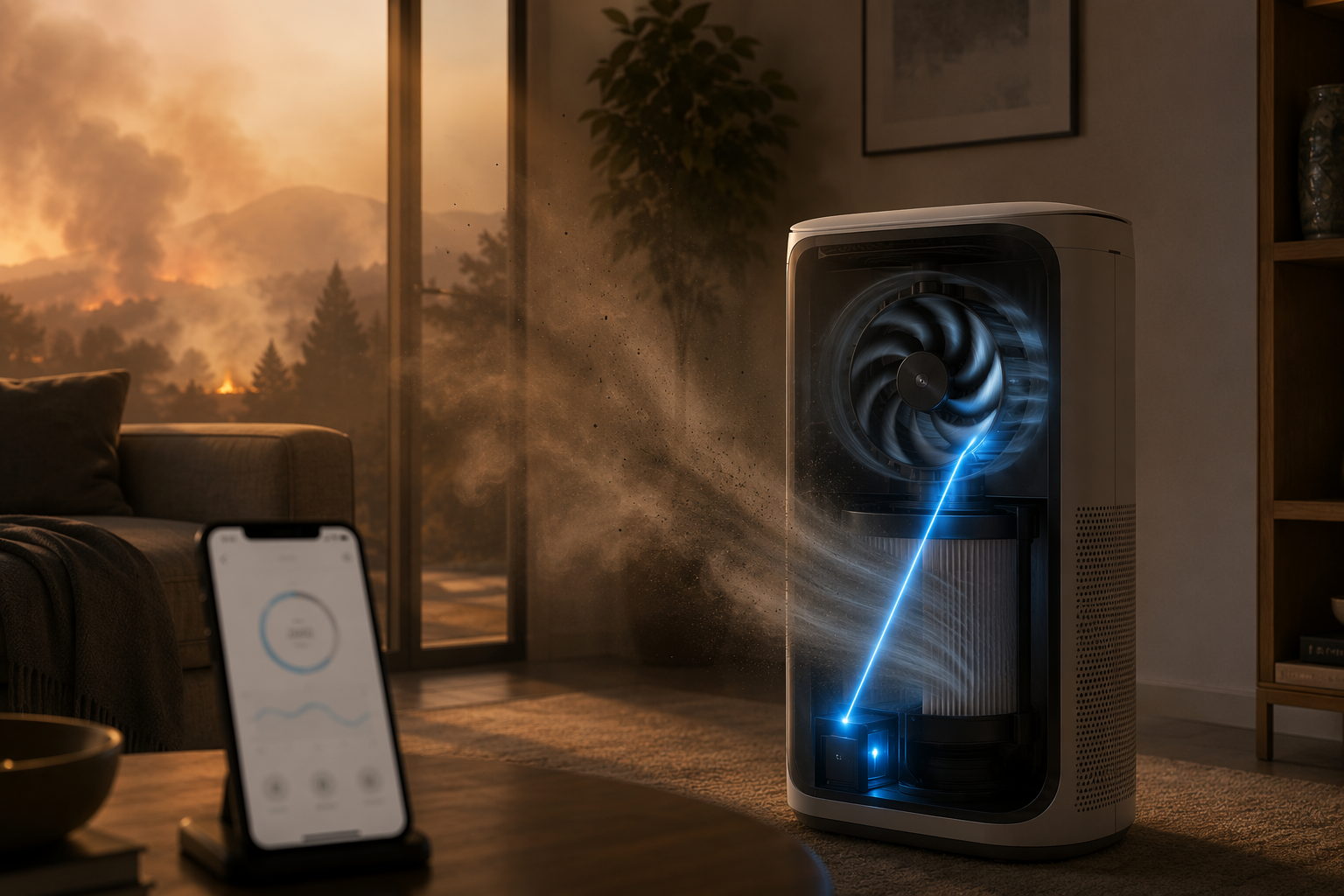
Wildfire smoke is a PM2.5 problem before it is an app problem. A purifier that waits for someone to notice haze, open an app, and raise the fan has already handed the household another chore at the worst possible time. A useful auto mode watches particle levels and changes airflow on its own.
That distinction matters because indoor smoke does not politely arrive while someone is standing beside the machine. It creeps in overnight, while windows are cracked, when a bathroom fan pulls in outside air, or when a door opens repeatedly for pets and kids. The Air Purifier HQ, citing EPA-linked findings, reports that indoor PM2.5 during wildfire events can reach 55% to 60% of outdoor levels without a running air cleaner.[2] Auto mode is valuable when it prevents the avoidable mistake: the unit sitting on low while the room is taking on smoke.
Remote on/off is still convenient. Voice control is useful when hands are full. A phone alert can be the thing that reminds someone to close windows or check a filter. But those features are supporting players. If the onboard sensor is slow, dirty, or poorly matched to the fan response, the purifier can look smart in an app while behaving timidly in the room.
Laser sensors earn their keep during a smoke week
Particle sensors inside purifiers are not interchangeable. A laser-based PM sensor reads fine particles by scattering laser light through a sensing chamber. An infrared sensor uses a simpler light source and can still be useful, but HouseFresh found that infrared sensors are more vulnerable to residue buildup during sustained smoke, which can affect accuracy unless the sensor is cleaned.[1]
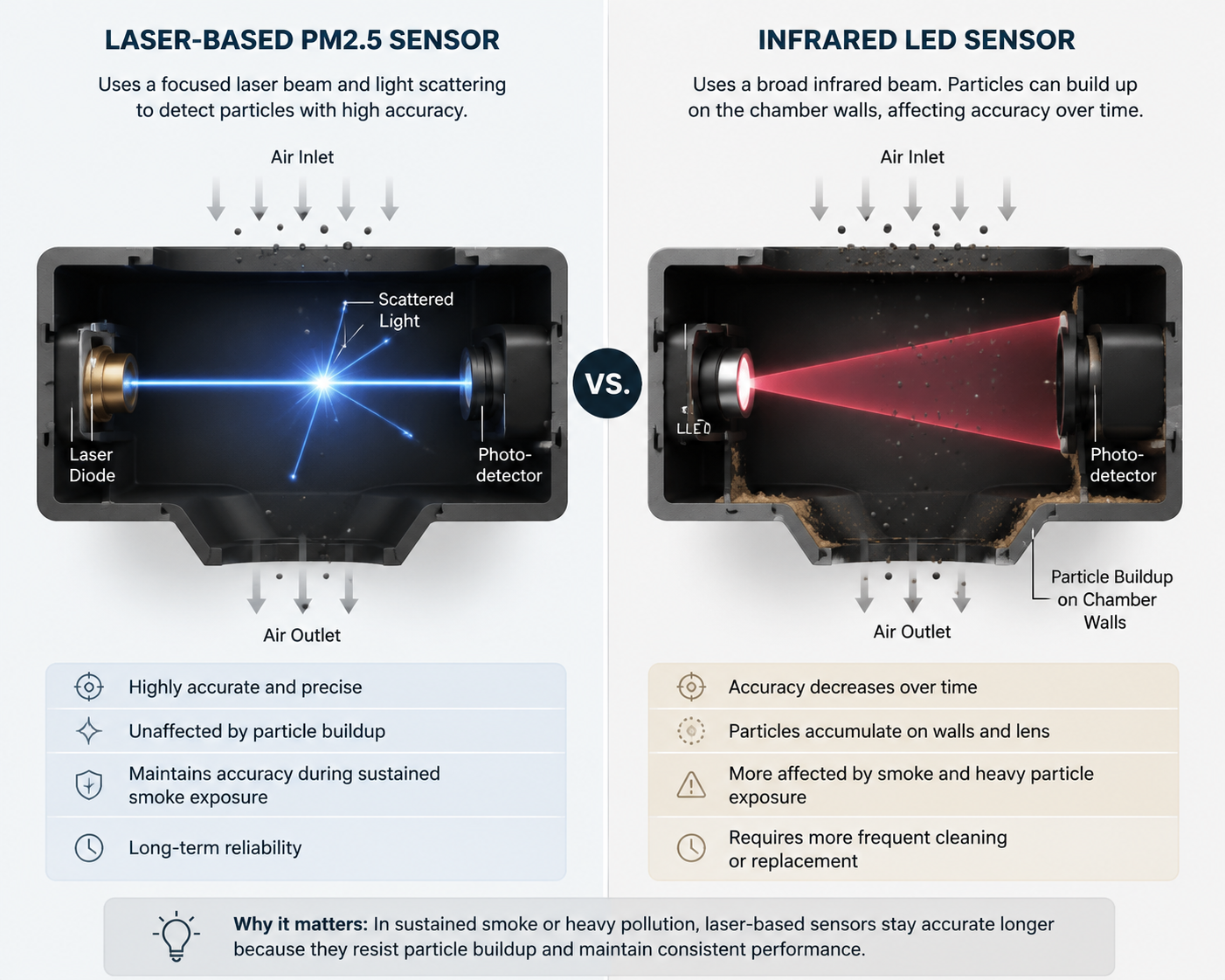
This is where two connected purifiers with similar app promises can split apart. The Levoit Vital 200S is a strong value model: HouseFresh identifies it as a best-value smart pick under $250, with VeSync app support, Alexa and Google integration, a PM1 CADR of 249 CFM, coverage of 373 square feet at 5 air changes per hour, and estimated annual running costs of about $123.48 under 24/7 operation.[1] Its caveat is the infrared sensor. In a normal week, that may be an acceptable trade-off. In a heavy smoke period, the owner needs to know that sensor cleaning is part of keeping auto mode trustworthy.
The nearby upgrade is the Levoit Core 600S-P, which HouseFresh places close in price and identifies as using a laser sensor.[1] That does not automatically make it the right machine for every room, but it changes the maintenance burden around the feature that is supposed to protect you while you are not watching it.
The same sensor issue shows up higher in the market. Coway's Airmega 400S and ProX use laser-based sensing in HouseFresh's smoke-focused testing context, while the Airmega ProX is listed with a 462 CFM smoke CADR and roughly $200 per year in filter costs.[1] Those numbers put it in a different room-size and budget category, not just a fancier smart-home category.
The purifier still has to be big enough for the room
A smart auto mode cannot make up for undersized airflow. If the smoke CADR is too low for the space, the sensor can correctly panic all day and the room can still stay dirtier than it should.
The sizing rule gets stricter during wildfire smoke. The Air Purifier HQ, citing AHAM guidance, notes that smoke CADR should be sized to the full room square footage during wildfire events rather than relying on the looser two-thirds rule commonly used for everyday allergen guidance.[2] That is not a small footnote. It is the difference between a purifier that briefly looks impressive in a product listing and one that can keep exchanging enough air when outdoor PM2.5 stays elevated.
| Model example | What the smart feature is really buying | Smoke-season caveat |
|---|---|---|
| Levoit Vital 200S | Low-cost connected control, VeSync app, Alexa/Google support, auto mode, and strong value under $250.[1] | Infrared sensor needs periodic cleaning during sustained smoke; bonded filter can raise replacement costs. |
| Levoit Core 600S-P | Similar smart-home appeal with a laser-based sensor at a nearby price point.[1] | Still needs room sizing checked against smoke CADR, not just app features. |
| Blueair Blue Pure 311i Max | Balanced particle removal, app support, Alexa/Google support, and laser-based sensing; CNET measured a T90 room-clear time of 1:28 and lists smoke CADR at 250 CFM.[3] | Carbon layer is light, so odor control is secondary. |
| Coway Airmega 400S | Large-room smart option with about 328 CFM smoke CADR, twin-fan airflow, IFTTT support, and more meaningful pelletized carbon for odor/VOC control.[2] | Higher street price, commonly above $500, and platform integrations should be verified before buying for automation. |
| Coway Airmega ProX | Very-large-space option with laser sensing and 462 CFM smoke CADR in HouseFresh's smoke-focused model notes.[1] | Filter costs are in a higher ownership tier, around $200 per year. |
That table is not a ranking. It is a reminder to compare the actual job each smart feature performs. A smaller bedroom may not need the same machine as an open living room. A household that already has an external air quality monitor may care less about app charts on the purifier and more about whether the purifier accepts reliable automation triggers. A smoke-prone home with one main living area may be better served by a larger unit with stronger carbon and higher CADR than by several underpowered connected devices.
Carbon design is where the running cost hides
Smoke is not only particles. HEPA-style filtration handles fine particle removal, but odor and some gaseous compounds need carbon. The trouble is that many smart purifiers use a bonded carbon-and-HEPA cartridge: once the carbon is spent, the whole cartridge goes in the trash even if the particle filter media still has useful life.
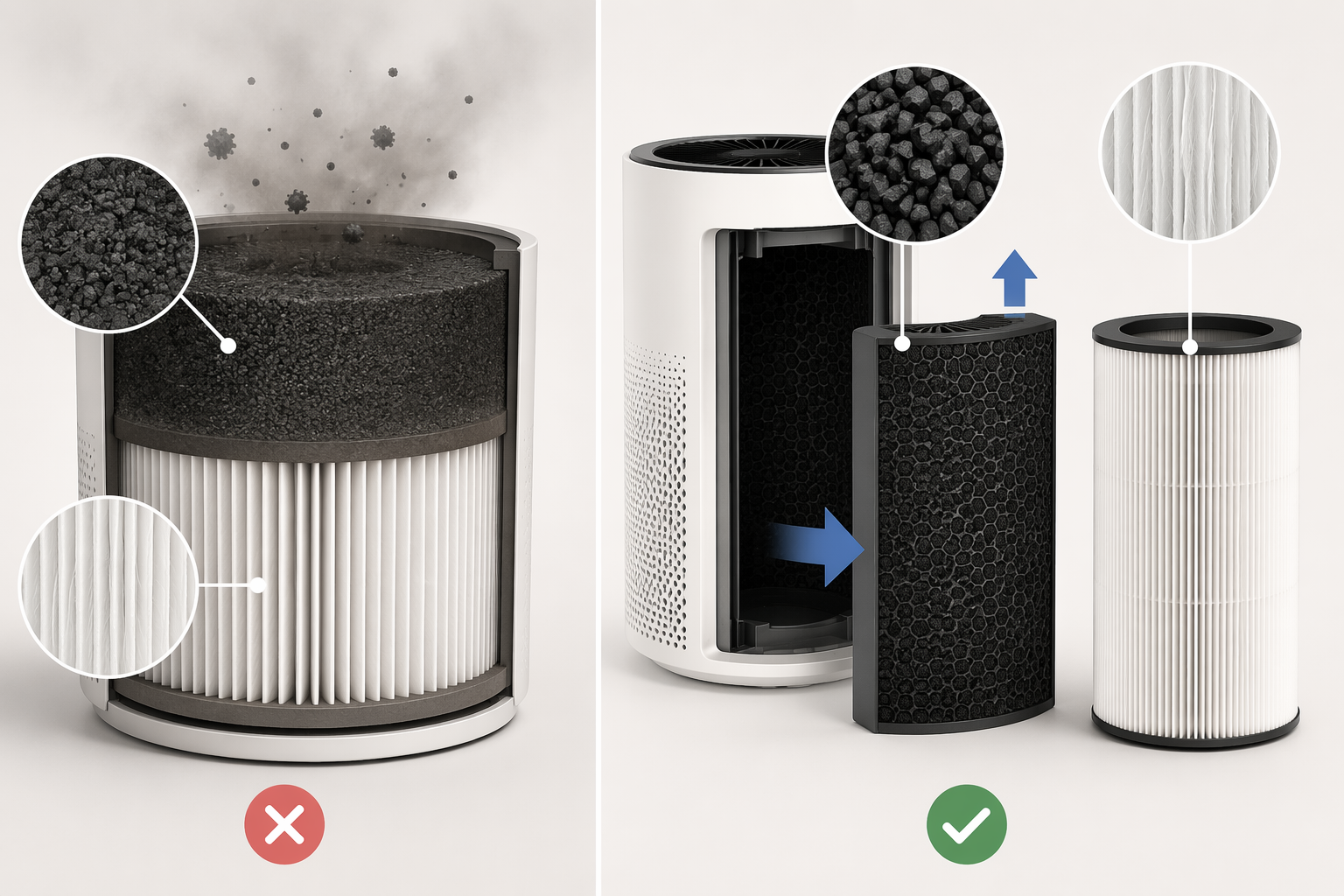
The Air Purifier HQ and HouseFresh both flag this as a cost issue with models that fuse carbon and HEPA into a single cartridge, including examples such as the Levoit Vital 200S and Blueair Blue Pure 311i Max.[1][2] The Air Purifier HQ notes that carbon can saturate in about 8 weeks during heavy smoke rather than lasting the advertised 6 to 12 months, which can force earlier full-cartridge replacement if the carbon layer is bonded to the HEPA media.[2]
That does not make bonded filters bad. They are simple, tidy, and common in good machines. It does mean the advertised filter-life number deserves suspicion in a real smoke season. If odor control matters, look for how much carbon the unit actually carries, whether it is a light sheet or pelletized carbon, and whether the carbon can be replaced separately from the particle filter.
This is one reason the Coway Airmega 400S sits differently from many midpriced smart units. The Air Purifier HQ describes it as having real pelletized carbon for VOC and smoke-odor control, alongside a smoke CADR of about 328 CFM and a twin-fan design meant to maintain airflow at larger-room scale.[2] That is a material difference, not just a premium app badge.
App control helps most when it changes household behavior
A purifier app is worth more than a remote control when it makes a stressed household do the right thing sooner. Useful alerts are the ones that tell someone PM2.5 is rising, the unit has ramped up, the filter is loading faster than expected, or the device has gone offline. Less useful are beautiful graphs that no one checks until the room already smells like smoke.
- Useful: an alert that indoor PM is rising while windows are open.
- Useful: auto mode that moves quickly from quiet operation to higher airflow.
- Useful: filter-life tracking that reflects heavy use instead of a calendar fantasy.
- Mostly convenience: voice commands for fan speed when the purifier already has a good auto mode.
- Mostly convenience: remote on/off if the unit should be left running continuously during a smoke event.
Voice assistant labels should be read narrowly. Alexa or Google support may let someone ask for status or change a setting, which can be handy. HomeKit and SmartThings buyers should be especially careful to confirm current support rather than assume a model works because an old forum post or applet once did. IFTTT and platform automations depend on current APIs, manufacturer support, and region-specific app behavior.
If you want a broader quick-pick list after sorting the feature claims, use the site’s Best Smart Air Purifiers for Wildfire Smoke in 2026 guide as a companion. If you are building a whole-home response rather than choosing one purifier, the system-level piece on three smart home devices to protect against wildfire smoke is the better next stop.
When an external monitor still makes sense
The onboard sensor in a purifier reads the air near the purifier. That is enough for many single-room setups, especially when the purifier is correctly sized and placed. It is less reassuring in homes with separated bedrooms, long hallways, open stairwells, or a purifier tucked into a corner because that was the only available outlet.
An independent air quality monitor can reveal whether the room where people sleep is actually improving, not just whether the purifier’s intake area looks cleaner. It can also act as the trigger point for a broader smart-home routine: close up the house, pause ventilation, raise purifier speed, and notify someone before the smell arrives. For readers choosing that extra sensor, the site’s guide to which smart air quality monitor detects wildfire smoke best covers that decision more directly.
A smoke-season buying rule
The recent Canadian and Minnesota wildfire smoke episodes on July 15 and 16, 2026, are a useful reminder of the pattern, not an exception: smoke can arrive fast, linger for days, and expose the weak parts of a device that looked fine in normal indoor air. The smart purifier worth buying is the one whose automatic behavior remains useful when no one has time to manage it.
Start with the sensor. Prefer laser-based PM2.5 sensing when the budget allows. If choosing an infrared-sensor model like the Vital 200S for its price and app features, treat sensor cleaning as part of smoke-season maintenance. Then check smoke CADR against the actual room, not the marketing room size. After that, inspect the carbon design and replacement cost with the assumption that heavy smoke can spend carbon much faster than a normal filter-life estimate suggests.
A connected purifier that only accepts commands is convenient. A smart home air purifier for wildfire smoke should measure PM2.5 accurately, raise airflow automatically, fit the room’s smoke CADR need, and avoid hidden cartridge costs you are not willing to carry.
Corrections & Community Notes
Spotted an outdated spec, changed compatibility, or new firmware behavior? Submit a correction below to help keep this profile current. For formal editorial updates, use the contact page.
Comments
Join the discussion with an anonymous comment.