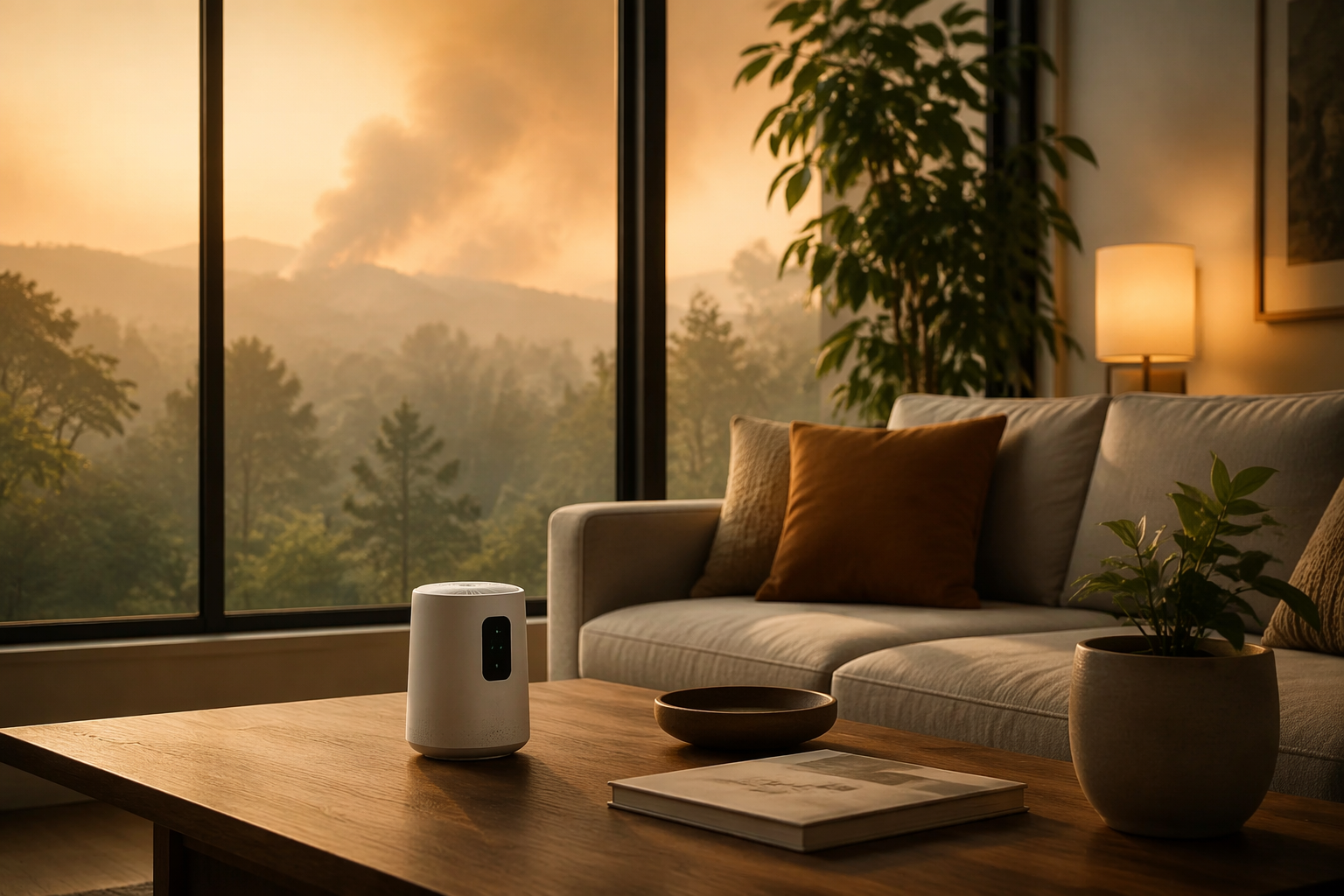
The bad wildfire-smoke moment is not when an app turns a map tile red. It is when the room still looks normal, the windows are already closed, and someone starts wondering whether the purifier should be higher, the HVAC fan should stay on, or the kids should move out of the front room. A smart air quality monitor for wildfire smoke earns its place right there: it has to see the PM2.5 rise quickly enough, and credibly enough, that the household can act before the air feels wrong.
That standard immediately cuts through a lot of product-page noise. VOC, CO2, radon, temperature, humidity, and general “air health” scores can be useful in the right context. For smoke season, they come after one question: can this monitor detect fine particulate matter from smoke, mostly PM2.5, with enough accuracy and response speed to change behavior or trigger automation?
Low-cost consumer monitors are not regulatory instruments. Berkeley Lab researchers found that low-cost monitors overreported PM2.5 by 1.6x to 2.4x compared with reference monitors, but their relative changes tracked “phenomenally well,” making them useful for seeing smoke trends even when the absolute number needs caution.[1] That is the practical bar for home use: not laboratory perfection, but a reading that rises when smoke enters, falls when filtration works, and stays consistent enough to trust as a trigger.
What “detects wildfire smoke best” actually means
For wildfire smoke, PM2.5 is the main number to watch because smoke particles are small enough to travel indoors and linger in breathing air. A monitor that can count VOCs beautifully but cannot call a smoke spike unhealthy is the wrong kind of smart.
The strongest evidence in this category comes from corrected particle-sensor data, not from sensor-count bragging. EPA researchers developed a correction for PurpleAir data that kept normalized mean bias error within 10% at every AQI breakpoint up to 500+ µg/m³, and the corrected data predicted the NowCast AQI category correctly 94% of the time.[2] EPA also uses corrected PurpleAir data on the AirNow Fire and Smoke Map, where more than 12,000 PurpleAir sensors are shown alongside official monitoring information.[2]
That does not make every home monitor equally dependable. Consumer Reports’ 2026 testing found that the best indoor air quality monitors detected a PM2.5 drop in under 30 seconds, while some models, including Ikea Alpstuga and uHoo, never reported unhealthy levels during a smoke test.[3] That finding matters more than whether a device has a polished app. If smoke enters and the monitor never calls it unhealthy, automation cannot compensate.
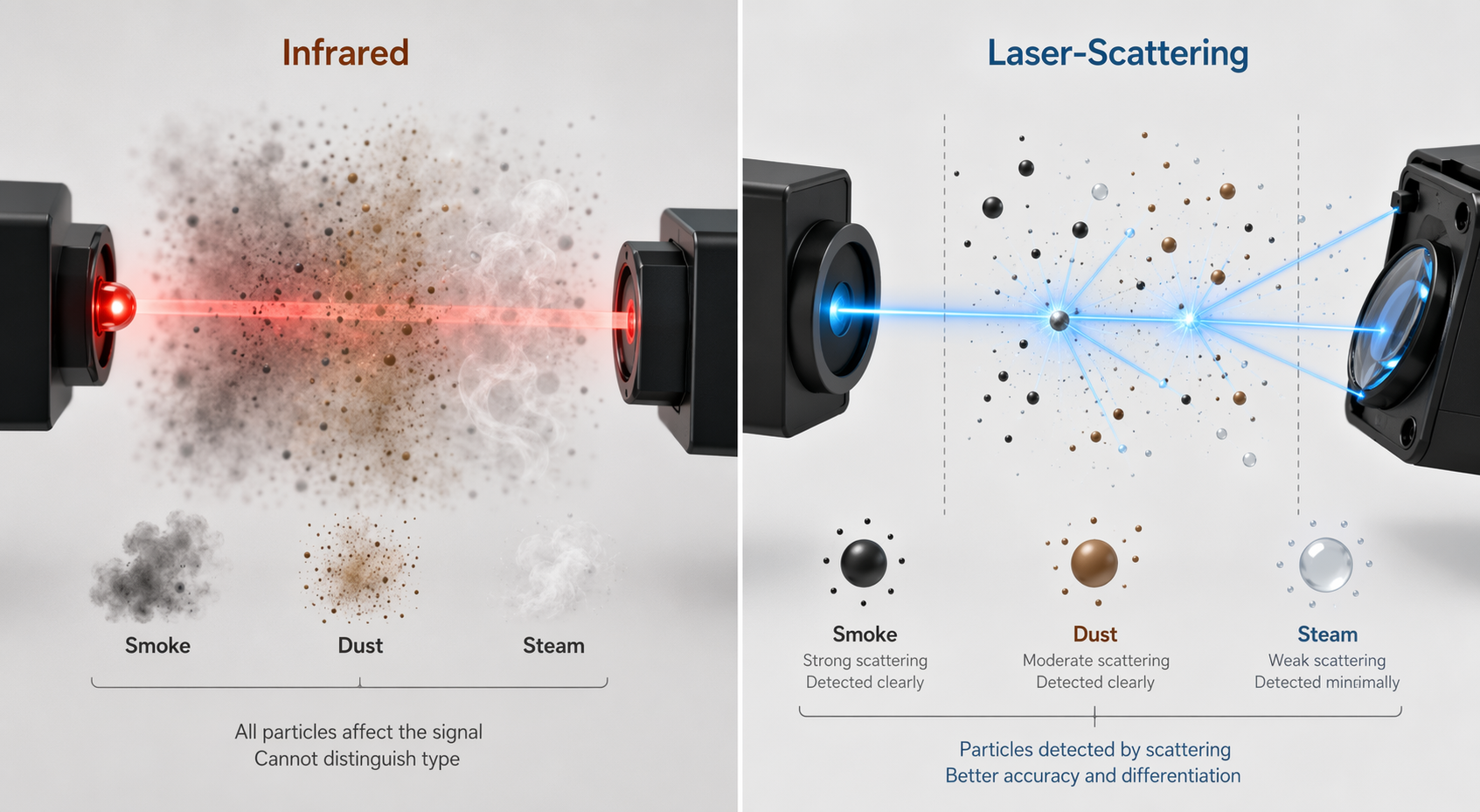
Laser-scattering particle sensors are the safer bet for smoke because they are built around counting light scattered by fine particles. Cheaper infrared approaches may still show a trend, but they are less reassuring when the job is distinguishing a hazardous smoke increase from ordinary household dust, steam, or sensor noise. For a wildfire buyer, the useful smart monitor is not the one with the longest list of environmental measurements; it is the one whose PM2.5 behavior can be cross-checked, corrected, or tied to a credible test.
Best smart air quality monitors for wildfire smoke
The picks below are ranked by smoke-season usefulness first: PM2.5 credibility, response behavior, and automation path. Price bands are approximate because discounts move around, but the buying logic does not change much.
1. PurpleAir Zen: best for corrected, cross-checkable smoke readings
PurpleAir Zen is the smoke-season pick for people who want indoor readings that connect back to a larger evidence system. Its appeal is not just that it measures PM2.5; it uses dual Plantower PMS5003 particle sensors, and PurpleAir’s broader sensor network is the one EPA studied, corrected, and incorporated into AirNow’s Fire and Smoke Map.[2]
That makes the Zen unusually useful during a bad week of smoke. You can compare what your indoor monitor says with nearby outdoor PurpleAir and AirNow Fire and Smoke Map readings, then decide whether the purifier is keeping up or whether smoke is leaking in faster than expected. Cross-checking will not turn a consumer monitor into a federal reference instrument, but it makes the number less lonely.
NonToxicLab’s 2026 testing grouped PurpleAir Zen among the best consumer monitors, reporting that top performers such as Airthings View Plus, AirGradient One, and PurpleAir Zen tracked within 15% to 20% of reference instruments during stable conditions.[4] That still leaves room for correction and judgment, especially during fast-changing smoke events, but it is a better starting point than a vague “air quality” score.
Choose PurpleAir Zen if wildfire smoke is the main problem, you care about corrected PM2.5 data, and you want your indoor reading to make sense next to the outdoor map everyone is already refreshing.
2. AirGradient One: best for Home Assistant and open automation
AirGradient One is the monitor to buy when the household already thinks in automations rather than notifications. Its open-source firmware and native Home Assistant and Homey support make it the most flexible choice here for custom purifier behavior: ramp a smart plug when PM2.5 crosses a threshold, send a phone alert if the bedroom rises overnight, or compare indoor and outdoor trends before opening windows.
That openness matters because smoke response is personal. A family with one large HEPA purifier in the living room may want an aggressive threshold. Someone in a small apartment may want the monitor to trigger a box-fan filter setup or remind them to shut a leaky window. AirGradient gives tinkerers more control over those decisions than a closed app with one generic “poor air” notification.
The caution is that flexibility is not the same thing as universal simplicity. Alexa and Google Home households can still get a good smoke setup without maintaining Home Assistant. But for people who want transparent data, local-ish control, and automations that do exactly what they intend, AirGradient One is the most compelling smart-home pick. NonToxicLab’s 2026 testing placed AirGradient One among the consumer monitors that tracked within 15% to 20% of reference instruments during stable conditions.[4]
3. Qingping Air Monitor Pro Gen 2: best mid-range accuracy/value candidate
Qingping Air Monitor Pro Gen 2 sits in the sweet spot for buyers who want a better PM2.5 monitor without jumping straight to a premium device. At roughly the mid-range price tier, it is attractive because Qingping’s particle-sensing performance has been observed favorably in comparative monitor testing, and the Pro Gen 2 adds a smart-home path through Home Assistant support.[5][6]
Its role is different from PurpleAir Zen’s. PurpleAir’s advantage is corrected, map-adjacent smoke data. AirGradient’s advantage is open automation. Qingping’s advantage is value: a strong PM2.5-focused monitor with enough integration potential to become more than a display on a shelf.
That makes it a good fit for someone who wants a credible indoor trend and may later connect it to a more advanced smart-home system. If the goal is to spend less than the premium tier while still taking smoke readings seriously, Qingping Pro Gen 2 is the mid-range model to look at first.
4. Airthings View Plus: best premium all-around household monitor
Airthings View Plus is the premium choice for homes that want wildfire-smoke awareness plus a broader picture of indoor air. It monitors PM2.5 along with radon and other household air factors, supports Alexa and Google, works with IFTTT, and is positioned with a longer warranty than the cheaper category typically offers.
For smoke alone, PurpleAir Zen and AirGradient One are more interesting. For a household that also cares about radon and wants a polished mainstream smart-home experience, Airthings View Plus earns its premium slot. NonToxicLab’s 2026 testing included Airthings View Plus among the top consumer monitors that tracked within 15% to 20% of reference instruments during stable conditions.[4]
The tradeoff is focus. Airthings View Plus gives a richer indoor-air dashboard, but a smoke-season buyer should still judge it by the PM2.5 reading and the automation it can trigger. Radon and CO2 do not compensate for a slow or vague smoke response.
5. Temtop M2000 or M10: best budget PM2.5 awareness without smart-home control
Temtop’s M2000 and M10 models belong in the budget tier because they give a low-cost way to watch PM2.5 without buying into a full smart-home device. That is useful if the real need is simple: check whether indoor smoke is rising, compare rooms, or see whether a purifier appears to be reducing particles.
The limitation is just as important. These are not the best picks if you want automatic purifier control, push alerts, or a monitor that feeds a smart-home dashboard. They are budget awareness tools, not automation hubs. For renters, spare rooms, garages, or backup checks, that can still be enough.
6. Amazon Smart Air Quality Monitor: cheapest Alexa automation path, not the strongest smoke-evidence pick
Amazon’s Smart Air Quality Monitor deserves a separate category because its strength is obvious: low-cost Alexa Routines. For about the budget-smart price tier, it can tell Alexa to turn on an Echo-connected purifier, switch a smart plug, or announce an air-quality alert. If the home already runs on Alexa, that convenience is real.
The smoke-season caveat is also real. The research base here does not include peer-reviewed wildfire-smoke chamber testing for Amazon’s monitor, and the same limitation applies to many GoveeLife-style budget smart monitors. Claims about those products lean on manufacturer specifications and general tester observations rather than wildfire-specific validation.
That does not make the Amazon monitor useless. It means the buyer should be clear about what they are buying: an inexpensive automation trigger for Alexa, not the most proven PM2.5 smoke instrument in this guide. If the routine matters more than independent smoke-performance evidence, it is the cheapest path. If the reading itself is the priority, look higher in the list.
A free cross-check many homes should use anyway
Before buying any monitor, check the AirNow Fire and Smoke Map during real smoke events. It is free, it includes official monitoring information, and it incorporates corrected PurpleAir sensor data.[2] For some households, especially those who only need outdoor smoke guidance and do not plan to automate indoor purifiers, that may reduce the need for a dedicated smart monitor.
The reason to add an indoor monitor is that outdoor data cannot tell you whether smoke has slipped through your own walls, window seals, range hood, bathroom fan, or HVAC behavior. Two houses on the same block can have different indoor particle levels depending on filtration, leakage, room layout, and purifier placement. Outdoor maps tell you when to be suspicious. Indoor PM2.5 tells you whether your room is actually holding.
Placement can ruin a good monitor
A reliable sensor still needs a sane location. Wirecutter’s 2026 guidance is straightforward: place an air quality monitor in the breathing zone, about 3 to 5 feet off the floor, and avoid putting it right next to windows or vents.[5] That keeps the monitor from reporting a blast of supply air, a draft from a cracked window, or a weird corner pocket instead of the air people are actually breathing.
For wildfire smoke, the best first location is usually the main occupied room or the bedroom where someone needs overnight protection. If the reading jumps near an exterior wall but stays lower near the purifier, that is still information; it may show where smoke is entering or whether the purifier is undersized for the space. Just do not treat one poorly placed sensor as the whole-house truth.
How to choose
| If this is your priority | Choose | Why |
|---|---|---|
| Most actionable wildfire-smoke PM2.5 data with outdoor cross-checking | PurpleAir Zen | Corrected PurpleAir data has strong EPA support and appears on the AirNow Fire and Smoke Map. |
| Flexible purifier automation and Home Assistant control | AirGradient One | Open-source firmware and native Home Assistant/Homey support make custom smoke routines easier. |
| Mid-range PM2.5 value with smart-home potential | Qingping Air Monitor Pro Gen 2 | Good fit when accuracy/value matters more than premium extras. |
| Premium whole-home air-health monitoring | Airthings View Plus | Adds broader monitoring such as radon with Alexa, Google, and IFTTT support. |
| Low-cost PM2.5 awareness without automation | Temtop M2000 or M10 | Useful for watching smoke trends when a standalone display is enough. |
| Cheapest Alexa-triggered routine | Amazon Smart Air Quality Monitor | Best treated as an Alexa automation device, not the most independently proven smoke monitor. |
During wildfire season, the best monitor is not the one with the most sensors. It is the one whose PM2.5 reading you trust enough to make the purifier turn on, the alert arrive, or the household decision happen in time.
References
- Low-cost home air quality monitors prove useful for wildfire smoke, Berkeley Lab, 2020
- Development and application of a United States-wide correction for PM2.5 data collected with the PurpleAir sensor, Sensors, 2022
- Best Indoor Air Quality Monitors of the Year, Consumer Reports, 2026
- Best Indoor Air Quality Monitor, NonToxicLab, 2026
- The Best Home Air Quality Monitor, Wirecutter, 2026
- The best air quality monitors, HouseFresh, 2026
Reader Feedback
Share your purchase experience, flag outdated picks, or ask clarifying questions about the checklist items.
Comments
Join the discussion with an anonymous comment.