
Outdoor Smart Plugs: Specs, Protocols, and Platform Compatibility
Compare the top outdoor smart plugs side by side across IP ratings, protocols, platform compatibility, and price to find the best fit for your deck, garage, or yard.
Last updated
An outdoor smart plug is a small purchase that can become annoying fast if one spec is wrong. Most of the good options look alike on the shelf: black weather-resistant housing, two covered outlets, app scheduling, voice control, and no subscription. The real choice is narrower than the packaging suggests. For most buyers, the deciding factors are platform compatibility, outlet count, weather rating, and whether the plug can safely handle the load you want to run.
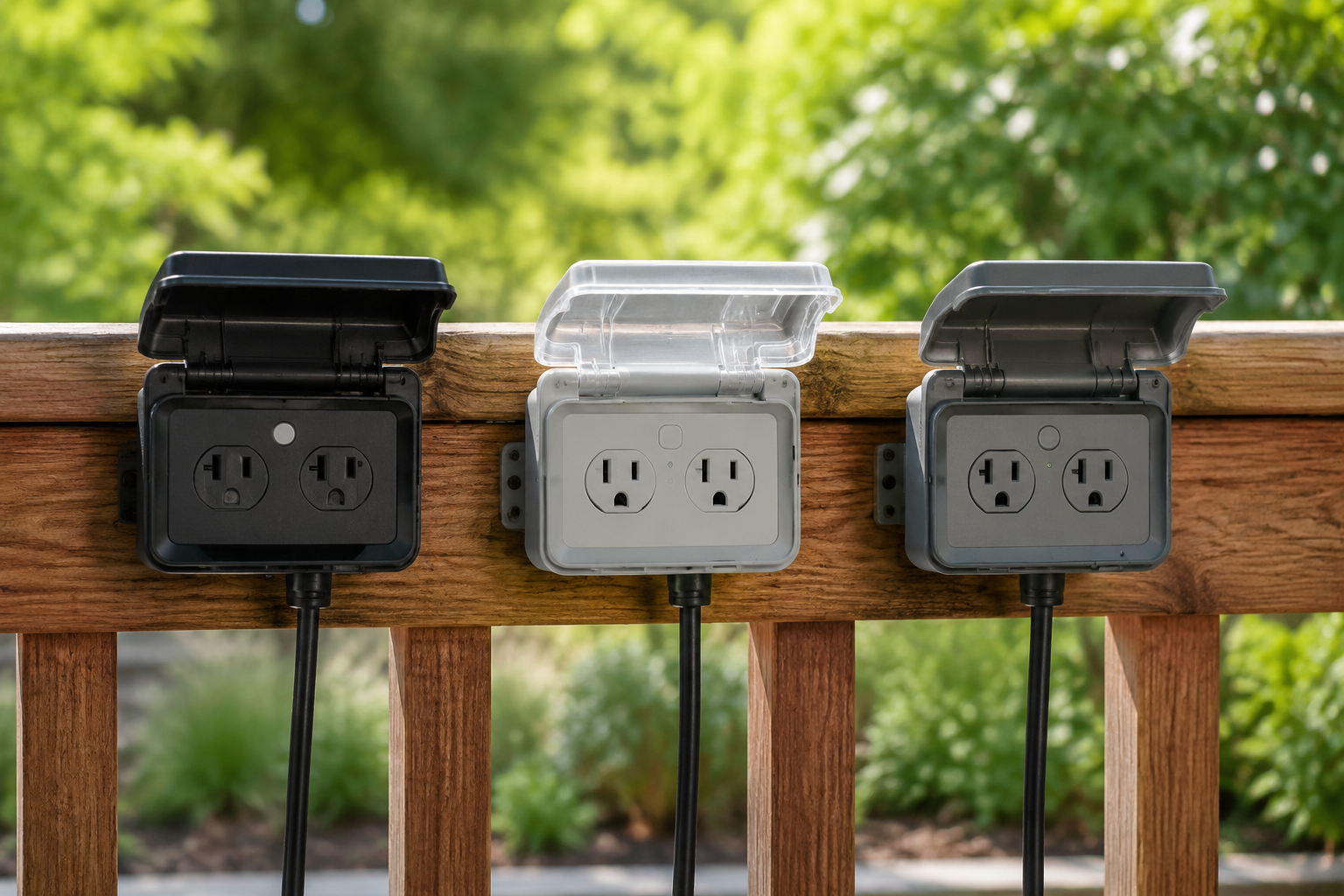
The baseline is fairly consistent in the U.S. market as of Q2 2026: many outdoor smart plugs sit around IP64 weather protection, 2.4 GHz Wi-Fi, two outlets, a 15A maximum load, and free core features such as schedules, remote control, and voice assistant support.[1][2][3] That similarity is useful. It means a buyer does not need to chase a generic “best outdoor smart plug” label; they need to match the few specs that actually change the purchase.
| Model | Approx. Price | Weather Rating | Outlets | Max Load | Protocol / Connectivity | Major Platform Fit | Hub Required | Energy Monitoring | Subscription |
|---|---|---|---|---|---|---|---|---|---|
| TP-Link Kasa EP40 | $25 | IP64 | 2 | 15A | Wi-Fi | Alexa, Google Home; not native Matter/HomeKit in the cited materials | No | No | No core subscription |
| Tapo P400M / TP25 | $22 | IP65 | 2 | 13A | Matter over Wi-Fi | Alexa, Google Home, Apple Home/HomeKit through Matter | No Matter bridge required beyond the user’s platform controller | No | No core subscription |
| Wyze Plug Outdoor | $18 | IP64 | 2 | 15A | Wi-Fi | Alexa, Google Home; Wyze app ecosystem | No | Yes | No core subscription; optional Wyze services may exist |
| GE Cync Outdoor Smart Plug | $30 | IP64 | 2 | 15A | Matter / Wi-Fi in cited 2026 materials | Alexa, Google Home, Apple Home/HomeKit through Matter | No Matter bridge required beyond the user’s platform controller | Not specified in cited materials | No core subscription |
| BN-Link Yard Stake | $39 | IP44 | 6 | 15A | Wi-Fi / outdoor stake format in cited roundups | Voice platform support varies by listing | No in cited roundups | Not specified in cited materials | No core subscription |
| Lutron Caséta Outdoor Smart Plug | $80 plug + about $80 bridge | IP65–IP66 | 1 | 15A; motor-rated up to 1/2 HP | Lutron Clear Connect via Caséta bridge | Alexa, Google Home, Apple HomeKit, SmartThings through the Lutron system | Yes | No | No core subscription |
| Ring Outdoor Smart Plug | Varies by retailer | Outdoor-rated in cited roundups | 2 | Not fully specified in cited materials | Ring ecosystem | Ring/Amazon ecosystem; motion integration noted in cited roundups | Yes in cited materials | Not specified in cited materials | No core subscription; Ring services may add features |
| IKEA Tofsmygga / Grillplats | Not confirmed for U.S. retail | Outdoor plug in cited Matter roundup | Not fully specified in cited materials | Not fully specified in cited materials | Matter over Thread | Alexa, Google Home, Apple Home/HomeKit through Matter, assuming U.S. availability and compatible Thread border router | Thread border router / Matter controller expected | Not specified in cited materials | Not specified in cited materials |
Those table cells carry most of the decision. The Kasa EP40, Wyze Plug Outdoor, GE Cync, and many comparable two-outlet models are trying to solve the same deck-and-yard problem. They are not meaningfully different because one can turn on patio lights at sunset and another can run a schedule; that is table stakes. They diverge when one adds Matter, one reports energy use, one drops to 13A, one adds four extra outlets, or one requires an expensive bridge.
If you need more basic buying context before comparing models, the site’s outdoor smart plug choosing guide is the better starting point. This profile assumes you are already deciding which box belongs outside.
Weather Rating Comes Before App Features
“Outdoor” is not a single rating. In the cited roundups, the category runs from IP44 on the BN-Link Yard Stake to IP66 on Lutron Caséta, with IP64 common on models such as Kasa EP40, Wyze Plug Outdoor, and GE Cync.[1][2][3] That spread matters more than whether the app has a nicer timer screen.
IP44 can make sense for a covered or semi-protected seasonal setup, especially when the six-outlet stake format solves a real wiring problem. It is a weaker weather spec than IP64 or IP65, so it is harder to justify for an exposed wall outlet, open garden bed, or anywhere the plug may sit in wind-driven rain. IP65 and IP66 move the product into stronger protection territory; Lutron’s higher weather protection is one reason its price cannot be judged only against $20 Wi-Fi plugs.[2]
Operating temperature is another outdoor spec worth checking, but the available materials only document a consistent -4°F to 122°F range for Kasa and Tapo models.[1][2] For other models, verify the current manufacturer listing if the plug will live through very hot walls, unheated garages, or winter exposure.
Matter Changes the Platform Question
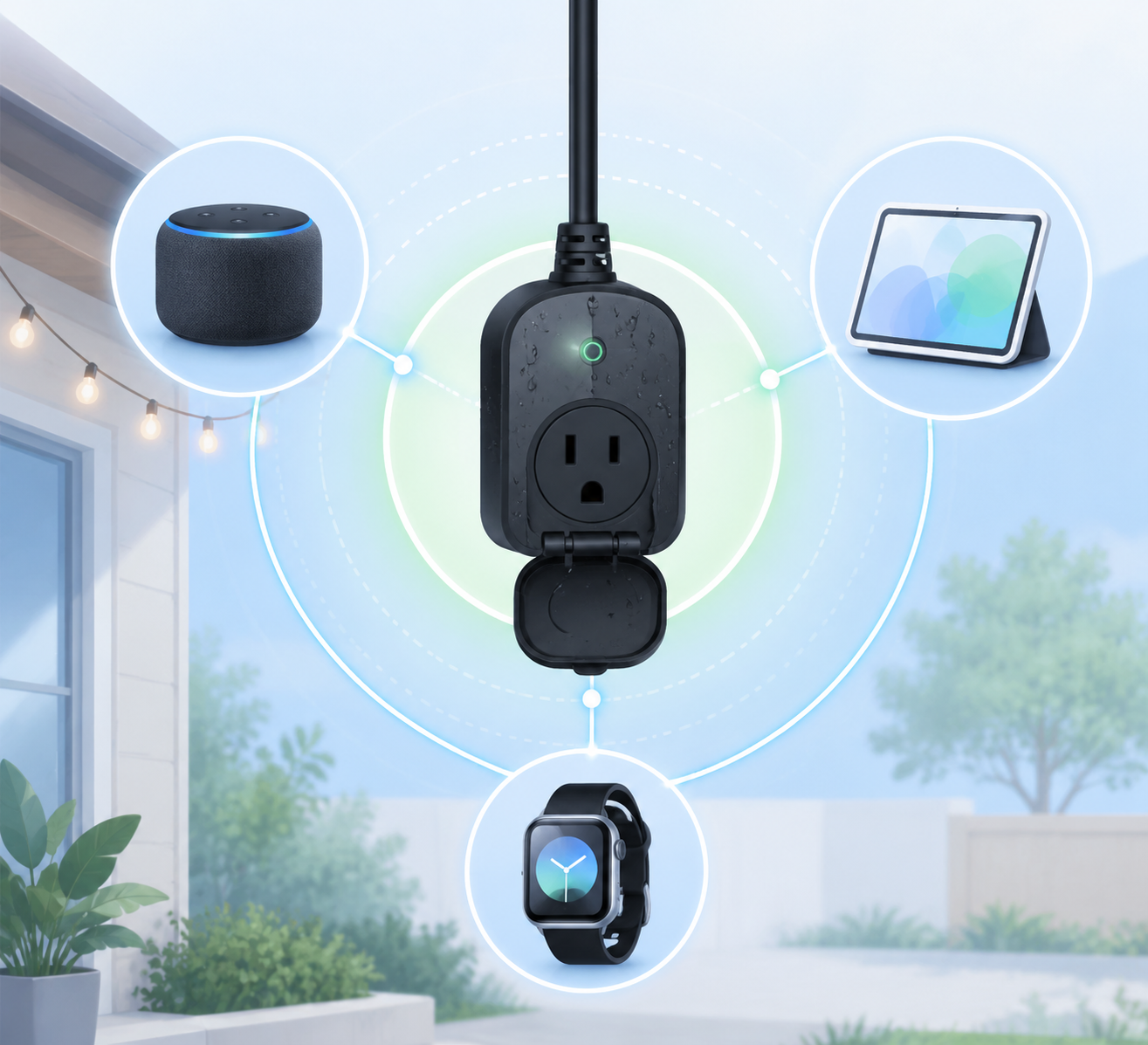
Matter-capable outdoor plugs deserve extra attention because they change the usual Alexa-versus-Google-versus-HomeKit sorting problem. Tapo P400M/TP25, GE Cync, and IKEA Tofsmygga are identified in the available 2026 materials as Matter options, which can allow one device to work across Alexa, Google Home, and Apple Home/HomeKit when the rest of the household has the necessary Matter controller setup.[4][5]
That is different from an ordinary Wi-Fi plug that works with Alexa and Google Home through the brand’s cloud integration but does not appear as a Matter device. For a household that has already settled on one ecosystem, that distinction may not change much. For a mixed household—one person using an iPhone and Apple Home, another using Alexa speakers, and a tablet dashboard in Google Home—it can prevent the plug from becoming someone’s isolated accessory.
Matter does not automatically make every spec better. The Tapo P400M/TP25 is the cleanest example: it improves ecosystem flexibility and carries an IP65 rating, but its cited load rating is 13A rather than the 15A common on many U.S. outdoor plugs.[1][6][7] For low-draw lighting, that may be a perfectly acceptable trade. For heavier outdoor equipment, it is the line on the spec sheet that should stop the purchase.
IKEA’s Tofsmygga / Grillplats is the model to treat most cautiously. It is interesting because the cited reporting describes it as a Matter-over-Thread outdoor plug, but U.S. availability was unconfirmed in May 2026.[4] A Thread-based outdoor plug could be attractive in the right home, but a buyer in the U.S. should not plan around it until the exact local product, rating, and outlet format are confirmed.
For readers focused specifically on Apple’s ecosystem, the broader HomeKit smart plug comparison and the Apple HomeKit device guide can help separate native HomeKit, Matter, and bridge-based compatibility.
The Trade-Offs That Actually Change the Pick
Tapo P400M / TP25: Matter and IP65, with a lower load ceiling
Tapo is the model that makes sense when platform flexibility is the headache. At about $22, it brings Matter support and IP65 protection into a price range that still feels like a standard outdoor smart plug purchase.[1][4][7] The compromise is the 13A rating. That does not make it weak for typical lighting, but it does make it less flexible than a 15A plug when the load is uncertain.
Wyze Plug Outdoor: the rare energy-monitoring case
Energy monitoring is easy to assume and often absent. The available materials identify Wyze Plug Outdoor as the notable outdoor model with energy monitoring, while Kasa EP40, Tapo P400M, and Lutron Caséta are cited as lacking it.[8] If the goal is to see what a fountain, heater, light string, or garage fan is using over time, Wyze belongs on the shortlist for that reason alone.
That should not be stretched into a category-wide energy-savings claim. An outdoor smart plug can reduce waste when it reliably turns something off, but most outdoor models in the available comparison set do not report consumption. Scheduling is common; measurement is not.
BN-Link Yard Stake: six outlets, weaker protection
BN-Link’s yard-stake format solves a different problem from the two-outlet wall-hanging plugs. Six outlets can be the cleaner answer for holiday lights, landscape accents, or several low-draw decorations clustered in one area. The trade-off is right in the table: IP44 is below the IP64 and IP65 ratings common elsewhere in the group, even though the cited materials list it at 15A and around $39.[2][7]
That makes it a situational pick rather than a general upgrade. Choose it when outlet count and physical layout matter more than maximum weather protection, and be more careful about exposure.
Lutron Caséta: expensive, bridge-based, and still sometimes right
Lutron Caséta looks overpriced if the job is simply switching patio string lights. The available materials cite about $80 for the outdoor plug plus about $80 for the required bridge, far above the $15–$40 range occupied by standard outdoor plugs.[2][9] It also has one outlet, not two.
The reason to slow down is load type and system reliability. Lutron’s outdoor plug is cited as IP65–IP66 and explicitly motor-rated up to 1/2 HP.[2][9] That matters for use cases such as certain pumps or motor loads where a generic plug’s 15A number does not tell the whole story. The bridge requirement is a real cost, but it can be justified when the Lutron system is already in the home or when the outdoor load is exactly the kind of thing you do not want handled by the cheapest Wi-Fi box available.
Which Outdoor Smart Plug Fits Which Job
| Use Case | Best-Fit Direction | Trade-Off to Accept |
|---|---|---|
| Deck or patio lighting | A no-hub two-outlet Wi-Fi plug such as Kasa EP40, Wyze, or a similar IP64/15A model | Platform support may be Alexa/Google-oriented unless you choose a Matter model |
| Mixed Alexa, Google Home, and Apple Home household | Matter-capable models such as Tapo P400M/TP25 or GE Cync | Check load rating; Tapo is cited at 13A rather than 15A |
| HomeKit-first outdoor control | Matter outdoor plug or bridge-based system that explicitly supports Apple Home | Do not assume ordinary Wi-Fi compatibility equals HomeKit compatibility |
| Energy tracking | Wyze Plug Outdoor | Energy monitoring is rare outdoors, so model choice narrows quickly |
| Seasonal multi-outlet displays | BN-Link Yard Stake when six outlets solve the layout | IP44 protection is weaker than IP64/IP65 alternatives |
| Motor-load or reliability-sensitive use | Lutron Caséta Outdoor Smart Plug | High total cost and required bridge |
For ordinary deck lighting or a garage fan within the plug’s rating, the standard two-outlet, no-hub Wi-Fi design is usually enough. Kasa EP40 is the clean example here: about $25, IP64, two outlets, and a 15A rating in the cited materials.[1][10] If the home already runs on Alexa or Google Home and there is no HomeKit requirement, that kind of plug is often the least complicated purchase.
If Apple Home or mixed-platform control is part of the household, start with Matter rather than hoping a non-Matter Wi-Fi plug will behave like one. Tapo P400M/TP25 and GE Cync are the most practical Matter entries in the available comparison set; IKEA remains interesting but uncertain for U.S. buyers until availability is confirmed.[4][7]
Ring is different because it makes most sense inside a Ring-centered setup. The cited materials note hub requirement and motion integration, which can be useful if the outdoor plug is part of a security-lighting routine rather than a standalone yard outlet.[1][7] Outside that context, a no-hub Wi-Fi or Matter plug is usually simpler.
Indoor plugs should stay out of this comparison unless the outlet is truly indoors. An indoor model such as the Amazon Smart Plug may be useful for lamps and appliances inside the house, but it does not replace an outdoor-rated enclosure, outlet cover design, and weather rating.
Price Is Useful Only After the Spec Match
Approximate May–June 2026 street pricing puts standard outdoor smart plugs in a tight budget-to-midrange band: Wyze around $18, Tapo around $22, Kasa around $25, GE Cync around $30, and BN-Link around $39 in the cited materials.[1][2][3][7] At that spread, a $5 or $10 difference should not override the spec that determines whether the plug fits the platform, load, or weather exposure.
Lutron is the exception, not the price anchor. Its cited plug-plus-bridge cost puts it in a separate category, so it should be bought for its bridge-based Caséta system, stronger outdoor rating, and motor-rated use case—not because it is a nicer version of a basic two-outlet Wi-Fi plug.[9]
The practical takeaway is simple: choose Matter if the home crosses ecosystems, choose Wyze if energy monitoring is the point, choose BN-Link only when six outlets beat stronger weather protection, and choose Lutron only when the bridge-based system or motor-rated load solves a real problem. For most other outdoor outlets, a no-hub two-outlet Wi-Fi plug with the right IP rating and amperage is enough.
References
- Best Outdoor Smart Plugs, CNET
- The Best Smart Switches and Dimmers, Wirecutter
- The Best Smart Plugs and Power Strips, PCMag
- Matter smart plugs 2026 cheap ecosystem switch, The Gadgeteer, May 28, 2026
- How to Choose an Outdoor Smart Plug: Everything You Need to Know, TP-Link
- Best smart plugs, PCWorld
- The Best Outdoor Smart Plugs, Reviewed
- Your smart plug can pay for itself if you use it correctly, CNET
- Lutron Caseta Outdoor Smart Plug review, The Ambient
- TP-Link Kasa Smart Wi-Fi Outdoor Plug review, TechHive
Known issues with this device / protocol
Spec-version history
For active regressions on this protocol, see Update Watch.
No linked Update Watch entries yet.