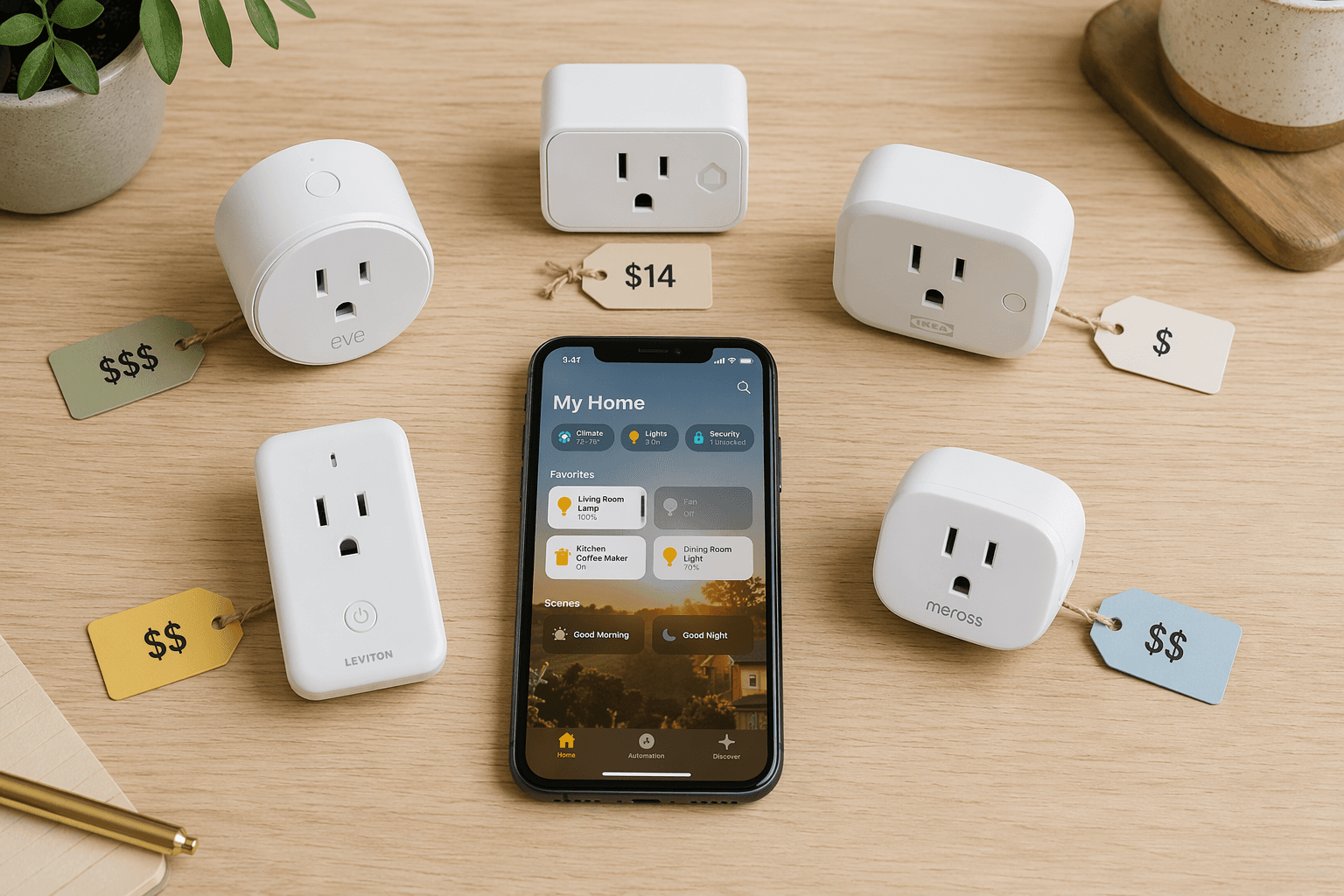
If you are shopping for the best HomeKit smart plug in mid-2026, the answer splits before it settles: buy Eve Energy if reliability and Thread matter most, TP-Link Kasa EP25 if you want the best value without adding a hub, IKEA Grillplats if you already have the right Matter or Thread setup and want the lowest plug price, Leviton Decora D215P if you are deliberately building around Matter over Wi-Fi, and Meross Mini if you want a cheap native HomeKit plug and do not need energy monitoring.
No one plug wins every column. The plug that behaves best in a dense HomeKit home is not the cheapest. The cheapest plug is not necessarily the cheapest first purchase. The best value plug still adds another 2.4 GHz Wi-Fi client. And the models with energy monitoring may show that data in the manufacturer’s app rather than where many Apple users expect to see it: the Home app.
Prices and availability change quickly, especially with multi-packs and retailer promotions. The comparisons below use approximate U.S. retail pricing and product positioning available in June 2026.
The short version: which HomeKit smart plug to buy
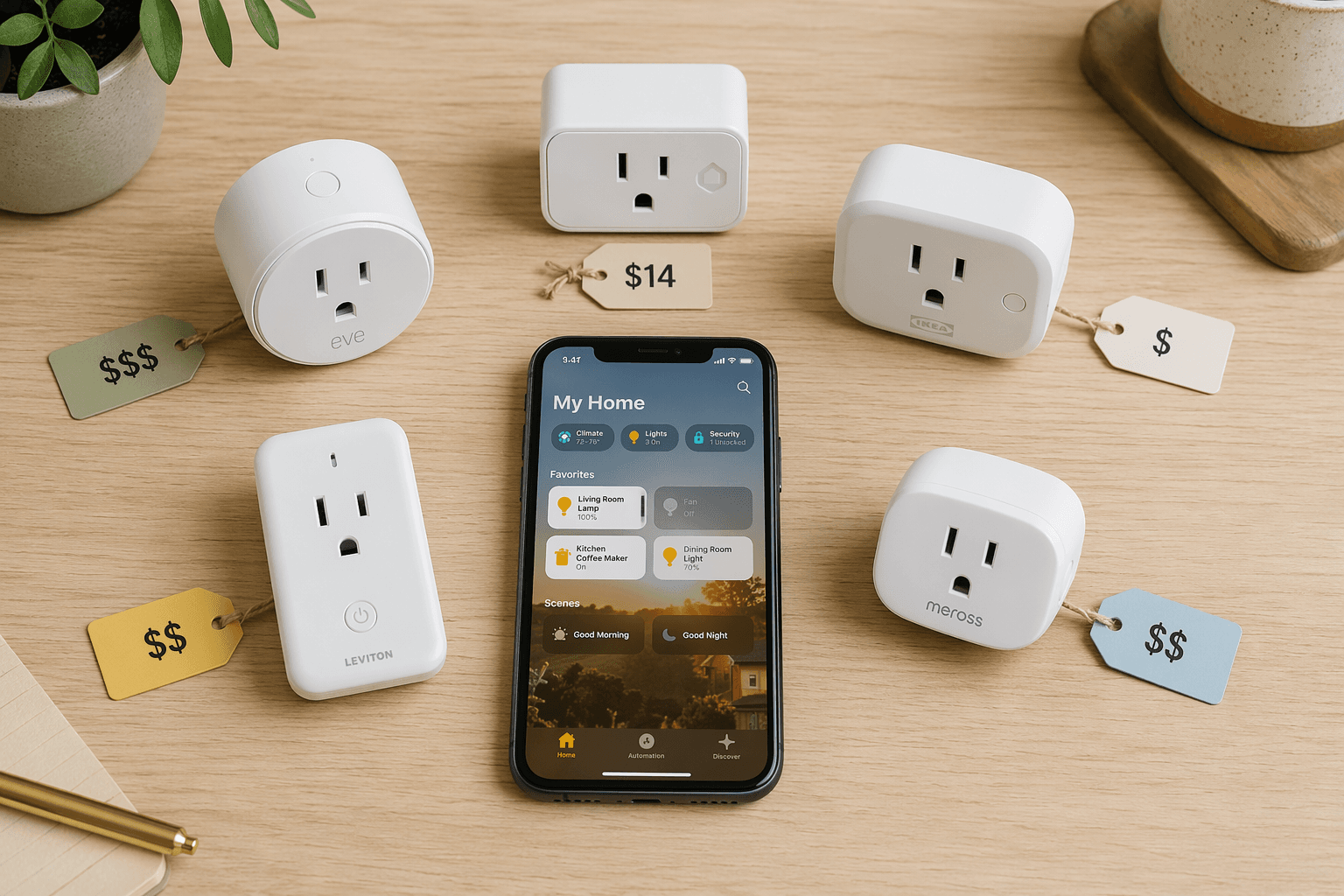
| Plug | Approx. price | HomeKit path | Protocol | Hub or border-router requirement | Energy monitoring | Cross-platform support | Best fit |
|---|---|---|---|---|---|---|---|
| Eve Energy | About $35 per plug; sold by Apple in a Matter 2-pack [1][2] | Matter in Apple Home | Thread | Needs a Thread border router such as HomePod mini, Apple TV 4K, or HomePod 2nd gen | Power meter support through Eve’s app; do not buy it assuming full Apple Home energy views [1] | Matter platforms, depending on controller support | Best when dropped automations are more costly than paying extra per plug |
| TP-Link Kasa EP25 | About $13 per plug in a 4-pack | Native HomeKit over Wi-Fi | 2.4 GHz Wi-Fi | No hub required | Energy monitoring in the Kasa/Tapo app, not exposed as expected in Apple Home | Apple Home, Alexa, Google, SmartThings | Best price-to-capability balance for most Apple households |
| IKEA Grillplats | $8 per plug [3] | Matter in Apple Home | Thread | Needs a Matter controller and, for Thread, a Thread border router; IKEA’s Dirigera hub changes the entry-cost math | No energy monitoring [3] | Matter platforms, depending on controller support | Cheapest plug if your HomeKit/Matter infrastructure is already in place |
| Leviton Decora D215P | About $23 [4] | Matter in Apple Home | Wi-Fi | Matter controller required; no separate Thread border router because it is Wi-Fi | Not the reason to choose it here | Matter platforms | Best for Matter-first homes that want a slim, polished plug |
| Meross Smart Plug Mini | About $13 | Native HomeKit over Wi-Fi | 2.4 GHz Wi-Fi | No hub required | No energy monitoring in the budget model highlighted here [5] | HomeKit model support varies by SKU; check the HomeKit version before buying | Budget native HomeKit pick when simple on/off control is enough |
Wirecutter names the Kasa EP25 its top indoor smart plug after testing more than 65 smart plugs, while Engadget also selects it as the best overall smart plug for 2026 [6][7]. CNET’s broader smart plug list favors the Leviton D215P for HomeKit/Matter households, and CNET’s separate April 2026 Grillplats hands-on gave IKEA’s $8 plug an 8/10 while noting setup through a Matter QR scan [3][4]. iMore continues to position Meross as the budget HomeKit pick [5]. Those outside picks are useful, but they do not all weigh a crowded Apple Home in the same way.
Eve Energy is the reliability ceiling, and you pay for it
Eve Energy is the plug I would choose for the outlet that everyone notices when it fails: the living-room lamp tied to a scene, the fan that should shut off at bedtime, the holiday lights that are supposed to make the house feel automated rather than needy. It supports Matter over Thread and includes power-meter features in Eve’s own ecosystem [1]. Apple sells the Matter version in a 2-pack, which puts it in a different price class from the budget Wi-Fi plugs [2].
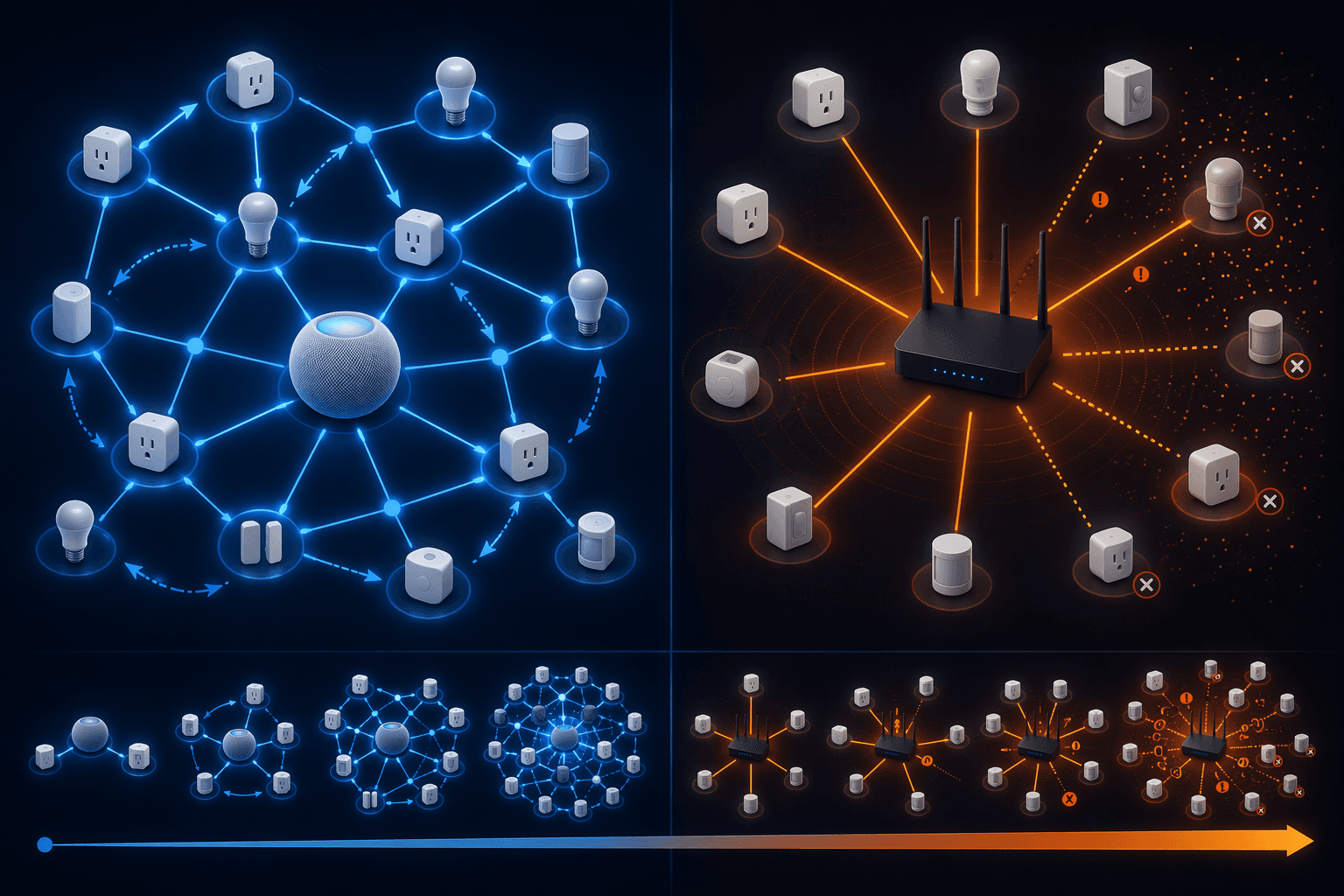
The premium is not just branding. Thread plugs can become part of the mesh, so adding more Thread devices can help nearby Thread devices rather than piling every little outlet onto the same 2.4 GHz Wi-Fi network. That matters most after the home has stopped being a two-plug experiment. A renter putting two lamps on schedules may never feel the difference. A house with plugs, sensors, bulbs, buttons, and holiday automations often will.
The catch is infrastructure. Eve Energy needs a Thread border router for the Thread advantage to matter. In an Apple home, that usually means a HomePod mini, Apple TV 4K, or second-generation HomePod. If you are not sure whether you already own the right piece, this is the point where the difference between a hub, bridge, controller, and border router becomes more than vocabulary; our HomeKit hub vs. bridge guide is worth checking before buying.
Community sentiment is not a controlled reliability study, but it is hard to ignore in this category because smart plug annoyance is cumulative. In a MacRumors HomeKit recommendation thread, Eve is repeatedly treated as the dependable choice, the one people reach for when they want a plug to “just work” rather than become another device to babysit [8]. That kind of forum evidence should be read carefully, but it aligns with the way Eve is positioned: expensive, boring, and unusually trusted.
Kasa EP25 is the practical value pick for most buyers
The Kasa EP25 is the plug I would tell most people to buy first if they want HomeKit control, low cost, and no new hub. It uses native HomeKit over Wi-Fi, so the setup path is familiar: add the plug, connect it to 2.4 GHz Wi-Fi, and bring it into Apple Home. It also works beyond Apple’s ecosystem, which matters if the household has Alexa speakers, Google displays, or SmartThings devices mixed in.
The value case is unusually strong because the EP25 is commonly sold in a 4-pack that brings the per-plug cost to roughly $13. Wirecutter’s top-pick status carries weight here because it comes from a broad test pool of more than 65 plugs, not a quick single-device impression [6]. Engadget also names the EP25 its best overall smart plug for 2026 [7].
There are two reasons I would still pause before filling every outlet with them. First, each EP25 is another 2.4 GHz Wi-Fi device. That is fine in a small setup with a competent router. It gets less charming when plugs, cameras, robot vacuums, bulbs, and old IoT devices are all fighting for attention. If your smart home already feels flaky, the problem may be the network rather than the automations; see why smart homes keep breaking before blaming HomeKit alone.
Second, energy monitoring is useful but not as Apple-native as many buyers assume. The EP25 can show energy data in TP-Link’s Kasa/Tapo app, but that does not mean kWh data will appear cleanly in the Apple Home app. If you are buying a plug mainly to audit appliance energy use, plan around the manufacturer app rather than Apple Home.
For lamps, fans, coffee makers with physical switches, dehumidifiers, and seasonal lights, that trade-off is easy to accept. The EP25 is cheap enough to deploy in useful numbers, does not demand a new controller purchase, and has stronger third-party validation than most budget HomeKit plugs.
IKEA Grillplats is only an $8 decision if the hub math already works
IKEA’s Grillplats is the most interesting disruption in this group because $8 changes how people think about smart plugs. At that price, outfitting a few lamps or holiday outlets starts to feel less like a smart-home project and more like buying a pack of timers. CNET’s April 2026 hands-on rated it 8/10 and described setup by Matter QR scan as taking seconds [3].
That review is encouraging, but it is not long-term evidence from a large HomeKit deployment. It is a single-reviewer hands-on. For a brand-new $8 Thread plug, that distinction matters. Early setup can be perfect and still tell you very little about what happens after firmware updates, controller changes, router resets, and the slow accumulation of smart-home clutter.
The bigger issue is true cost. If you already own a HomePod mini, Apple TV 4K, or another suitable Matter/Thread setup, Grillplats really can be a very cheap way into Thread smart plugs. If you are starting from zero, the plug price is misleading. IKEA’s Dirigera hub is about $110+, which means a buyer without compatible infrastructure is no longer making an $8 entry purchase; they are making a much larger system purchase to use the cheapest plug properly.
There is also no energy monitoring [3]. That is not a dealbreaker for lamps and simple appliances, but it removes one of the reasons people sometimes choose a premium plug. Grillplats makes the most sense when you already have the Apple or Matter backbone and want many basic on/off outlets without giving Wi-Fi another pile of clients.
Leviton is the cleaner Matter Wi-Fi choice
Leviton’s Decora D215P is the plug for someone who wants Matter support but does not want to think about Thread. CNET names the D215P as its HomeKit/Matter smart plug pick for 2026 and calls out its slim design [4]. At about $23, it sits between the budget Wi-Fi plugs and Eve Energy, which makes it feel less like a bargain and more like a fit-for-purpose choice.
Matter over Wi-Fi can be the right answer in a household that is standardizing around Matter controllers and cross-platform flexibility. It is less compelling if the only goal is the cheapest reliable HomeKit outlet, because Kasa undercuts it, and less compelling if the goal is to build a Thread mesh, because Eve and IKEA are the relevant candidates. If your whole smart home buying strategy is now organized around Matter, our HomeKit platform overview gives the broader context for where Apple Home fits.
Meross Mini remains the simple budget HomeKit fallback
Meross is the familiar budget recommendation: native HomeKit, no hub, low price, and straightforward on/off control. iMore lists Meross as its budget HomeKit smart plug pick [5]. MacRumors users also report running multiple Meross plugs reliably, though forum reports are anecdotal rather than a measured failure-rate comparison [8].
The caution is in the details. Buy the HomeKit-compatible SKU, not just any Meross plug that looks similar. Expect 2.4 GHz Wi-Fi. Do not expect energy monitoring from the budget Mini discussed here. For two lamps in an apartment, that may be perfectly rational. For a growing HomeKit home where the network is already carrying too many cheap Wi-Fi devices, I would spend the planning energy elsewhere.
Thread, Wi-Fi, and the tenth-device problem
Thread is not magic. A bad device can still be bad, a weak border-router placement can still cause pain, and Matter compatibility does not guarantee every feature appears identically in every app. But Thread has a practical advantage in the exact place HomeKit homes tend to get annoying: lots of small devices that need to respond without each one becoming another Wi-Fi client.
That is why Eve Energy deserves its reputation in larger HomeKit setups. It is not just that the plug turns on. It is that it can help the mesh that other Thread devices use. IKEA Grillplats could become important for the same reason if it proves reliable over time, because an $8 Thread plug is a very different proposition from a $35 Thread plug. The evidence for Eve is more mature; the evidence for Grillplats is still early.
Wi-Fi plugs are not second-class by default. Kasa EP25 is a good product, and Meross can be a sensible budget buy. The question is scale. Two Wi-Fi plugs on a decent router are usually not a strategic problem. Twenty little 2.4 GHz accessories on a weak router can turn every automation into a trust exercise.
Energy monitoring: check the app before you pay extra
Energy monitoring is the feature most likely to disappoint careful Apple buyers because the words on the box can be technically true while the experience is not what they pictured. Eve Energy includes power-meter features through Eve’s app [1]. Kasa EP25 shows energy data in TP-Link’s app. Grillplats does not include energy monitoring [3]. Meross Mini, in the budget HomeKit model considered here, is not the energy-monitoring choice [5].
The practical question is not only “does the plug measure energy?” It is “where will I see the number, and will it survive the way I connect the plug?” Matter and HomeKit integration can expose core on/off control cleanly while leaving manufacturer-specific or advanced data somewhere else. If you need appliance-level kWh tracking, verify the exact app behavior for the exact model before buying a multi-pack.
So which one should you actually buy?
- Choose Eve Energy if reliability, Thread mesh behavior, and long-term HomeKit sanity matter more than saving $10 to $20 per outlet.
- Choose TP-Link Kasa EP25 if you want the best balance of price, HomeKit compatibility, no-hub setup, energy data in the manufacturer app, and broad platform support.
- Choose IKEA Grillplats if you already own the necessary Matter/Thread infrastructure and want the lowest possible price for basic on/off control.
- Choose Leviton Decora D215P if your home is Matter-first, you prefer its slim design, and you are comfortable paying more than Kasa for that fit.
- Choose Meross Mini if you want a cheap native HomeKit Wi-Fi plug, can live with 2.4 GHz Wi-Fi, and do not need energy monitoring.
If the plug will control something visible and frequently used, I would rather overbuy reliability than explain another failed automation. If you are buying four plugs for ordinary lamps and fans, Kasa EP25 is the hard one to beat. If IKEA’s $8 plug fits the infrastructure you already own, it is the most exciting budget move in the category—but only after the hub math is honest.
References
- Eve Energy — Eve Home
- Eve Energy Matter Smart Plug & Power Meter 2-pack — Apple Store
- Ikea Is Back With Its Own Smart Plug — CNET, April 2026
- Best Smart Plugs for 2026 — CNET
- Best smart plugs for HomeKit and the Home app — iMore
- The 5 Best Smart Plugs of 2026 — Wirecutter, The New York Times
- The best smart plugs in 2026 — Engadget
- Smart Plug Recommendation for HomeKit — MacRumors Forums
Discussion
Share your experience with the compared products, flag outdated pricing or specs, or ask clarifying questions about the comparison verdict.
Comments
Join the discussion with an anonymous comment.