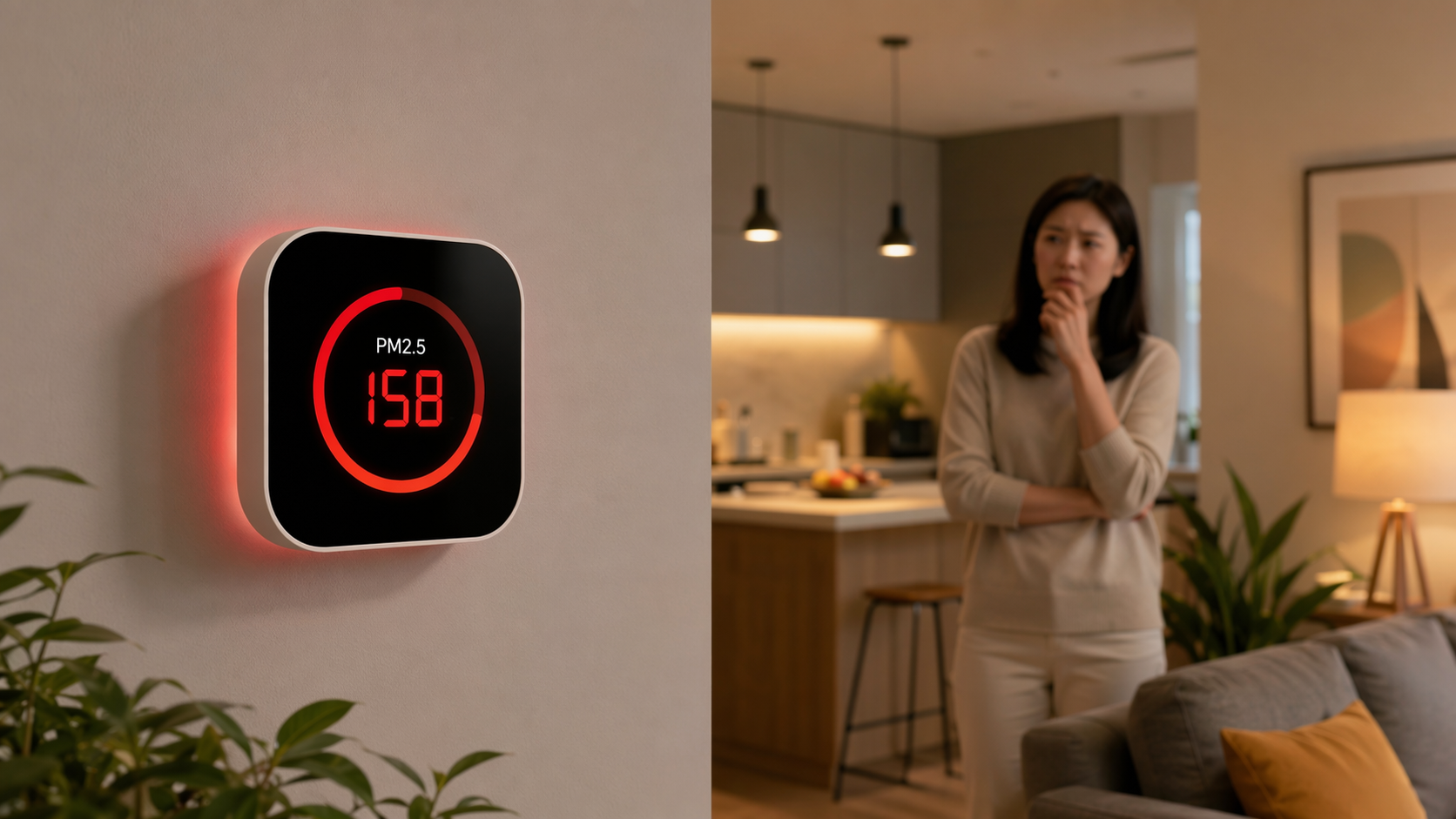
The first thing to check is not the automation. If your smart home air quality monitor is showing smoke-level PM2.5, assume the air needs attention while you figure out whether the reading is a short indoor spike, outdoor smoke getting inside, or a sensor placed where it is guaranteed to panic.
Start with a simple order of operations: confirm the monitor actually measures PM2.5, identify the likely source, clear the air in the way that matches that source, then fix the routine or placement problem that made the alert feel confusing. A purifier routine that failed to start is annoying. A room full of fine particles is the immediate problem.
Do This First When the Monitor Says Smoke
- Look for the pollutant name. For smoke, the useful reading is usually PM2.5, not just a generic “air quality” score.
- Find the source. Cooking, toasting, candles, and searing usually create a sharp indoor spike. Wildfire smoke or an indoor combustion problem behaves more like sustained contamination.
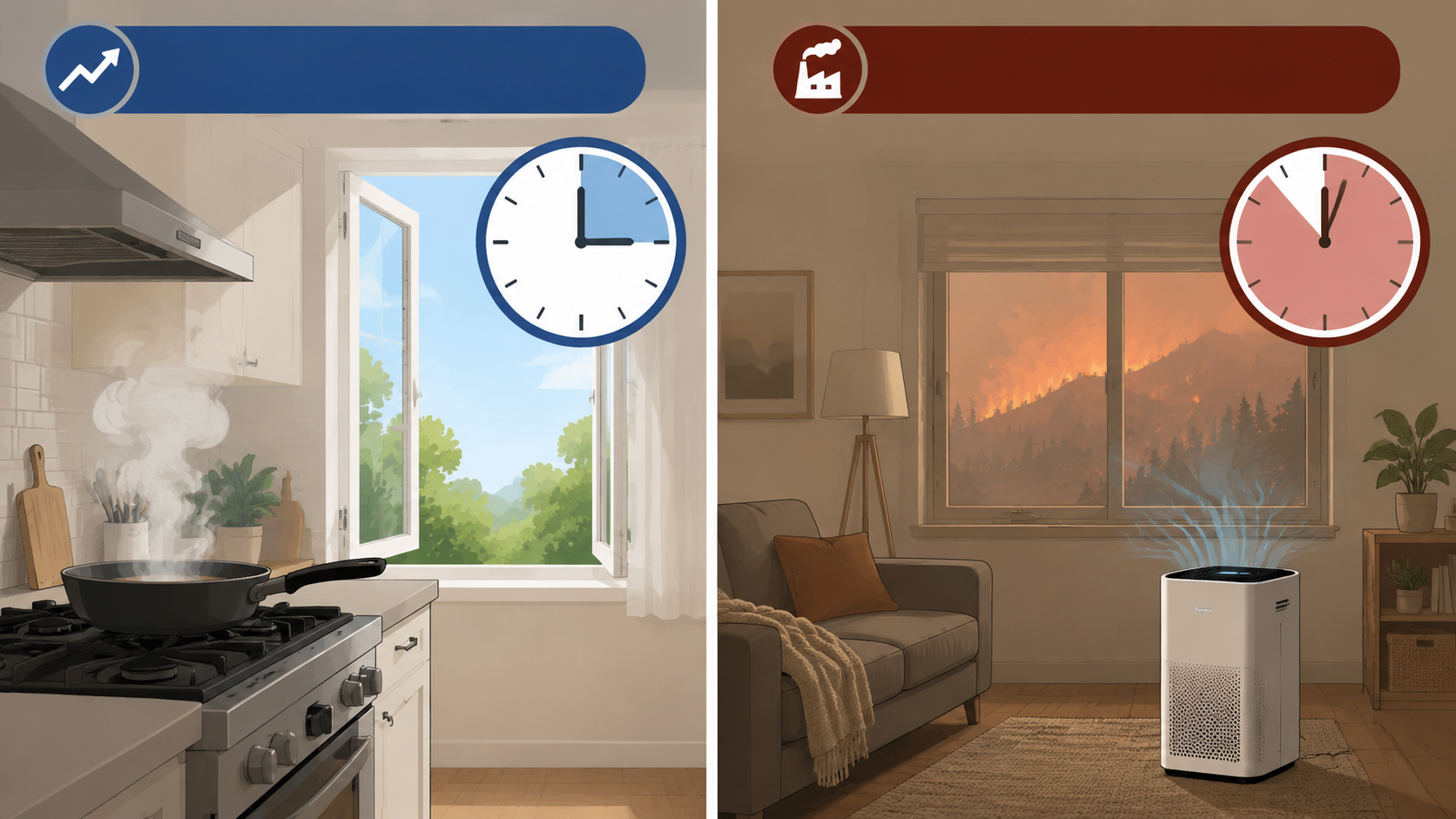
- If the source is indoors and temporary, remove the source, use kitchen exhaust if it vents outdoors, ventilate if outdoor air is clean, and run the purifier.
- If the source is outdoor smoke, close windows and doors, avoid bringing smoky air inside, run HEPA filtration, and check outdoor AQI before ventilating.
- After the air is improving, check whether your automation was waiting for a threshold crossing that already happened.
That order matters because a smart home dashboard can make a pan of seared food and a wildfire infiltration event look similar for a few minutes. Both can push PM2.5 into alarming territory. They do not clear the same way, and the wrong response can make the second one worse.
Make Sure the Device Is Measuring Smoke Particles
Smoke is a particle problem first. A monitor that measures PM2.5 with an optical particle sensor can see the fine particles that make smoke dangerous. A device that reports only TVOC, carbon dioxide, temperature, or humidity may still be useful for other indoor-air questions, but it is not directly measuring smoke particulate.
This is where product wording can trip people up. The Kidde Smoke + CO + Indoor Air Quality Alarm is a smoke and carbon monoxide alarm with IAQ features, but its listed IAQ measurements are TVOC, temperature, and humidity, not PM2.5.[1] TechHive’s review makes the same functional distinction: it is not a PM2.5 monitor for smoke particulates.[2] That does not make the device useless; it means it should not be treated as the instrument that tells you how much fine smoke particle pollution is in the room.
If your device does report PM2.5, keep going. The reading may still be imperfect, especially at home-monitor prices, but it is at least looking at the right pollutant. The EPA notes that low-cost indoor air pollution monitors can help reveal patterns, while their accuracy varies by pollutant, device, calibration, and use conditions.[3] In a smoke event, the pattern often matters as much as one exact number: did the reading jump and start falling, or did it rise and stay there?
A Cooking Spike Should Fall Fast
Searing meat, burning toast, frying oil, candles, and a smoky oven can drive PM2.5 readings high enough to look like a serious smoke event. Practical home-automation guidance reports cooking spikes in the 200–300 μg/m³ range, well above the EPA unhealthy threshold of 55 μg/m³ cited in that guidance, and describes these events as transient when ventilation is used.[4]
The key is not whether the number briefly looks ugly. The key is whether you can account for the source and whether the line starts coming down. A cooking spike that begins while a pan is smoking and declines after the burner is off, the exhaust fan is running, and the room is ventilated behaves like a temporary indoor event. The same reading with no obvious source, or a reading that stays elevated after the kitchen is quiet, deserves more suspicion.
| Pattern on the monitor | Likely situation | Best immediate response |
|---|---|---|
| Sharp rise during searing, frying, toasting, or candle use; then a steady decline | Temporary indoor PM2.5 spike | Stop or reduce the source, use exhaust, ventilate if outdoor air is clean, and run the purifier |
| High reading with smoky outdoor conditions or an open window during a wildfire event | Outdoor smoke infiltration | Close the building envelope, run HEPA filtration, and check outdoor AQI before bringing in air |
| High reading with no cooking source and no outdoor smoke explanation | Possible indoor combustion or another unresolved source | Treat it as unresolved, investigate safely, and do not rely on automation alone |
| Large jump only when the monitor is near the stove, oven, bathroom, vent, or window | Placement-amplified reading | Move the sensor after the immediate air issue is handled |
For ordinary cooking smoke, 15–30 minutes is a reasonable clearing expectation when the source is gone and ventilation is actually moving contaminated air out rather than just stirring it around.[4] That window is not a promise. A small kitchen, weak range hood, recirculating microwave fan, closed interior doors, or a purifier sized for a much smaller room can stretch the event.
Watch the slope. If PM2.5 falls quickly for the first several minutes, the system is probably doing useful work. If the number flattens high, either particles are still being generated, the purifier is undersized or on too low a speed, ventilation is poor, or outdoor air is feeding the problem.
Wildfire Smoke Does Not Behave Like Burnt Toast
Wildfire smoke changes the clearing logic. With cooking smoke, opening a window can be the right move if outdoor air is clean. During a wildfire smoke episode, that same instinct can import more PM2.5 and keep the monitor high. Before ventilating, check outdoor conditions through EPA AirNow or another trusted local source; if outdoor AQI is poor, the house needs filtration and sealing, not fresh air from the wrong side of the wall.
A properly sized HEPA purifier can clear visible smoke particles in roughly an hour under the assumptions used by Intellipure: HEPA plus carbon filtration, appropriate sizing, and about four air changes per hour. Odor can take much longer because smoke compounds adsorbed into materials and captured by activated carbon do not disappear on the same schedule; Intellipure gives an upper estimate of up to 24 hours for smoke odors.[5]
Those numbers are useful only if the assumptions hold. A purifier on sleep mode in a large open-plan room is not operating like a correctly sized system at four air changes per hour. A room with leaky windows during a wildfire episode is not a closed test chamber. If the PM2.5 reading falls when the purifier runs on high and rises when it returns to auto or low, the monitor is telling you the room still needs more clean-air delivery.
For a deeper device workflow around outdoor smoke, it makes sense to leave this troubleshooting path and look at a dedicated wildfire setup such as smart home devices for wildfire smoke. The short version here is simple: if outdoor smoke is the source, do not clear indoor air by inviting more outdoor smoke inside.
Why the Purifier Routine Did Nothing
A failed routine often looks like a bad monitor or a bad purifier. In many smart home setups, it is a trigger logic problem. Community reports around the Amazon Smart Air Quality Monitor describe routines that do not run when the reading is already above the chosen threshold; the common explanation is that Alexa and similar platforms fire on a state change crossing the threshold, not on the continued existence of a bad state.[6]
That distinction is easy to miss. Suppose the routine says, “When PM2.5 becomes poor, turn on the purifier.” If PM2.5 crossed into poor while the purifier was unplugged, the routine disabled, Wi-Fi unstable, or Alexa delayed, the system may not run later just because the room is still poor. The condition is true, but the event that triggers the routine has already passed.
Amazon has not officially confirmed a universal bug in the way users describe it, so it is safer to treat this as a platform-behavior failure mode rather than a settled manufacturer defect. The practical fix is still the same: do not build the whole response around a single crossing.
- Use graduated purifier speeds instead of one panic threshold: low or medium for mildly elevated PM2.5, high for clearly bad air, and maximum for smoke-level readings.
- Add a short delay condition so a one-minute cooking puff does not slam the purifier to high before the reading proves it is persistent.
- Create a second routine or scheduled check that asks whether PM2.5 is still above the threshold, rather than waiting only for a new crossing.
- Add a recovery rule that steps the purifier down only after the reading has stayed improved for several minutes.
- Keep notifications separate from purifier control, so a missed automation does not also silence the household warning.
Home-automation recipes commonly recommend delay conditions and graduated fan speeds for exactly this reason. The Home Automation Cookbook describes a five-minute delay condition and staged fan behavior, and says that cooking-related false triggers are the leading support complaint, with relocation plus a delay solving about 90% of cases in its guidance.[4] Treat that as a practical field rule, not a law of physics. It works because it separates a short puff from an event that is still developing.
If you are building this in Alexa, the platform itself is part of the troubleshooting surface, not just the monitor. A broader look at the Amazon Alexa platform is useful when routines need state checks, delays, and fallback behavior rather than a single if-this-then-that moment.
Placement Can Turn One Pan Into a Whole-Home Emergency
Once the air is being handled, look at where the monitor lives. A sensor beside the stove is not giving you a calm whole-home reading; it is sitting in the plume. That may be useful if you intentionally want a kitchen-source detector, but it is a poor place for the monitor that controls the main living-room purifier.
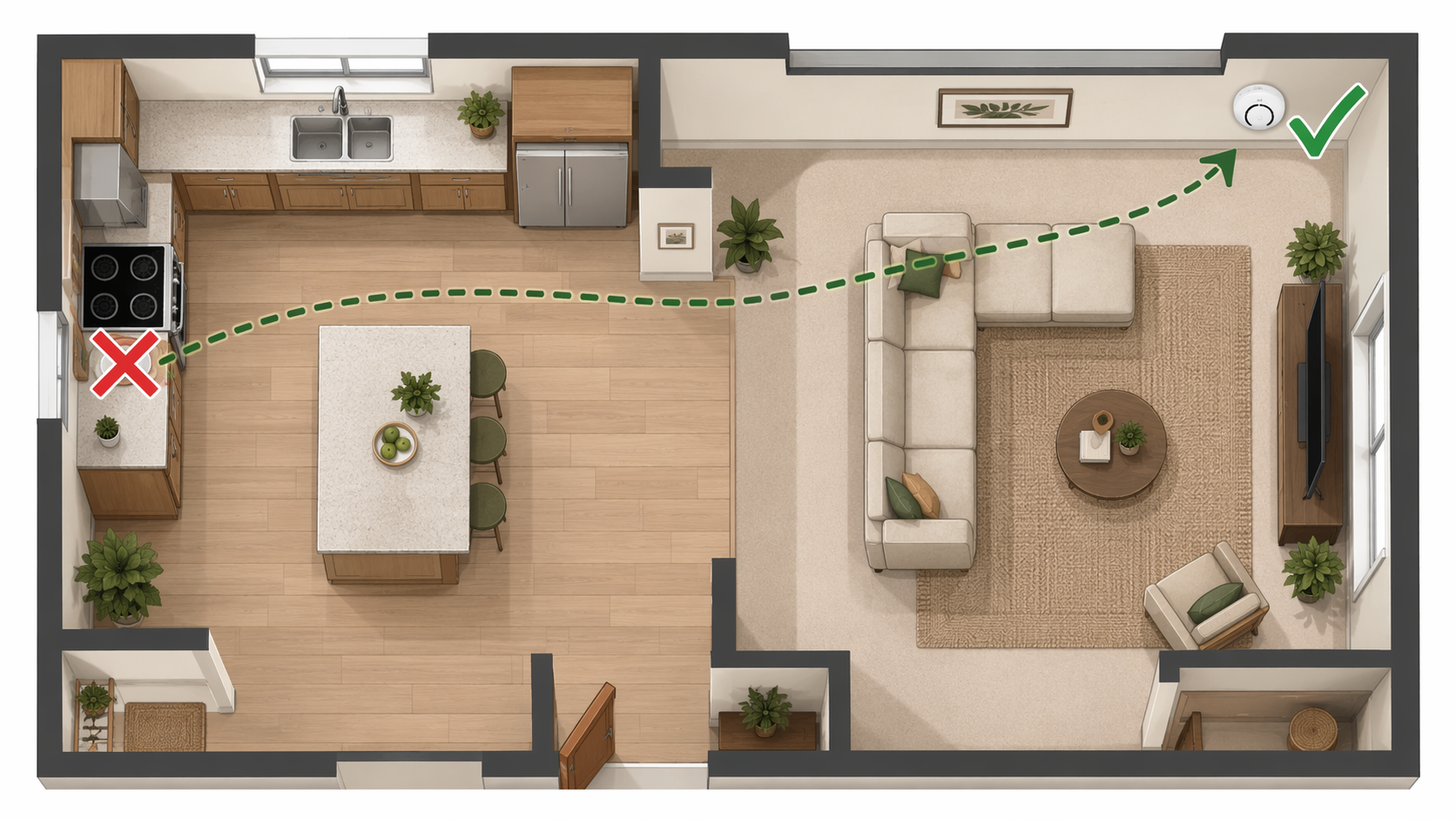
The more repeatable placement is at breathing height, roughly 3–6 feet above the floor, in a central occupied area, away from kitchens, bathrooms, HVAC vents, open windows, and corners where airflow is poor. For a room or zone reading rather than a cooking-plume reading, keep the monitor more than 10 feet from the stove.
Do not move the monitor during the event and then try to interpret the chart as if nothing changed. Let the room clear, relocate the sensor, and watch the next few ordinary cooking cycles. If every dinner produces a red alert from the old location and only a modest, short rise from the new one, the earlier setup was over-sampling the source.
When to Distrust the Number Without Ignoring the Pattern
Consumer PM2.5 monitors are not reference instruments. The Amazon Smart Air Quality Monitor is a good example of why this needs a careful tone: users have reported poor agreement with other monitors, while Amazon has claimed accuracy of ±1 μg/m³ from 0–100 μg/m³ in material summarized by Filter Factory.[7] Those two things can coexist as claims about different conditions, test methods, firmware, calibration, or expectations. A bad comparison on a forum does not prove every unit is wrong; a manufacturer accuracy claim does not prove your unit is placed well or reading correctly in your room.
Reference context helps. The PurpleAir Zen uses dual Plantower PMS6003 laser particle counters, and an AQMD field evaluation found close correlation with a $25,000 GRIMM EDM 180 reference instrument under the evaluated conditions.[8] That does not turn every low-cost sensor into a lab instrument, but it does show why a decent particle counter, placed sensibly, can be useful for household decisions.
Use the monitor as a trend instrument. If it jumps when smoke appears, falls when ventilation or filtration improves, and stays high when outdoor smoke is leaking in, it is giving you actionable information even if the exact μg/m³ value is not courtroom evidence. If it behaves randomly, disagrees wildly with another nearby PM2.5 monitor, or changes only when sunlight, steam, or HVAC airflow hits it, troubleshoot placement and device condition before rebuilding your whole automation stack.
A Stable Smoke-Clearing Setup
The useful setup is not complicated, but it is more specific than “turn on an air purifier.” Put a PM2.5-capable monitor in a representative occupied area. Keep a separate mental category for short indoor spikes and sustained infiltration. Use outdoor AQI before opening windows during smoke season. Size the purifier for the room instead of expecting an undersized unit on auto mode to rescue a whole floor; if purifier specifications are the next problem, move to a dedicated CADR and wildfire-smoke guide such as smart air purifiers for wildfire smoke.
For automation, give the system memory. A five-minute delay keeps a toaster incident from becoming a full-house alarm. Graduated speeds let the purifier respond before the air is terrible. A periodic “still above threshold?” check catches the case where the first state change was missed. A recovery delay prevents the fan from dropping the moment one good reading appears.
If the monitor itself lacks PM2.5, it is the wrong instrument for smoke-clearing decisions. If you are choosing a replacement specifically for wildfire or smoke detection, use a PM2.5-focused selection guide such as which smart air quality monitor detects wildfire smoke best rather than assuming every IAQ label means the same thing.
Keep the alert enabled. Make it less dumb. A smoke warning is useful when the household can tell whether it is seeing a pan, smoky outdoor air, a placement problem, or an automation rule that never got the state change it was waiting for.
References
- Kidde Smoke + CO + Indoor Air Quality Alarm product page — Kidde
- Kidde Smart Fire/CO Alarm with IAQ Monitor review — TechHive
- Low-Cost Air Pollution Monitors and Indoor Air Quality — US EPA
- Activate Air Purifier When Air Quality Drops — Home Automation Cookbook
- How Long for Air Purifier to Work Effectively — Intellipure, July 2025
- No routines will work with Amazon Smart Air Quality Monitor — Amazon Forum
- Smart Home Air Quality Monitoring: Your Complete Guide — Filter Factory, July 2025
- PurpleAir Zen field evaluation — AQMD
Community Notes & Edge Cases
Has this fix worked for you? Is it still valid after a recent firmware or app update? Share firmware-specific variations, platform quirks, or edge case solutions below. Substantive corrections can also be submitted via the contact page for editorial review.
Comments
Join the discussion with an anonymous comment.