Using smart home devices for air quality and health makes financial sense only if the question is framed correctly. A monitor, purifier, smart thermostat, or ventilation controller is unlikely to look compelling as a simple utility-bill payback purchase. The stronger case starts with the fact that the home is where the exposure happens: Americans spend about 90% of their time indoors, and indoor concentrations of some pollutants are often 2 to 5 times higher than typical outdoor concentrations. [1]
That does not make every device purchase rational. It does mean indoor air belongs on the household balance sheet. If the air inside the house affects headaches, sleep, asthma symptoms, attention, or the afternoon fog that passes for “just being tired,” then the return is not only in kilowatt-hours. The energy savings matter, but they are the easier part to count.
The First Return Is Knowing What the Air Is Doing
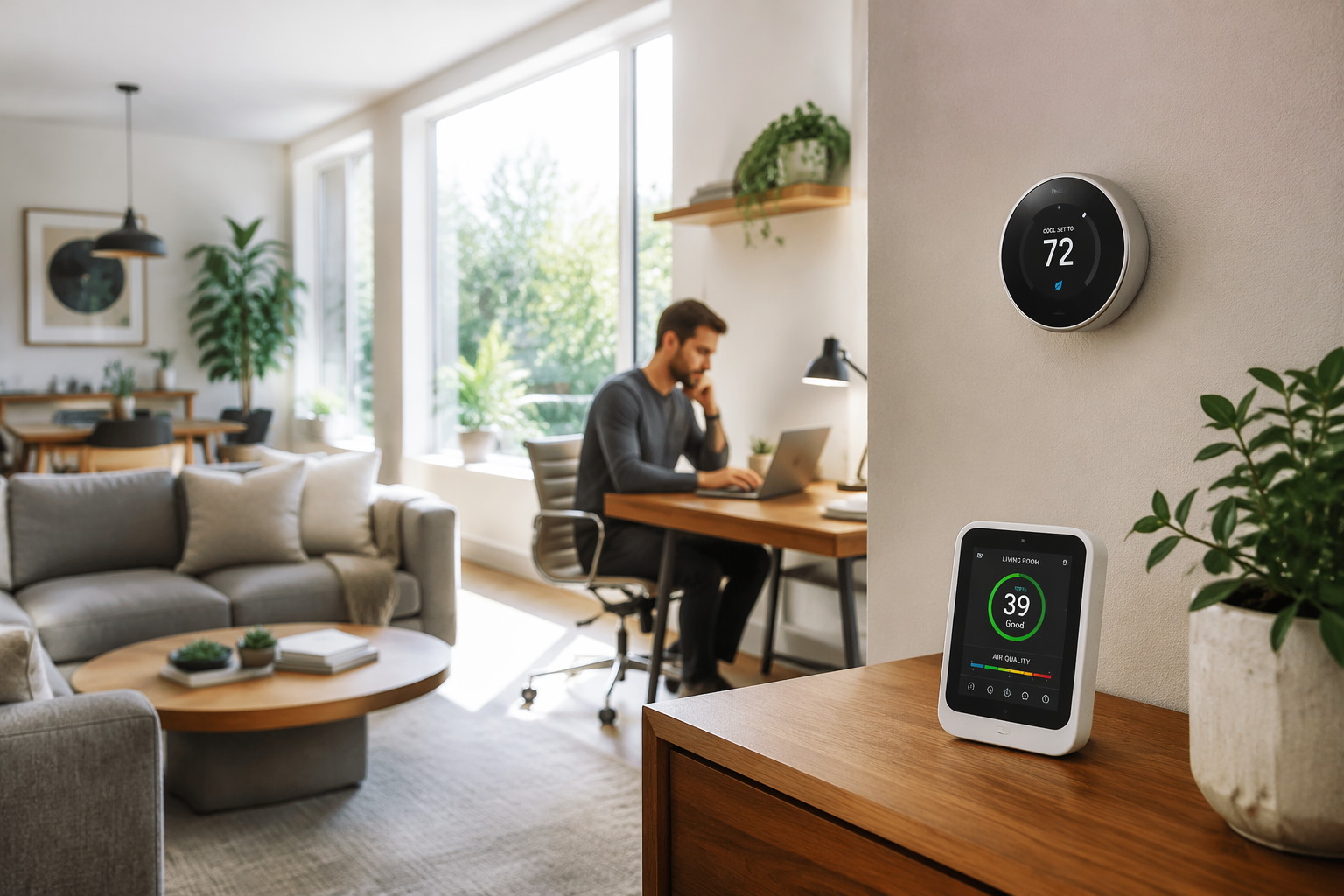
Most homeowners can feel temperature. Fewer can feel carbon dioxide rising in a closed bedroom, fine particles entering during a smoke event, or ventilation running harder than necessary while the house is empty. That is the practical value of smart air quality systems: they turn a hidden condition into a measurable one, then let the house respond without depending on someone noticing stale air at the right moment.
The minimum useful setup is not a pile of gadgets. It is a loop: sensing, response, and control. A monitor detects CO2, PM2.5, VOCs, humidity, or a related indoor-air signal. A purifier, HVAC fan, fresh-air damper, or ventilation system responds. A thermostat or ventilation controller prevents that response from wasting more heating and cooling energy than necessary.
The loop matters because indoor air problems are often intermittent. A house may be fine at noon and stale by midnight. A kitchen may spike during cooking and recover quickly with the right exhaust. A bedroom may drift upward in CO2 overnight even if the rest of the house looks acceptable. A smart system does not make the home a laboratory, but it can reduce the amount of guessing.
The Cognitive Evidence Is Stronger Than the Usual Comfort Argument
Comfort is real, but it is too soft to carry the financial case by itself. The more interesting evidence comes from Harvard’s COGfx research on indoor air quality and cognitive function. In Study 1, participants worked in a controlled, simulated office environment under different building conditions. Cognitive function test scores were twice as high in “green+” conditions, which combined high ventilation with reduced CO2 and lower VOCs, compared with conventional conditions. [2]
That finding should not be casually pasted onto a house and converted into a made-up productivity number. Study 1 was not a residential field study. It was a controlled office-like setting, which is useful because it isolates air-quality variables, but it does not prove that a family installing a monitor and purifier will double anyone’s work output at home.
Still, the result is hard to ignore because the conditions are not exotic. CO2, ventilation, and VOCs are ordinary indoor-air variables. A bedroom with the door closed, a home office with weak air exchange, new furnishings, cleaning products, cooking emissions, and outdoor particle events are not rare edge cases. They are the kind of conditions a household can actually observe and manage.
COGfx Study 3 adds a different kind of evidence. Instead of a simulated environment, it looked across 100 buildings in 6 countries and found significant associations between higher PM2.5 and CO2 and reduced selective attention among office workers. [2]
That is not the same as proving a specific smart home system will produce a specific cognitive gain. It does, however, move the discussion away from vague wellness language. Fine particles and CO2 are measurable. Selective attention is not a scented-candle promise. For households where people work from home, study, care for children, or manage health-sensitive conditions, the financial question is not limited to whether the thermostat shaved a few dollars off the bill.
| Evidence | What It Supports | What It Does Not Prove |
|---|---|---|
| EPA indoor exposure data | Homes deserve attention because people spend most time indoors and indoor pollutant levels can exceed outdoor levels. | It does not show that any one device fixes the problem. |
| Harvard COGfx Study 1 | Better ventilation, lower CO2, and lower VOCs can substantially improve cognitive test performance in a controlled office-like environment. | It does not prove identical gains in typical homes. |
| Harvard COGfx Study 3 | PM2.5 and CO2 are associated with reduced selective attention across real buildings. | It does not assign a dollar value to a household’s attention or productivity. |
Why the Health Side Usually Carries More Value Than the Energy Side
Energy savings are easier to verify than cognitive gains, but ease of measurement should not be confused with size of value. The Harvard team’s commercial-building analysis estimated that health and productivity benefits could exceed energy costs by 150 times. [2]
That ratio should stay in its lane. It comes from commercial settings, not homes, and there is no directly comparable residential study that turns better home air into a dependable dollar figure. A homeowner should not use it as a payback calculator.
The ratio is still useful because it corrects the order of importance. If better indoor air helps people function, avoid symptoms, maintain attention, or reduce exposure to pollutants, the main return is probably not the $8 or $18 saved on a given month’s utility bill. The bill matters because it offsets cost with measurable recurring savings. The larger value is the avoided drag of poor air in the rooms where people live and work.

The Energy Return Is Real, but It Has to Be Counted Carefully
Smart thermostats are the cleanest energy-savings piece of the argument. ENERGY STAR says certified smart thermostats save an average of 8% on heating and cooling, and its consumer-facing materials describe typical savings in the 8% to 15% range depending on use and conditions. [3]
Those are HVAC savings, not total household energy savings. They also vary by climate, home envelope, equipment, schedule, and occupant behavior. A household that already runs conservative setpoints may see less. A household with poor scheduling, large setbacks, or rooms that routinely overheat or overcool may have more room to improve.
Manufacturer claims can be higher. Ecobee says its smart thermostat users can save up to 26%, or about $284 per year, based on its internal analysis. [4] That figure is worth noting, but it should not be treated the same way as an independent average. It is company-reported, and the word “up to” does a lot of work.
Ventilation controls are a different bucket. The U.S. Department of Energy’s Building America research found smart ventilation controls can reduce ventilation energy use by up to 60% while maintaining or improving indoor air quality. [5] That does not mean a home cuts its total HVAC bill by 60%. It means the energy tied to ventilation—the cost of bringing in and conditioning outdoor air—can be reduced when ventilation responds intelligently instead of running in a blunt fixed pattern.
This is where smart air quality systems become more than a wellness purchase. Ventilating more can improve air but waste energy if it ignores outdoor conditions, occupancy, and HVAC load. Ventilating intelligently can target the benefit: more fresh air when the house needs it, less conditioning penalty when it does not.
A Practical Household Ledger
A cost-conscious household does not need fake precision to make a rational decision. It needs to separate the ledgers.
- Health and cognition: the largest potential value, supported by indoor exposure data and COGfx findings, but hard to convert into a household-specific dollar amount.
- Thermostat savings: the most measurable recurring return, with ENERGY STAR’s 8% to 15% range as the sober baseline.
- Ventilation savings: potentially significant for the ventilation portion of energy use, especially where outdoor-air exchange is actively controlled.
- Avoided overreaction: sensing can prevent running purifiers, fans, or ventilation at high levels when the air is already acceptable.
- Decision confidence: measurements reduce arguments about whether the air is stale, whether filtration is needed, or whether a room is the problem.
The investment looks weakest when each device is judged alone. A standalone monitor that never triggers action is mostly a dashboard. A purifier that runs constantly may improve air but adds operating cost. A thermostat that saves energy while ignoring stale rooms can optimize the wrong thing. The combined setup is stronger because the pieces cover each other’s weaknesses.
For readers who want to move from the financial case into implementation, the next step is narrower: understand which pollutants a smart air quality monitor should track, compare smart thermostat sensing and remote sensor logic, or look at money-saving smart home automations after the basic return logic is clear.
Where the Case Is Strongest
The combined case is strongest in homes where people spend long hours inside, work or study from home, have bedrooms that feel stale overnight, live with smoke or outdoor particle events, or include someone more sensitive to air quality. RMI’s consumer research found that 76% of U.S. consumers want indoor air quality ratings for buildings, and 77% said a hotel’s IAQ rating would influence their choice. [6] Those are preference findings, not proof of health outcomes, but they show that indoor air is becoming financially legible to ordinary consumers.
Sensitive households may reasonably weight the health side more heavily. Someone comparing devices for asthma, wildfire smoke, older adults, infants, or other vulnerable situations may want a more targeted guide to smart air quality monitors for sensitive groups or practical air quality defense automations. That is a different decision than buying a gadget because a product page promises a lower bill.
For a typical U.S. household, the disciplined answer is yes, smart home air quality systems can be financially rational—but not because energy savings alone prove a neat payback. The health and cognitive evidence carries the main weight. Smart thermostats and ventilation controls add the more measurable recurring return. The best setup connects sensing, filtration or ventilation response, and thermostat or ventilation intelligence so the home can improve air without wasting energy unnecessarily.
The caveats are part of the answer. The commercial 150x health-productivity ratio is not a residential payback formula. Thermostat savings vary. The DOE ventilation figure applies to ventilation energy, not the entire HVAC bill. Even with those limits, the combined case is stronger than either half alone: indoor air affects how people function inside the home, and smart controls can reduce the cost of doing something about it.
References
- Indoor Air Quality, U.S. Environmental Protection Agency
- The COGfx Study, Harvard T.H. Chan School of Public Health
- Smart Thermostats, ENERGY STAR
- Smart Thermostat Premium, Ecobee
- Building America: Smart Ventilation Controls Boost Energy Efficiency and Indoor Air Quality, U.S. Department of Energy
- The Need for U.S. Indoor Air Quality Guidelines, RMI
Data Updates
Know about updated rebate programs, changed subscription prices, or new ENERGY STAR certifications? Submit a note below to help keep this content current. For formal data corrections, use the contact page.
Comments
Join the discussion with an anonymous comment.