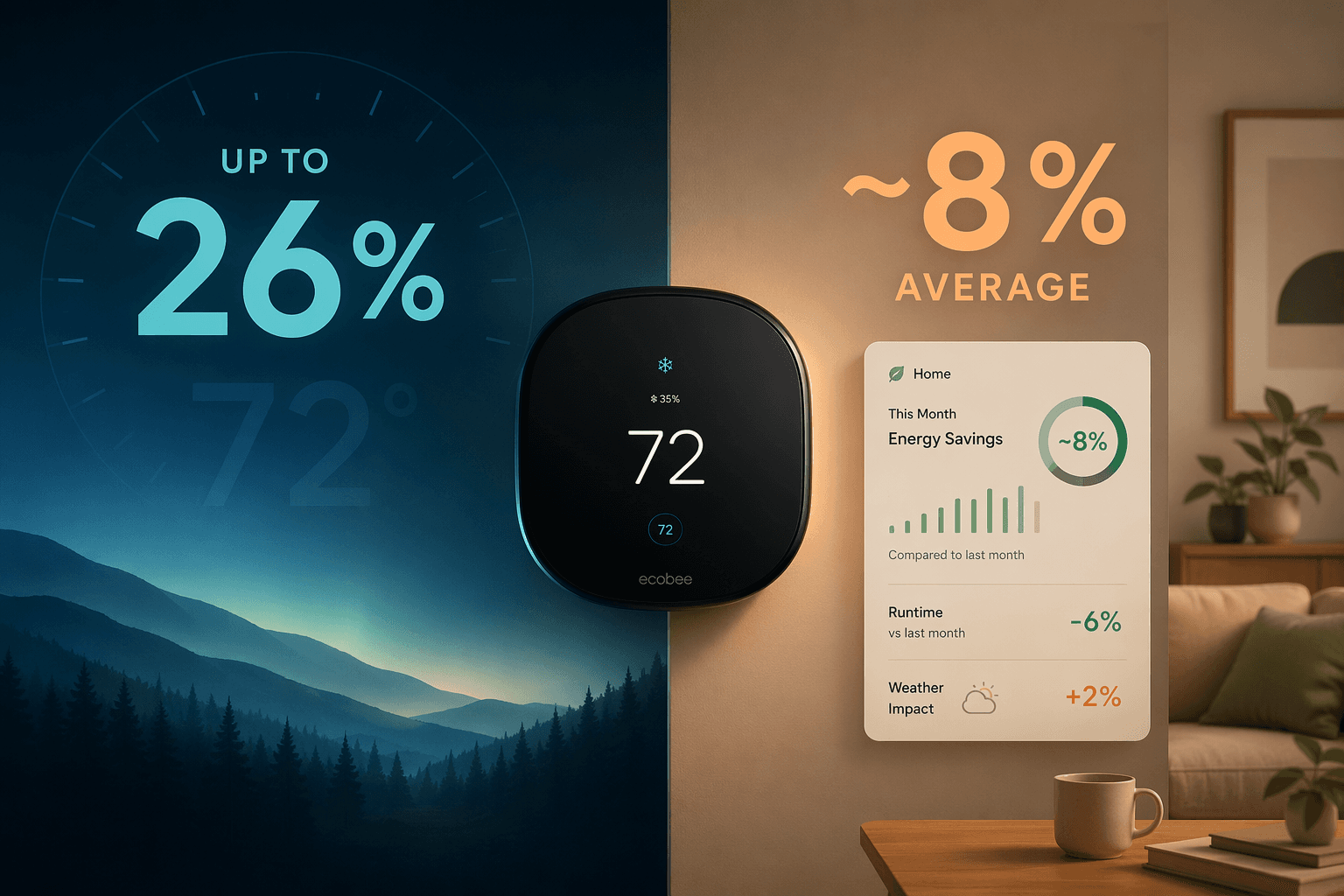
The awkward part of pricing an ecobee smart thermostat is that two honest-looking savings numbers can point in very different directions. ecobee says its thermostats can save up to 26% on heating and cooling, which it translates to about $284 per year for its higher-end models using an average annual heating and cooling cost of $1,091.[1] ENERGY STAR, looking across certified smart thermostats more broadly, says the average savings is about 8%, or roughly $50 per year.[2]
That is not a rounding error. It is the difference between a thermostat that pays for itself before you finish arguing about the app settings and one that takes a couple of heating seasons to earn back its price. The reason is not that one number is automatically fake and the other is automatically “real.” The reason is the baseline.
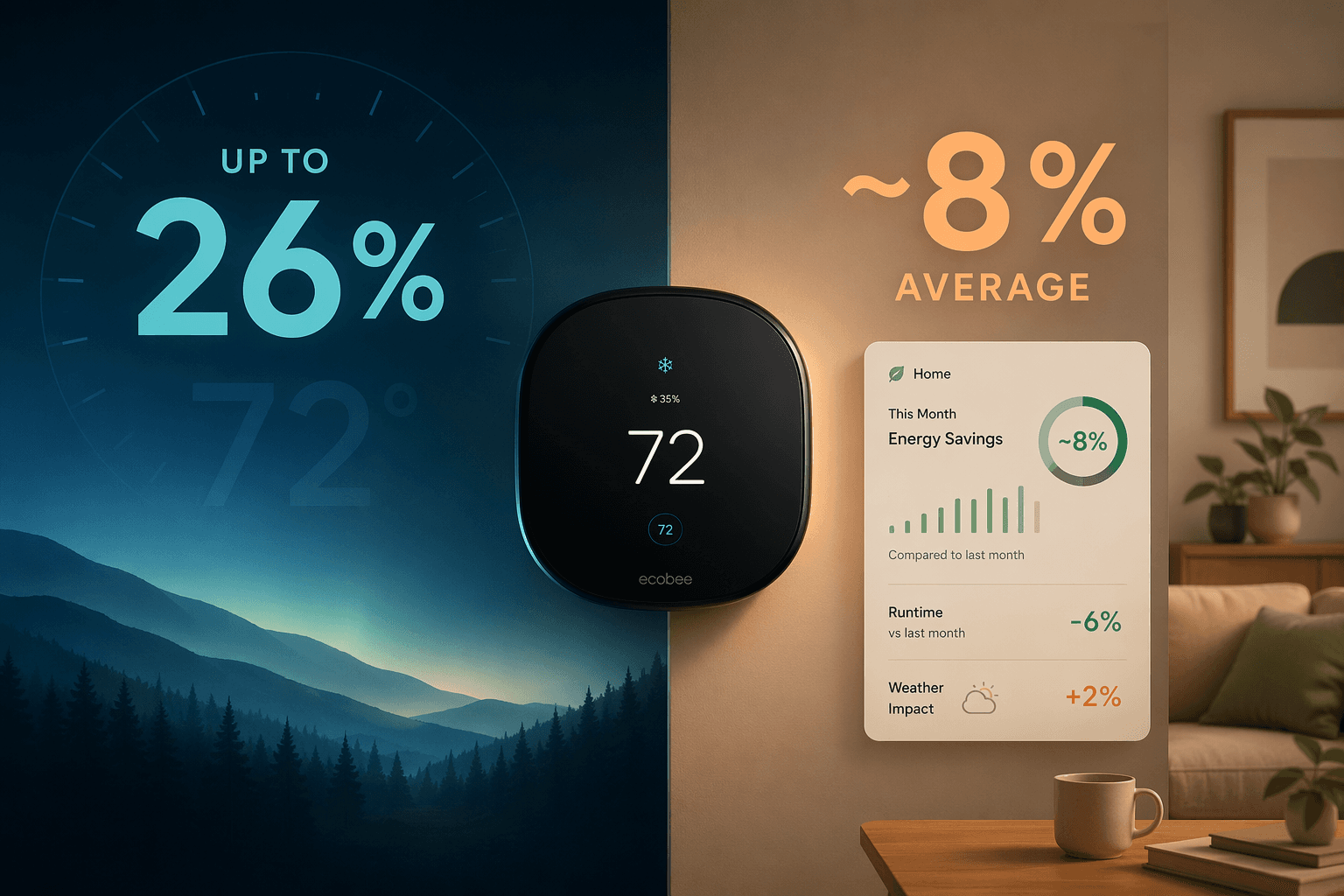
The 26% number is measured against a constant 72°F home
ecobee’s savings page says its April 2021 internal analysis compared homes using Smart Schedule against a thermostat held constantly at 72°F. ecobee also discloses that the analysis was internal and was not third-party verified.[1]
That 72°F hold matters more than the brand name on the wall. A house held at 72°F all day and all night gives a smart thermostat plenty of waste to attack: nighttime setbacks, away-mode setbacks, recovery timing, and occupancy-based changes can all create measurable reductions. If that describes your house now, the ecobee claim is at least aimed at your situation.
If you already have a programmable thermostat that actually follows a decent schedule, the comparison gets less generous. You may already be taking the easy savings: cooler winter nights, warmer summer workdays, and fewer hours conditioning an empty house. In that case, the ecobee is not replacing a constant 72°F habit. It is replacing a partly managed habit with a more automated one.
That is where ENERGY STAR’s figure is useful. Its smart thermostat FAQ gives a broad certified-product average of about 8% savings on heating and cooling, averaging around $50 per year.[2] For a homeowner who already uses schedules reasonably well, that outside average is a better starting point than the top-line “up to” claim.
A simple payback calculation beats the slogan
The kitchen-table version of the math is plain: find what you spend each year on heating and cooling, estimate the savings percentage that fits your current habits, then divide the thermostat cost by the annual savings.
Annual savings = annual heating and cooling cost × expected savings rate
Payback period = thermostat purchase price ÷ annual savings
Using ecobee’s own average heating and cooling cost of $1,091, the two baselines look very different. At 26%, the annual savings is about $284. At 8%, the annual savings is about $87 if you apply the percentage to that same $1,091 heating-and-cooling spend. ENERGY STAR’s own average dollar figure is lower, at roughly $50 per year, because it reflects its broader certified-thermostat average across homes.[1][2]
| Savings assumption | What it represents | Annual savings on $1,091 heating/cooling spend | Payback on $139.99 thermostat | Payback on $259.99 thermostat |
|---|---|---|---|---|
| 26% | ecobee upper-bound-style comparison against constant 72°F hold | About $284/year | About 6 months | About 11 months |
| 8% | ENERGY STAR-style smart thermostat average applied to ecobee’s $1,091 cost base | About $87/year | About 19 months | About 36 months |
| $50/year | ENERGY STAR’s approximate average annual dollar savings | $50/year | About 34 months | About 62 months |
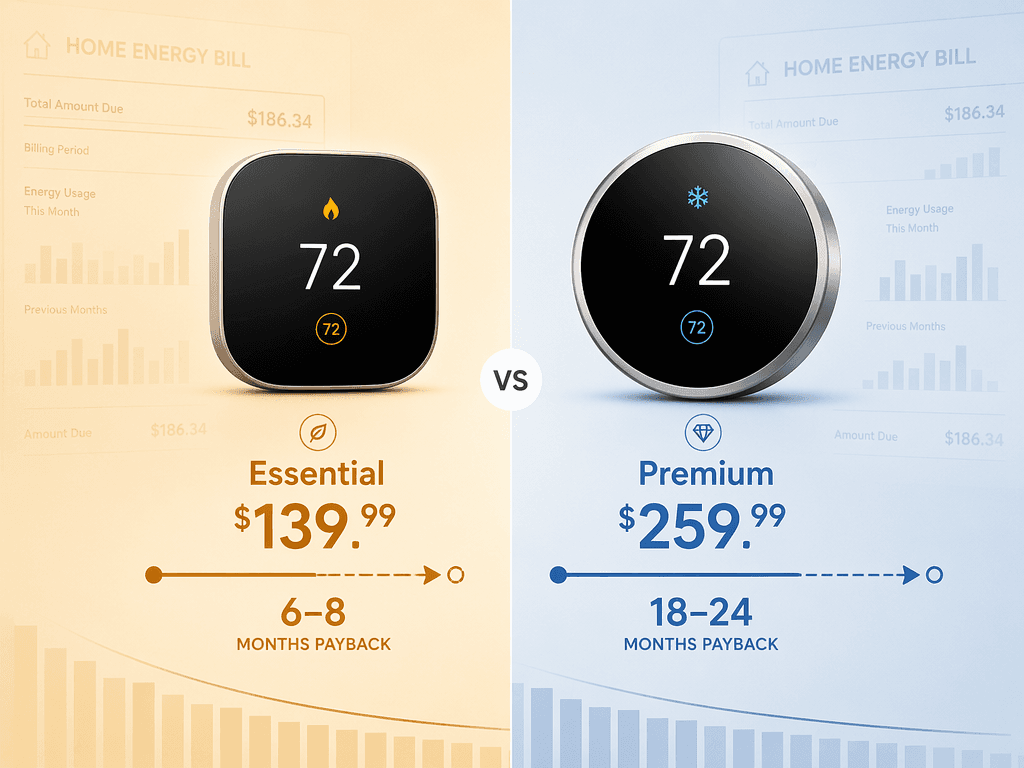
This is why “pays for itself in six months” can be true for one buyer and badly optimistic for another. ecobee says the Smart Thermostat Essential, priced at $139.99, can pay for itself in about six months based on its own estimated savings of about $250 per year.[3] Use the ENERGY STAR-style $50 annual savings figure instead, and that same thermostat takes roughly 34 months before the savings equal the purchase price.
The cheaper Essential changes the ROI story
For a value-conscious buyer, the Essential deserves more attention than a feature checklist usually gives it. At $139.99, it needs less annual savings to make sense than a $199.99 or $259.99 model. ecobee’s Essential page lists an estimated 23% savings claim and the roughly six-month payback claim based on about $250 per year in savings.[3]
The Premium and Enhanced models carry ecobee’s higher 26% savings claim, and ecobee attributes the model-level difference to occupancy sensing: the radar occupancy sensor in Premium and Enhanced helps the thermostat make more aggressive occupancy-based decisions.[1][4][5] That can matter in homes where schedules lie — a work-from-home day here, a late school pickup there, a guest room that is occupied once in a while. It matters less if your home’s routine is predictable and your existing schedule already matches it.
There is also a small buying-note wrinkle: utility marketplaces may sometimes refer to the lower-cost model as Smart Thermostat Lite rather than Essential. Treat that as a listing issue to verify before checkout, not a reason to build the whole decision around the name. If you need the feature-by-feature differences, a separate ecobee model comparison is the better place to sort sensors, displays, voice features, and accessory support.
What pushes your savings above or below average
The same thermostat can be a strong buy in one house and a slow payback in the next. The device is only one part of the bill. The rest is weather, equipment, insulation, rates, and whether the people in the house will tolerate the temperatures that produce savings.
- Climate: A long cooling season or heating season gives the thermostat more hours to optimize. Mild climates give it fewer chances to save.
- Annual HVAC spend: A household spending heavily on heating and cooling can save more dollars at the same percentage savings than a household with low energy use.
- Current thermostat behavior: Replacing a constant hold or sloppy manual changes creates more upside than replacing a well-used programmable schedule.
- HVAC age and efficiency: Older or less efficient systems can make waste more expensive, although the thermostat does not turn old equipment into high-efficiency equipment.
- Insulation and air sealing: A leaky house may lose conditioned air quickly, which can reduce comfort during setbacks and complicate recovery.
- Occupancy patterns: Irregular schedules make occupancy logic more valuable. Predictable schedules leave less for sensors to correct.
- Local energy rates: Higher rates turn the same avoided kilowatt-hours or fuel use into more dollars.
- Setback tolerance: Savings require letting the house drift. If everyone overrides the thermostat at the first sign of discomfort, the expected savings shrinks.
A household that leaves the air conditioning at one temperature through the workday, pays high summer electric rates, and accepts wider cooling setbacks is a very different customer from a household with a mild climate, a tight schedule, and someone who taps “hold” every time the temperature moves. Both may like the ecobee. They should not expect the same payback.
eco+ can add savings, but only under the right utility conditions
ecobee’s eco+ features are the part of the system that can keep working after the installation excitement wears off. Smart Home & Away, schedule adjustments, Time of Use optimization, and utility-program participation are not glamorous, but they are exactly the kind of quiet correction that can matter on a bill.
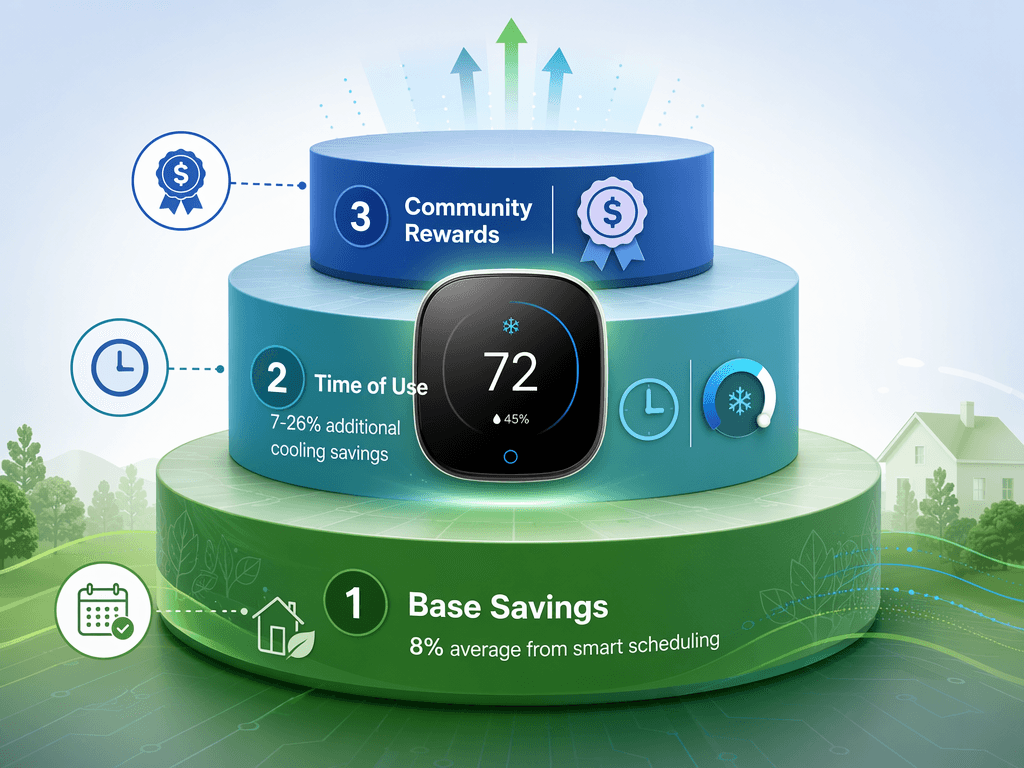
The important catch is that these are conditional layers, not guaranteed layers. ecobee says its Time of Use feature saved an additional 7% to 26% on cooling costs in a third-party study conducted from June through August 2020 across the United States and Canada.[6] That finding is about cooling costs under time-varying rate conditions; it should not be treated as a blanket 7% to 26% reduction on the whole utility bill.
Community Energy Savings is similar. ecobee says participating users have received over $25 million in rewards, with individual users receiving up to $125.[6] That is real money where programs are available, but availability, reward size, and comfort impact depend on the utility program. If this is the piece you are counting on, check your utility before you count the savings. A deeper look at smart thermostat demand-response earnings can help separate bill savings from program rewards.
Time-of-use settings and demand-response events also explain why some owners think the thermostat is “changing itself.” Sometimes that is the point. Sometimes it is the wrong setting for the household. If comfort complaints start causing manual overrides every week, the savings calculation you made on purchase day is no longer the calculation you are living with. For that situation, it is worth reviewing how to handle ecobee temperature overrides, eco+, and Smart Recovery behavior before deciding the thermostat itself failed.
Run the numbers on your own bill
If your utility bill separates heating and cooling clearly, use those numbers. If it does not, make a conservative estimate rather than pretending the whole electric or gas bill is thermostat-controlled. Lights, appliances, water heating, plug loads, and fixed charges do not disappear because the hallway has a smarter screen.
- Estimate your annual heating and cooling spend.
- Pick a savings assumption: closer to 26% if you are replacing constant holds or poor manual habits; closer to 8% if you already use a programmable thermostat well.
- Add only the eco+ savings or rewards you can actually use, such as a time-of-use rate or a confirmed utility demand-response program.
- Divide the thermostat price by the expected annual savings.
For example, suppose a household estimates $900 per year in heating and cooling costs. This is a hypothetical example, not a measured case. At 8%, the savings would be $72 per year. A $139.99 Essential would take just under two years to pay back; a $259.99 Premium would take about three and a half years. At 26%, the savings would be $234 per year, and both paybacks would look much faster.
That spread is the whole decision. The thermostat did not change between those two examples. The assumed starting behavior did.
So how much should you expect?
A fast payback is most plausible when several things line up: you buy the lower-cost Essential, your heating and cooling bills are high, your current thermostat habits are wasteful, your schedule is irregular enough for occupancy logic to help, and your utility offers time-of-use or demand-response opportunities. In that setting, the six-to-18-month range is believable.
A more ordinary payback is closer to the ENERGY STAR-style average, especially if you are upgrading from a programmable thermostat that already runs a reasonable schedule. The ecobee may still be worth buying for automation, remote control, better occupancy handling, and utility-program participation, but the bill savings may not behave like the 26% headline.
The Premium model can still make sense, particularly if you value its sensor package and broader smart-home features, but a typical already-managed home should be prepared for a payback that can stretch beyond two years. If the purchase is mainly about return on investment, compare the Essential first, then decide whether the Premium extras are worth paying for. Readers still choosing between brands may also want a side-by-side Sensi, Nest, and ecobee comparison rather than assuming the highest-feature thermostat has the best financial return.
ecobee can save real money. The 26% figure is best treated as an upper-bound scenario built around replacing a constant 72°F hold, while the cleaner buying decision comes from your own bills, your current thermostat habits, your local rates, and the price of the model you are actually putting in the cart.
References
- ecobee Savings Page, ecobee, https://www.ecobee.com/en-us/savings/
- ENERGY STAR Smart Thermostats FAQs, ENERGY STAR, https://www.energystar.gov/products/heating_cooling/smart_thermostats/smart_thermostat_faq
- Smart Thermostat Essential, ecobee, https://www.ecobee.com/en-us/smart-thermostats/smart-thermostat-essential/
- Smart Thermostat Premium, ecobee, https://www.ecobee.com/en-us/smart-thermostats/smart-thermostat-premium/
- Smart Thermostat Enhanced, ecobee, https://www.ecobee.com/en-us/smart-thermostats/smart-thermostat-enhanced/
- ecobee eco+ Page, ecobee, https://www.ecobee.com/en-us/eco-plus/
Data Updates
Know about updated rebate programs, changed subscription prices, or new ENERGY STAR certifications? Submit a note below to help keep this content current. For formal data corrections, use the contact page.
Comments
Join the discussion with an anonymous comment.