How Much Do Smart Thermostats Actually Save?
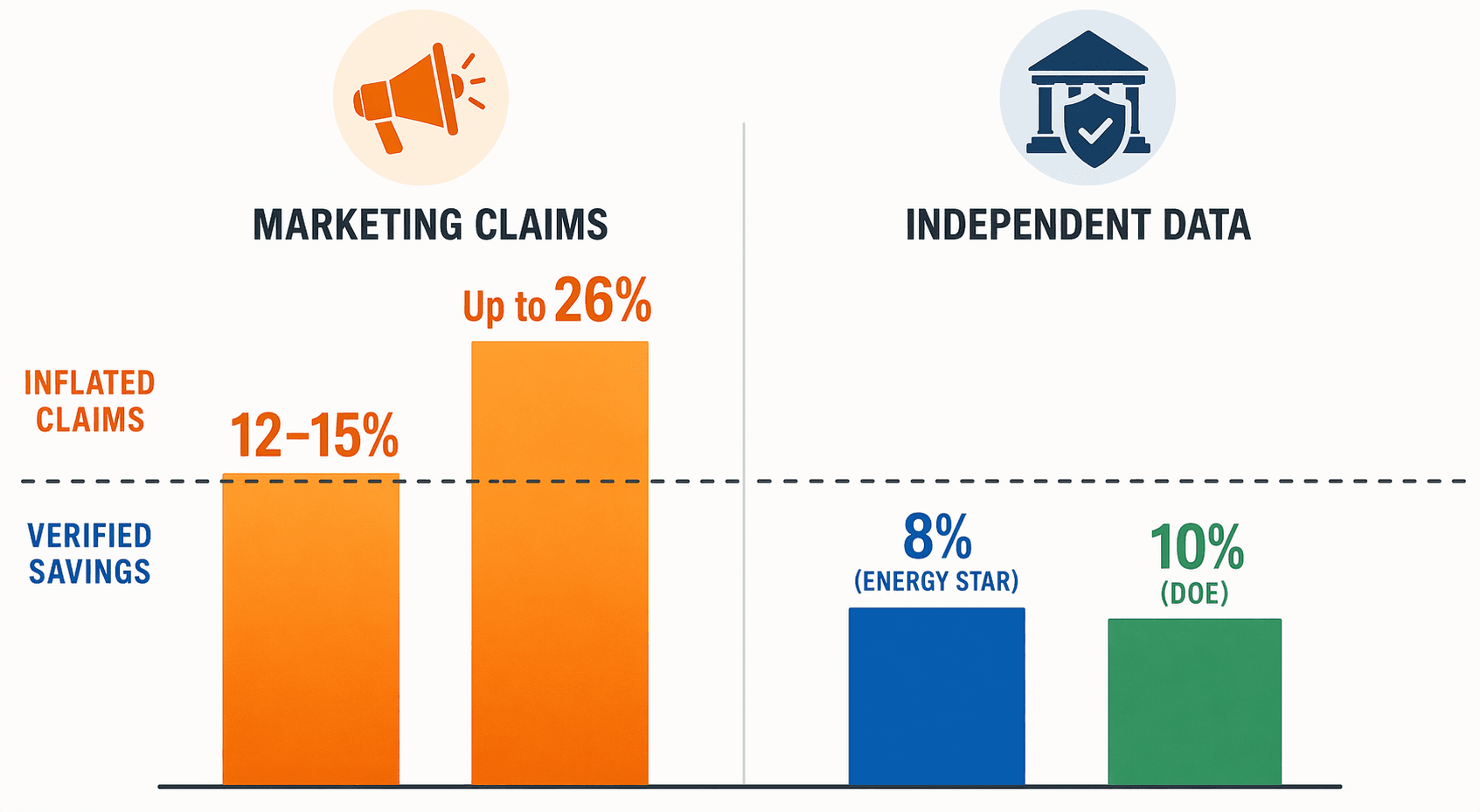
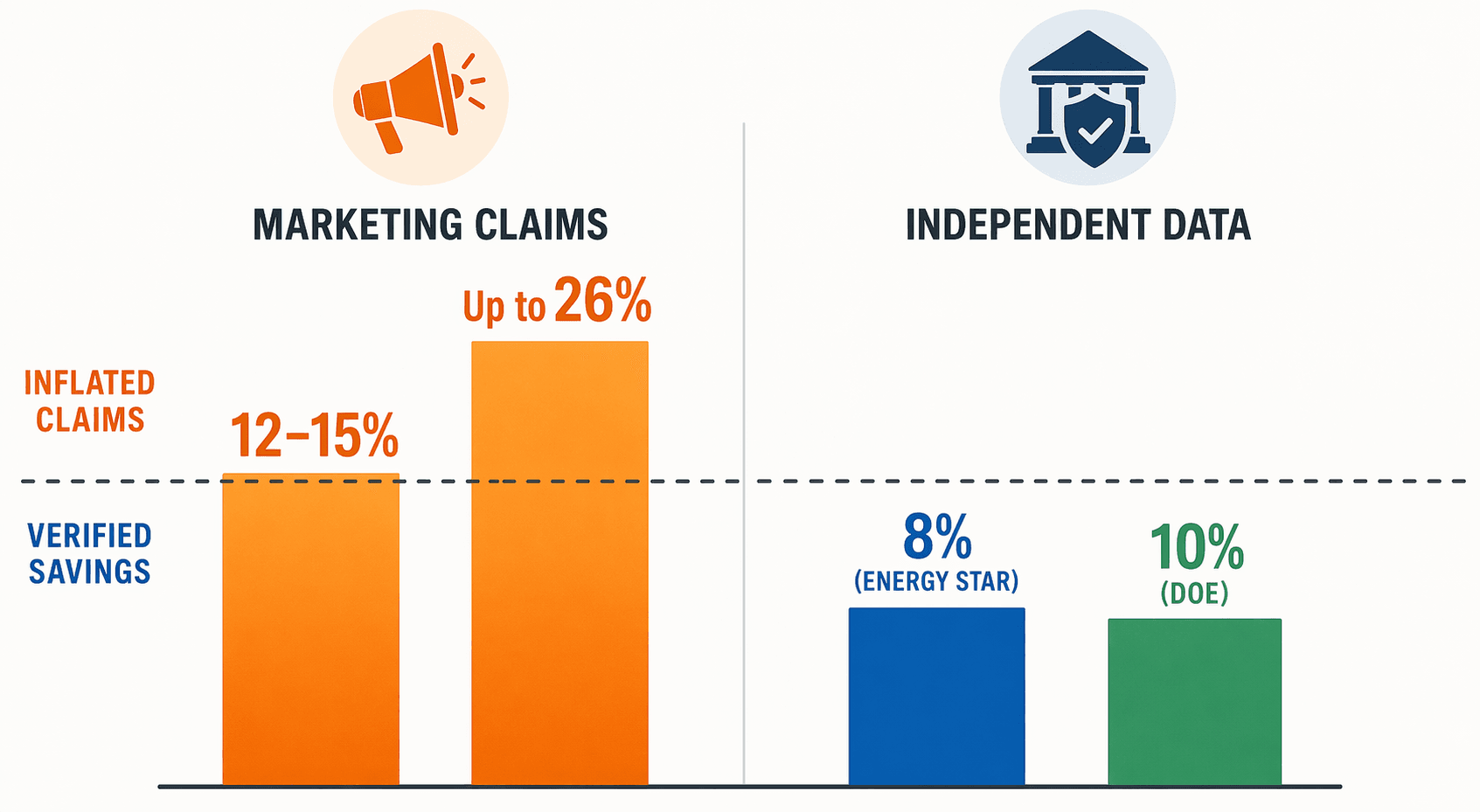
Google Nest says its Learning Thermostat saves 12–15% per year — about $131 to $145. Ecobee claims up to 26%, roughly $250 a year. Those numbers come from the companies that sell the thermostats. I don't dismiss them entirely, but they're manufacturer-commissioned research, not independently verified.
ENERGY STAR, the government-backed certifier, sets a minimum 8% heating runtime reduction and 10% cooling runtime reduction to earn its label. That's verified by third‑party field data across hundreds of homes. The ENERGY STAR FAQ states: "On average, ENERGY STAR certified smart thermostats save approximately 8% of heating and cooling bills, or about $50 per year (based on older energy cost baselines)." That 8% is a floor, not a ceiling. The 12–15% and 26% figures might be real for some homes in ideal conditions, but the average is lower. I'd trust the number that was audited.
Your Baseline: What You Spend on Heating and Cooling
Percentages are useless without a baseline. Heating and cooling account for nearly half of the average household's annual energy bill — more than $900 a year at older rates, according to ENERGY STAR. But utility costs have risen 41% over five years. A more recent analysis from CliQforHome puts the average combined non‑water utility bill around $4,300 per year. Heating and cooling make up 45% to 55%: $1,935 to $2,365. That's the pool a thermostat can draw from.
The old $50‑per‑year figure from ENERGY STAR sounds trivial now because it was calculated against much lower energy prices. At today's rates, the same 8% adds up differently.
8–10%: The Only Number Backed by Independent Data
ENERGY STAR's certification requires a weighted national average annual heating runtime reduction of at least 8% (lower 95% confidence limit) and cooling runtime reduction of at least 10%. That means the thermostat must deliver those reductions in real homes, not in a lab. The Department of Energy adds: you can save as much as 10% by setting the thermostat back 7°–10°F for 8 hours a day. Wirecutter confirms: "All Wirecutter picks are Energy Star–certified, meaning they will save at least 8% of your annual heating and cooling bill." No manufacturer asterisk — just a floor that applies across models and climates.
| Source | Claimed Savings | Verification |
|---|---|---|
| Google Nest (manufacturer study) | 12–15% ($131–$145/yr) | Internal, not independently audited |
| Ecobee (manufacturer claim) | Up to 26% (~$250/yr) | Internal, not independently audited |
| ENERGY STAR (certification criteria) | ≥8% heating, ≥10% cooling | Third‑party field data, auditable |
| DOE (setback recommendation) | Up to 10% | General guidance, not thermostat‑specific |
| Wirecutter (editorial recommendation) | At least 8% | Relies on ENERGY STAR certification |
A note: the ACEEE/Cadmus field study reported smart thermostats saving 12.5–16.1% compared to programmable models saving about 5%. That data appears only in the CliQforHome article — I haven't found the original report. I'd treat those higher numbers as supporting context, not primary evidence. The main takeaway is that even the conservative 8–10% range produces real dollar savings.
What That Means in Dollars Today: $155–$237 per Year
Apply 8% to the $1,935–$2,365 HVAC spend: $155–$189 per year. Apply 10%: $194–$237 per year. That gives a defensible range of $155 to $237 annually from an ENERGY STAR certified smart thermostat. The old $50‑per‑year figure is still cited, but it's based on older, lower energy costs. At today's prices, 8% is worth roughly three to four times that.
Even at 8%, It Pays for Itself in Under a Year
The payback math is straightforward and compelling even with the lower savings estimate. A $70 device saving $155 per year pays back in about 5 months. A $250 device saving $237 per year pays back in about 13 months. Over 7–10 years, a $70 thermostat returning $155–$237 per year accumulates roughly $1,085–$1,660 — a 15‑to‑24 times return on the purchase price. CNET says "Almost every smart thermostat purchase will pay for itself within a year or two." That matches the numbers above.
Utility rebates make the math even better. Many U.S. utilities offer $50 to $200 rebates on ENERGY STAR certified smart thermostats, which can bring a $200 device down to $0–$150 before you start saving. Some also pay $20–$50 per year in bill credits for participating in demand‑response programs.
Why Smart Beats Programmable (Quickly)
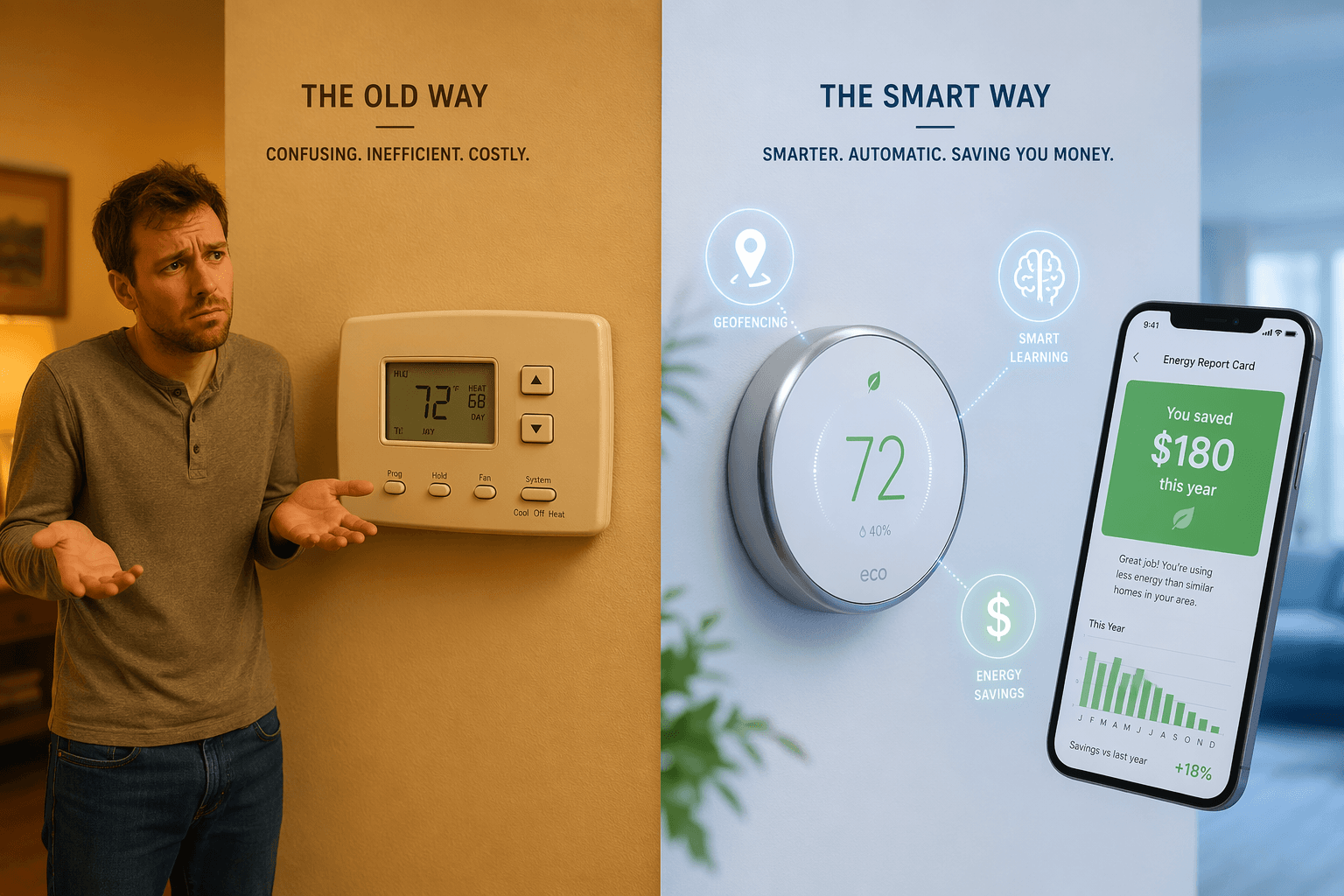
A cheap programmable thermostat can theoretically do the same job. In practice, people don't use them. A Consumer Reports survey found that 29% of programmable thermostat owners never set the schedule. ACEEE/Cadmus data shows that 51–78% of programmable users override their programmed schedules regularly. ENERGY STAR suspended its programmable thermostat certification in 2009 — the program effectively admitted that the devices weren't delivering the savings, because people weren't programming them. Smart thermostats solve that by learning automatically or using geofencing.
For a deeper comparison, see our full breakdown.
When the Savings Shrink: Who Should Adjust Expectations
The 8–10% range is a weighted national average. Some homes will see less, and that's not a product failure. The following conditions reduce the savings you can expect: always‑occupied homes (less opportunity to set back), already efficient HVAC (less waste to trim), temperate climates (lower total HVAC spend), and variable‑speed heat pumps (gentler cycles). None of these mean a smart thermostat is useless. They mean the savings will be at the lower end of the range — still positive, still paying back the device.
The Verdict: Trust 8–10%, But Don't Ignore the Opportunity
Ignore the 12–26% hype. The independently verified data says 8–10% is the real range. That translates to $155–$237 per year at 2026 energy prices — enough to pay back a $70–$250 device in less than a year and deliver a 15–24× return over its lifespan. Smart thermostats are a low‑risk investment for most households. Pick any ENERGY STAR certified model from a major brand, install it, and the savings will follow. The brands' inflated claims don't change that — they just make the case even stronger than the marketing suggests.
Data Updates
Know about updated rebate programs, changed subscription prices, or new ENERGY STAR certifications? Submit a note below to help keep this content current. For formal data corrections, use the contact page.
Comments
Join the discussion with an anonymous comment.