If someone in your home is sensitive to air pollution, the wrong monitor can be worse than no monitor at all. It can sit on a dresser glowing green while the pollutant that actually triggers symptoms is rising: fine smoke particles after a neighbor’s fire pit, carbon dioxide in a closed bedroom, VOCs from new furniture, nitrogen dioxide from a gas range, or radon in a lower-level family room.
That is why a smart air quality monitor for sensitive groups should be judged first by its sensors, not its app polish. For most health-vulnerable households, the minimum useful set is a laser PM2.5 sensor, a true NDIR CO2 sensor, and a VOC sensor. Depending on the home, NOx and radon may matter just as much. A pretty dashboard cannot fix a monitor that is estimating one pollutant from another.
Start With The Sensors, Not The Screen
Indoor air deserves this much scrutiny because it is often where exposure is longest. EPA guidance notes that indoor air can be two to five times more polluted than outdoor air, and in some cases much higher.[1] That does not mean every home is dangerous. It does mean a monitor bought for an asthmatic child, an older adult, or someone with COPD has to answer a practical question: what should I change right now?
The answer depends on which sensor is doing the measuring.
| Pollutant | Useful sensor standard | What it changes at home |
|---|---|---|
| PM2.5 | Laser particle sensor | Run an air purifier, close windows during smoke, change cooking ventilation |
| CO2 | NDIR CO2 sensor | Open a window, run ventilation, check whether a bedroom or classroom-like room is under-ventilated |
| VOCs / TVOC | Dedicated VOC sensor | Identify off-gassing, cleaning products, candles, paint, new furniture, or poor flush-out after renovation |
| NOx / NO2 | Dedicated NOx or NO2 sensing | Watch gas-stove, gas-oven, fireplace, and attached-garage pollution patterns |
| Radon | Continuous radon sensor or long-term radon test | Decide whether the home needs radon mitigation |
PM2.5 is the first non-negotiable for asthma, wildfire smoke, cooking particles, and many heart and lung concerns. These particles are small enough to travel deep into the lungs, and the EPA’s orange “Unhealthy for Sensitive Groups” AQI band for PM2.5 begins at 35.5 micrograms per cubic meter.[2] A useful monitor should show that kind of spike quickly enough that someone can close a window, turn on a purifier, or stop frying food before the room has been bad for an hour.
CO2 is different. In a home, it is usually a ventilation signal, not a poison alarm. A bedroom climbing above 1,000 ppm overnight tells you exhaled air is accumulating and fresh air is not keeping up. That can matter for sleep, stuffiness, and whether other indoor pollutants are being diluted. But the monitor has to use NDIR CO2. Estimated CO2, often labeled eCO2, is usually inferred from VOC behavior. Spray a cleaner, light a candle, bring in a new dresser, and the device may report a CO2 jump even when ventilation has not changed.
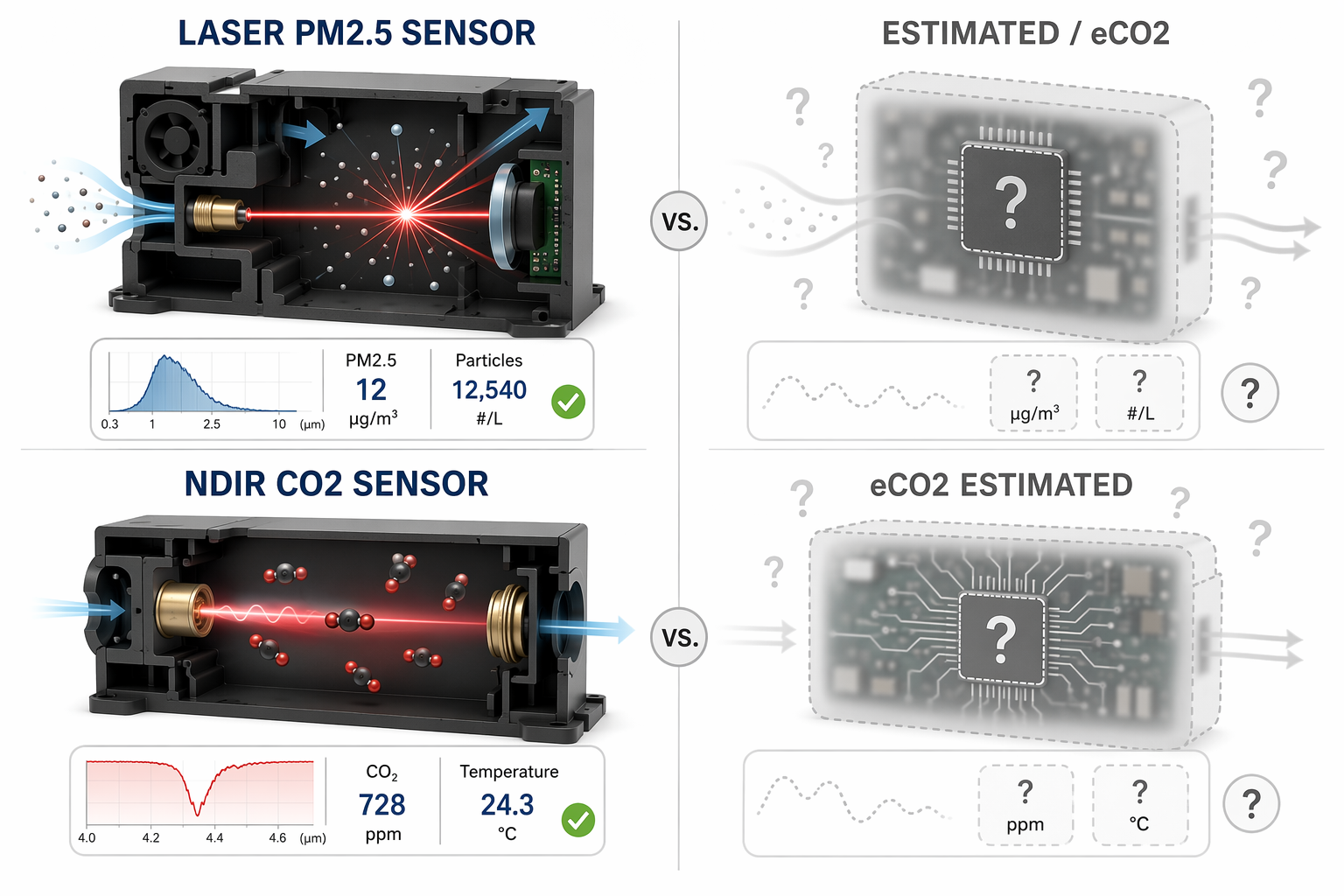
VOC readings need the same restraint. A TVOC reading above 1,000 ppb is a useful warning that something is actively off-gassing or that a cleaning event needs ventilation. It is not a diagnosis. VOC sensors are broad and reactive by design; they are better at showing a pattern than naming one chemical. That still makes them valuable in nurseries, bedrooms, renovated rooms, and homes where fragrance, cleaners, or new furniture seem to coincide with symptoms. For nursery-specific setup choices, the furniture and materials discussion in Smart Home Gadgets for Nursery Design is the better companion read.
Radon deserves a harder line. The EPA action level is 4 pCi/L, and EPA estimates radon causes about 21,000 lung cancer deaths per year in the United States.[3] But radon is also geographically and building-specific. A continuous radon monitor is especially useful for basements, slab-on-grade homes, homes in higher-risk zones, and households that want long-term visibility after mitigation. It is not the first pollutant to prioritize if the immediate problem is a child coughing during wildfire smoke.
Why Cheap Multi-Pollutant Claims Deserve Suspicion
Consumer sensors are allowed to be imperfect. A home monitor is not reference-grade equipment, and normal variation against professional instruments is part of the category. The problem is not modest imprecision. The problem is false specificity: a low-cost device using one metal-oxide sensor and then presenting separate-looking numbers for CO2, VOCs, formaldehyde, and other pollutants as if each had been directly measured.
NonToxicLab’s 2026 testing and teardown work found that this kind of “fake” or algorithmically generated reading is common among inexpensive Amazon-style monitors, especially models that imply they can measure many pollutants without the sensor hardware to support those claims.[4] That is the category to avoid for sensitive groups. If a monitor cannot clearly say it has laser PM2.5 and NDIR CO2, treat its numbers as a rough curiosity, not a basis for bedroom, nursery, or elder-care decisions.
Independent testing also shows why speed matters. Consumer Reports found that top monitors detected PM2.5 spikes in under 30 seconds, while some budget models failed to report unhealthy air even in a smoke-filled test room.[5] For a healthy adult using a monitor to satisfy curiosity, that might be annoying. For an asthmatic or an older adult, a missed spike can mean the purifier stays off and the window stays open.
Match The Monitor To The Person In The House
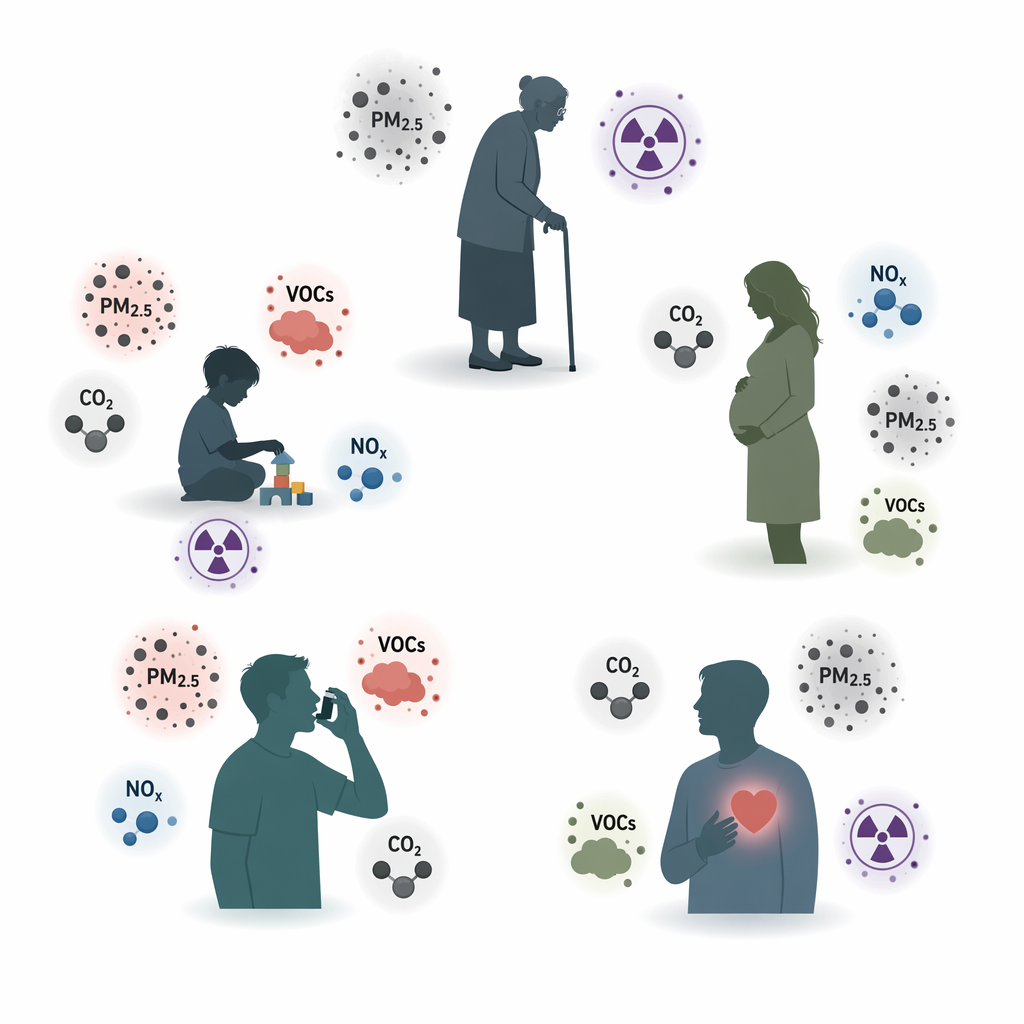
Sensitive groups are often discussed as one bucket, but the buying decision is sharper when you start with the person and the room. Children are at higher risk because their lungs are still developing and they breathe more air per pound of body weight.[2] Older adults may be less able to compensate for environmental stressors, and AirNow identifies PM2.5 and ozone as having the greatest potential to affect their health.[6] Asthma, COPD, pregnancy, allergies, and heart disease each push different pollutants higher on the list.
| Household sensitivity | Pollutants to prioritize | What to buy for |
|---|---|---|
| Asthma or COPD | PM2.5 first; VOCs and NOx depending on triggers | Fast laser PM2.5 alerts, purifier automations, and cooking or smoke visibility |
| Children or nursery | PM2.5, CO2, VOCs | Nighttime ventilation, smoke detection, and off-gassing awareness from furniture or renovation |
| Older adult | PM2.5, CO2, radon when geography or room location warrants it | Remote viewing, alerts, and history that caregivers can check without being in the room |
| Heart disease | PM2.5 and ozone-related outdoor context; indoor PM2.5 control | Particle alerts and purifier pairing rather than decorative IAQ scores |
| Gas stove or gas appliances | NOx / NO2, PM2.5, CO2 | Cooking-event visibility and ventilation habits |
| Basement or radon-prone area | Radon plus PM2.5 and CO2 | Continuous radon trends or a dedicated radon testing plan |
For asthma, PM2.5 is the anchor. Wildfire smoke, indoor smoking drift, frying, searing, candles, and some fireplace use all show up as particle events. A monitor should be able to trigger an air purifier or at least send a phone alert while the event is happening. If smoke is your main seasonal concern, use this guide as the sensor filter, then compare smoke-specific performance in Which Smart Air Quality Monitor Detects Wildfire Smoke Best?.
For a nursery or child’s bedroom, PM2.5 still comes first, but CO2 and VOCs become more useful than many buyers expect. CO2 shows whether a closed door and sealed windows are leaving the room under-ventilated overnight. VOCs show whether new furniture, paint, mattress materials, or cleaning products are still off-gassing. The monitor should sit where it represents the breathing zone without being close enough to a humidifier, diffuser, window crack, or purifier outlet to distort the reading.
For an elderly parent living alone, remote access matters more than it does in a generic smart-home roundup. The adult child checking the app is not admiring a graph; they are deciding whether a bedroom is stuffy, whether a purifier is responding, or whether a smoke event went unnoticed. This is where history, alerts, and integrations become health-adjacent features rather than conveniences.
For gas appliances, do not assume a CO2 reading tells the whole story. Gas stoves and ovens can produce nitrogen dioxide and related combustion pollutants. Wirecutter’s 2026 guide highlights AirGradient One partly because it tracks NOx produced by gas appliances, a relevant concern in the large share of U.S. homes that cook with gas.[7] If cooking is the trigger, a monitor without NOx can still be useful for PM2.5, but it is not seeing the whole combustion picture.
Best Smart Air Quality Monitors For Sensitive Groups
These recommendations follow the sensor logic above. A device that is fine for curiosity can still be the wrong buy for a vulnerable household. The winners here are not the monitors with the most colorful screens; they are the ones whose real sensors line up with the risk profile.
Best All-Around: Airthings View Plus
Airthings View Plus is the cleanest fit for households that need PM2.5, NDIR CO2, and continuous radon in one consumer monitor. The combination matters. It covers particle events, ventilation patterns, VOC trends, and long-term radon visibility without asking a caregiver to stitch together several devices. Airthings also supports IFTTT, Alexa, and Google Assistant integrations, and the View Plus carries a five-year warranty.[7]
This is the monitor I would start with for an elderly parent’s bedroom, a finished basement used as living space, or a family that wants one dashboard for both daily air quality and radon trends. It is not the cheapest answer, and it is not the most combustion-focused answer. Its advantage is that it handles the broadest set of household risks without resorting to pretend CO2 or a separate radon device.
Best For Gas Appliances And Tinkerers: AirGradient One
AirGradient One is the pick when gas appliances are central to the problem. Its NOx tracking makes it more relevant for homes where symptoms or odor complaints cluster around cooking, oven use, or combustion events. Wirecutter named it a top pick in 2026 and noted its relevance to gas-appliance pollution, while also noting that mainstream smart-home integration was limited as of 2025, with Home Assistant and Homey support but no native Alexa or Google Home integration at that time.[7]
That trade-off is acceptable for households already comfortable with Home Assistant or local dashboards. It is less ideal for a caregiver who wants a simple Alexa routine or a plug-and-play phone alert for an older relative. Platform support changes, so check current integrations before buying, but do not dismiss the monitor just because it looks more technical. For the right home, NOx visibility is not a hobbyist extra.
Best Value Pick: Qingping Air Monitor Pro Gen 2
Qingping Air Monitor Pro Gen 2 is the value pick when you want meaningful PM2.5, CO2, and VOC visibility without paying for a radon-focused device. HouseFresh testing has treated Qingping as a strong value option, while also flagging companion-app issues.[8] That caveat matters. A buggy app is not just an annoyance if the household depends on remote alerts.
It makes the most sense for a parent or adult with asthma who will actually look at the display, set up Xiaomi Home automations where appropriate, and accept that the software experience may not feel as polished as the hardware. If the monitor is going into a relative’s home and you need dependable remote access with minimal troubleshooting, pay more for the safer ecosystem.
Best For Detailed Per-Sensor Readings: uHoo
uHoo is the monitor to consider when the household wants a more granular breakdown, including readings such as formaldehyde, ozone, and nitrogen dioxide. That can be useful after renovation, in a home with strong chemical sensitivities, or when someone is trying to separate particle triggers from gas-phase irritants. The catch is cost structure: full historical data requires a subscription that has been reported around $4 to $5 per month, and that price should be checked before purchase.
There is also a testing caution. Consumer Reports found that certain uHoo units did not report unhealthy air in a smoke-filled room during its evaluation.[5] That does not make the whole product line useless, but it does mean buyers focused on asthma or wildfire smoke should verify the exact model, sensor package, and test results rather than assuming a long pollutant list guarantees strong PM2.5 performance.
Budget Spot-Checking Only: Temtop M2000
Temtop M2000 belongs in a narrower category. It is useful for spot-checking: walking room to room during wildfire season, checking whether frying dinner spiked particles, or confirming that a purifier is lowering PM2.5 in the room where it sits. It has no app and no Wi-Fi, so it is not a smart monitor in the caregiver sense.
That limitation is not fatal if the job is simple. A budget spot checker can still teach a household which activities create particle spikes. It should not be assigned to monitor an elderly parent remotely, wake you for a nursery smoke event, or automate a purifier. If you need that automation layer, the device has to be connected. For trigger-based setups, see How to Automate a Smart Home Air Quality Monitor for Hazardous Conditions.
Set Alerts Around Decisions, Not Anxiety
A monitor becomes useful when each alert has a job. PM2.5 alerts should start the air purifier, close the HVAC fresh-air intake if your system supports that, or tell someone to shut windows during smoke. CO2 alerts should prompt ventilation, not panic. VOC alerts should lead to source control: stop using the product, air out the room, move new furniture, or change cleaning routines. Radon alerts should lead to testing confirmation or mitigation planning, not opening a window once and calling the problem solved.
For PM2.5, use the EPA sensitive-group band as a meaningful reference point. If your monitor repeatedly shows readings around or above 35.5 micrograms per cubic meter, that is not a cosmetic graph change for a vulnerable household.[2] It is a reason to improve filtration, investigate the source, and make sure your purifier is sized and placed correctly. If the alert was smoke-related, Your Smart Air Quality Monitor Detected Smoke: Now What? walks through the next decision sequence.
Pairing the monitor with a purifier is often the most useful automation. The monitor sees the spike; the purifier changes the air. During wildfire season, purifier capacity and filter behavior matter as much as the monitor’s alert. For that side of the setup, compare purifier features in Smart Air Purifier Features That Actually Help in Wildfire Smoke or the model-focused guide to Best Smart Air Purifiers for Wildfire Smoke in 2026.
Thermostat-based air quality readings can be helpful as a supplement, especially when the thermostat already controls ventilation or HVAC fan behavior. They should not replace a room-level monitor in a nursery, bedroom, basement, or kitchen if that is where the sensitive person spends time. A thermostat sees the air near the thermostat. The person with symptoms breathes somewhere else. If you are comparing thermostat ecosystems, Ecobee Premium vs. Nest Learning Thermostat (4th Gen) is the more relevant comparison.
What I Would Not Buy For A Sensitive Household
I would not buy a monitor for a vulnerable person if the listing hides the sensor types, claims too many pollutants from too little hardware, uses eCO2 as if it were true CO2, or cannot alert anyone outside the room. I would also be careful with devices that show a single comfort score without exposing the actual PM2.5, CO2, VOC, radon, or NOx readings. Scores are fine as decoration. They are not how you decide whether to run a purifier at 2 a.m.
- For asthma, COPD, heart disease, and wildfire smoke: require fast laser PM2.5 detection.
- For bedrooms, nurseries, and crowded rooms: require NDIR CO2, not eCO2.
- For new furniture, paint, cleaners, fragrance, or renovation: include VOC tracking, but interpret it as a pattern.
- For gas stoves, ovens, fireplaces, or attached garages: consider NOx or NO2 visibility.
- For basements and radon-prone areas: use continuous radon monitoring or a dedicated radon test plan tied to the EPA 4 pCi/L action level.
The best purchase is the one whose real sensors match the actual vulnerability in the home. Airthings View Plus is the safest all-around choice when radon, PM2.5, and ventilation all matter. AirGradient One is the sharper tool for gas-appliance pollution if you can live with more technical integrations. Qingping Pro Gen 2 can be a strong value if app roughness is acceptable. uHoo is worth considering for detailed gas-phase breakdowns when subscription costs make sense. Temtop M2000 is a spot-checking tool, not a caregiver monitor.
Buy the monitor for the pollutant that will change your next action. Then place it in the room where the sensitive person actually breathes, set alerts at thresholds you are prepared to respond to, and connect it to filtration or ventilation wherever the home allows.
References
- Low-Cost Air Pollution Monitors and Indoor Air Quality, EPA
- Patient Exposure and the Air Quality Index, EPA
- How to improve indoor air quality to help control asthma, Airthings
- Best Indoor Air Quality Monitor in 2026 (PM2.5, VOCs, CO2, Radon Tested), NonToxicLab
- 3 Best Indoor Air Quality Monitors of 2026, Consumer Reports, 2026
- Older Adults and Air Quality, AirNow.gov
- The 3 Best Home Air Quality Monitors of 2026, Wirecutter, 2026
- The best air quality monitors we have tested, HouseFresh
Reader Feedback
Share your purchase experience, flag outdated picks, or ask clarifying questions about the checklist items.
Comments
Join the discussion with an anonymous comment.