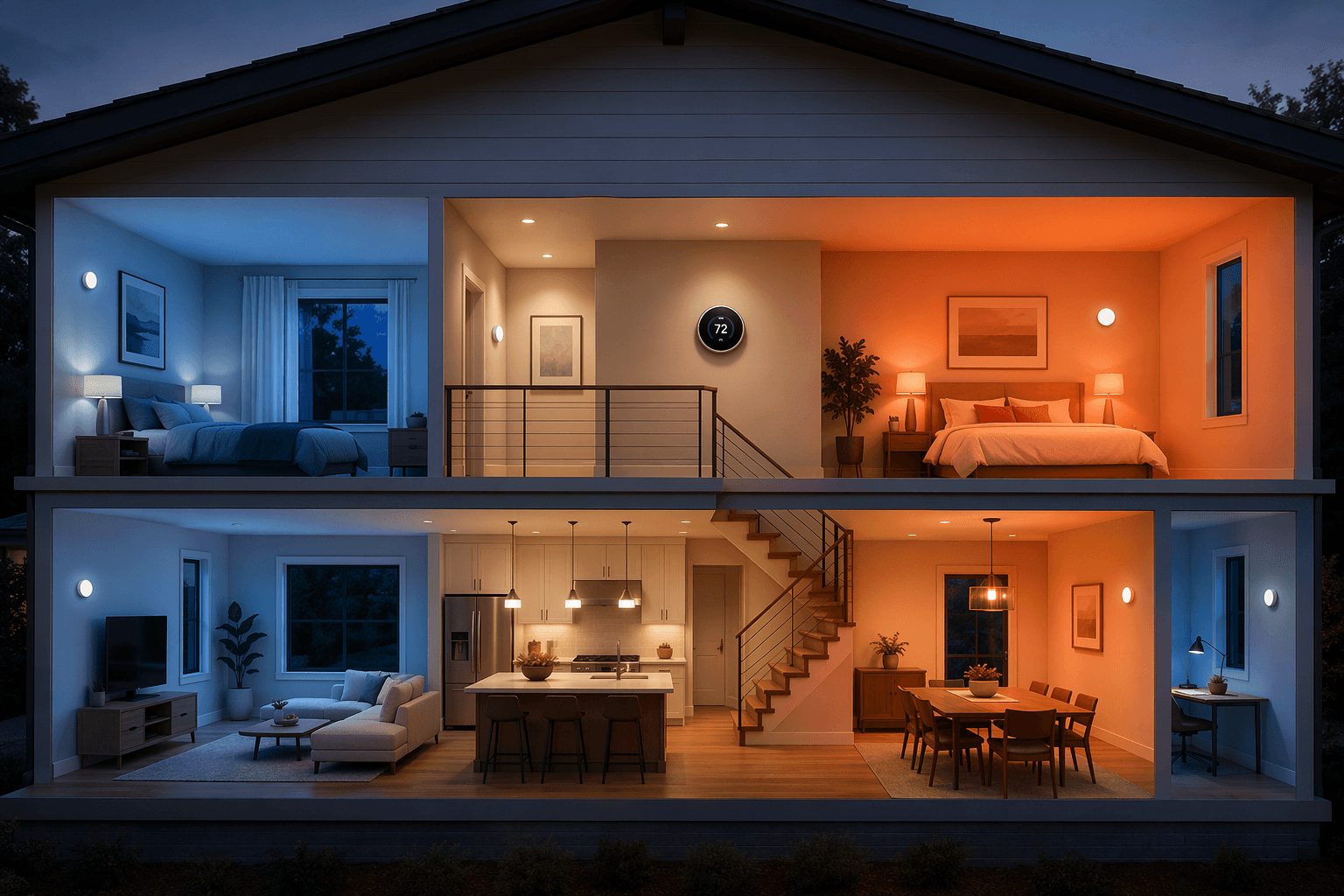
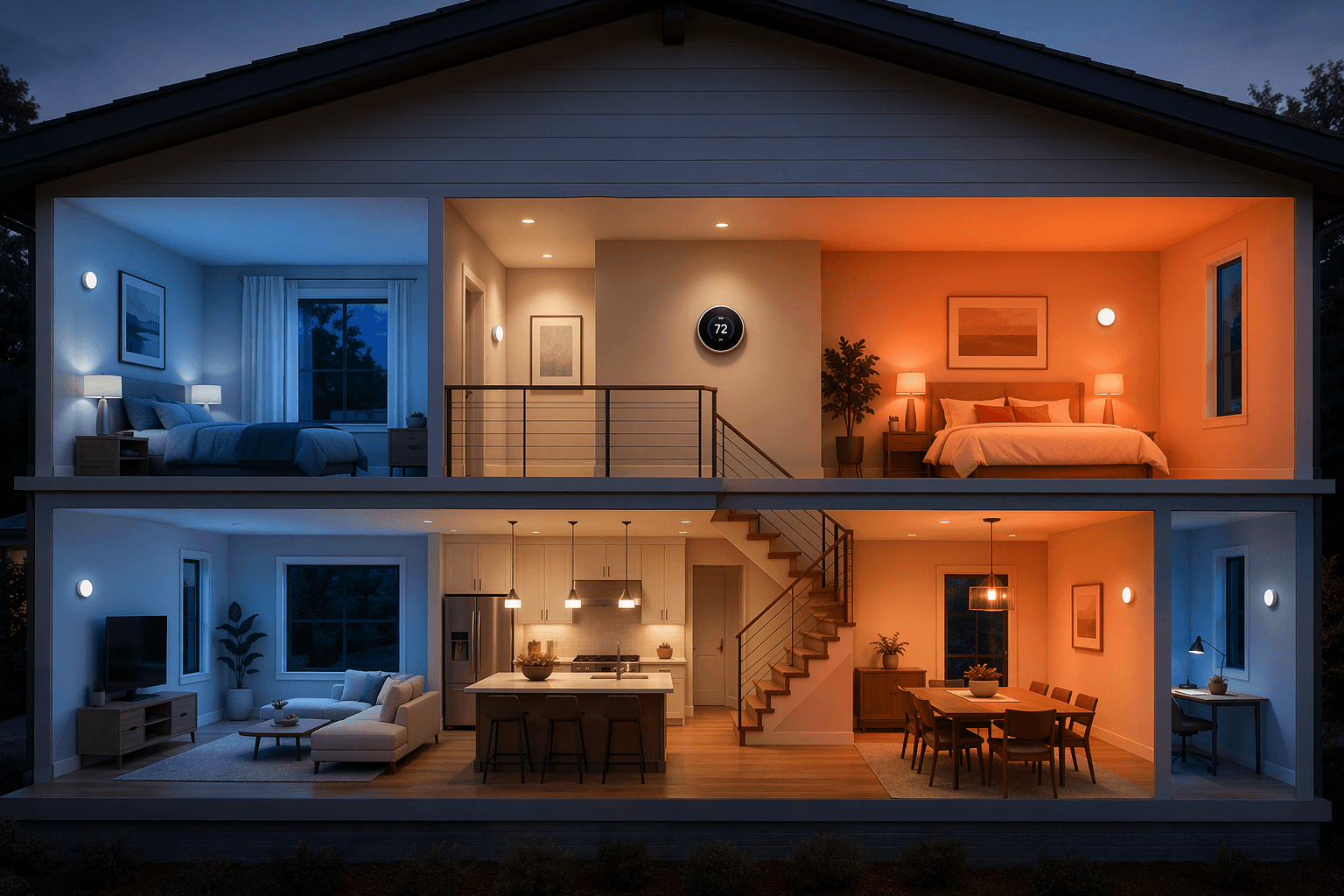
The hallway thermostat can be perfectly satisfied while the back bedroom is still too warm, the nursery is cooler than expected, and the home office turns into a greenhouse every afternoon. That is the real reason to shop for a smart thermostat with remote sensor support: not because another gadget looks tidy on a wall, but because one temperature reading in one hallway is often a poor witness for the whole house.
Remote sensors can help, but only if four things line up: the sensor has to measure the right thing, reach the room reliably, stay powered without becoming another maintenance chore, and feed a thermostat logic that responds in a way your household actually uses rooms. A sensor that only reports temperature on a rigid schedule is a very different tool from one that notices motion and shifts comfort priority automatically.
The specs that decide whether remote sensors will actually help
| System | What the remote sensor measures | Claimed sensor range | Battery expectation | Max sensors per thermostat | Comfort logic | Typical extra sensor cost |
|---|---|---|---|---|---|---|
| Ecobee Smart Thermostat with SmartSensors | Temperature and occupancy from the remote sensor; humidity is measured at the thermostat, not the remote sensor | About 60 ft using 915MHz radio | Up to 5 years with a CR2477 cell | Up to 32 sensors | Follow Me can prioritize rooms with detected motion; Ecobee also supports averaging across participating sensors | About $100 for a 2-pack, or roughly $50 per sensor [1] |
| Google Nest with Nest Temperature Sensor | Temperature only; no occupancy or presence detection in the remote sensor | About 50 ft over Bluetooth | Google claims up to 2 years with a CR2 battery; user reports commonly describe shorter 12–18 month life, so the official claim should be treated as the clean spec, not a guarantee | Up to 6 sensors | Earlier Nest behavior relies on scheduled sensor assignment; 4th Gen adds averaging across multiple sensors, but the sensors still do not detect occupancy | About $40 per sensor [2] |
| Honeywell Home T9 | Temperature and motion | Claimed 200 ft in ideal open-air conditions | About 1 year using AAA batteries | Up to 20 sensors | Occupancy-priority behavior with per-room target temperatures; TechHive described the remote sensors as the star attraction and highlighted the unusually long range | About $40 per sensor [3] |
| Sensi Touch 2 | Remote sensor support; detailed sensing specs are not established in the provided research with the same confidence as the other three systems | Not as central in the available source material as Ecobee, Nest, and Honeywell T9 | Not established in the provided research with the same confidence as the other three systems | Up to 15 sensors | Viable if its sensor limit and thermostat compatibility match the home, but the available evidence is thinner for detailed comfort-logic comparison | Varies by package and retailer [4] |
That table is the buying decision in miniature. Ecobee has the strongest low-maintenance sensor story. Nest has the simplest temperature-balancing story, especially if the household runs on predictable routines. Honeywell T9 has the most ambitious room-by-room control story on paper. Sensi Touch 2 belongs in the comparison because its sensor ceiling is real, but it does not have the same depth of available sensor-behavior evidence in this research set.
For a broader ecosystem overview, the site’s remote sensor buyer’s guide is the better companion. Here, the question is narrower: which sensor system is most likely to make a wrong room feel right?
Comfort logic matters more than the sensor existing
The easiest mistake is to treat every remote sensor as a small thermostat. It is not. Most of the comfort difference comes from what the main thermostat does after the sensor reports back.
Ecobee: motion-aware comfort without constant schedule babysitting
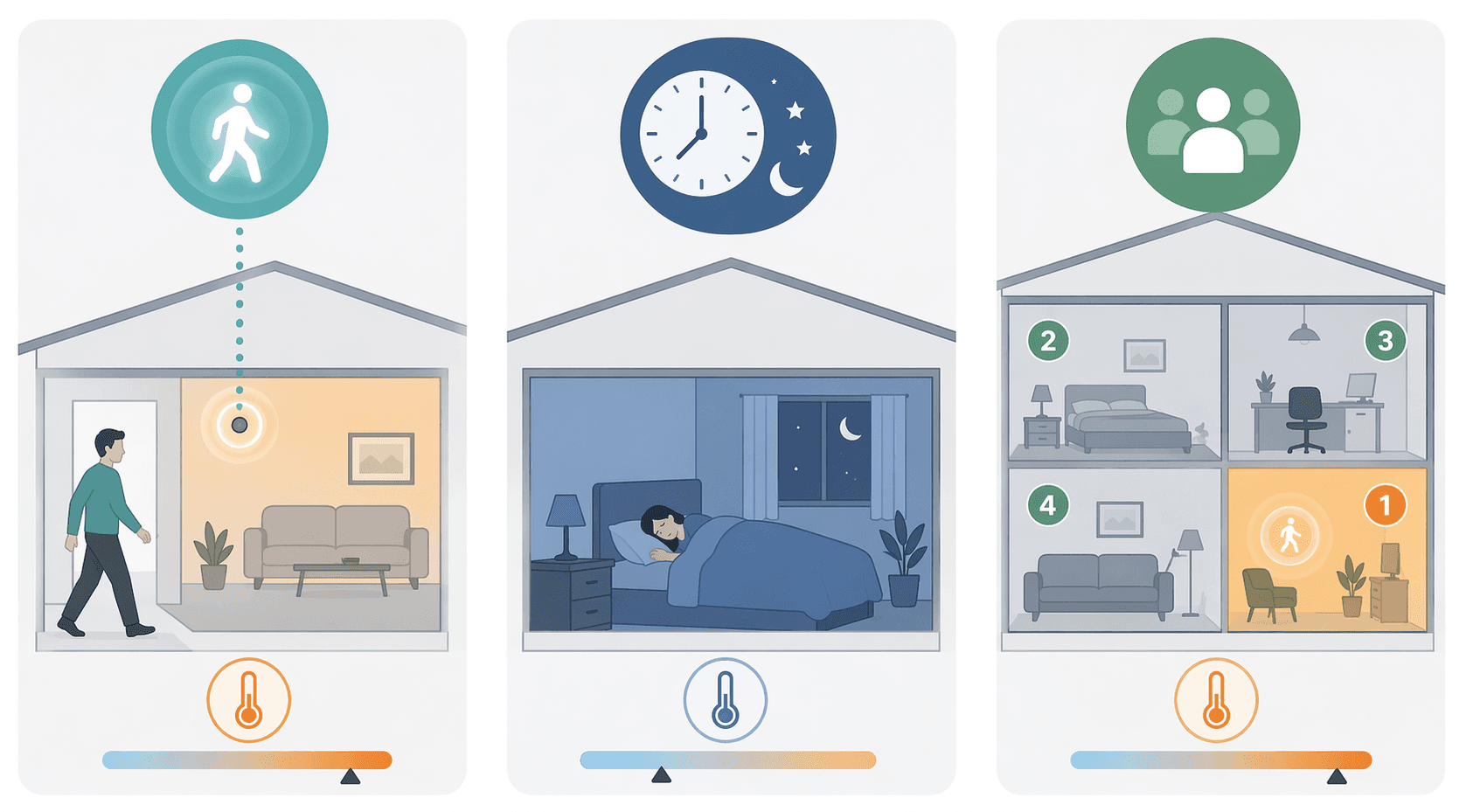
Ecobee’s advantage is that its SmartSensors combine temperature and occupancy. In Follow Me mode, the thermostat can weigh rooms where motion has been detected, instead of blindly obeying a fixed time block. If someone works in the guest room on Tuesday and the kitchen table on Wednesday, that matters. The thermostat has a signal that the occupied room deserves attention rather than assuming the schedule still describes the house.
Ecobee also supports averaging across sensors, which can be useful when the goal is to smooth a whole floor rather than chase one room. The caveat is practical, not philosophical: averaging a cold room and a warm hallway may make the thermostat run longer, and the room with the weakest airflow may still lag. Sensors reveal the imbalance; they do not rebalance ductwork.
Nest: simpler temperature balancing, still mostly schedule-driven
Nest Temperature Sensors are much less autonomous because they measure temperature only. They do not detect whether anyone is in the room. In earlier Nest setups, that means the user assigns which sensor should control comfort at which time: bedroom at night, living room in the evening, perhaps office during work hours. That can work in a predictable household, but the system is not learning that the nursery is occupied during an unexpected nap or that the office is empty today.
Nest 4th Gen improves the picture by adding averaging across multiple sensors. That is a meaningful upgrade for smoothing temperatures, especially in smaller homes where a few rooms matter most. It does not change the central limitation: the remote sensors still lack occupancy awareness, so automatic occupied-room comfort remains weaker than Ecobee’s Follow Me approach or Honeywell T9’s occupancy-priority behavior.
Honeywell T9: the most granular idea, with a 2026 buying problem
Honeywell T9 is technically compelling because it combines three things that matter in messy homes: a long claimed 200 ft sensor range, motion sensing, and per-room target temperatures. TechHive’s review specifically emphasized the remote sensors, noting both the range advantage and the room-level control that lets users target different spaces more directly than a simple average [3].
That makes the T9 especially interesting for a far bedroom or a room that needs a different target from the rest of the house. A nursery setpoint, for example, is not always just an average of the hallway and living room. Sometimes the point is to say: this room is the one that matters right now.
The catch in Q2 2026 is availability. The site’s Honeywell T9 device profile notes that the T9 shows as discontinued or backordered. That does not erase the engineering appeal, but it does change the recommendation. A remote-sensor system that is hard to buy, replace, or expand is a riskier foundation for a house you expect to keep tuning over time.
Range claims are comparison tools, not promises through walls
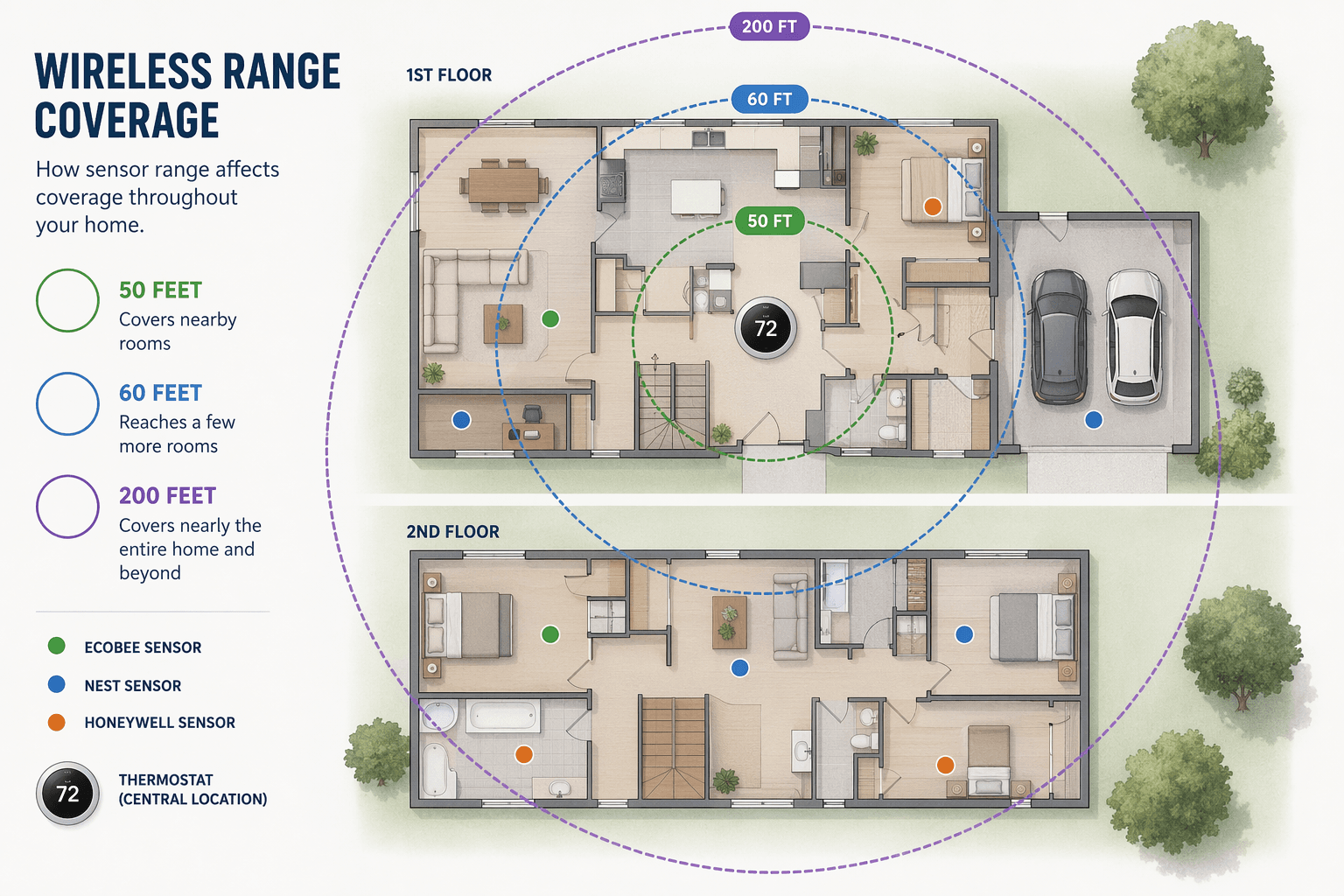
Honeywell T9’s 200 ft claim is the standout number, and it deserves attention. It is far longer than Nest’s roughly 50 ft Bluetooth range and Ecobee’s roughly 60 ft 915MHz radio range in the provided specifications [1][2][3]. If the problem room is across the house, down a hall, or on another level, that difference may decide whether a sensor can even stay connected.
Still, open-air range is not the same thing as range through plaster, framing, floors, ductwork, appliances, and whatever else sits between the thermostat and the room. The right way to read those numbers is relative: 200 ft gives Honeywell more margin than 60 ft or 50 ft, but none of the three should be treated as a guaranteed whole-house blanket in a multi-story layout.
This is where the floor plan matters more than the product page. A sensor for a room above the garage may be physically close in a straight line and still behave badly because of construction and interference. A sensor at the end of a same-floor hallway may be farther away but easier to reach. If the target room is already a Wi-Fi or Bluetooth dead zone, do not assume a thermostat sensor will be immune just because the box lists a range.
Battery life changes the system after the first month
Remote sensors feel low-effort when they are new. The maintenance question shows up later, after the sensor in the far bedroom quietly stops reporting or starts nagging for a battery while everyone is trying to get out the door.
Ecobee’s up-to-5-year SmartSensor battery claim is the cleanest story here and is a real advantage if you plan to scatter sensors across bedrooms, office spaces, and living areas [1]. Nest’s official claim is up to 2 years, but the research brief notes real-world user reports closer to 12–18 months, so buyers should not treat the 2-year number as a household certainty [2]. Honeywell T9’s roughly 1-year AAA expectation is easier to service in one sense because AAA cells are common, but it also means a more regular maintenance rhythm [3].
The more sensors you install, the more this matters. One annual battery swap is forgettable. Eight sensors with staggered battery warnings are not. A larger home may need the sensor count and range that Honeywell or Ecobee offer, but the battery burden should be counted as part of the system, not an afterthought.
How the systems fit common uneven-temperature problems
Far bedrooms
For a far bedroom, start with range and battery life before app preferences. Honeywell T9 has the strongest range specification, but its 2026 availability caveat matters. Ecobee has less claimed range but a stronger battery story and occupancy-aware logic. Nest can work if the bedroom is within range and the need is predictable, such as using that sensor overnight.
Nursery or child’s room
A nursery is where schedule-only control can feel brittle. If the room is used at consistent sleep times, Nest’s scheduled sensor assignment may be enough. If naps, caregivers, and occupancy vary, Ecobee’s motion-aware prioritization or Honeywell T9’s occupancy-priority design is a better conceptual fit. The sensor still cannot solve poor airflow, but it can stop the hallway from being the only room with a vote.
Sun-exposed room
A west-facing room that overheats in the afternoon is a good candidate for a remote sensor, but not always for aggressive averaging. If the thermostat starts chasing that room hard, the rest of the house may cool more than expected. A motion-aware mode is useful here because an empty hot room may not deserve the same priority as an occupied one.
Home office
A home office exposes the difference between predictable and unpredictable use. If the office is occupied every weekday from the same hours, Nest’s schedule-based approach is more tolerable. If work moves between rooms, calls run late, or the office doubles as a guest room, Ecobee’s Follow Me approach better matches real behavior.
Larger home with many rooms
Sensor limits become real in larger homes. Ecobee supports up to 32 sensors, Honeywell T9 up to 20, Sensi Touch 2 up to 15, and Nest up to 6 in the provided research. Most homes will not need anywhere near those ceilings, but a larger or multi-zone-like layout can hit Nest’s limit sooner than expected. Once you are counting bedrooms, offices, basement rooms, and main living areas, the ceiling stops being theoretical.
Cost is not just the thermostat price
The sensor add-on cost is modest for one room and noticeable for a whole floor. A typical 3-bedroom home needing 3–4 sensors lands around $120 with Nest or Honeywell sensors at about $40 each, while Ecobee’s 2-pack pricing puts a similar setup around $150–$200 depending on how many sensors are needed [1][2][3].
That extra Ecobee cost is not automatically wasteful if the household benefits from occupancy-aware comfort and longer claimed battery life. Likewise, Nest’s lower sensor cost is not automatically the better buy if the rooms are used unpredictably. The cheaper sensor can become expensive if it does not change the comfort problem that prompted the purchase.
Compatibility still matters before any of this. C-wire needs, HVAC type, and thermostat support can overrule a neat sensor plan. For that broader purchase filter, use the Smart Thermostat Buyer’s Guide 2026 before committing to a sensor ecosystem.
The energy-savings promise needs a warning label
Remote sensors are often sold in the same breath as energy savings, but comfort control and lower runtime are not the same goal. ENERGY STAR reports average savings of about 8% for certified smart thermostats, while Consumer Reports discusses that figure in the broader question of whether smart thermostats are worth it [5][6]. That does not mean adding remote sensors to chase a cold bedroom will cut the bill by another neat percentage.
Ecobee’s own savings claims can be higher under ideal conditions with eco+ and sensors, but those are not typical-user guarantees. Consumer Reports also warns that sensors can increase bills if they cause the system to run longer to condition distant rooms [5]. That is the trade: the far bedroom may finally be comfortable because the HVAC runs longer or differently than it did when the hallway thermostat was the only judge.
Homes with variable-speed heat pumps add another wrinkle. These systems often prefer steady operation, so aggressive averaging or setbacks may not produce the same savings story a buyer expects from a simpler on/off system. The sensor can still improve comfort, but the energy math becomes more household-specific.
So which remote sensor system is the safest bet?
Ecobee is the safest active-comfort choice for most buyers who want the thermostat to respond to occupied rooms without constant schedule editing. Its combination of temperature sensing, occupancy detection, high sensor ceiling, and up-to-5-year battery claim makes it the least fussy option for a multi-room home where people do not always follow the thermostat schedule.
Honeywell T9 is the most technically interesting remote-sensor system in this comparison. The 200 ft claimed range, occupancy-priority behavior, and per-room targets are exactly the kind of features that can matter in a difficult house. In 2026, though, the discontinued/backorder caveat keeps it from being the easy default recommendation.
Nest is acceptable for simpler, schedule-driven balancing. If the bedroom matters at night, the living room matters in the evening, and the routine rarely changes, Nest’s lower-cost sensors and 4th Gen averaging may be enough. It is not the best answer for automatic occupied-room comfort because the sensors do not detect presence.
Sensi Touch 2 remains viable when its compatibility, sensor limit, and price fit the exact home, but it is less central here because the available evidence does not support the same level of comfort-logic comparison as Ecobee, Nest, and Honeywell T9. If you are already comparing those three ecosystems, Sensi needs to win on your specific installation constraints, not on a vague promise that it supports sensors too.
Remote sensors can fix comfort problems. Sometimes that is worth the money even if the energy bill does not fall. The honest purchase test is whether the sensor system can reach the rooms, stay alive, detect what matters, and make the thermostat listen to the right space at the right time.
References
- SmartSensor specs and battery claims — Ecobee
- Nest Temperature Sensor specs and battery — Google Nest Help
- Honeywell Home T9 Smart Thermostat review: Remote sensors are the star attraction here — TechHive
- The Best Smart Thermostats for 2026 — PCMag
- Are Smart Thermostats Worth It? — Consumer Reports
- Smart Thermostats certified savings data — ENERGY STAR
Data Updates
Know about updated rebate programs, changed subscription prices, or new ENERGY STAR certifications? Submit a note below to help keep this content current. For formal data corrections, use the contact page.
Comments
Join the discussion with an anonymous comment.