
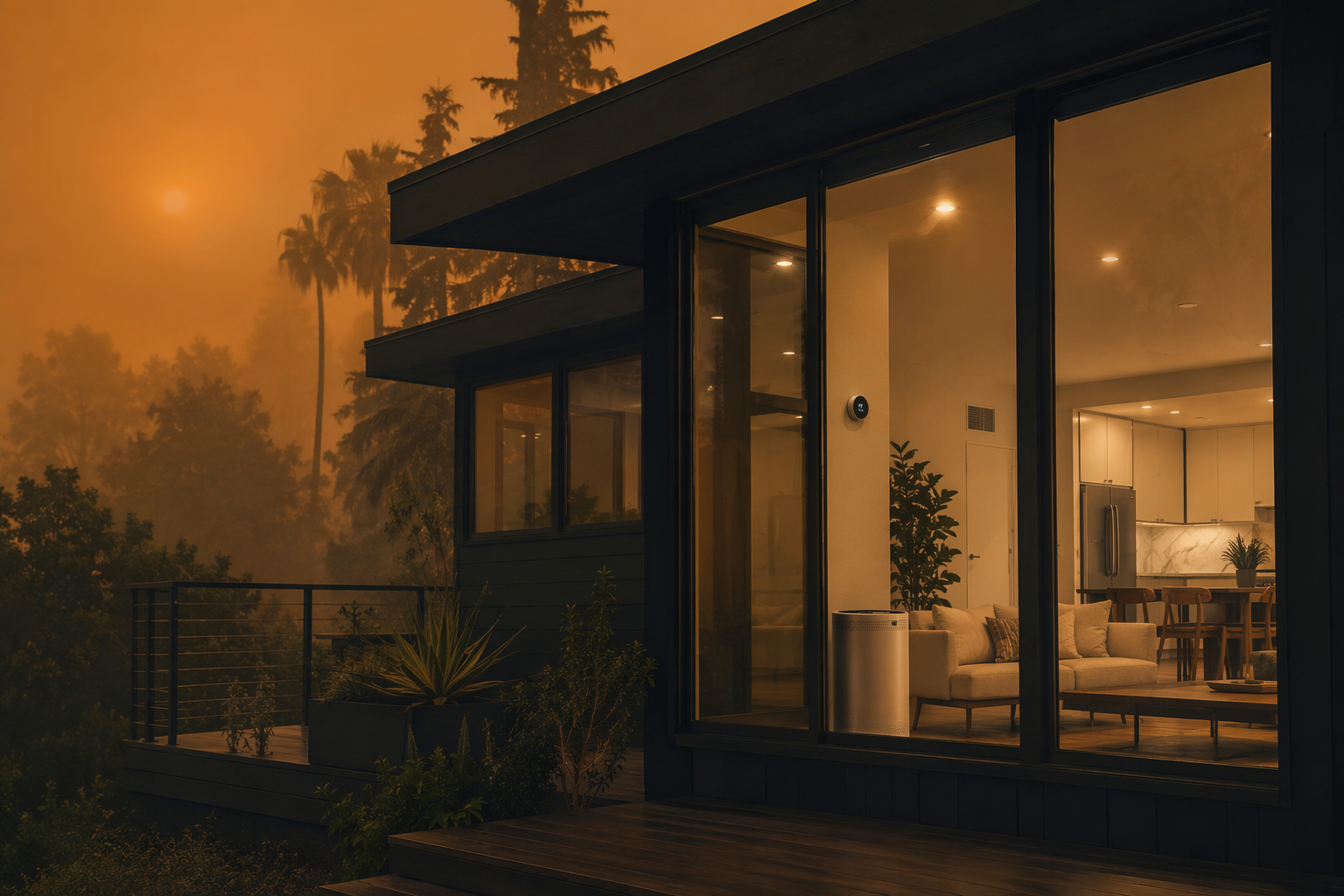
Code Purple is the moment when a smart home should stop asking for attention and start acting. At AQI 201–300, AirNow classifies outdoor air as “very unhealthy,” with a health alert for everyone, not only people with asthma, heart disease, or other higher-risk conditions. Washington, DC saw Code Purple conditions during the June 2023 smoke episode, and parts of Pennsylvania’s Times Observer region reported a Code Purple declaration on July 16, 2026.[1][2]
The weak link is usually not awareness. It is the delay between the alert and the household response: the HVAC fan left on auto, a fresh-air intake still open, a purifier running quietly in a bedroom while the family is in the living room. The better question is not which smart home devices protect health during Code Purple air quality in isolation. It is what has to happen automatically when outdoor air becomes very unhealthy.
Why the HVAC System Comes First
The most useful evidence for this setup does not come from a purifier spec sheet. A June 2025 Indoor Environments study simulated automated HVAC optimization across roughly 5,000 Ecobee donor homes during the 2020 California wildfire season. The modeled system reduced indoor PM2.5 by 54±5% on average and by up to 61±5% on peak smoke days. In an average-sized home, a MERV 13 filter paired with automated fan control performed about as effectively as four portable air cleaners.[3]
That is the load-bearing reason to treat the thermostat and filter as the center of the system. The study also estimated about $5 per month in added household energy cost, plus $29 million in monetized health benefits tied to a 53±5% reduction in premature mortality from reduced PM2.5 exposure.[3][4]
The result is serious, but it is not a universal promise. It was a simulation, not a guarantee that every house will see the same reduction. Homes leak differently, smoke loads vary, and not every thermostat ships with the control logic needed to behave like the modeled system. The practical lesson is narrower and more useful: when PM2.5 rises outside, the house should close off outdoor air where possible, move indoor air through a high-efficiency HVAC filter, and add room-level HEPA filtration where people actually are.
The Three-Device System
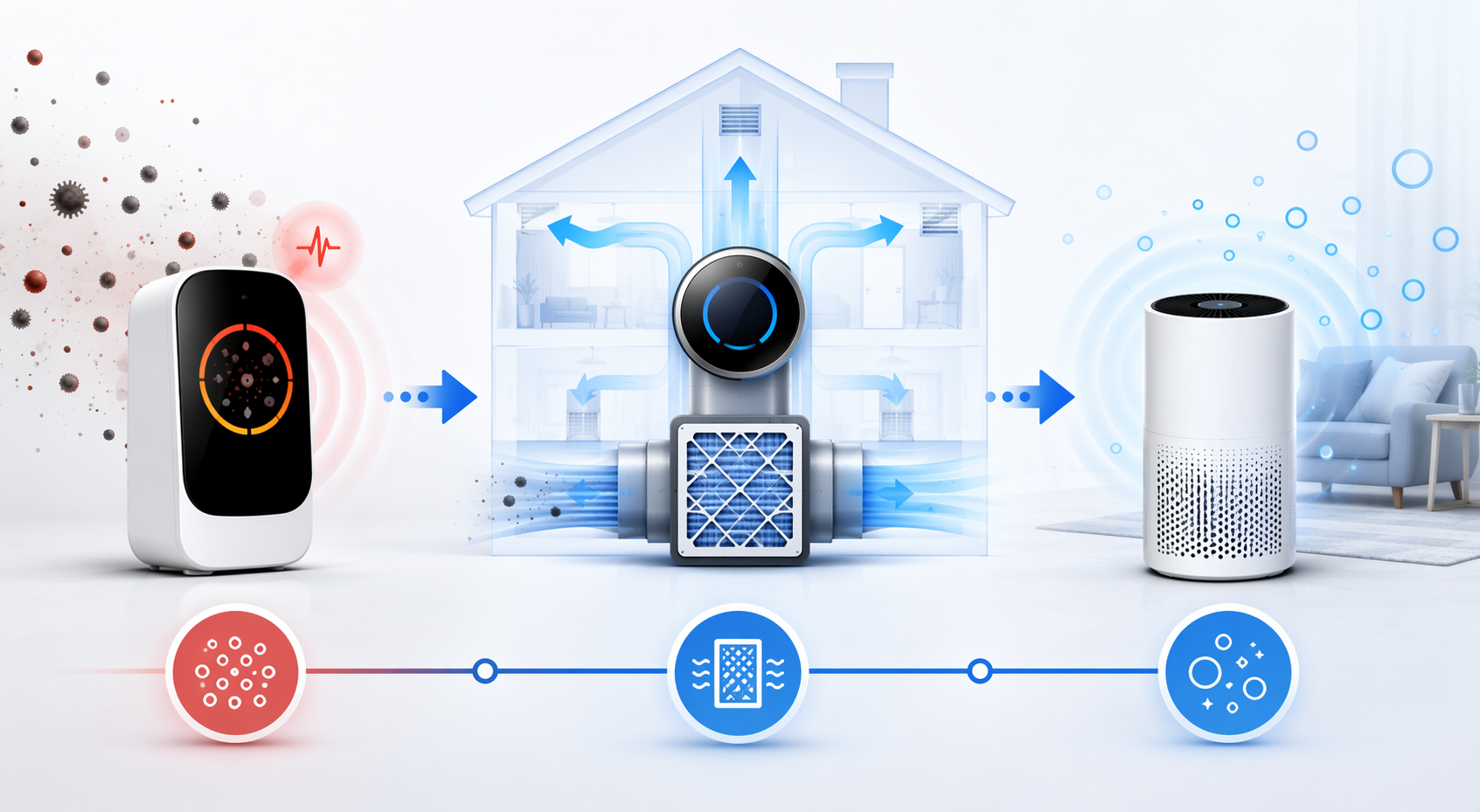
A Code Purple response needs three roles, not three disconnected gadgets. The air quality monitor supplies the trigger. The smart thermostat and MERV 13 filter do the whole-home work. The HEPA purifier lowers particle levels in the occupied room faster than the central system can do alone.
| Role | What it must do during Code Purple | Devices worth considering |
|---|---|---|
| Air quality monitor | Detect PM2.5 changes quickly enough to trigger an automation | PurpleAir Zen; AirGradient ONE |
| Smart thermostat plus HVAC filter | Run the fan, push air through MERV 13 filtration, and avoid unnecessary outdoor-air intake | ecobee Smart Thermostat Premium; Honeywell Home ElitePRO |
| HEPA purifier | Increase room-level particle removal where people are sleeping, working, or gathering | Coway Airmega 400S; Blueair Blue Pure 311i+ Max; Levoit Core 400S |
This distinction matters because the monitor alone does not clean anything, the purifier alone may not protect the whole house, and the thermostat alone may not know when outdoor smoke has crossed a dangerous threshold. The system works when a measurement becomes an action.
The Monitor: Choose a Trigger You Can Trust and Inspect
For Code Purple automation, the monitor’s job is not to produce a pretty dashboard. It has to expose PM2.5 readings to whatever platform will control the thermostat and purifier. PurpleAir Zen and AirGradient ONE are the most interesting options for different reasons.
PurpleAir Zen uses dual Plantower PMS6003 sensors and a Bosch BME688 gas sensor, and PurpleAir cites an AQMD field evaluation showing results within ±10% of reference-grade instruments.[5] That field-evaluation credibility matters when the monitor is allowed to start changing HVAC behavior without waiting for someone to open an app.
AirGradient ONE is attractive for a different household: the one that wants the system to be inspectable and repairable. HouseFresh highlights its open-source firmware, replaceable Plantower PMS5003 particle sensor, SenseAir S8 NDIR CO2 sensor, and native Home Assistant integration.[6] Consumer Reports’ 2026 monitor coverage also points readers toward indoor monitors as decision tools, but the automation path still depends on whether the device’s data can reach the rest of the smart home.[7]
For Code Purple, place the monitor indoors near the occupied zone you care about most, not beside a kitchen range, fireplace, bathroom, or open window. If you also use an outdoor reading, treat it as the early warning and the indoor reading as the performance check. The automation should start from outdoor danger or rising indoor PM2.5, then keep running until the indoor number falls and the outdoor event has passed.
The Thermostat and Filter: Where the Reduction Is Won or Lost
The HVAC setup is the part most likely to be underconfigured. A smart thermostat does not help much if the fan stays on auto and only moves air when there is a heating or cooling call. During a smoke event, the fan may need to run for filtration even when the temperature is already comfortable.
- Set the HVAC fan to on or circulation mode during Code Purple, rather than relying only on auto.
- Install a MERV 13 filter if the HVAC system can handle it without airflow problems.
- Disable or close fresh-air intake, economizer, or ventilator functions during heavy smoke unless a qualified HVAC professional has configured a safer strategy.
- Replace filters every 3 months during wildfire season, or sooner if the filter has visibly darkened.
Ecobee’s Smart Thermostat Premium is relevant because it combines HVAC control with built-in eCO2 and VOC monitoring, can trigger ventilator activation automatically, and can send push alerts for indoor air quality conditions.[8] For Code Purple, the important part is not the presence of a general “air quality” tile. It is whether the thermostat can run the fan, avoid bringing in smoky outdoor air, and connect to automations that respond to PM2.5.
Honeywell Home ElitePRO belongs in the same conversation because Resideo’s July 2026 wildfire-season guidance emphasizes air quality optimization services and HVAC configuration during smoke events.[9] If you are choosing between thermostat ecosystems, the more useful buying question is whether the model exposes the controls your automation needs. A broader thermostat comparison can help narrow that choice, especially if you are balancing Nest, Ecobee, Honeywell, and Amazon models for everyday use as well as smoke response.
One caution is worth taking seriously: a tighter filter can increase resistance in some systems. If a MERV 13 filter causes weak airflow, noisy operation, short cycling, or equipment warnings, the answer is not to ignore the symptom. Use the highest-efficiency filter your system can support safely, and involve an HVAC technician if the system was not designed with higher-MERV filtration in mind.
The HEPA Purifier: Room-Level Backup, Not the Whole Plan
Portable purifiers still matter. The EPA has reported that HEPA air cleaners can reduce particle concentrations by up to 85%, but that figure applies to particles, not every pollutant in bad outdoor air.[10] Code Purple may involve ozone, NO2, or other gases. MERV 13 and HEPA filtration are mainly a particulate defense.
Consumer Reports’ July 2026 wildfire-smoke purifier recommendations identify the Coway Airmega 400S as a top performer for wildfire smoke, with a smoke CADR of 350 CFM, Wi-Fi, and smart auto mode.[11] The Blueair Blue Pure 311i+ Max and Levoit Core 400S are also practical choices when matched to the room size and platform needs.[11]
During Code Purple, auto mode is useful only if the purifier’s sensor sees the same air people are breathing and reacts aggressively enough. A safer automation is blunt: when outdoor AQI reaches Code Purple or indoor PM2.5 rises past your chosen threshold, set the purifier to high in occupied rooms. Turn it down later, after indoor readings recover.
Automation Recipes That Actually Change the House
The automation should be written around consequences, not notifications. A notification can still be useful, but it should not be the main control mechanism. The action chain is simple: detect Code Purple or rising PM2.5, stop avoidable outdoor-air intake, run HVAC filtration, boost portable purification, then notify the household that the system has changed state.
Google Home
Google Home works best here when the devices involved expose clear starters and actions. If your monitor, thermostat, and purifier all appear with usable controls, build a household routine around an air quality condition or a helper trigger from a connected service.
- Create a Code Purple routine triggered by the monitor, an outdoor AQI service, IFTTT, or another integration that Google Home can see.
- Set the HVAC fan to on or circulation mode.
- Turn off ventilation, fresh-air exchange, or economizer behavior if the thermostat exposes that control.
- Set the main purifier to high in the room where people are present.
- Send a household notification that Code Purple mode is active.
The limitation is device exposure. Many consumer routines can turn things on and off, but may not expose fan runtime, ventilator logic, or a PM2.5 value as a clean automation trigger. In that case, Google Home can still handle the visible routine while Home Assistant, IFTTT, or a manufacturer automation handles the missing trigger.
Apple HomeKit
HomeKit households should start by checking whether each device exposes the right service type inside Apple Home. A thermostat that appears only as a temperature controller may not expose the fan control needed for smoke filtration. A purifier that appears as a switch may not expose fan speed.
- Use a HomeKit-compatible monitor or bridge the PM2.5 sensor into Apple Home through a reliable hub.
- Create an automation for unhealthy outdoor or indoor particle readings.
- Set the thermostat fan behavior if HomeKit exposes that control; otherwise use the thermostat’s own app or a bridge.
- Turn on the HEPA purifier and set the highest practical fan speed.
- Add a manual “Code Purple” scene as a fallback for any family member to activate.
Apple Home can be a clean front end, but it is not always the deepest control layer. If ecosystem compatibility is the gating issue, use a thermostat buyer guide focused on HomeKit, Alexa, and Google Home households before assuming a device will expose every control you need.
Home Assistant
Home Assistant is the most realistic path if you want to approach the kind of control logic used in the Berkeley work. The Center for the Built Environment published open-source thermostat wildfire algorithms on GitHub that can be adapted by advanced users.[12] That does not make the setup plug-and-play, but it shows the right level of control: outside conditions, indoor PM2.5, thermostat state, fan behavior, and filtration strategy all in one loop.
alias: Code Purple Air Defense
trigger:
  - platform: numeric_state
    entity_id: sensor.outdoor_aqi
    above: 200
  - platform: numeric_state
    entity_id: sensor.indoor_pm25
    above: 35
action:
  - service: climate.set_fan_mode
    target:
      entity_id: climate.main_thermostat
    data:
      fan_mode: "on"
  - service: switch.turn_off
    target:
      entity_id: switch.fresh_air_intake
  - service: fan.set_percentage
    target:
      entity_id: fan.living_room_purifier
    data:
      percentage: 100
  - service: notify.mobile_app
    data:
      message: "Code Purple air defense is active: HVAC fan on, fresh air intake closed, purifier high."
That example is intentionally generic. Entity names, available services, and thresholds vary by device. The important design choice is that the system has a trigger, a filtration action, an outdoor-air action, a room purifier action, and a notification after the house has already responded.
Eve’s smart home guidance and Vesternet’s March 2026 automation guide both describe air-quality-event automations, and those recipes are useful as patterns when your platform supports the same device capabilities.[13][14] The caveat is the same across platforms: an automation that only sends an alert is not yet an air-defense system.
Buying Paths After You Know the Workflow
Once the workflow is clear, the buying decision gets less sentimental. Do not start with the purifier that has the nicest app. Start with the missing role in your house.
| Path | Best fit | Likely device mix |
|---|---|---|
| Budget upgrade | You already have a compatible smart thermostat and mostly need detection plus room cleaning | AirGradient ONE; existing thermostat with MERV 13 filter; Levoit Core 400S |
| Mid-range system | You want a balanced setup with stronger purifier capacity and easier app control | PurpleAir Zen or AirGradient ONE; ecobee Smart Thermostat Premium; Blueair Blue Pure 311i+ Max |
| Premium particulate defense | You want stronger whole-home coordination and high-capacity room purification | PurpleAir Zen; ecobee Smart Thermostat Premium or Honeywell Home ElitePRO; Coway Airmega 400S |
If your existing thermostat cannot control fan runtime or ventilation behavior, upgrading the thermostat may produce more Code Purple value than buying a second purifier. If the thermostat is already capable but the purifier is undersized for the main room, spend there. If you do not have a PM2.5 monitor that can trigger automations, the system is still depending on someone noticing the alert.
For broader seasonal planning, a companion guide on three smart home devices to protect against wildfire smoke is the better place to think about preparation before the AQI crosses into emergency territory. This article stays deliberately narrower: Code Purple is the threshold where the automation should already be ready.
What This System Can and Cannot Promise
A well-configured three-device system can materially reduce indoor PM2.5 exposure during Code Purple events. The strongest available number for that claim is the 54±5% average reduction and up to 61±5% peak-smoke-day reduction from the 2025 simulation of Ecobee donor homes.[3]
The system is still home-by-home. A leaky house, an open fresh-air intake, an overloaded filter, or a thermostat that cannot sustain fan operation will weaken the result. And because HEPA purifiers and MERV 13 filters are primarily particle-control tools, they should not be sold as a shield against every pollutant that can appear during a very unhealthy air event.
The operational standard is plain: detect the air problem, stop avoidable outdoor-air intake, run central filtration, and boost room-level cleaning without waiting for a person to remember each step. That is where smart home devices can protect health during Code Purple air quality, and where the usual collection of separate gadgets becomes a working particulate-defense system.
References
- AQI Basics, AirNow.gov
- Code Purple Air Quality Alert Issued For Warren County, Times Observer, July 16, 2026
- Smart thermostat controls for reducing indoor PM2.5 exposures during wildfire smoke events, Indoor Environments, June 2025
- Smart thermostats can help protect homes from wildfire smoke, UC Berkeley Center for the Built Environment
- PurpleAir Zen Air Quality Monitor, PurpleAir
- The Best Air Quality Monitors, HouseFresh, 2026
- Best Indoor Air Quality Monitors, Consumer Reports, 2026
- Six Ways to Improve Air Quality in Your Home, ecobee
- How to Optimize Air Quality During Wildfire Season, Resideo, July 2026
- Guide to air cleaners in the home, U.S. Environmental Protection Agency
- Best Air Purifiers for Wildfire Smoke, Consumer Reports, updated July 2026
- thermostats_wildfire, Center for the Built Environment, GitHub
- How to automate air quality with your smart home, Eve Home
- Smart Home Automation Ideas for Air Quality, Vesternet, March 2026
Corrections & Community Notes
Spotted an outdated spec, changed compatibility, or new firmware behavior? Submit a correction below to help keep this profile current. For formal editorial updates, use the contact page.
Comments
Join the discussion with an anonymous comment.