Philips Hue Matter Upgrade: What to Know Before Enabling It
Current Philips Hue owners considering the Matter upgrade will find an honest assessment of benefits and reliability risks, plus step-by-step guidance to decide whether to enable Matter on their Hue Bridge.
Last updated
Philips Hue's Matter upgrade works in the technical sense. But for most existing users, enabling it introduces reliability problems that degrade an otherwise rock-solid system. I’ve watched this rollout closely, and The Verge spent three months living with it. The results are clear: slow responses, disconnections, loss of Apple HomeKit Adaptive Lighting, and Alexa duplication bugs. Until Matter's ecosystem-wide issues mature, the practical benefits are minimal. Most of you should skip it for now.
Here is what actually broke — and why.
What Actually Broke
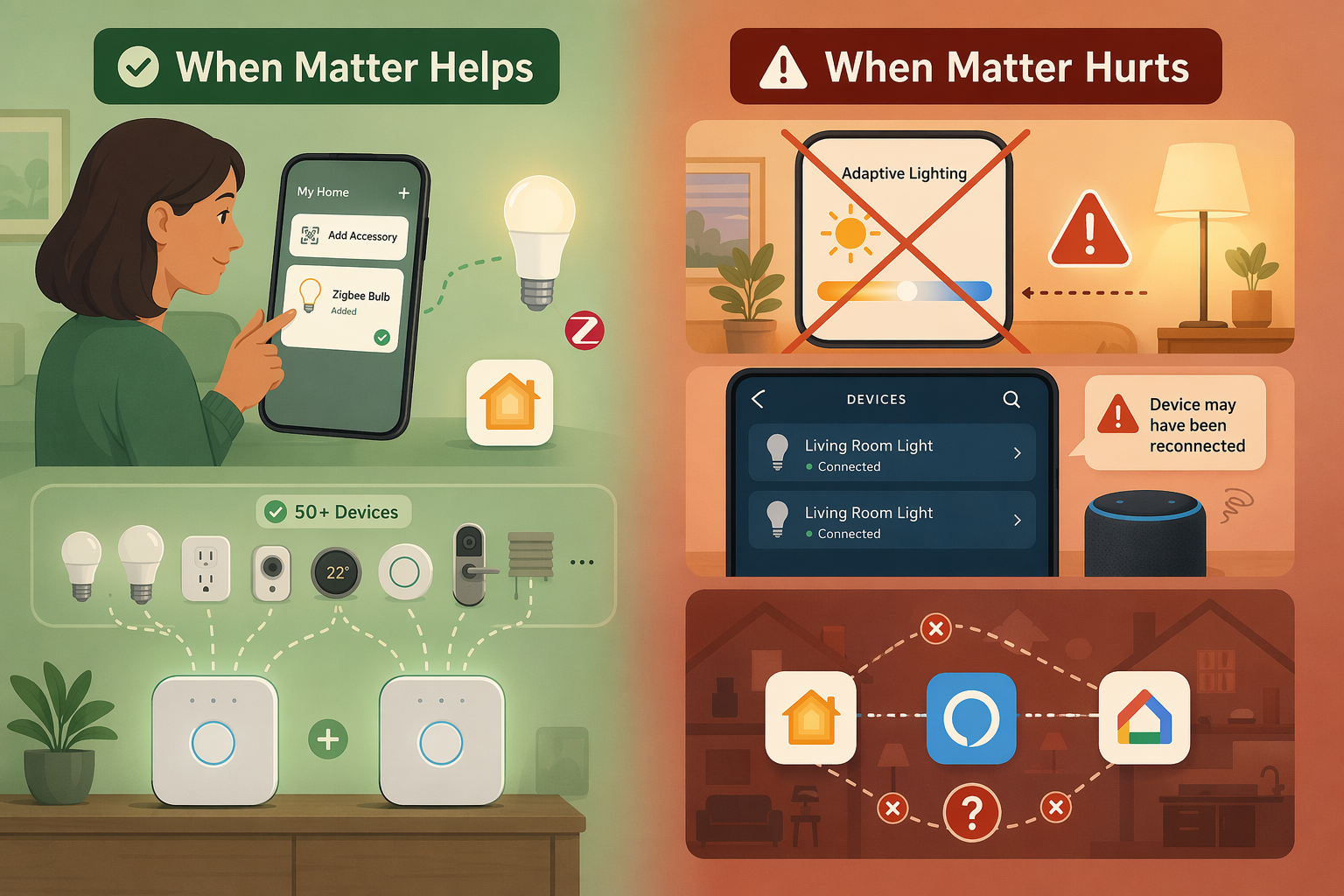
Jennifer Pattison Tuohy of The Verge ran the Hue Matter upgrade through a three-month real-world test. The bridge could only maintain two simultaneous platform connections at a time, and those for only a few hours before disconnections occurred. The only fix was to remove and re-pair.
Alexa users got device reconnection notifications every ten minutes, even when nothing had changed. Each notification interrupted routines. On top of that, Matter created duplicate device entries — the same bulb appeared twice in the Alexa app.
Apple HomeKit’s Adaptive Lighting — the feature that automatically shifts color temperature from cool in the morning to warm at night — stopped working entirely. Hue has its own "natural light" alternative, but it only works inside the Hue app. You lose the seamless HomeKit integration.
These are not edge cases. The test was done by a journalist who followed the official setup steps. The system never reached the stability of the pre-Matter cloud setup. Slow responses, failed commands, and the constant need to re-pair made the whole experience feel like a beta.
Why It Happens (and Why It’s Not Hue’s Fault)
The root cause is in Matter’s multi-controller protocol. When multiple platforms (Apple Home, Google Home, Alexa) all claim control over the same devices, the standard struggles to coordinate ownership and state updates reliably. Hue’s previous cloud-based approach handled this gracefully: each platform talked to the Hue cloud, and the cloud mediated conflicts. Matter’s local multi-admin removes the cloud but adds a protocol-level coordination problem that has not been fully solved yet.
This is a known ecosystem-wide issue. Our Matter in 2026: An Honest Status Review covers the broader landscape — Hue is far from the only product line where Matter’s Multi-Admin causes instability. The difference is that Hue already had a perfectly working multi-platform solution. Matter takes it away and offers a promise that is not yet kept.
When It Actually Helps
I said "most" users should skip Matter, not all. There are two specific scenarios where the trade-off is worth accepting.
- You exceed the 50-device limit. The standard Hue Bridge caps at 50 lights and 12 accessories. With Matter, you can pair multiple bridges into a single Matter controller, effectively merging their device lists. If your home has 70 bulbs across two bridges, Matter lets you see and control all of them from Apple Home or Google Home without managing two separate integrations.
- You own third-party Zigbee bulbs and want them in Apple Home. Brands like Osram, Cree, Innr, and IKEA use standard Zigbee and can be paired to a Hue Bridge. Without Matter, they appear in the Hue app but not in Apple Home. With Matter, the Hue Bridge exposes them as Matter devices, and Apple Home can see them. This is a real win for people who have mixed ecosystems.
Does the Bridge Pro Fix It?
No. The Bridge Pro has a faster processor and more memory, but the problems documented by The Verge are not caused by the bridge being too slow. They are protocol-level issues in Matter’s multi-controller coordination. A faster processor does not change how Matter negotiates ownership between Apple Home and Alexa. Both bridges run the same Matter firmware — the protocol behavior is identical.
Should You Enable It?
The default recommendation is: do nothing. Your Hue system already works. Matter is a feature you can add later when the protocol matures. You do not miss out on anything by waiting.
If you fall into one of the two beneficial scenarios and are willing to accept the stability trade-off, here is how to proceed: enable Matter in the Hue app under Settings → Smart Home → Matter, generate a setup code, and scan it into your target platform. Test stability over several days. If you see problems, you can disable Matter and revert to cloud-only control — your Hue system remains fully functional.
For a full setup walkthrough, see our Philips Hue Smart Lighting Setup Guide.
The Bottom Line
Philips Hue’s Matter implementation works in the technical sense. You can pair it, it talks to other platforms, and local control works — when it works. But the reliability is not there yet for the use case that most people already have covered by cloud integrations.
If you do not have a specific reason to enable Matter, do not. Your existing Hue system is already reliable. The theoretical benefits are not worth the documented, daily-experience costs of losing Adaptive Lighting, dealing with Alexa duplication, or spending your evenings re-pairing lights.
If you do have a specific reason — more than 50 devices or orphan Zigbee bulbs — go ahead, but go in with eyes open. Monitor stability, and know that you can always disable Matter and go back to the old way.
Matter is the future of smart home interoperability. It is just not fully ready for Hue owners yet. Check back in six to twelve months — the protocol is actively being updated, and the next revision may solve the multi-controller coordination problem. Until then, your Hue lights are fine as they are.
Known issues with this device / protocol
Spec-version history
For active regressions on this protocol, see Update Watch.
No linked Update Watch entries yet.