A smart home air quality index monitor is only useful if it is watching the thing you are actually worried about. Wildfire smoke is mostly a PM2.5 problem. Stale bedrooms and crowded home offices are CO2 problems. New cabinets, paint, and cleaning products push you toward VOC sensing, with caveats. A gas stove makes NOx more relevant. A basement in a radon-prone area is a different purchase entirely.
That sounds obvious until you shop the category. Many monitors collapse everything into one friendly air quality score, then hide the sensor mix in the specs. The result is a product that may be excellent for one household and nearly useless for another. The EPA’s broad indoor-air context is enough reason to take the choice seriously: indoor air can be 2 to 5 times worse than outdoor air, and Americans spend about 90% of their time indoors.[1] But the buying decision still starts with the pollutant, not the dashboard.
Start With What You Need To Detect
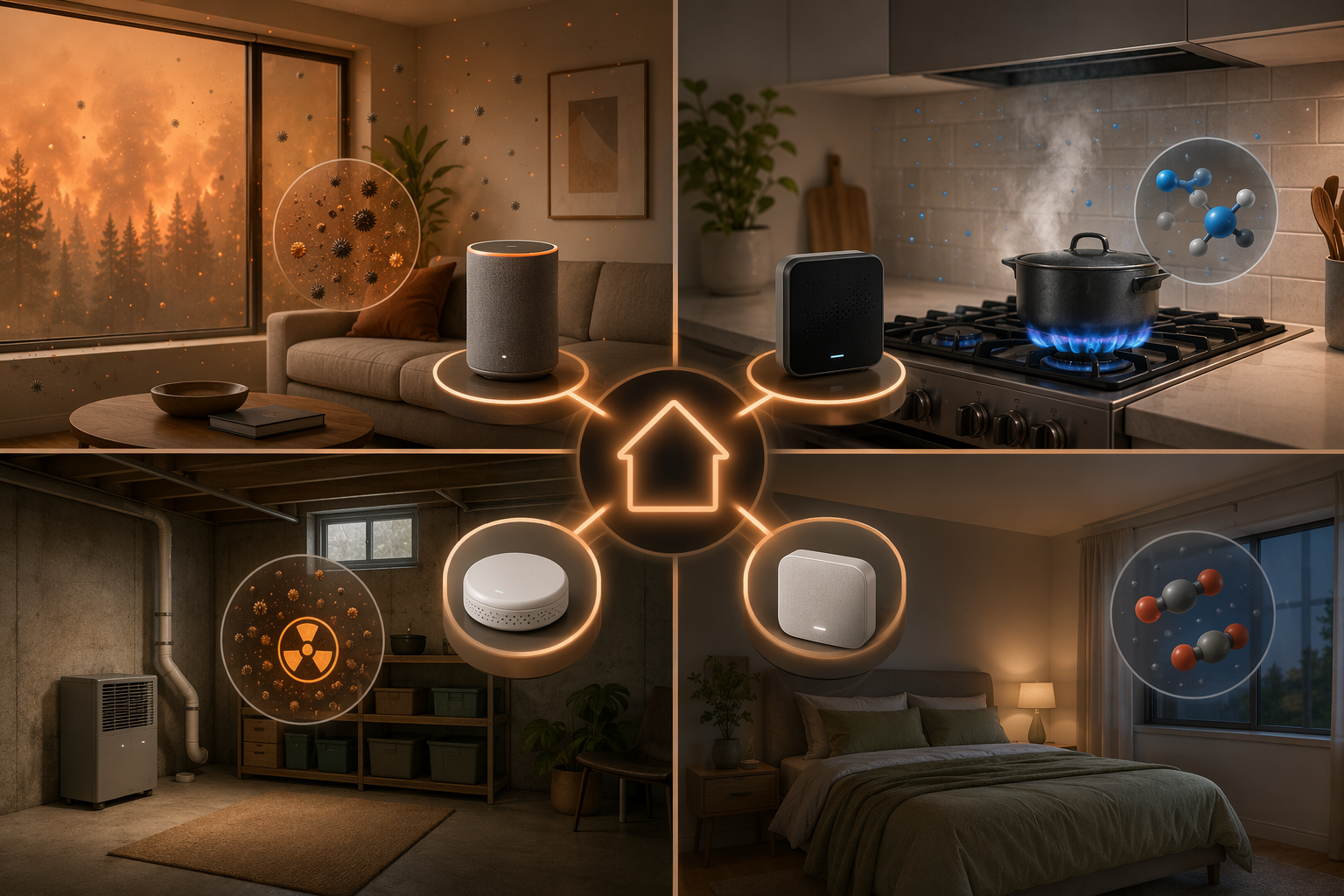
The quickest way to narrow the field is to name the problem before naming the product. A good all-around monitor can be the right answer, but only after it covers the specific pollutant that would make you act.
| Concern | Sensor to prioritize | What to watch for | Monitor type that fits |
|---|---|---|---|
| Wildfire smoke, wood smoke, combustion particles | PM2.5 | Fast response, readable live values, useful purifier automation | Broad monitors such as AirGradient ONE, or strong PM-focused monitors |
| Stale rooms, poor ventilation, crowded bedrooms or offices | CO2 | NDIR CO2 sensing, portable display, trend history | AirGradient ONE, Apollo AIR-1, Aranet4 HOME |
| New furniture, paint, cleaners, off-gassing | TVOC | Relative changes, not compound identification | Broad monitors with VOC index reporting |
| Gas stove concerns | NOx, plus PM2.5 where available | A sensor suite that does not stop at VOCs | AirGradient ONE for NOx-inclusive monitoring |
| Basements or regional radon risk | Radon | Radon support is non-negotiable | Airthings View Plus |
PM2.5: the wildfire-smoke sensor
If wildfire smoke is the reason you are shopping, PM2.5 is the first line on the spec sheet. It is the sensor that tells you whether fine particles are rising indoors while the sky outside turns orange, a neighbor lights a fire pit, or cooking smoke drifts through the house.
Speed matters here. Consumer Reports’ 2026 testing found that top monitors detected PM2.5 in under 30 seconds, while some budget models performed badly enough to be misleading; the IKEA Vindstyrka failed to detect cigarette smoke entirely in that testing.[2] That is the difference between a monitor that can help you decide when to run a purifier and one that gives you a calm-looking screen while the room changes around it.
Wirecutter’s current top pick, the AirGradient ONE, belongs high on the list for smoke-aware homes because it measures PM1, PM2.5, and PM10, along with CO2, TVOC, and NOx. Wirecutter also highlights its open-source design, replaceable Plantower PMS5003 particulate sensor, replaceable SenseAir S8 NDIR CO2 sensor, and typical price range of $170 to $230.[3] That combination is rare: broad coverage, repairable parts, and enough openness to avoid turning a monitor into a sealed black box.
PM accuracy claims deserve a little suspicion. Smart Air’s testing found the PurpleAir PA-II at 95% accuracy versus reference monitors, while Temtop and Atmotube devices ranged from 70% to 91%.[4] Those figures are useful, but they are still controlled third-party results. Placement, airflow, humidity, sensor aging, and the particle mix in a real house can all change what you see on the screen.
If smoke is your main concern, use a PM2.5-capable monitor as part of a smoke plan, not as a decorative number. The next problem is deciding what turns on when the number rises. For a deeper smoke-specific monitor comparison, see Which Smart Air Quality Monitor Detects Wildfire Smoke Best? and, for the broader setup, Three Smart Home Devices to Protect Against Wildfire Smoke.
CO2: the ventilation number people actually understand
CO2 does not tell you that a room is toxic. It tells you ventilation is not keeping up with occupancy. That makes it one of the most practically useful readings in a home office, classroom corner, bedroom, or rental where you want evidence that opening a window, running an ERV, or changing HVAC fan behavior made a difference.
For fixed smart-home use, AirGradient ONE and Apollo AIR-1 both make sense because they pair CO2 with other sensors. Apollo AIR-1 is the cleaner fit for a Home Assistant-first house: it typically sells for $90 to $110, uses native ESPHome, includes a Sensirion SEN55 PM sensor with a rated 10-year lifespan, includes an SCD40 CO2 sensor, and is designed for fully local control.[5]
For renters, room-to-room checking, and people who do not want another hub dependency, the Aranet4 HOME has a narrower but very useful job. It is a $189 portable NDIR CO2 monitor with an e-ink display and up to 7 years of battery life on AA lithium cells.[3] It does not try to be a whole-home AQI device. That is part of the appeal: put it where people are, read the number, move it when the question changes.
VOCs: useful for trends, weak for certainty
VOC sensing is where smart monitors most often look more precise than they are. A TVOC reading can show that something changed after painting, cleaning, unpacking furniture, or using a fragrance-heavy product. It cannot tell you which compounds are present or which are harmful.
HouseFresh’s testing and guidance make that limitation explicit: consumer VOC sensors report relative indices rather than absolute parts-per-billion measurements and cannot distinguish harmful VOCs from harmless ones.[6] That does not make them useless. It means the reading is best treated as a trend alarm, not a lab report.
If your main concern is new-furniture off-gassing, choose a monitor that reports VOC trends clearly, then watch whether ventilation changes the number. Do not buy a VOC-focused device and assume it will protect you from smoke, radon, or gas-stove pollutants it does not measure.
NOx: easy to miss if you cook with gas
Gas-stove households should look carefully at NOx support. Many air monitors include PM2.5 and VOCs, then stop there. That can still be useful around cooking, but it misses a pollutant category that matters when combustion is happening in the kitchen.
This is one reason the AirGradient ONE is more than just a Wirecutter pick with a nice philosophy. Its PM, CO2, TVOC, and NOx coverage makes it a better fit for households that want one visible station covering several common indoor-air questions.[3] It is not a radon monitor, and it is not the cheapest Alexa trigger. It is a strong generalist when the generalist actually has the right sensors.
Radon: do not substitute a general AQI monitor
Radon is the category where broad smart monitors stop being broad enough. If your concern is a basement, slab-on-grade living area, or regional radon risk, radon has to be on the device’s sensor list. A PM2.5, VOC, or CO2 monitor cannot stand in for it.
The Airthings View Plus has a distinct role because it includes radon along with PM2.5, CO2, VOCs, temperature, humidity, and pressure. It typically sells for $299 to $330 and supports Alexa, Google Assistant, and IFTTT, though it is cloud-reliant.[3] That cloud dependency would bother me in a Home Assistant rack, but it is less important than the basic fact that it measures the pollutant a radon-focused buyer actually needs.
Then Ask What Your Smart Home Will Do With the Reading
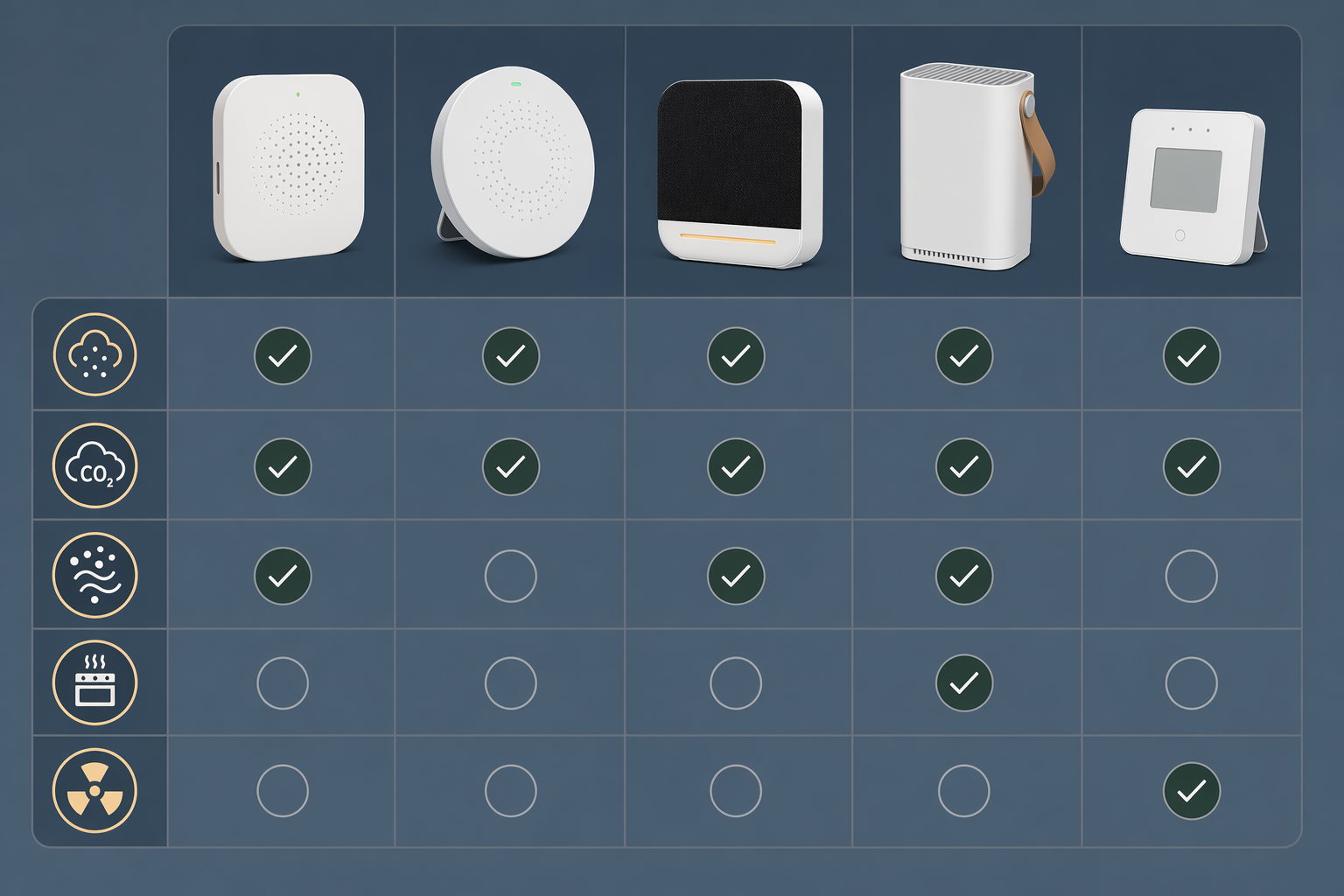
A monitor with a beautiful display is enough for some rooms. In a smart home, though, the better question is what happens next. Does the reading trigger a purifier? Does it notify the right person? Can it run locally if the internet drops? Does it expose the actual sensor values, or just a vague indoor-air score?
Alexa: easiest automations, narrower sensor trade-offs
If your house already runs on Alexa routines, the Amazon Smart Air Quality Monitor is the low-friction choice. It usually costs $50 to $70, has deep Alexa Routines integration, and measures PM2.5, carbon monoxide, and VOCs.[3] For a budget device that can trigger Alexa-connected purifiers, fans, plugs, or notifications, that integration is the point.
The trade-off is that it lacks CO2 and radon, and it does not have a standalone app.[3] That is fine if your goal is an Alexa-native smoke, CO, or VOC prompt. It is the wrong answer if you are trying to prove a bedroom is under-ventilated or track radon in a basement.
Google Home: check native support before you buy
Google Home buyers should be more cautious than the product boxes imply. Airthings View Plus supports Google Assistant, which makes it the safer radon-inclusive path for Google households.[3] For other monitors, verify whether Google can see the readings you care about, not just whether a companion app can show them.
The practical test is simple: before buying, look for the exact exposed measurements. PM2.5, CO2, VOC, NOx, and radon are not interchangeable. If Google only receives a generic air quality status, you may not be able to build the routine you had in mind.
Apple HomeKit: plan for bridges or local workarounds
HomeKit support remains uneven in this category. If Apple Home is your main control surface, do not assume that a monitor with Wi-Fi, Bluetooth, or a polished app will appear usefully in HomeKit. Check whether the device exposes the specific air quality characteristics you need, and whether you are comfortable using Home Assistant, Homebridge, or another bridge if native support is absent.
This is where open and local devices become more attractive. A monitor that works well with ESPHome or Home Assistant may require more setup, but it can avoid the dead end of a cloud app that looks good and automates poorly.
Home Assistant: local control is the feature
For Home Assistant users, the best monitor is usually the one that exposes clean local entities and keeps working without a vendor cloud. SmartHomeScene’s Home Assistant sensor guide highlights this path, and Apollo AIR-1 is the obvious fit among the named options because it uses native ESPHome and is designed for fully local control.[5]
AirGradient ONE also deserves attention here because of its ESPHome compatibility and open-source, repairable design.[3] If you want broader coverage than Apollo AIR-1 and are willing to spend more, AirGradient’s PM, CO2, TVOC, and NOx sensor mix gives Home Assistant more to work with. If your main goal is local CO2 and PM automation at a lower price, Apollo AIR-1 is cleaner.
The automation layer is where the monitor becomes more than a graph. A PM2.5 rise can turn on an air purifier through a smart plug. CO2 can raise an ERV speed or send a ventilation reminder. VOC spikes can log against cleaning or renovation events. If you want more examples of turning sensor readings into useful local behavior, see 5 Smart Plug Automation Recipes for Home Assistant Using Energy Monitoring.
Matter: useful boundary, not a reason to wait
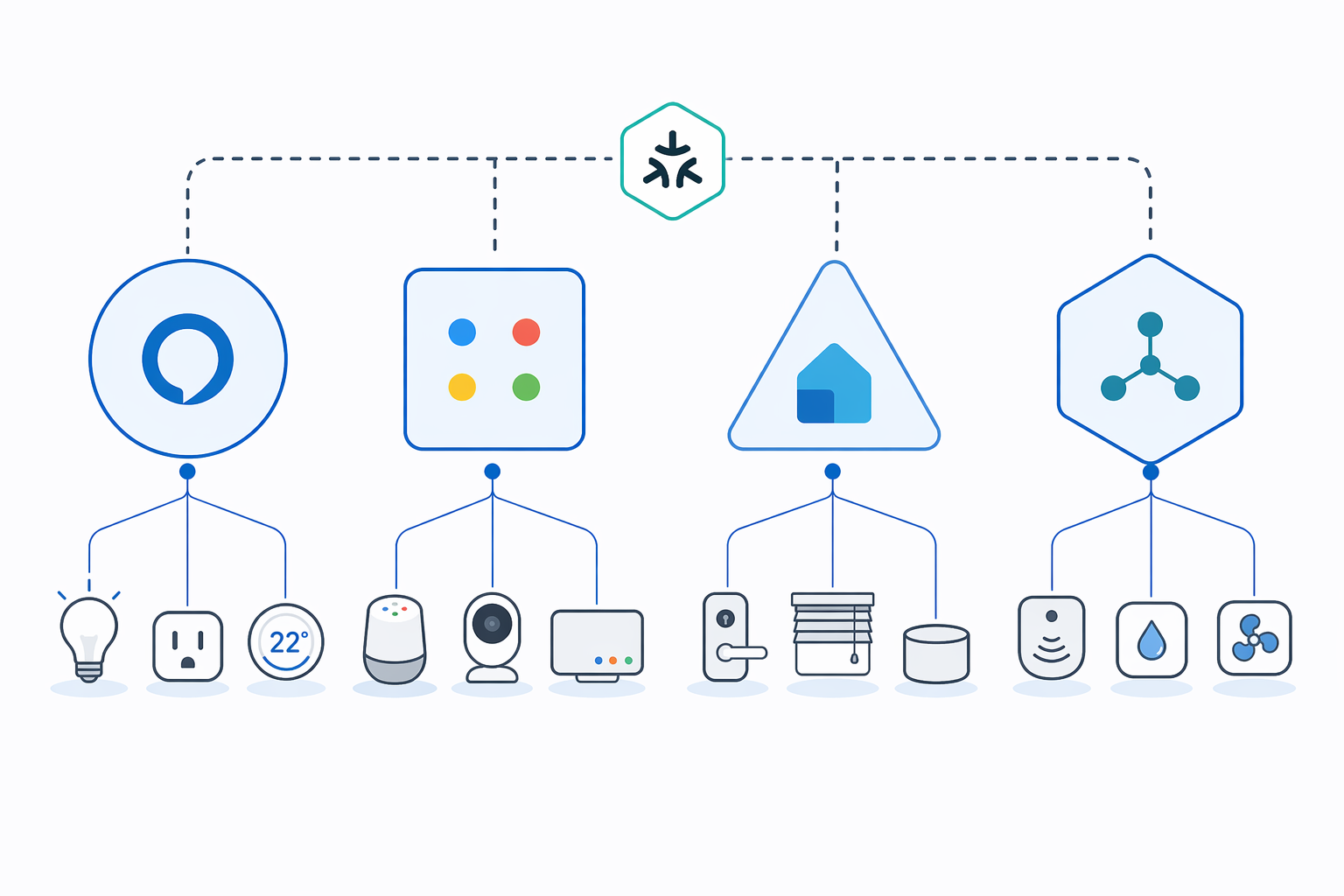
Matter 1.2 added an air quality sensor cluster, but as of mid-2026 very few air quality monitors are Matter-certified.[3] That means most buyers should still choose based on native platform support, Home Assistant integration, or the device’s own app and display rather than assuming Matter will solve compatibility.
Matter may become the cleaner cross-platform path later, but for a 2026 purchase it is mostly a boundary check: if a monitor claims Matter support, verify which sensor values are exposed to your platform. For the broader state of the standard, see The Matter Smart Home Devices You Can Trust Right Now and What Actually Works with Matter in 2026.
The Shortlist That Actually Matches Different Homes
These are not equal-weight trophies. They are different answers to different household problems.
- Best broad smart-home pick: AirGradient ONE. Choose it when you want PM1/2.5/10, CO2, TVOC, and NOx in one open-source, repairable monitor with ESPHome-friendly local-control potential.
- Best radon-inclusive pick: Airthings View Plus. Choose it when radon is a real requirement and cloud reliance is an acceptable trade-off.
- Best Alexa routine trigger on a budget: Amazon Smart Air Quality Monitor. Choose it for Alexa-native automations around PM2.5, CO, and VOCs, not for CO2 or radon.
- Best Home Assistant/local-control pick: Apollo AIR-1. Choose it when native ESPHome, local operation, PM sensing, and CO2 sensing matter more than a polished mainstream app.
- Best portable CO2-only pick: Aranet4 HOME. Choose it when you want a long-battery e-ink CO2 monitor you can move between rooms, rentals, or shared spaces.
Placement Can Make a Good Monitor Look Bad
Even a strong sensor can mislead you if it sits in the wrong place. HouseFresh’s monitor testing emphasizes real-world placement and performance because readings shift with airflow, nearby sources, and room conditions.[6] A monitor next to a window, purifier exhaust, humidifier, candle, or stove is not necessarily describing the air where people are breathing.
For living spaces, place the monitor near the breathing zone, away from direct blasts of supply air and away from the source you are trying to evaluate unless you intentionally want a source test. For bedrooms and offices, keep it close enough to represent the occupied area. For smoke events, compare trends over time rather than treating a single spike as the whole story.
If your monitor reports smoke or a sudden PM2.5 jump and the cause is not obvious, do not immediately assume the sensor is broken. Check placement, cooking, candles, outdoor air, humidifier mist, and purifier airflow first. For a focused troubleshooting path, see Your Smart Air Quality Monitor Detected Smoke: Now What?.
A Practical Buying Order
Buy in this order: pollutant, ecosystem, living situation, then interface. If the monitor misses the pollutant, no app can rescue it. If it cannot talk to your smart home, it may still be a good display but a poor automation device. If it needs cloud access in a house built around local control, you will resent it every time an integration breaks.
- Name the non-negotiable pollutant: PM2.5 for smoke, CO2 for ventilation, VOCs for trends, NOx for gas-stove concerns, radon for radon risk.
- Confirm the sensor type in the specs instead of relying on a generic AQI score.
- Check whether your platform receives the actual values you want to automate.
- Decide whether cloud reliance is acceptable for the job the monitor will do.
- Plan placement before judging accuracy or setting alert thresholds.
For many smart homes, AirGradient ONE is the most satisfying all-around answer because it covers the common pollutants, exposes useful data, and respects repairability. For radon, buy the Airthings View Plus instead. For Alexa routines on a tight budget, the Amazon monitor is easier to justify. For Home Assistant, Apollo AIR-1 is the local-control path. For portable CO2, Aranet4 HOME does one job cleanly. The right smart home air quality index monitor is the one whose sensors match your fear and whose integrations match the action you expect it to take.
References
- Indoor Air Quality, EPA, https://www.epa.gov/indoor-air-quality-iaq
- Best Indoor Air Quality Monitors of the Year, Consumer Reports, 2026, https://www.consumerreports.org/home-garden/indoor-air-quality-monitors/best-indoor-air-quality-monitors-of-the-year-a7500139084/
- The Best Home Air Quality Monitor, Wirecutter, 2025-2026, https://www.nytimes.com/wirecutter/reviews/best-home-air-quality-monitor/
- Best PM2.5 Air Quality Monitors 2024, Smart Air, https://smartairfilters.com/en/blog/best-pm2-5-air-quality-monitors-2024/
- Best Air Quality Sensors for Home Assistant, SmartHomeScene, https://smarthomescene.com/blog/best-air-quality-sensors-for-home-assistant/
- Air Quality Monitors, HouseFresh, https://housefresh.com/air-quality-monitors/
Corrections & Community Notes
Spotted an outdated spec, changed compatibility, or new firmware behavior? Submit a correction below to help keep this profile current. For formal editorial updates, use the contact page.
Comments
Join the discussion with an anonymous comment.