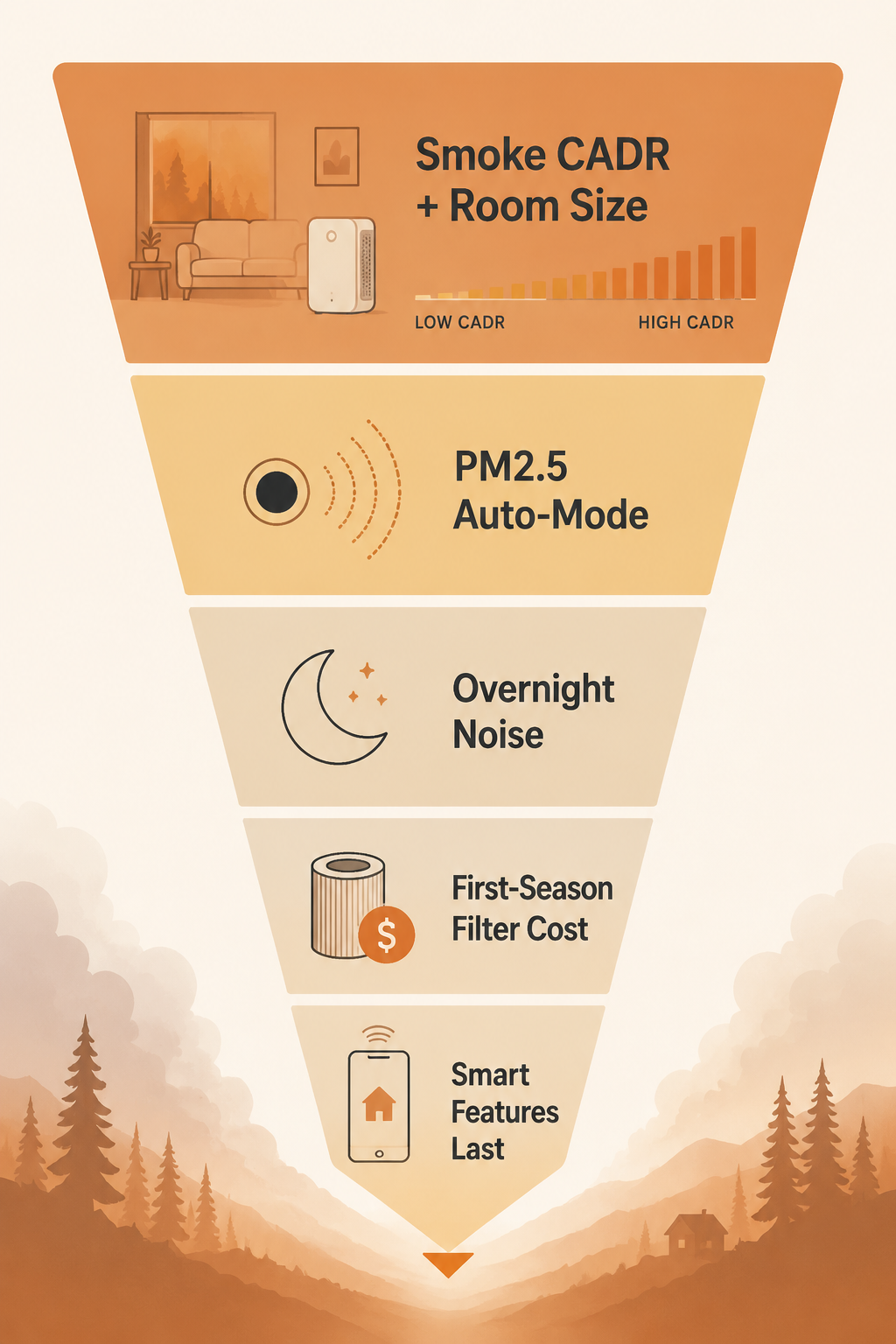
The wrong smart home air purifier for smoke can look perfectly competent on a normal week. It connects to Wi-Fi, shows a calm colored ring, hums quietly in the corner, and still falls behind when PM2.5 rises fast enough to turn the sky orange before dinner. For smoke-related air quality health risks, the buying order changes: start with smoke CADR and room size, then ask whether auto-mode reacts to PM2.5, whether the useful speeds are tolerable overnight, and whether the filter budget survives the first bad season.
That order matters because smoke is not just “dirty air” in the generic sense. Fine particulate matter can reach deep into the lungs, and smoke events are one of the reasons public health agencies tell people to create cleaner indoor air spaces when outdoor air is unhealthy.[1][2] A secondary Airpura article cites Stanford Woods Institute work comparing AQI 150 exposure to roughly seven cigarettes per day, but that comparison should be treated carefully until the original study is checked directly; the safer purchase lesson does not need the drama. PM2.5 is small, persistent, and health-relevant enough on its own.[3]
Smoke Changes the Sizing Math
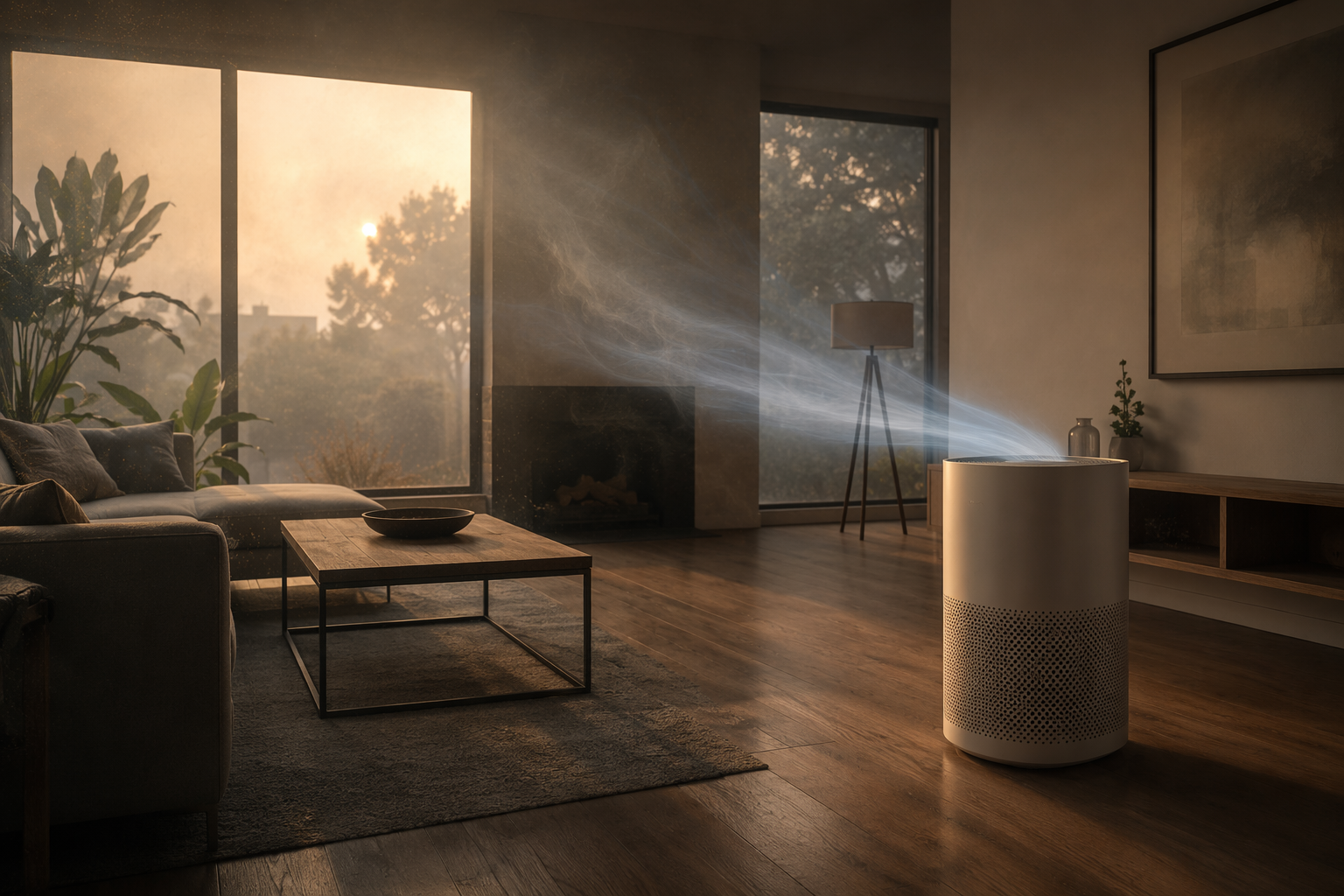
The first number to look for is smoke CADR, not overall CADR, fan wattage, room coverage claimed on a retail card, or a brand’s prettiest app screenshot. AHAM’s smoke CADR test uses particles in the 0.09–1.0 micron range, which is the harder particle range that matters for smoke buying decisions.[4] Dust and pollen numbers can be useful for other problems, but they should not carry the decision when the household problem is wildfire smoke, cigarette smoke drifting through shared walls, or repeated cooking smoke.
A practical baseline is the AHAM 2/3 rule: the purifier’s CADR should be at least two-thirds of the room’s square footage. A 300-square-foot bedroom or living room would therefore need at least 200 CADR as an ordinary match. For heavier wildfire-smoke zones, the stricter rule is easier to remember and harder to game: smoke CADR should roughly equal the room’s square footage.[5]
| Room | Minimum Ordinary Match | Heavy Smoke Target |
|---|---|---|
| 150 sq ft bedroom | 100 smoke CADR | 150 smoke CADR |
| 250 sq ft bedroom or office | 167 smoke CADR | 250 smoke CADR |
| 350 sq ft living room | 233 smoke CADR | 350 smoke CADR |
| 500 sq ft open area | 333 smoke CADR | 500 smoke CADR |
This is where many good-looking smart purifiers fall out of consideration. A model with a smoke CADR around 230 can be a serious choice for a closed bedroom, office, or modest living room. It is not the same thing as whole-apartment protection in a leaky floor plan. If smoke is seeping under a door, coming through a window frame, or moving between rooms, the purifier is fighting a replacement problem, not a one-time cleanup.
For apartment-specific smoke sizing, the room boundary matters as much as the machine. A closed bedroom can become a cleaner-air room faster than an open kitchen-living area. Readers dealing with dense housing, window-unit gaps, and wildfire episodes in New York can use the regional sizing path in this NYC wildfire smoke purifier guide.
The Shortlist Starts After the CADR Cut
Once the room and smoke CADR match, the comparison becomes more useful. Coway Airmega 250S, Levoit Core 400S, Blueair Blue Pure 311i+ Max, and WINIX 5510 all appear in current buyer coverage because their smoke-relevant numbers put them in the same practical conversation for medium rooms, not because they solve the same household problem in the same way.[6][7][8]
| Model | Why It Belongs in the Smoke Conversation | What to Check Before Buying |
|---|---|---|
| Coway Airmega 250S | Smoke CADR around 233 and a strong reputation for PM2.5-aware auto behavior | Whether its room fit and filter costs work for the actual smoke season |
| Levoit Core 400S | Smoke CADR around 231 and often treated as a budget-friendly smart option | Whether controls, filter pricing, and room size beat similarly rated models |
| Blueair Blue Pure 311i+ Max | Strong smoke CADR class with low-noise operation around 25 dB on low | Whether the quiet speed is enough for the room during active smoke |
| WINIX 5510 | Smoke CADR around 232 and competitive medium-room performance | Whether the plasma feature is wanted, disabled, or avoided |
| Dyson Big+Quiet BP03 | Higher-end airflow design with different chamber-test behavior | Whether open-room circulation justifies the price for the specific home |
The Dyson Big+Quiet BP03 deserves a separate kind of caution. Some chamber tests can understate or misrepresent how a directional or room-circulating design behaves in a real space, while open rooms can also punish any purifier that does not move enough air through the filter repeatedly.[6] That is not a reason to dismiss it. It is a reason not to buy it solely because it feels more advanced.
Auto-Mode Should Follow PM2.5, Not Mood Lighting
A useful smoke purifier does not wait until the room is obviously bad before increasing fan speed. It watches particle levels and reacts proportionally. That is the difference between a smart feature that removes guesswork and a smart feature that merely reports trouble while people are trying to sleep.
Coway’s Airmega 250S is the clearest reference case here because its auto-mode is widely discussed as one of the more convincing PM2.5-driven approaches in the category.[6][8] The key is not that every buyer must choose Coway. The key is that any alternative should answer the same question: when PM2.5 rises, does the purifier increase work in a way that matches the rise, or does it sit in a low-speed comfort zone until the room is already loaded?
For households that already use separate monitors, an external PM2.5 sensor can help close the gap. It can alert before the purifier’s onboard sensor notices smoke at its intake, and it can drive automations if the purifier supports them. That is useful for smoke creeping through a hallway or bedroom door, where the first warning may not happen beside the purifier itself. For deeper automation paths, see PM2.5-triggered smoke automations and Code Purple air-quality monitor guidance.
Quiet Only Counts at a Useful Speed
Noise specs can mislead in the same way room-size claims do. A purifier may be nearly silent on its lowest setting and ineffective for a smoke-loaded room at that speed. The relevant question is not “Can I hear it?” but “Can I sleep beside the speed that is actually clearing smoke?”
Blueair’s Blue Pure 311i+ Max stands out in current coverage because its low setting is reported around 25 dB while staying in a smoke-capable class for medium rooms.[6] That low number is useful, but it still needs context: during an active smoke intrusion, the machine may need to leave low speed. A quiet low setting helps overnight comfort; a tolerable medium setting protects the routine.
CNET and RTINGS chamber tests, including T90-style cleanup timing, are helpful for comparing how quickly models reduce particles under controlled conditions.[6][7] They are not a promise that a purifier will perform the same way in a bedroom with a cracked window, a bathroom fan pulling air, a hallway gap, and outdoor smoke continuing to enter. Treat chamber results as a way to compare machines, not as a timer for your apartment.
The First Smoke Season Can Be the Real Price
Filter cost is not a footnote during smoke season. Heavy smoke can load filters roughly two to three times faster than normal household use, a rule-of-thumb estimate rather than a standardized promise. A purifier that is affordable on purchase day can become the wrong machine if the owner stretches a loaded filter through August because replacements are expensive, out of stock, or annoying to track.
This is where Levoit Core 400S and WINIX 5510 become useful comparisons against Coway and Blueair. Similar smoke CADR figures push the buyer toward the less glamorous questions: replacement-filter price, availability, subscription pressure, washable prefilter upkeep, and whether any ionizer or plasma feature is optional. Consumer Reports’ smoke-focused guidance also keeps the emphasis on smoke performance rather than general wellness language.[9]
- Price the purifier with at least one extra filter set if smoke season is a regular risk.
- Check whether the app estimates filter life from runtime and fan speed or simply counts calendar days.
- Confirm replacement filters are easy to buy before the first regional smoke event.
- Avoid treating odor reduction as proof of PM2.5 removal; smoke CADR and carbon capacity answer different questions.
Smoke odor is its own trap. A HEPA-style particulate filter can reduce fine particles without removing much gas-phase odor, while a light carbon layer may soften smell without making the purifier a serious VOC solution. If smoke odor from tobacco, cooking, or wildfire residue is a major concern, look separately at activated carbon design and mass. Do not let a pleasant-smelling room stand in for a PM2.5 reading.
Smart Features Come Last, But They Still Matter
After smoke CADR, auto-mode, noise, and filter economics are acceptable, smart-home features can make the purifier easier to live with. Remote control matters when a caregiver wants to raise bedroom filtration before an older adult goes to sleep. AQI alerts matter when a parent needs to close windows before the room drifts upward. Voice control can help when someone is already in bed and hears the fan sitting too low.
The useful smart stack is plain: an outdoor AQI alert, an indoor PM2.5 reading, a purifier that can be forced to a higher mode, and a household rule for closing the cleaner-air room. Readers building beyond one purifier can use a four-layer smoke-ready smart home defense or the three-device Code Purple setup as a system-level route.
A Smoke-Season Buying Rule
Buy the smart home air purifier that meets smoke CADR for the room you will actually close off, not the biggest room printed on the box. Use AHAM’s 2/3 rule as the floor and CADR-equals-square-footage as the heavy-smoke target. Then keep only the models that react to PM2.5 without long hesitation, stay tolerable at useful overnight speeds, and have filter costs you can sustain through a bad season.
If two models clear that bar, choose the one your household will run correctly when everyone is tired: the app is understandable, the filter is replaceable, the fan is not punished into silence, and the cleaner-air room can be set before bedtime. That is the part that turns a smart purifier from a nice device into smoke-season equipment.
References
- American Lung Association blog, American Lung Association
- EPA IAQ page, U.S. Environmental Protection Agency
- Airpura blog citing Stanford, Airpura
- AHAM Verifide standards, AHAM Verifide
- Oransi CADR guide, Oransi
- CNET 2026 roundup, CNET, 2026
- RTINGS 2026 roundup, RTINGS, 2026
- PCMag 2026 roundup, PCMag, 2026
- Consumer Reports smoke-specific guide, Consumer Reports
Reader Feedback
Share your purchase experience, flag outdated picks, or ask clarifying questions about the checklist items.
Comments
Join the discussion with an anonymous comment.