A Code Purple air quality alert means the outdoor AQI is 201-300 on the EPA scale, a level labeled "Very Unhealthy." At that point, the health alert is no longer mainly about sensitive groups; the risk of health effects is increased for everyone. Purple sits above Red and below Maroon, which makes it the second-worst tier on the AQI scale.[1]
That is the plain meaning behind a Code Purple air quality alert, and it is also where a smart home air quality monitor becomes more than a dashboard. The alert tells you the outside air is dangerous. The monitor tells you whether that danger has crossed your walls.
Pennsylvania gave a recent example on July 16-17, 2026, when the state Department of Environmental Protection declared a statewide Code Purple alert as smoke from Canadian and Minnesota wildfires spread across the region.[2] That kind of alert can feel sudden, especially in a home where the windows are already open, the HVAC fan is running, a child is about to go outside, or a pet has been waiting for a walk.
Code Purple Is Not Just a Sensitive-Groups Warning
The AQI scale is simple enough to memorize and still easy to misuse. Green is 0-50, Yellow is 51-100, Orange is 101-150, Red is 151-200, Purple is 201-300, and Maroon is 301-500.[1] The important part is not the color trivia. It is the shift in who needs to act.
Orange and Red already matter for people with asthma, heart or lung disease, older adults, children, outdoor workers, and anyone who reacts badly to smoke. Purple is different because it widens the concern. The EPA language for 201-300 is direct: "Health alert: The risk of health effects is increased for everyone."[1]
So the first home decision is not whether the alert sounds dramatic. It is whether the home is actually being protected: windows closed, outdoor air reduced where possible, filtration increased, purifier running, outdoor activity postponed, and indoor readings watched closely enough that nobody has to wait for smoke smell as the warning system.
Staying Indoors Only Helps If Indoor Air Stays Cleaner
During wildfire smoke, the pollutant to watch most closely is PM2.5: fine particles small enough to move through gaps, weak filtration, and ordinary household routines. An outdoor AQI alert is usually based on regional monitoring and forecasting. Your living room is a smaller, messier environment.
A tight home with good filtration may hold the line for a while. A leaky apartment, an older house, a window air conditioner with poor sealing, or an HVAC system pulling air through inadequate filtration may not. During Code Purple conditions, indoor PM2.5 can rise as smoke leaks in or as ventilation choices move polluted outdoor air through the building.
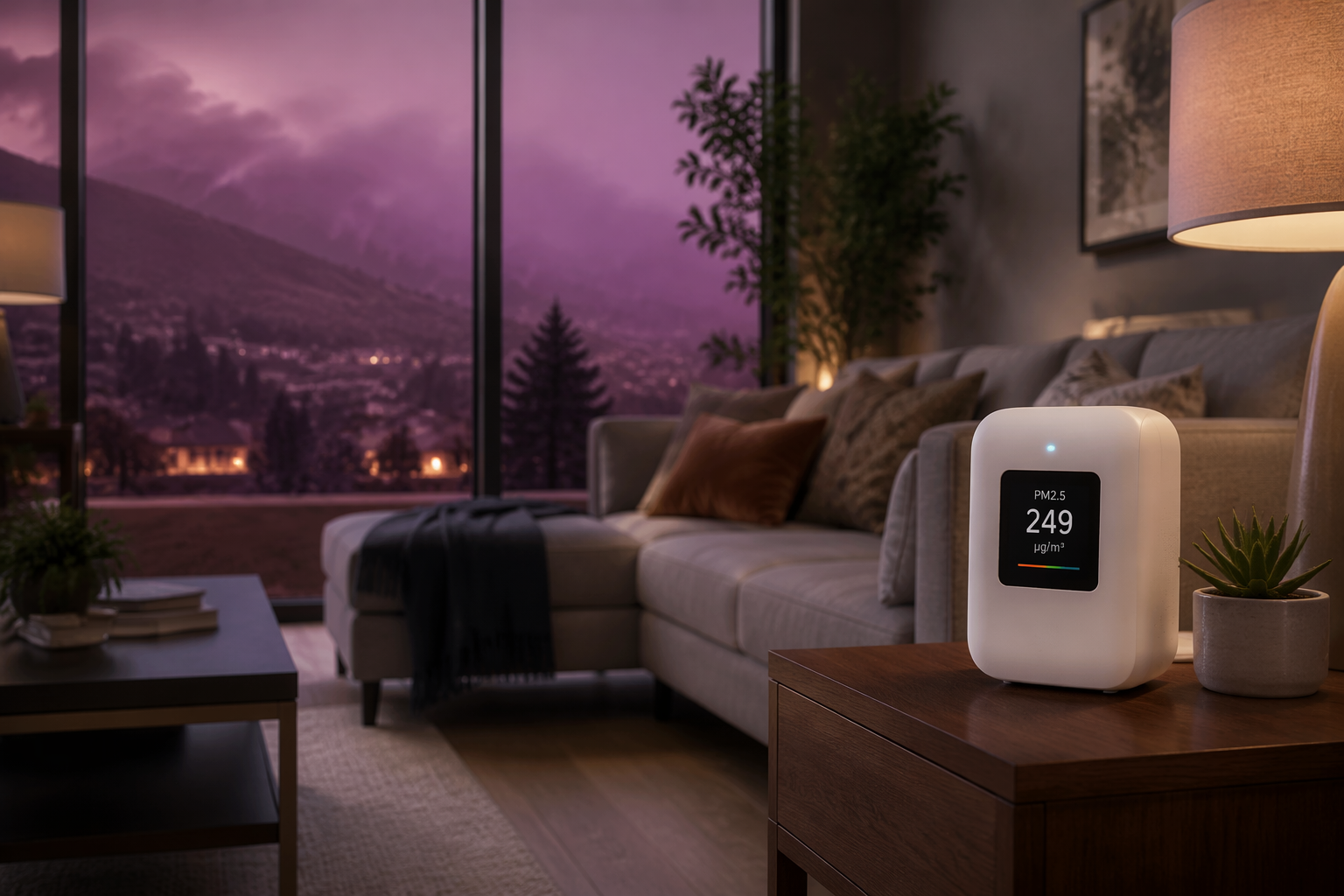
This is where the alert and the monitor question meet. A phone alert says, in effect, "The air outside is very unhealthy." An indoor monitor answers the next question: "Is the air in here still acceptable, or has the smoke already arrived?"
The Alert-to-Action Chain That Actually Matters
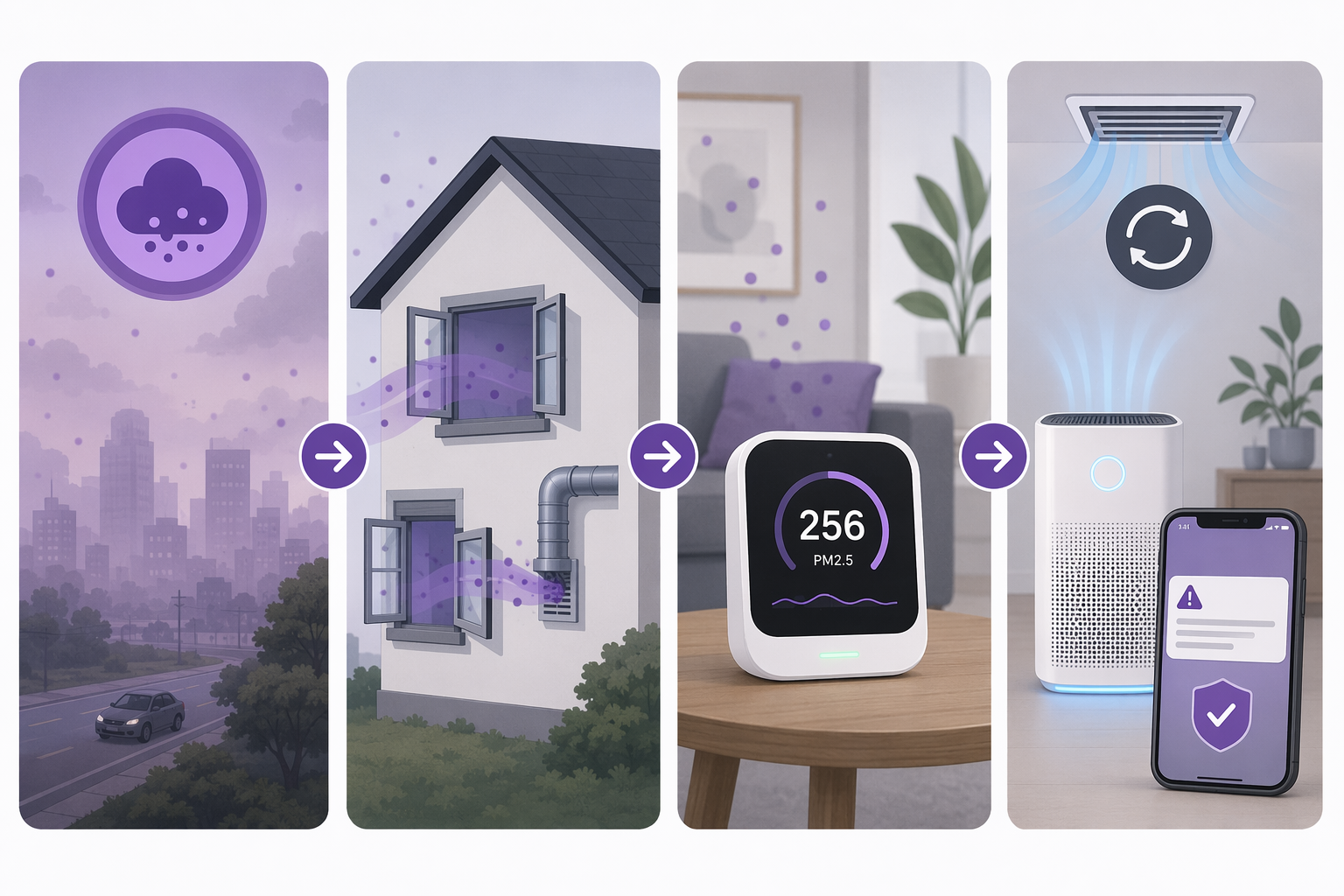
A useful smoke setup is not complicated in concept. The outdoor AQI crosses into Code Purple. Smoke particles begin finding their way indoors. A monitor detects a PM2.5 rise in the room where people actually spend time. Then the smart home does one or more things before someone remembers to check an app.
- Turn on a smart air purifier or raise it from low to high.
- Send a phone notification that the indoor PM2.5 level is rising.
- Change HVAC behavior, such as using recirculation where the system supports it.
- Close compatible smart vents or dampers if they are part of the home setup.
- Trigger a visible cue, such as a smart light color, for someone who will not hear a phone alert.
The point is not to make the home perform theater. It is to remove fragile human timing from the moment when people are distracted, asleep, commuting, caring for kids, or trying to keep pets calm indoors. A monitor that merely displays a number is still useful. A monitor that can also trigger the device that cleans the air is more useful during smoke.
Response time matters here. Consumer Reports found that top indoor air quality monitors detected a PM2.5 spike in under 30 seconds, while some poorly rated units did not report unhealthy air even in a smoke-filled room.[3] That is the difference between automation that reacts while the air is changing and a dashboard that reassures you because it is late.
A pretty app cannot compensate for a slow or unreliable PM2.5 reading. During Code Purple, the monitor's job is not to make air quality feel quantifiable. It is to notice the spike soon enough that the purifier, HVAC, vent, or human response still has time to matter.
What to Look For in a Smart Monitor During Code Purple
For wildfire smoke readiness, the first requirement is credible PM2.5 detection. Extra sensors can be useful, especially for VOCs, carbon dioxide, humidity, or radon, but they should not distract from the smoke problem. If the monitor is weak on PM2.5, it is weak for Code Purple.
| Need | Why it matters during Code Purple | What to check |
|---|---|---|
| Fast PM2.5 response | Smoke can enter before a person notices odor or sees haze indoors. | Look for independent testing or credible field evidence, not just "has a sensor." |
| EPA-scale clarity | Higher AQI means worse air; Purple is 201-300. | Avoid automations or dashboards that invert the scale without clearly translating it. |
| Platform integration | The monitor needs to reach the purifier, HVAC, vent, speaker, light, or phone alert. | Match the monitor to Home Assistant, Alexa, Google Home, IFTTT, or the platform you actually use. |
| Local visibility | A room reading is more actionable than a regional forecast when smoke is entering unevenly. | Place the monitor where people sleep or spend long periods, not next to a window or purifier outlet. |
The platform question is practical, not ideological. A great Home Assistant monitor is not automatically the right fit for an Alexa-only household. A budget Alexa sensor is not automatically enough for someone building a smoke-defense system around local automations. If you want full setup recipes, use a dedicated automation guide such as automating an air quality monitor for wildfire smoke rather than trying to build from a product page.
Four Monitor Paths, With Different Trade-Offs
These are not the only smart air quality monitors worth considering, but they show the main split: local automation power, mainstream voice-assistant convenience, PM2.5 accuracy focus, and budget Alexa control. The right choice depends less on the box and more on whether it can start the response chain in your home.
| Monitor | Best fit | Caveat |
|---|---|---|
| AirGradient ONE | Home Assistant users who want a strong local dashboard and multi-pollutant tracking. | Not the easiest path for Alexa or Google Home households. |
| Airthings View Plus | Alexa, Google Assistant, and IFTTT households that want broader sensor coverage. | Higher price and broader focus than a smoke-only PM2.5 setup. |
| PurpleAir Zen | People who prioritize PM2.5 credibility and are comfortable with APIs or community integrations. | Not a plug-and-play Alexa or Google Home device. |
| Amazon Smart Air Quality Monitor | Budget Alexa users who want simple routines. | Attractive mainly inside an Alexa setup; evaluate PM2.5 performance against your smoke-readiness needs. |
AirGradient ONE is compelling if your home already runs on Home Assistant. Wirecutter named it a 2026 top pick and lists pricing at $230, with a DIY kit at $138.[4] AirGradient also says it is officially "Works With Home Assistant" certified, auto-discovered on the network, and exposes its sensors to Home Assistant.[5] That is exactly the kind of local integration that can turn a PM2.5 spike into a purifier or HVAC action without waiting for someone to open an app.
Airthings View Plus is the more mainstream smart-home fit. Consumer Reports ranked it first in its April 2026 indoor air quality monitor ratings, and Airthings lists support for Alexa, Google Assistant, and IFTTT, along with broad sensor coverage including radon.[3][6] For households that already use voice assistants and simple routines, that matters more than an elegant Home Assistant dashboard they will never maintain.
PurpleAir Zen is the one to consider when PM2.5 credibility is the main concern and the household can tolerate a more technical path. HouseFresh reported that PurpleAir's dual laser counters were highly aligned with a $25,000 GRIMM EDM 180 reference instrument in an AQMD field evaluation.[7] PurpleAir also points to API-based and home-automation uses, but this is not the same as native, beginner-friendly Alexa or Google Home support.[8]
Amazon's Smart Air Quality Monitor is the budget Alexa option, with HouseFresh listing it at $70 and noting its Alexa-routine appeal.[7] That can be enough for a basic action such as notifying the household or turning on compatible devices. It is not the same thing as choosing the strongest smoke monitor available, and buyers should be honest about which problem they are solving.
For deeper shopping comparisons across pollutants, placement, and device trade-offs, start with a broader guide to how to choose a smart home air quality monitor. If the monitor decision is already made and the next question is filtration, a smart air purifier for Code Purple guide is the more useful next stop.
Automation Helps Most When It Is Boring and Specific
The safest automation is usually the least dramatic one: if indoor PM2.5 rises during an outdoor Code Purple event, turn on the purifier and notify the people who can act. If the HVAC supports the right mode, reduce outdoor-air intake or favor recirculation. If the household uses smart vents or dampers, close the path that pulls smoky air through a vulnerable room.
IFTTT lists air-monitor integrations, including triggers for "Air quality is very unhealthy" at AQI greater than 200, and says Pro users get 5-minute polling.[9] That can be useful, but it is also a reminder that cloud automations may not be instant. Five minutes can be acceptable for a reminder. It is less comforting if smoke is entering quickly and the purifier is waiting on that trigger.
Home Assistant-style local automations can be faster and more flexible, but only if the monitor exposes the right sensor data and the automations are already tested. Mid-2026 setup details can change quickly across platforms, APIs, and device firmware, so any recipe should be checked before the next smoke day, not during it.
- Use EPA AQI consistently: higher numbers are worse, and Purple starts at 201.
- Build the first automation around PM2.5, not a general "air quality" score that hides the pollutant.
- Test the action path on a normal day: monitor reading, trigger, purifier or HVAC response, and phone alert.
- Keep a manual fallback, because Wi-Fi, cloud services, and integrations can fail during the same stressful day you need them.
For a fuller defensive setup, the monitor should not stand alone. A practical smoke-ready smart home pairs detection with filtration, HVAC choices, and clear household rules. A more complete four-layer approach belongs in a dedicated smoke-ready smart home defense plan.
Where the Smart Monitor Fits in a Code Purple Home
A Code Purple alert should change the household mode. Outdoor exercise gets postponed. Windows stay closed. Filtration matters. The HVAC setting deserves attention. People who assume indoor air is automatically safe need a visible reading, not reassurance.
The monitor's place is in the middle of that response. It is not a substitute for public alerts, medical advice, good filters, or a capable purifier. It is the local witness. It tells you whether the bedroom is holding steady, whether the living room spiked after a door opened, whether the purifier is catching up, and whether the home's plan is working in the air people are actually breathing.
During Code Purple, a smart air quality monitor is useful when it has credible PM2.5 detection, reports fast enough to matter, and connects to the platform that can actually trigger your purifier, HVAC, vents, or alerts. Manual alerts tell you the outside air is dangerous. An indoor monitor tells you whether your home is holding the line, and it can start the response before you notice the air has changed.
References
- AQI Basics, AirNow.gov
- DEP declares Code Purple air quality alert for all of Pa. on Friday as wildfire smoke spreads, WVIA, July 16, 2026
- 3 Best Indoor Air Quality Monitors of 2026, Consumer Reports, April 2026
- The 3 Best Home Air Quality Monitors of 2026, Wirecutter/NYT
- Air Quality Monitors Made for Home Assistant, AirGradient
- View Plus - Smart radon & air quality monitor, Airthings
- The best air quality monitors we have tested, HouseFresh, 2026
- Case Study: Why Air Quality Monitors Are Next Step in Home Automation, PurpleAir
- Air Monitor Integrations, IFTTT
Policy Updates & Reader Notes
Privacy policies, monitoring plan prices, and security disclosures change frequently. Report new data retention terms, updated plan pricing, or new vulnerability disclosures below. For formal editorial corrections, use the contact page.
Comments
Join the discussion with an anonymous comment.