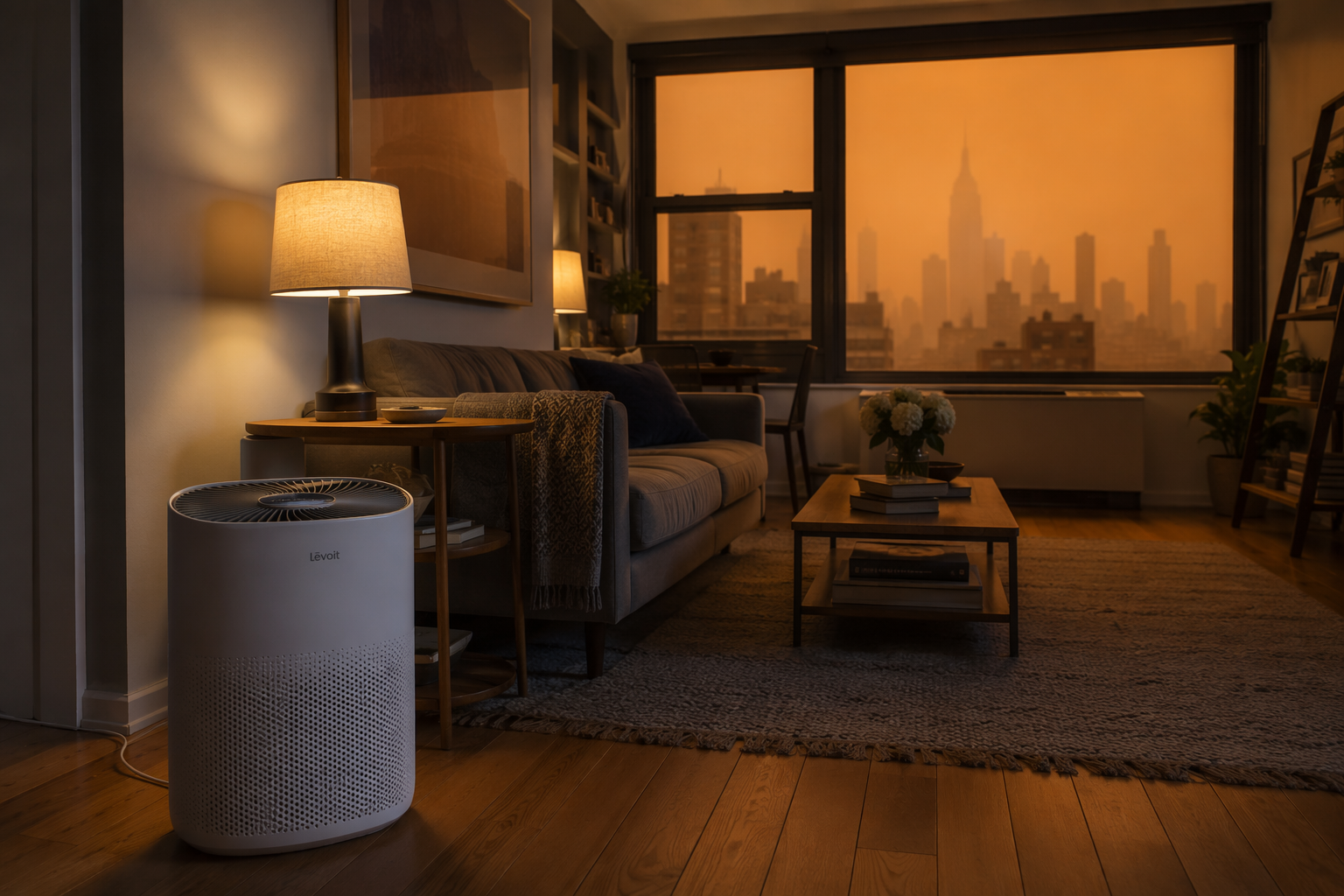
Wildfire smoke changes the buying math for a NYC apartment. PM2.5 can get indoors even when the windows are shut; EPA-cited research has found indoor PM2.5 in a sealed home without a purifier reaching roughly 55% to 60% of outdoor levels during wildfire smoke conditions.[1] In June 2023, Manhattan’s AQI hit 342, and July 2026 Code Purple alerts across parts of the Northeast made the problem feel less like a freak episode and more like a seasonal purchase decision.[2]
For a smart air purifier for wildfire smoke in NYC, start with smoke CADR, not the app. AHAM’s general sizing guidance uses a CADR of at least two-thirds of room square footage, but for wildfire smoke, the safer working rule is closer to 1:1: a 250 CFM smoke CADR unit belongs in about a 250 sq ft room when smoke is the threat.[3] That sounds unforgiving until you remember what an apartment is actually like: closed bedroom doors, hallway turns, drafty windows, and one purifier sitting in the living room while someone is sleeping behind a shut door.
The short version: most NYC studios and small 1-bedrooms should look for at least 200 CFM of smoke CADR in the main room. A 1-bedroom usually needs one purifier for the living area and another for the bedroom during a serious smoke event. A 2-bedroom should not be solved with one oversized product-page promise unless the apartment is unusually open and people are not trying to clean closed rooms at the same time.
Best Smart Air Purifiers for NYC Wildfire Smoke
| Rank | Model | Approx. July 2026 price | Smoke CADR | Best NYC fit | Smart features that matter |
|---|---|---|---|---|---|
| 1 | Blueair 311i Max | ~$230 | 250 CFM | 1-bedroom main room or larger studio | Blueair app, laser PM2.5 sensor, auto-mode, quiet high-speed performance |
| 2 | Levoit Vital 200S | ~$190 | 249 CFM | Studio or small 1-bedroom | VeSync app, laser PM2.5 sensor, auto-mode, scheduling |
| 3 | Levoit Core 600S-P | ~$200 range | 410 CFM | Large living room or open 2-bedroom common area | VeSync app, high CADR, remote control |
| 4 | Coway Airmega 400S | ~$630 | 328 CFM | Large room or open-concept apartment | WiFi/app control, dual intake |
| 5 | GoveeLife Smart Air Purifier 2 | ~$77 | 135 CFM | Small studio or bedroom | Govee Home app, budget connected controls |
These are not five versions of the same answer. A 135 CFM purifier and a 410 CFM purifier are not competing for the same job. The useful comparison is between the room you need to protect, the smoke CADR available, and whether the smart layer helps the purifier react while you are asleep, away from home, or trying not to stare at an AQI app all day.
1. Blueair 311i Max: Best Overall Balance for a NYC 1-Bedroom
The Blueair 311i Max is the cleanest fit for the most common NYC decision: one solid purifier for the living room of a 1-bedroom, or for a larger studio where the bed, couch, and desk all share the same air. It has a 250 CFM smoke CADR, an approximate July 2026 price around $230, Blueair app controls, and a laser PM2.5 sensor.[4][5]
The 250 CFM number is the reason it belongs near the top. Under the wildfire-smoke 1:1 sizing rule, it is not a magic whole-apartment machine; it is a strong single-room machine. In a railroad apartment, a closed bedroom at the far end will still need its own purifier. In an open studio, the 311i Max has enough air movement to make sense without stepping into the bulk and cost of the largest machines.
Its smart features are also the right kind. A laser PM2.5 sensor is more useful during smoke than a vague “air quality” light because it can respond more directly to fine-particle spikes. Published testing and reviews have credited laser-sensor auto modes on models such as the Blueair 311i Max and Levoit Vital 200S with reducing PM2.5 from hazardous to good within roughly 1 to 2 hours on automatic settings.[6] That does not mean auto-mode is always perfect, or that it replaces running the fan high when smoke is already inside. It means the sensor is doing relevant work rather than decorating the front panel.
The other practical advantage is noise. Consumer Reports and Wirecutter both place the 311i Max among the stronger wildfire-smoke choices, and Wirecutter highlights its quiet performance at high speed.[4][5] That matters in an apartment because the correct smoke setting is often not the cute low-speed mode from the product photo. If high speed is too irritating to leave on while sleeping or working, the CADR number becomes less useful in real life.
2. Levoit Vital 200S: Best Value for a Studio or Small 1-Bedroom
The Levoit Vital 200S is the value pick that does not feel like a compromise on the parts that matter. It is listed around $190, with a 249 CFM smoke CADR, VeSync app control, auto-mode, and a laser PM2.5 sensor.[1][7][8] For a studio or small 1-bedroom, that combination is more useful than a prettier app attached to a weaker fan.
Its role is close to the Blueair 311i Max, but the buying reason is a little different. The Vital 200S makes the most sense when the main room is the priority and the budget still has to leave room for filters, weatherstripping, or a second smaller bedroom unit. In a 450 sq ft studio, it is still below a strict 1:1 smoke-CADR match for the whole apartment, but it is much more credible than a compact 100-ish CFM unit asked to clean the same space during a Code Purple day.
The carbon setup is another reason it holds up in smoke-focused shopping. Available product and review information points to the Vital 200S using pelletized or granular carbon rather than a bonded carbon sheet, which is the direction to prefer for smoke odor and gases.[3] Carbon is not the same thing as particle filtration, and it will not make a purifier “solve” wildfire smoke by itself. But a token deodorizing sheet is easy to exhaust and easy to overvalue.
The warning on carbon life should be treated practically, not mystically. Expert commentary from The Air Purifier HQ says activated carbon can saturate in as little as 8 weeks during heavy smoke, far shorter than the 6- to 12-month replacement windows printed for ordinary use.[3] That is not a universal lab deadline for every apartment. It is a reason to trust your nose, watch performance during smoke weeks, and avoid assuming the filter indicator knows how much wildfire odor your building just absorbed.
3. Levoit Core 600S-P: Best Large-Room Value for a 2-Bedroom Living Area
The Levoit Core 600S-P is the one to look at when the main room is genuinely large or the apartment has an open living-dining area. It is listed in the ~$200 range with a 410 CFM smoke CADR and VeSync app control.[7][9] On raw smoke CADR per dollar, it is hard to ignore.
This is where “covers a huge space” needs translating. A 410 CFM smoke CADR can be a strong answer for a big living room, an open kitchen-living area, or the common space in a 2-bedroom. It is not permission to leave two bedroom doors closed and assume clean air will politely distribute itself through the hallway. Air purifiers clean the air they can move through their filter. Apartment walls are not a marketing footnote.
The Core 600S-P is especially useful if you would otherwise buy one midrange unit and ask it to do too much. For the same general budget class as smaller smart units, the higher CADR gives more room for imperfect conditions: leaky window frames, cooking smells layered on smoke, or a living room that is larger than it looked in the floor plan. The tradeoff is footprint and fan presence. In a tight studio, that may not be worth it; in a 2-bedroom common area, it often is.
4. Coway Airmega 400S: Best for Large Open Spaces, Not Small Budgets
The Coway Airmega 400S is the expensive, capable option for larger rooms and open layouts. It is listed around $630, with a 328 CFM smoke CADR, WiFi/app control, and dual intake.[5][8] That price makes it the wrong first recommendation for many renters, but the performance class is real.
The Airmega 400S makes the most sense when the apartment has one large shared space that actually behaves like one room. Think a wide living room connected to a dining nook, not a chopped-up prewar with doors, turns, and a bedroom down the hall. It can also make sense for someone who wants fewer machines in visible areas and is willing to spend more for a larger unit.
The catch is that a $630 smart purifier still cannot bend air through walls. For a 2-bedroom, the Airmega 400S may be the main-area purifier, not the whole plan. Bedrooms still need their own coverage if people sleep with doors shut during smoke.
5. GoveeLife Smart Air Purifier 2: Budget Pick for a Small Studio or Bedroom
The GoveeLife Smart Air Purifier 2 is the budget answer, not the “secretly just as good” answer. It is listed around $77, with a 135 CFM smoke CADR and Govee Home app support.[7][10] That can be adequate for a small studio, a bedroom, or a work-from-home corner where the door is closed and expectations stay realistic.
The reason to buy it is price plus connected control. The reason not to stretch its claims is CADR. Under the smoke-focused 1:1 rule, 135 CFM is not enough for a typical 1-bedroom living room, and it is not the machine to park in a hallway while hoping it protects the entire apartment. It may be the second purifier that makes a bedroom livable while a stronger unit handles the living room.
How to Size a Purifier for a Studio, 1-Bedroom, or 2-Bedroom
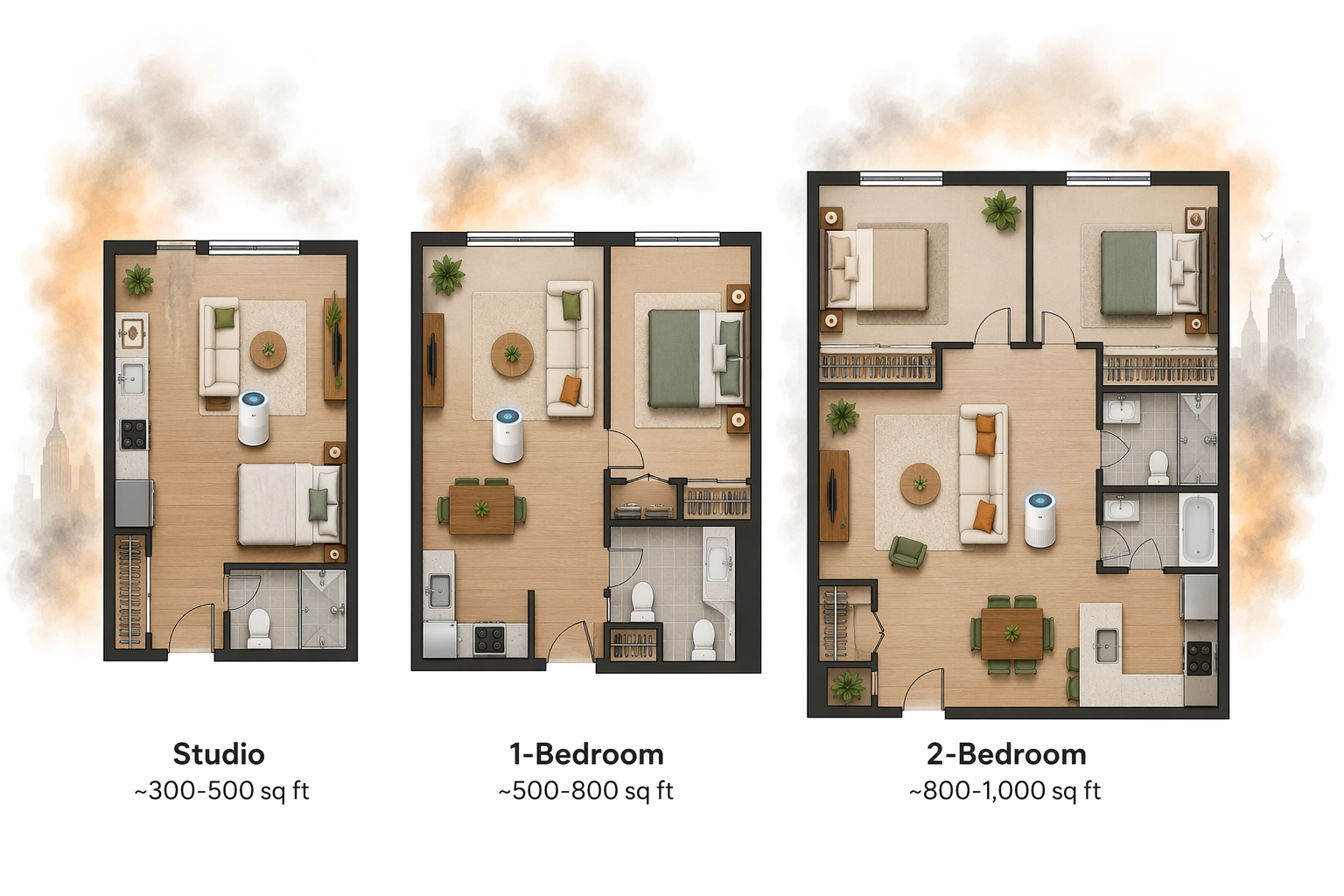
NYC apartments do not make purifier sizing clean. A typical studio is roughly 400 to 550 sq ft, a 1-bedroom roughly 600 to 800 sq ft, and a 2-bedroom roughly 800 to 1,100 sq ft, though these ranges are approximate rather than a single official housing standard.[2] More important than the lease square footage is which rooms need clean air at the same time.
| Apartment layout | Practical smoke strategy | Models that fit the job |
|---|---|---|
| Small studio | One purifier can work if it is sized for the main living/sleeping area; keep it away from walls and furniture blockage. | Levoit Vital 200S, Blueair 311i Max, GoveeLife Smart Air Purifier 2 for tighter budgets or smaller rooms |
| Large studio | Aim for a stronger midrange unit; avoid tiny smart purifiers unless they are only supplementing a specific zone. | Blueair 311i Max, Levoit Vital 200S, Levoit Core 600S-P if the space is open and smoky conditions are frequent |
| 1-bedroom | Plan for two units during serious smoke: one in the living room and one in the bedroom, especially if the bedroom door closes at night. | Blueair 311i Max or Levoit Vital 200S for the main room; GoveeLife or another appropriately sized unit for the bedroom |
| 2-bedroom | Use a high-CADR unit for the common area plus separate bedroom coverage; do not rely on one purifier for closed rooms. | Levoit Core 600S-P or Coway Airmega 400S for the living area; smaller units in bedrooms |
The mistake is buying by total apartment square footage and then placing one purifier where it looks least annoying. A 700 sq ft 1-bedroom does not need a single 700 CFM machine as much as it needs clean air where people actually spend the smoke event: the living room during the day, the bedroom overnight. Two correctly placed midrange units can beat one heroic purifier stranded behind a couch.
Prewar leakage pushes the decision toward slight oversizing. Drafty windows and poor sealing can let more outdoor PM2.5 into older NYC apartments than tighter modern construction, so a purifier that barely matches a room on paper may feel underpowered when the sky turns orange.[2] Weatherstripping, foam tape, and door sweeps are not glamorous smart-home accessories, but they reduce the amount of smoke the purifier has to keep chasing.
Smart Features Worth Paying For During Smoke
Smart features do not create filtration power. A purifier with weak CADR and a polished app is still a weak purifier. Published comparisons also note that non-smart models such as the Coway Mighty have performed nearly identically to smart models in particle removal, which is the reminder every connected-device shopper needs.[6] The app is not the filter.
- Laser PM2.5 sensor: worth prioritizing because it is more responsive to fine-particle smoke than weaker sensor claims.
- Auto-mode: useful when it ramps fan speed before the room smells acrid, especially overnight or while you are away.
- App-based AQI visibility: useful when you want to see whether the bedroom purifier is actually responding without walking room to room.
- Scheduling: useful for keeping bedroom coverage running before sleep and avoiding low-speed default settings during a multi-day event.
- Voice assistant badges: optional convenience, not a smoke-performance feature.
For more detail on sensor types and app behavior, a deeper guide to smart air purifier features for wildfire smoke can help separate useful automation from interface polish. The key for this buying decision is simpler: if the purifier cannot move enough air for the room, no automation feature rescues it.
Auto-mode also deserves a little distrust. During an active smoke event, the safest move is often to run the purifier higher than you normally would, especially right after outdoor PM2.5 rises or after a door has been opened repeatedly. Auto-mode is best treated as a backstop for distracted humans, not as a reason to stop paying attention.
Carbon, Filters, and Placement Matter More Than the App Store Rating
For wildfire smoke, particle filtration handles PM2.5; activated carbon helps with odor and gases. The better smoke-oriented picks use more meaningful carbon than a thin bonded sheet, but carbon is consumable. Heavy smoke can exhaust it quickly, and the 8-week saturation warning from expert commentary is best used as a caution flag rather than a calendar rule.[3]
Placement is just as unglamorous. Put the purifier in the room you are protecting, with enough clearance for intake and exhaust. Do not hide it behind a media console, wedge it under a desk, or assume a hallway location will clean two rooms through partially closed doors. If the bedroom is where you sleep during a smoke event, the bedroom needs its own airflow.
Filter replacement should follow conditions, not just the app’s countdown. Multi-day smoke, persistent odor, or reduced airflow can mean the filter is carrying more load than a normal month of dust and pet hair. Replacement costs belong in the buying decision, especially if the realistic plan is two purifiers instead of one.
The practical buying conclusion is blunt: choose by room and smoke CADR first. For a studio or small 1-bedroom, the Levoit Vital 200S and Blueair 311i Max are the strongest middle-ground picks. For a larger living area, the Levoit Core 600S-P or Coway Airmega 400S makes more sense. For a small bedroom or tight-budget studio, the GoveeLife Smart Air Purifier 2 can help if its limits are respected. Pay for smart features when they improve response and visibility, not when they decorate an underpowered purifier.
References
- How Can I Clear My Home of Wildfire Smoke? — Wirecutter
- 5 Best Air Purifiers for Wildfire Smoke — Consumer Reports
- Air Purifier CADR Rating: What Is It and How Much Do You Need? — The Air Purifier HQ
- The 4 Best Air Purifiers of 2026 — Wirecutter
- 5 Best Air Purifiers for Wildfire Smoke — Consumer Reports
- How Can I Clear My Home of Wildfire Smoke? — Wirecutter
- Best Air Purifiers of 2026 — CNET
- Best Air Purifiers for Smoke, Allergies, Pets, and Odors in 2026 — Business Insider
- Levoit Core 600S-P Review — The Air Purifier HQ
- GoveeLife Smart Air Purifier 2 Review — HouseFresh
Reader Feedback
Share your purchase experience, flag outdated picks, or ask clarifying questions about the checklist items.
Comments
Join the discussion with an anonymous comment.