If the decision is whether to cover tomatoes tonight, delay irrigation, pull in patio furniture, or trigger a wind alert, the smart home weather station vs Old Farmer's Almanac accuracy question gets very practical very fast. The Old Farmer’s Almanac says its weather forecasts are traditionally 80% accurate, while the best available independent benchmark for almanac-style long-range forecasts lands much closer to chance. Consumer weather stations, meanwhile, have been tested against National Weather Service instruments with temperature readings within about one degree Fahrenheit under real-world conditions.[1][2][3]
That does not make the almanac useless. It makes it the wrong tool for a job it was never built to do. A seasonal outlook can be interesting, comforting, even occasionally helpful for broad expectations. A backyard station is different: it measures what is happening at your property now, and that difference matters when a smart home has to decide what to do next.
What Is Actually Being Compared
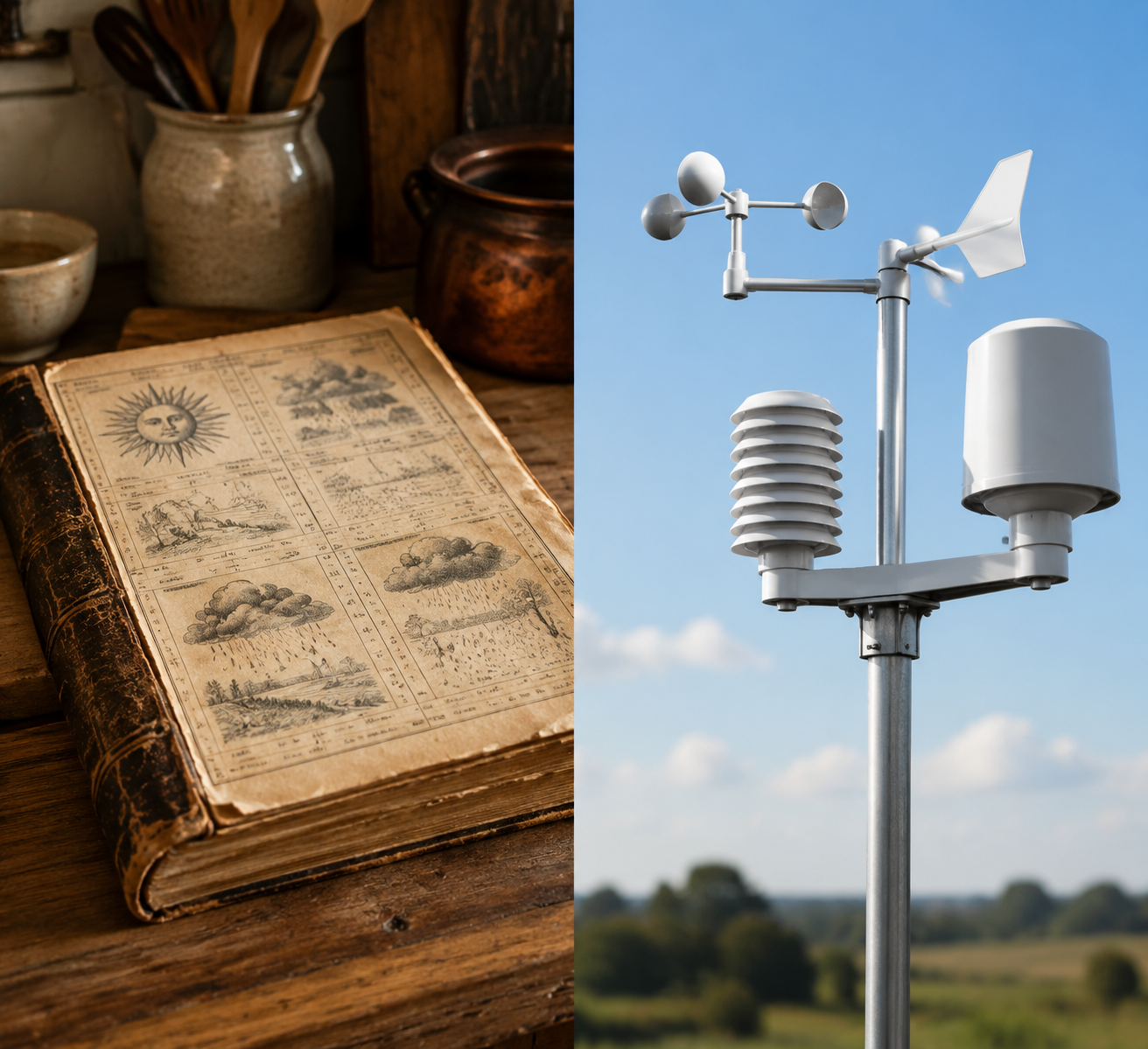
The Old Farmer’s Almanac is a broad forecast product, not a sensor. It publishes long-range weather forecasts, makes an 80% accuracy claim, and has a long cultural life that goes back to 1792.[1] Scientific American reported in 2023 that the Old Farmer’s Almanac contracts with AccuWeather for its forecasts, which means the modern product is not simply a mysterious handwritten formula handed down unchanged from another century.[2]
It is also worth keeping the names straight. The Old Farmer’s Almanac and the Farmers’ Almanac are separate publications. The independent accuracy figure most often cited for almanac-style forecasting comes from a 2010 Weatherwise study associated with the Farmers’ Almanac, not a clean lab audit of every Old Farmer’s Almanac forecast. That limitation matters. It also does not rescue the idea that a broad seasonal almanac forecast belongs in the same decision box as a sensor mounted in your yard.
A smart home weather station is a measurement system. Depending on the model, it may track temperature, humidity, rainfall, wind speed, wind direction, pressure, UV, solar radiation, and lightning risk. The smart-home part is not the display on the kitchen counter; it is the data flow into Alexa, Google Home, HomeKit, Home Assistant, IFTTT, Weather Underground, or irrigation controllers that can act on local conditions.
The Accuracy Gap Is Real, But the Two Numbers Mean Different Things
The Old Farmer’s Almanac’s 80% claim is a forecast-accuracy claim about its own product.[1] The roughly 52% figure comes from an independent evaluation of almanac-style long-range forecasts that has been repeatedly cited as a useful benchmark, but it should be treated carefully: it is not the same as a modern instrument comparison, and it does not measure whether a backyard sensor can read today’s air temperature correctly.[2]
That distinction cuts both ways. The 52% figure is not a courtroom-final verdict on every almanac forecast ever printed. But it is enough to warn a homeowner away from using almanac-style seasonal guidance for day-to-day actions. A coin-flip-level seasonal call may be fun to read in January. It is not a good reason to skip a frost cover in April.
The strongest consumer-station evidence in the research set comes from Wirecutter’s 2025 testing at a National Weather Service Cooperative Observer Program site in Vermont. Over one month, the Tempest weather station’s temperature readings differed from professional instruments by 0.65°F, while the Ambient Weather WS-2000 differed by 0.87°F. The same testing found weaker humidity performance, with the Tempest off by 7.53 percentage points.[3]
| Tool | What the evidence measures | Best supported accuracy takeaway | Practical use |
|---|---|---|---|
| Old Farmer’s Almanac | Broad published forecasts and long-range outlooks | Self-claims 80% accuracy; independent almanac-style benchmark is roughly 52% | Seasonal curiosity, general expectations |
| Smart home weather station | Real-time measurements at or near the property | Third-party testing found top consumer stations within 0.65–0.87°F of NWS temperature instruments | Irrigation, frost protection, wind alerts, storm preparation, automations |
Those numbers should not be mashed together as if they describe the same test. One is about predicting future weather over broad areas and long time windows. The other is about measuring present local conditions against professional instruments. For a smart home, though, that is exactly the point. Automations do not need folklore-level confidence about a coming season. They need a trustworthy input when soil is dry, wind is rising, rain has already fallen, or the temperature is sliding toward a frost threshold.
There is another useful reference point: modern professional forecasting has improved dramatically. Our World in Data reports that ECMWF three-day forecasts are now about 97% accurate, and it cites major gains in forecast skill over time.[4] The lesson is not that a backyard station replaces NOAA, ECMWF, or the National Weather Service. It is that modern weather decisions work best when forecasts and local measurements are used together instead of pretending a broad seasonal publication can do both jobs.
The Backyard Is Where Forecast Accuracy Gets Messy
Weather becomes personal at property scale. Popular Mechanics described a storm where one yard recorded 5 inches of rain, neighbors recorded 8 inches, and the nearest official station logged just 2 inches.[5] That is the kind of mismatch that matters more than a polished regional forecast when the next decision is whether the irrigation system should run at 5 a.m.
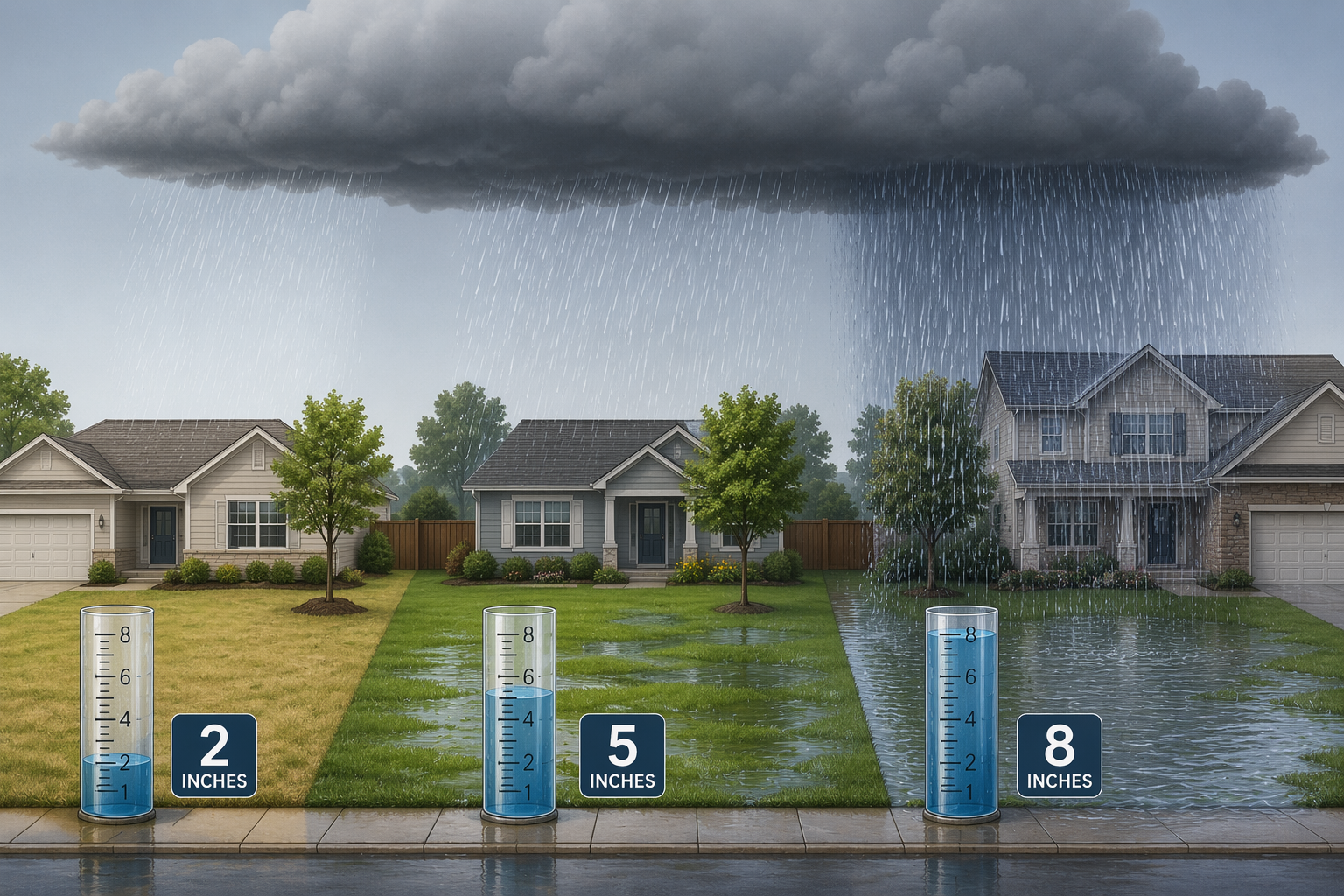
This is where a home station earns its keep. A forecast may say rain is likely in the area. The station tells the controller whether rain actually fell where the sprinkler heads are. A regional weather app may show a wind estimate. A pole-mounted anemometer tells you whether the gusts in your exposed side yard are approaching the point where umbrellas, shade sails, or patio furniture need attention.
Rainfall is the cleanest example, but not the only one. Frost pockets form unevenly. A low spot in the yard can cool faster than the airport station several miles away. A deck thermometer mounted in sun can lie in the other direction. A properly sited weather station is not magic, but it moves the measurement closer to the plant, pipe, driveway, coop, greenhouse, or roofline where the consequence happens.
Where Smart-Home Integration Changes the Value
A weather station that only shows numbers is still useful. A weather station that can trigger the house is more useful. The practical win is not that a dashboard says the temperature is 33°F; it is that the home can send a frost warning before the herbs are damaged, pause irrigation after real rainfall, or push a wind alert before a storm turns loose objects into problems.
- Irrigation: use measured rainfall, local temperature, and humidity to skip watering instead of relying on a citywide forecast.
- Garden protection: trigger frost alerts from the sensor closest to the garden, not the nearest airport.
- Wind safety: notify the household when gusts cross a chosen threshold for umbrellas, awnings, gates, or lightweight furniture.
- Storm preparation: combine official alerts with local pressure, rain, and wind changes for earlier household awareness.
- Fire-weather awareness: use local wind and humidity as extra context when regional red-flag conditions are active.
This is why the category belongs closer to protocols and platforms than to countertop gadgets. A station connected to Home Assistant, IFTTT, Alexa, Google Home, HomeKit-compatible bridges, or Weather Underground can become part of a wider ruleset. The same is true for weather-aware watering systems and newer garden sensors; if you are already looking at Matter 1.5 soil sensors for a smart garden, local weather data is the outdoor context those sensors often need.
The savings case is strongest around water. EPA-cited data puts weather-based irrigation reductions at 15–35% in outdoor water use when controllers use weather data instead of fixed schedules.[6] That does not mean every household gets an automatic payback. A small lot in a rainy climate is different from a large irrigated landscape under summer restrictions. But it is a real use case, not a dashboard novelty, and it fits naturally with broader smart-home automations that save money.
Storm alerts are the place to be careful. A home station should not replace official warnings. Tornado warnings, severe thunderstorm warnings, evacuation notices, and red-flag warnings still come from public agencies with radar, spotter networks, satellites, and forecasting teams. The smart-home role is to route those alerts better and add property-level context. A household can build that around a local tornado warning setup or use wind and humidity readings as part of red-flag warning smart-home preparation, but the official alert remains the authority.
What a $200–$400 Station Does Not Guarantee
The strongest station numbers have limits. Wirecutter’s test ran for one month at one NWS COOP site in Vermont. That is useful because the comparison was against professional instruments, but it does not prove every consumer station will perform the same way in every climate, yard, roofline, or installation.[3]
Siting matters. Put a temperature sensor over blacktop, near a dryer vent, in reflected afternoon sun, or too close to a wall, and the hardware may be blamed for a bad installation. Put a rain sensor under a tree canopy or where roof splash reaches it, and the rainfall total stops being a clean measurement. Wind is even trickier because fences, sheds, houses, and trees reshape airflow. A station can be much more useful than an almanac and still be only as good as its placement.
Humidity deserves special skepticism. In Wirecutter’s testing, temperature was impressively close to the NWS instruments, but humidity was weaker.[3] That does not make humidity useless for home automation, especially for trends, comfort context, or fire-weather awareness. It does mean a homeowner should not treat every measurement channel as equally precise just because it comes from the same device.
There is also a difference between measurement and prediction. A station can show pressure falling, wind rising, and rain beginning. Some systems turn that into short-term nowcasting. But the station in the yard does not have radar, satellites, upper-air observations, or numerical weather models. The best setup is not station instead of NOAA; it is official forecasts plus local sensors plus smart-home routing.
So Which One Is More Accurate?
For broad seasonal curiosity, the Old Farmer’s Almanac can stay on the counter. It costs little or nothing to consult, it has cultural staying power, and nobody needs a sensor mast to enjoy a long-range winter outlook. The mistake is letting that charm make a practical decision for the house.
For actionable home decisions, the smart weather station wins decisively. The evidence does not say every consumer station is perfect. It says the better models can measure local temperature close to professional instruments, while almanac-style long-range accuracy is not strong enough to justify decisions that depend on what is happening in one yard, on one night, under one storm cell.[2][3][5]
The buying threshold is straightforward: spend the $200–$400 when local weather changes what your home does. If you irrigate, garden seriously, manage outdoor equipment, watch wind exposure, prepare for storms, or want smart-home automation ideas that pay for themselves, local measurement has a job. If you only check tomorrow’s general forecast and never act on property-level weather data, the almanac can remain entertainment and the National Weather Service forecast can do the serious work.
References
- How Accurate Are The Old Farmer’s Almanac Weather Forecasts? — Almanac.com — link
- Where Farmers’ Almanacs’ Weather Predictions Come From — Scientific American — November 2023 — link
- The 3 Best Home Weather Stations of 2026 — The New York Times / Wirecutter — November 2025 — link
- Weather forecasts have become much more accurate — Our World in Data — link
- Why you should own a weather station — Popular Mechanics — link
- WaterSense Labeled Controllers — U.S. Environmental Protection Agency — link
Updates & Corrections
Protocol specifications and platform features change rapidly — especially with Matter version evolution. Report version changes, certification count updates, or platform policy changes that have occurred since the last editorial review.
Comments
Join the discussion with an anonymous comment.