If you are searching for a smart irrigation soil moisture sensor Matter setup in Q3 2026, the clean answer is still awkward: Matter 1.5 defines the right device types, but you cannot yet buy a complete certified native-Matter soil-and-irrigation stack at retail. You can buy devices that work around the gap. That distinction matters before anyone puts a probe in the ground.
The promising part is real. Matter 1.5, released in November 2025, added a Soil Sensor device type built around soil moisture percentage reporting, with optional temperature, and an Irrigation System device type for controlling one or more water valves. The irrigation side also includes Flow Measurement support and Binding, which is the kind of plumbing you want if a local system is eventually going to react to sensor and flow data without depending on one vendor's cloud routine.[1][2]
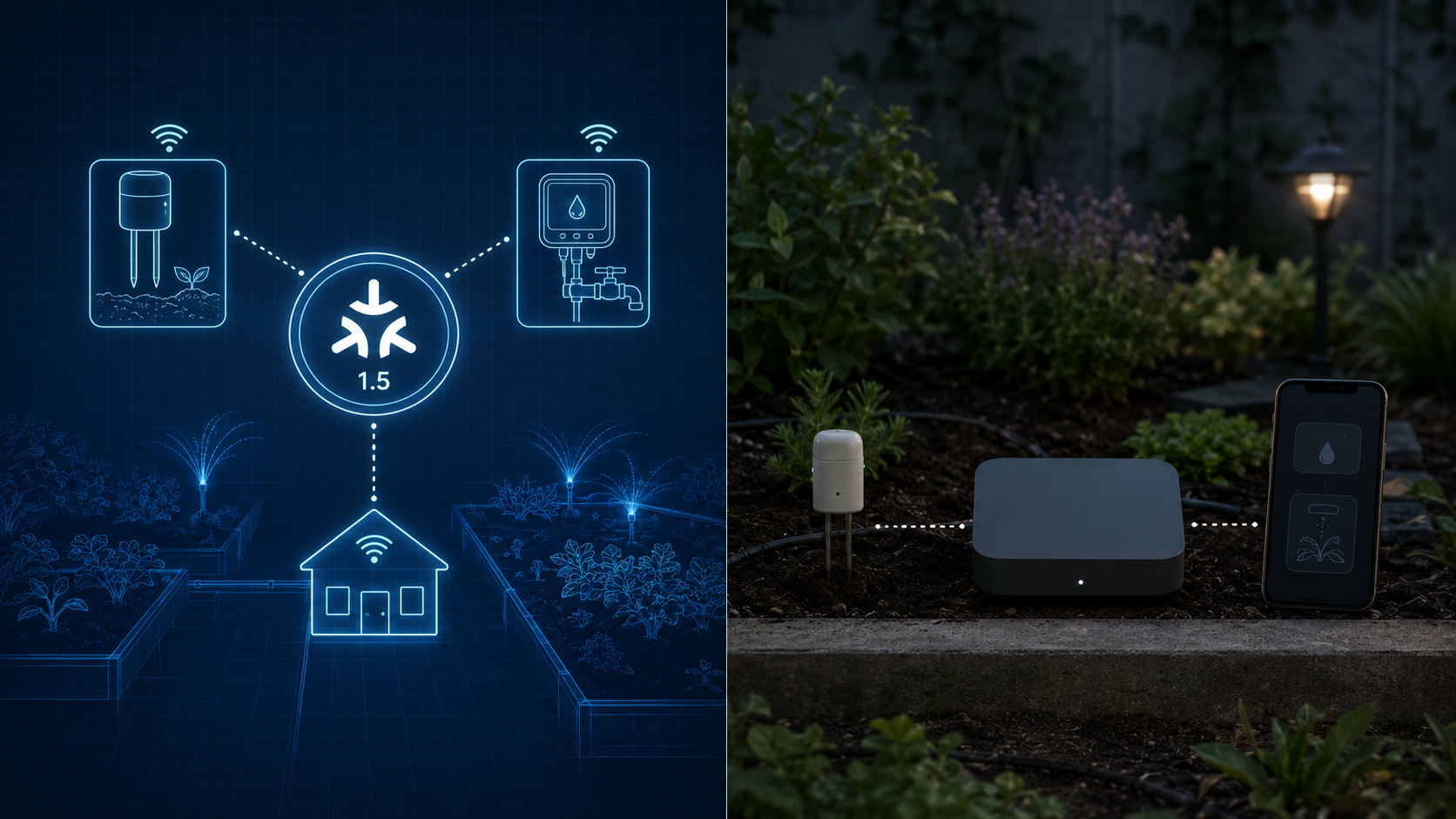
The missing part is also real. Matter Alpha's mid-2026 DIY guide says that “certified Matter soil moisture sensors are still not available on the market,” and its Irrigation System product directory shows no certified devices in that category.[3][4] So the current decision is not “which native Matter Soil Sensor should I buy?” It is whether you want to wait, use a bridge, build a development-board project, or step outside Matter for the garden.
Matter 1.6 is now the latest specification version, but for this buying decision it does not change the irrigation device-type situation. The relevant garden pieces remain the Matter 1.5 Soil Sensor and Irrigation System definitions.
What Matter 1.5 Actually Solves on Paper
Before Matter 1.5, a garden sensor could still be useful, but it usually arrived as somebody's custom interpretation of moisture, a generic sensor exposed through a hub, or a platform-specific accessory. Matter 1.5 gives the category names and clusters that make the idea legible across ecosystems: a soil probe reports soil moisture; an irrigation controller manages valves; a flow sensor can participate in a local loop.[1][2]
That is more than taxonomy. A standards-based setup could let a moisture reading, a valve controller, and a flow measurement device remain understandable to Apple Home, Google Home, Alexa, SmartThings, Home Assistant, or another Matter controller without every brand inventing its own private mapping. It also gives device makers a target that is specific to outdoor watering rather than pretending soil moisture is the same thing as room humidity.
But a device type in a specification is not a product on a shelf. It does not tell you whether a sensor has been certified, whether your platform displays it as soil moisture, whether automations expose the right trigger, or whether a valve controller exists to receive the command. Those are the places where the 2026 garden story is still uneven.
The Buy-Now Path: Zigbee Sensor, Matter Bridge
The most practical route today is not native Matter. It is a Zigbee soil sensor behind a Matter bridge. ThirdReality's Smart Soil Moisture Sensor Gen2 launched in March 2026, uses Zigbee 3.0, costs about $25–30, and can reach Apple Home, Google Home, and Alexa through the company's Smart Bridge MZ1, which costs about $30.[5]
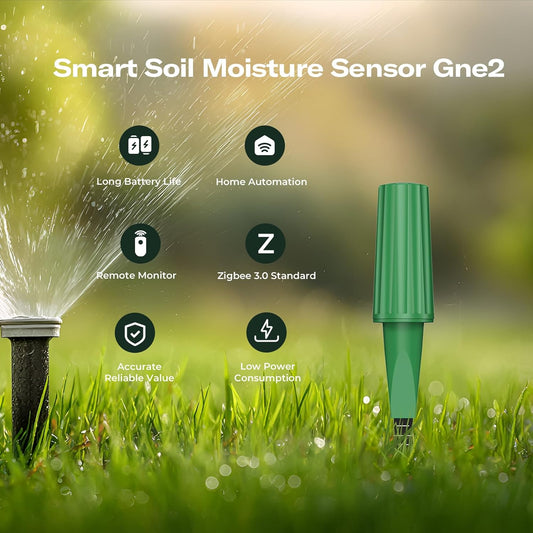
That is the boring answer, and in this category boring is useful. You can buy the sensor. You can buy the bridge. The bridge gives the major Matter ecosystems something to see. For someone who wants a moisture reading available inside a mainstream smart-home app this season, that is a much better starting point than waiting for a product category to materialize.
The compromise is in the wording. This is Matter-compatible through bridging, not a native Matter Soil Sensor. The sensor talks Zigbee to the bridge; the bridge talks Matter to the rest of the smart home. If you are still sorting out what sits where in a Matter setup, the difference between controllers, devices, and bridged devices is worth getting straight before you buy another hub. Google Nest Matter controllers vs devices is a useful primer for that mental model.
The bridge also becomes another powered box, another setup step, and a single point of failure between the plant and the platform. There may be a little extra latency, though for soil moisture that is rarely the pain point; soil does not change like a motion sensor. The more important question is how your chosen platform represents the reading and whether the automation controls you want are exposed in a usable way.
| Path | What You Get | What You Give Up |
|---|---|---|
| ThirdReality Zigbee sensor plus Smart Bridge MZ1 | Purchasable soil moisture sensing that can reach Apple Home, Google Home, and Alexa through Matter bridging | Not a native Matter Soil Sensor; requires the bridge; platform display and automation behavior depend on mapping |
| XIAO MG24 plus Grove capacitive sensor | True Matter-over-Thread experimentation with local connectivity | Programming, calibration, Thread setup, and current exposure as a generic humidity sensor |
| Ecowitt WH51 | Low-cost multi-zone monitoring with Home Assistant appeal | No Matter path |
| Wait for certified Matter 1.5 devices | Best chance of a clean standards-based soil and irrigation stack | No retail product to buy yet |
The DIY Path: True Matter-over-Thread, but Not Yet the Ideal Device Type
The XIAO MG24 route is more elegant on the network diagram and more demanding on the workbench. Matter Alpha's guide uses a Seeed Studio XIAO MG24 board with a Grove capacitive soil moisture sensor, with a total parts cost around $45–60, to build a true Matter-over-Thread soil moisture project using the Arduino Matter SDK.[3]
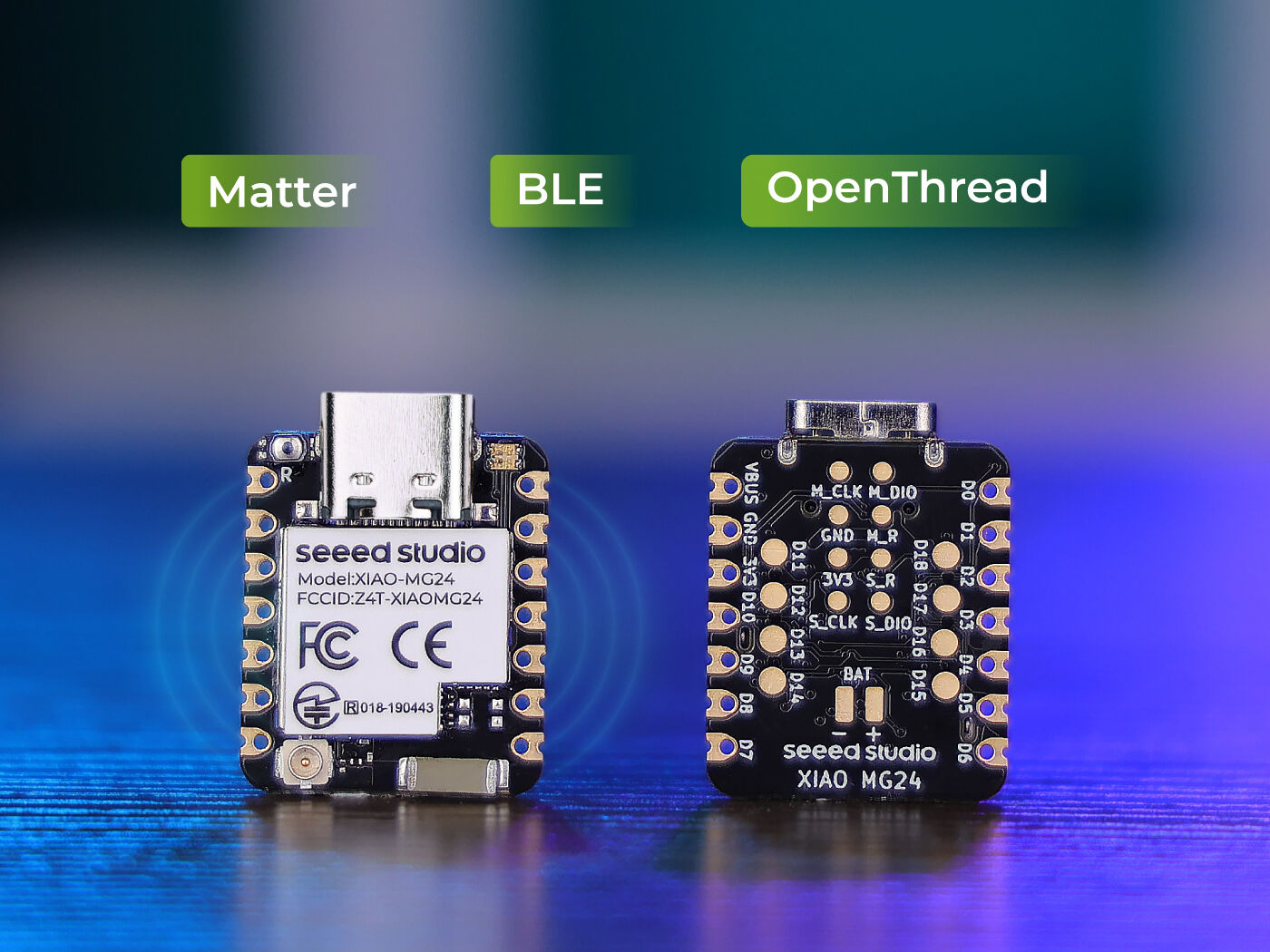
This avoids the Zigbee-to-bridge architecture. The device itself joins the Matter fabric over Thread, which is exactly the kind of local low-power network Matter was supposed to make less painful. You will need a Thread border router in your home, so check your platform hardware before assuming the board has somewhere to connect. If you need help choosing one, see the 2026 Thread border router guide.
The catch is not philosophical; it is implementation. The project requires Arduino IDE setup, programming, and manual calibration. More importantly, the current SDK limitation means the device is exposed as a generic humidity sensor rather than the native Matter Soil Sensor device type.[3] That can still be useful, but it is not the full Matter 1.5 garden model arriving early through a side door.
This path makes sense if the build is part of the appeal: you want to see Matter-over-Thread working, you are comfortable flashing firmware, and you do not mind adjusting calibration until the readings are meaningful for your own pots or beds. It is a poor fit if the goal is to hand a family member a box and say, “Add this to Apple Home.”
Where Ecowitt Fits: Good Garden Monitoring, Not a Matter Workaround
Ecowitt's WH51 belongs in the conversation because garden people like practical sensors more than protocol purity. It costs about $18 per sensor, is rated IP68, uses 433 MHz with a stated range up to 175 feet, and has a stated ±3% volumetric water content accuracy; SmartHomeExplorer's 2026 guide also notes its native Home Assistant integration.[6]
That makes it attractive for multi-zone monitoring, especially if your real problem is “I want several beds measured without spending a lot per probe.” It is not, however, a Matter path. If your smart garden plan depends on the same device being visible through Matter to mainstream ecosystems, Ecowitt is a side road, not a bridge over the current standards gap.
Why the Gap Is Still Worth Caring About
The reason to keep watching this category is not that every lawn needs another dashboard. Outdoor water use is large enough that better control can matter. EPA WaterSense says smart irrigation controllers can reduce outdoor water use by 20–50%, and WaterSense-labeled controllers save an average of 8,800 gallons per home each year.[7]
Those numbers do not prove that a bridged Zigbee probe or a DIY Matter board will save that much water in your yard. The EPA figures are broad controller savings, and actual results depend on climate, soil, landscape size, existing watering habits, and whether the controller is actually allowed to change the schedule. They do explain why Matter's soil and irrigation definitions are worth more than a niche checkbox. If the standard matures into real products, the smart-home side could finally understand the watering loop instead of merely switching a hose timer on and off.
This is also where Matter's broader product maturity matters. Lighting, plugs, locks, sensors, and thermostats are much farther along than outdoor irrigation devices. The Matter devices buyer's guide is useful context: the standard is not failing because garden hardware is late, but garden hardware is clearly not in the same retail phase as the mature categories.
What to Do in Q3 2026
If your goal is a clean certified Matter 1.5 setup with a native Soil Sensor feeding a native Irrigation System device, wait. The specification is ready enough to describe the shape of that system, but the retail shelf is not ready enough to sell it.
If your goal is usable soil moisture visibility in Apple Home, Google Home, or Alexa this season, the ThirdReality Zigbee sensor plus Smart Bridge MZ1 is the most realistic buy-now route. Treat it as a bridged Matter-compatible setup, not as proof that native Matter garden hardware has arrived.
If your goal is to experiment with real Matter-over-Thread hardware, the XIAO MG24 project is interesting and technically cleaner than a bridge, but only if you accept development-board work, calibration, and the current generic humidity-sensor exposure. It is a project, not a polished garden accessory.
If your goal is simply better garden monitoring and you already live comfortably in Home Assistant, non-Matter systems such as Ecowitt WH51 may be the better value. Just make that choice knowingly: you are optimizing for garden function and cost, not for Matter ecosystem standardization.
References
- Matter 1.5 Introduces Cameras, Closures, and Enhanced Energy Management Capabilities, Connectivity Standards Alliance, November 2025
- Matter 1.5 for Next Generation Smart Homes, Silicon Labs
- How to Make a Matter Soil Moisture Sensor with XIAO MG24, Matter Alpha
- Irrigation System, Matter Alpha
- Built on Proven Experience: ThirdReality Launches Smart Soil Moisture Sensor Gen2, PRNewswire, March 2026
- Best Smart Soil Moisture Sensors for Garden 2026, SmartHomeExplorer
- WaterSense Labeled Controllers, EPA WaterSense
Updates & Corrections
Protocol specifications and platform features change rapidly — especially with Matter version evolution. Report version changes, certification count updates, or platform policy changes that have occurred since the last editorial review.
Comments
Join the discussion with an anonymous comment.