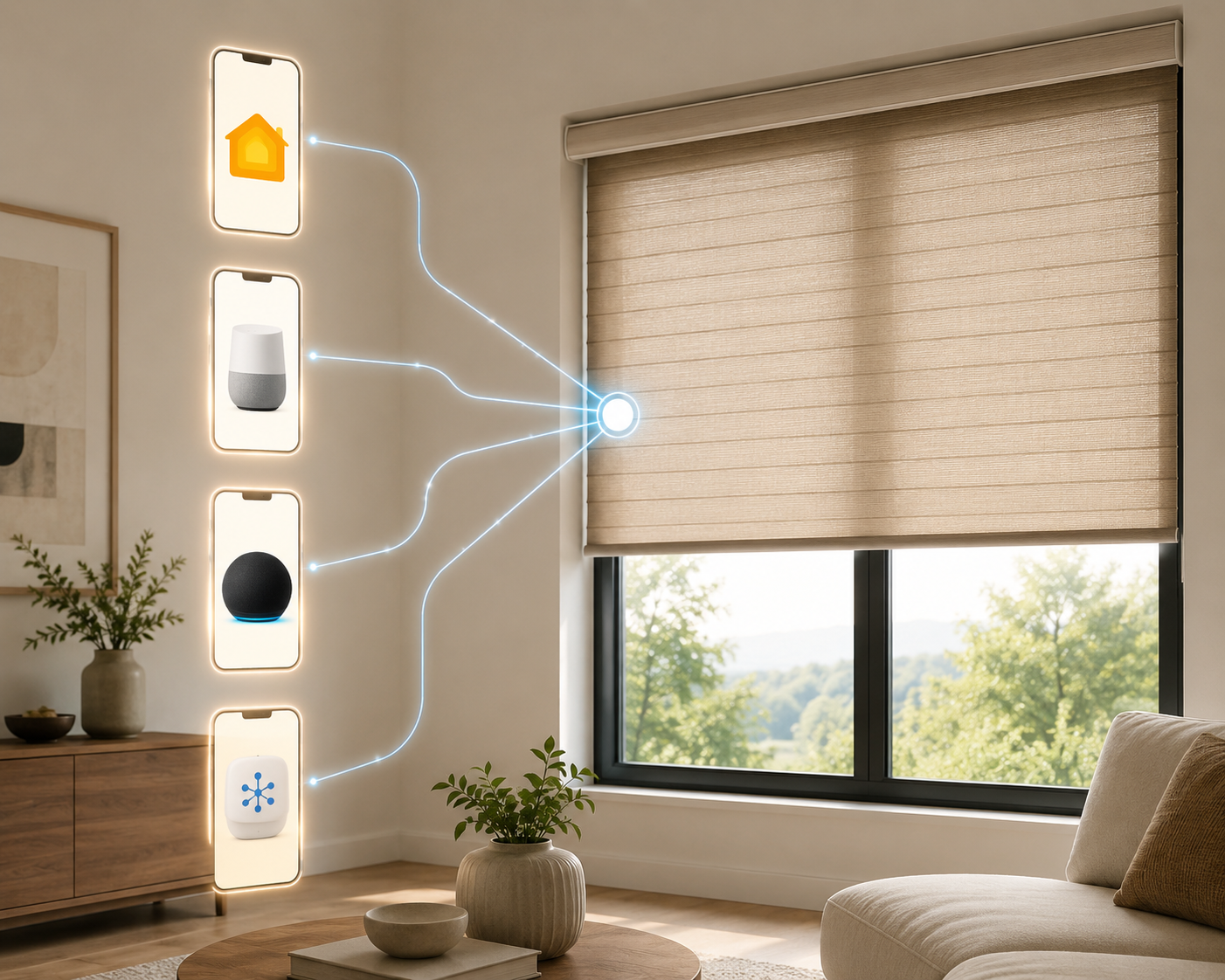
For smart blinds, “Matter closure support” means the blind is exposed to smart home platforms through Matter’s model for coverings or closures, so Apple Home, Google Home, Amazon Alexa, and SmartThings can understand commands such as open, close, set position, adjust tilt, and report status without depending only on the blind maker’s private app or cloud integration. In practical terms, the same installed shade can be added to more than one ecosystem instead of becoming a permanent vote for one app.
That matters more with blinds than with a $20 plug. Blinds are usually bought in multiples, sized to windows, mounted into trim or brackets, and annoying to replace when a household changes platforms. Matter does not make every blind behave identically in every app, but it can reduce the most expensive kind of lock-in: buying motors that only feel at home in one ecosystem.
Matter already knew about blinds before “closures” became the headline
The confusing part is that product pages and standards news do not always use the same words. Matter’s earlier support for smart blinds is usually discussed under the Window Covering device type. Matter-smarthome.de describes Matter window coverings as supporting open and close control, percentage position, tilt for compatible products, automations, and cross-platform use through Matter-enabled ecosystems.[1] Motionblinds also notes that the Window Covering device type has been part of Matter since Matter 1.0 and covers up/down movement, position percentage, and tilt.[2]
Matter 1.5, announced by the Connectivity Standards Alliance in November 2025, broadened the language with “closures,” described by the CSA as the largest new device type cluster ever added to Matter, covering window shades, drapes, awnings, gates, and garage doors.[3] Krasamo’s specification guide explains the shift as a move from the earlier Window Covering model into a unified Closures framework with modular building blocks for sliding, rotating, and swinging motion types.[4] Silicon Labs makes the same broad point from the platform side: closures in Matter 1.5 are a major expansion, not a tiny label change.[5]
For a buyer, the useful translation is narrower: if a blind says it supports Matter as a window covering or closure device, you should expect the platform to recognize it as a shade-like thing, not as a generic switch. The exact controls still depend on the motor, blind type, firmware, and app support.
What you should expect across Apple, Google, Alexa, and SmartThings
The main win is not that you avoid the manufacturer’s app forever. You may still need it for first setup, calibration, firmware updates, limits, or advanced features. The win is that, once the blind is commissioned into Matter, the everyday controls can appear inside the household platforms people already use.
- Apple Home can show the blind as a controllable window covering rather than relying on a vendor-only HomeKit integration.
- Google Home can control and display the same device when it has been added through Matter.
- Alexa can expose voice and app control for the blind, though its position wording has an important quirk covered later.
- SmartThings can participate in the same Matter setup when the product and platform path are supported.
This is where Matter Multi-Admin becomes useful in a mixed-platform home. One person can prefer Apple Home scenes, another can ask Alexa to lower the living room shades, and someone else can check status in Google Home or SmartThings. That does not mean every app exposes the same interface or automation options, but it does mean the blind is no longer tied to a single ecosystem by design. If you are still deciding how much platform commitment you want to make, the broader ecosystem tradeoff is worth sorting out before ordering custom-sized shades: The Smart Home Ecosystem Trap: Which Platform to Buy Into in 2026.
There is a real user-education gap here. In a December 2025 Home Assistant discussion, a user asked what “Matter closure devices” actually meant after seeing the term appear in Matter 1.5 coverage.[6] That is not a niche misunderstanding. “Closure” is standards language; “will my roller shade open in Apple Home and Alexa?” is the question buyers are actually trying to answer.
The percentage quirk: open in one app, covered in another
Matter can report position precisely, but the platforms do not all label that position the same way. Matter-smarthome.de documents a practical mismatch with screenshots: Alexa interprets the value as percentage covered, while Apple Home, Google Home, and SmartThings interpret the comparable display as percentage open. In the example described, Alexa shows 26% covered while the other platforms show 74% open.[1]
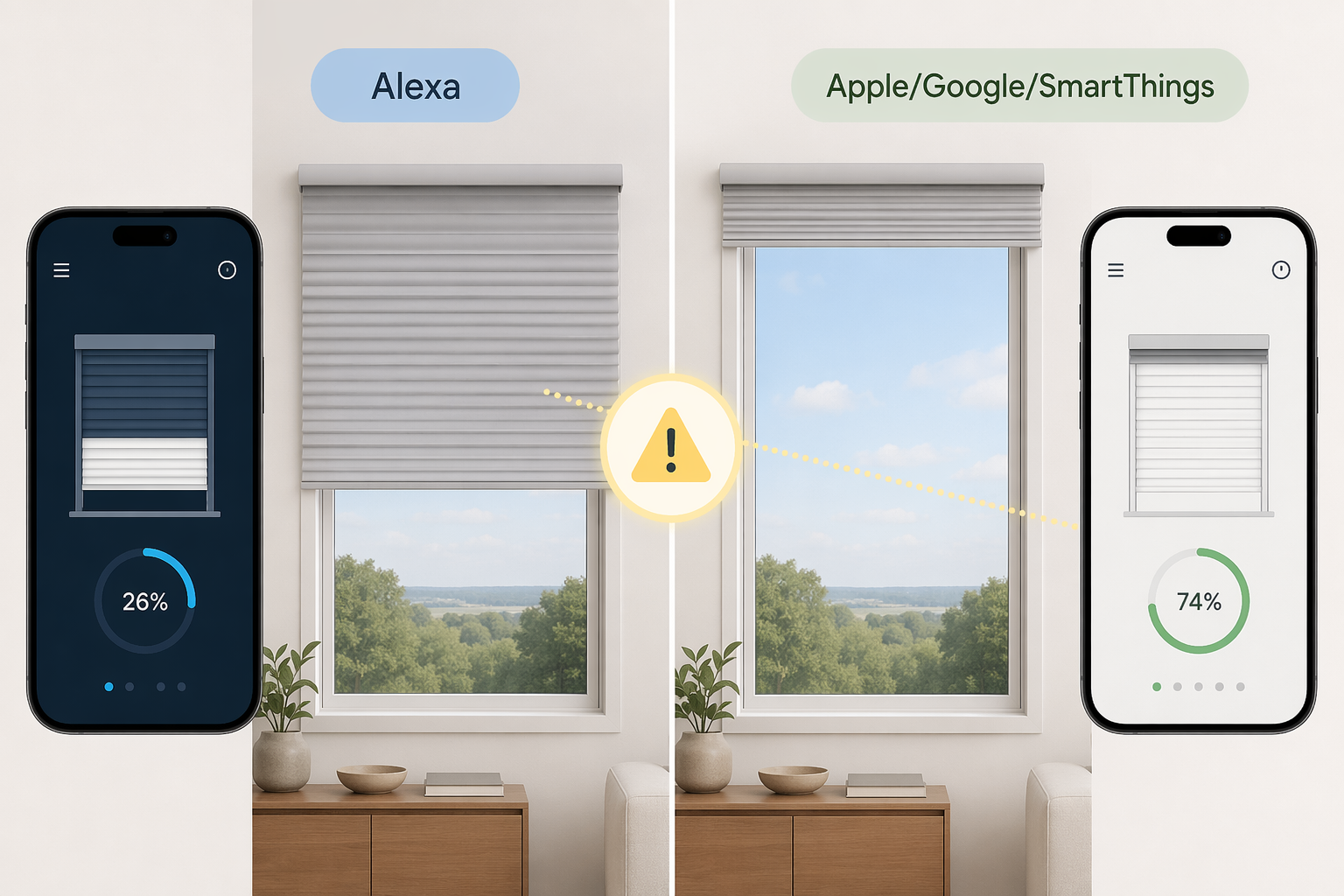
This is not a reason to write off Matter blinds. It is exactly the kind of daily mismatch that should be known before you automate a whole room. If you say or script “set the shade to 25%,” one platform’s mental model may feel inverted compared with another. A family that mostly taps icons may barely notice after a few days. A household with voice routines, mixed assistants, or carefully named automations may notice immediately.
The important limitation is that the available material does not confirm a Matter 1.5 fix or a platform-side resolution. Matter-smarthome.de states that there is currently no per-platform toggle to invert the reading.[1] Until that changes, buyers should treat Alexa’s covered-versus-open interpretation as an unresolved interoperability quirk, not as a setup mistake they can definitely solve later.
The hardware path matters as much as the logo
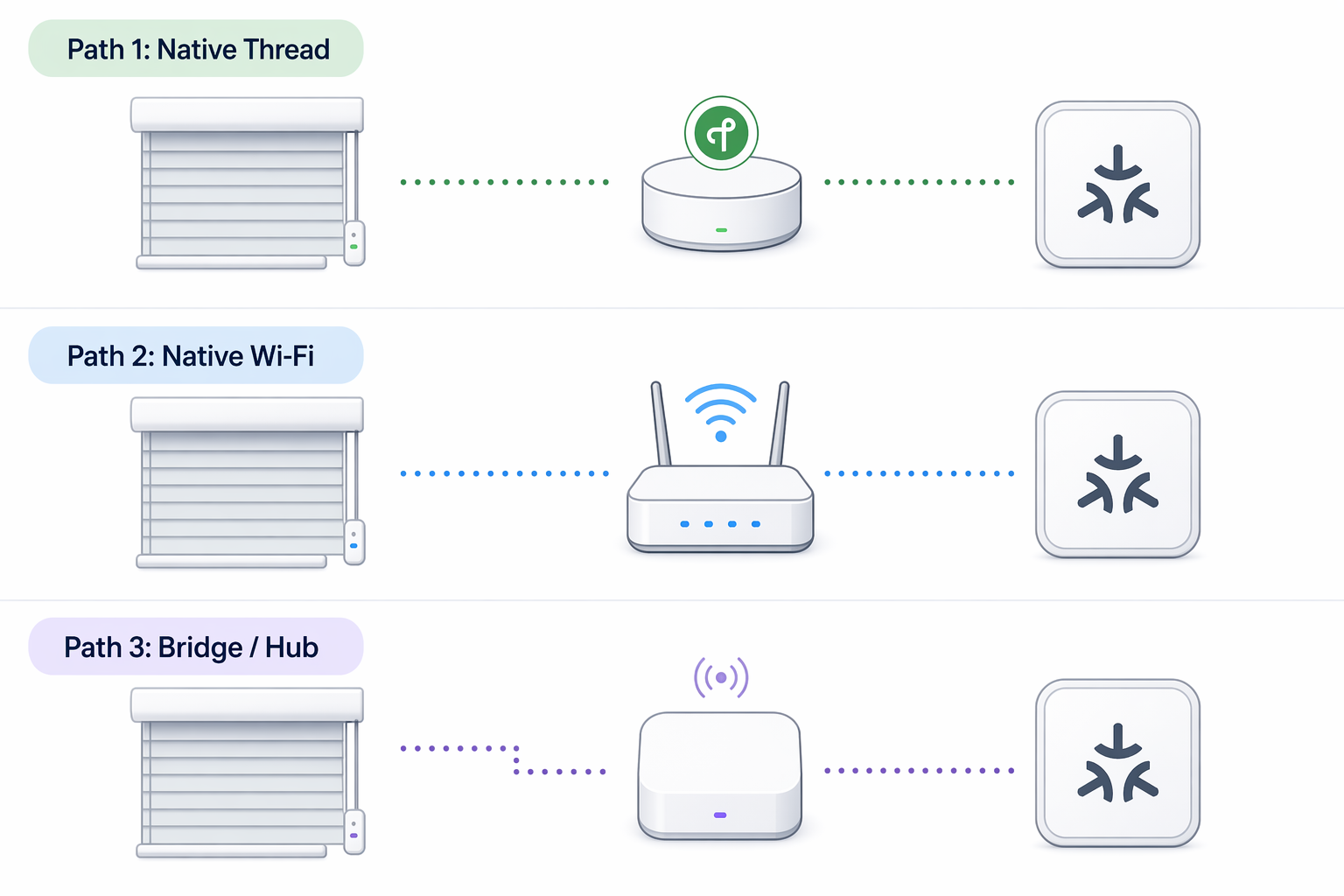
The label “Matter support” hides three different installation paths. This is where product pages often become too vague. A Matter controller is always required for Matter control. A Thread border router is required only for Thread-native blinds. Wi-Fi blinds use the home Wi-Fi network. Bridge-based blinds depend on a proprietary bridge or hub translating the blind into Matter.
| Path | What the blind talks to | Extra hardware to check | Best fit |
|---|---|---|---|
| Native Thread | Thread mesh, then your Matter fabric | Matter controller plus Thread border router | Low-power installations where you already have or want Thread infrastructure |
| Native Wi-Fi | Home Wi-Fi network, then your Matter controller | Matter controller; no Thread border router for the blind | Simpler single-device installs where Wi-Fi coverage is strong |
| Bridge or proprietary hub | Vendor bridge first, then Matter from the bridge | Matter controller plus the vendor bridge or hub | Existing blind systems or brands whose motors do not speak Matter directly |
A Matter controller is the device that commissions and manages Matter devices for a platform. Depending on the ecosystem, that might be a smart speaker, display, hub, streaming box, or other always-on controller-class device. If that distinction is still fuzzy, start with What Your Matter Hub Actually Does; the controller question has to be settled before any Matter blind behaves like a normal smart home device.
Native Thread blinds
Thread-native blinds are the cleanest version of the idea when the rest of the home is ready for them. The blind joins the low-power Thread mesh, and the Thread border router connects that mesh to the IP network used by Matter. MatterCatalog’s 2026 guide lists Thread-native options such as SmartWings, Eve, and Zemismart in its Matter smart blinds coverage.[7]
The catch is that a Matter controller alone is not enough if the blind is Thread-native. You also need a Thread border router that works with the platform you plan to use. Some devices combine both roles, but buyers should verify the exact model rather than assuming every hub, speaker, or display does both. For platform-specific router choices, see Best Thread Border Router for Your Smart Home Platform in 2026.
Native Wi-Fi blinds
Wi-Fi Matter blinds skip the Thread mesh. They connect through the home Wi-Fi network and are commissioned into Matter through a controller. That can be easier to understand at checkout because there is no border-router question, but Wi-Fi coverage at the window still matters. A shade in a far bay window can be a worse Wi-Fi client than a phone held near the router during setup.
Wi-Fi may be the practical choice for a small installation or a home that has no Thread infrastructure. It is not automatically worse than Thread, but it asks different questions: is the Wi-Fi stable where the shade is mounted, how many battery-powered Wi-Fi devices are you adding, and does the product expose the Matter controls you expect in your chosen platforms?
Bridge-based blinds
Bridge-based systems are less elegant on paper and sometimes more realistic in a house. The blind speaks the vendor’s own radio or protocol to a bridge; the bridge exposes one or more blinds to Matter. Matter-smarthome.de describes this as one of the three main approaches alongside native Thread and native Wi-Fi, and MatterCatalog’s guide includes bridge-dependent examples such as SwitchBot and IKEA in the broader Matter blinds market.[1][7]
This path can be the right answer when you already own compatible motors, want a specific blind style, or need a brand whose direct Matter motor is not available in your size. The tradeoff is dependency. If the bridge is offline, unsupported, or only exposes a limited device model to Matter, the platforms can only use what the bridge translates.
Product examples help, but they do not replace compatibility checks
It is tempting to turn Matter blinds into a brand roundup, but the more durable lesson is about paths. SmartWings, Eve, Zemismart, SwitchBot, and IKEA show up in current Matter blind discussions because they illustrate the spread between native Thread devices and bridge-dependent systems.[7] That does not mean every model, firmware version, shade type, or regional SKU exposes the same Matter behavior.
Be especially careful with phrases like “Matter-compatible hub” or “Matter support coming.” A hub can support Matter in one product category while not exposing every connected accessory type through Matter. A motor can support one ecosystem today and add another later. A platform logo on a listing can describe voice compatibility, app compatibility, or Matter compatibility, and those are not always the same claim.
Battery-life claims deserve the same restraint. Thread is often attractive for low-power window coverings, and Wi-Fi motors may have different power demands, but published estimates vary with shade size, fabric weight, motor choice, signal quality, and how often the blind moves. Treat battery life as a product-specific claim to verify, not as something guaranteed by the word Matter.
A buyer-ready checklist for Q3 2026
Before buying one blind, and definitely before ordering a full house of custom sizes, pin down the hardware path and the platform behavior. The useful questions are specific enough that a vague product page will often fail them.
- Confirm whether the blind is native Matter over Thread, native Matter over Wi-Fi, or exposed to Matter through a proprietary bridge.
- Confirm that you own a Matter controller for the ecosystem you plan to use; if Google hardware is involved, check whether the device is acting as a controller or just as a controllable device through resources such as Google Nest Matter Controllers vs Devices.
- For Thread-native blinds, confirm that you also have a Thread border router in the right place and on the right platform.
- Check the exact ecosystems you use: Apple Home, Google Home, Alexa, SmartThings, or a combination through Matter Multi-Admin.
- Look for explicit support for position percentage and tilt if your blind type needs both; do not assume tilt exists on every Matter blind.
- If Alexa will be part of daily control, test or at least tolerate the open-versus-covered percentage mismatch before scaling up.
Matter closure support is meaningful and worth looking for when smart blinds need to serve more than one ecosystem. It is not a magic phrase that guarantees identical controls, identical wording, or a hardware-free setup. The safer purchase is the one where the listing tells you the Matter path, the controller requirement, the Thread or bridge requirement if any, and the platforms that have actually been tested.
References
- Smart Blinds: Window Covering in the Matter Standard, matter-smarthome.de.
- Matter: A New Window of Opportunity, Motionblinds.
- Matter 1.5 Introduces Cameras, Closures, and Enhanced Energy Management Capabilities, Connectivity Standards Alliance, November 2025.
- Matter Specification, Krasamo, April 2026.
- Matter 1.5 for Next-Generation Smart Homes, Silicon Labs.
- Matter closure devices, GitHub Home Assistant Discussion, December 2025.
- Best Matter Smart Blinds 2026, MatterCatalog.
Updates & Corrections
Protocol specifications and platform features change rapidly — especially with Matter version evolution. Report version changes, certification count updates, or platform policy changes that have occurred since the last editorial review.
Comments
Join the discussion with an anonymous comment.