In mid-2026, the Matter smart home standard is finally serious enough that buyers should treat the badge as meaningful — and still not meaningful enough to stop asking which platform, which device type, which firmware, and which network it will run on. That sounds like hedging, but it is the only honest verdict. Matter has moved well past the early 1.0 promise of “someday this will be easier,” with a much larger certified ecosystem, broader device categories, and important fixes arriving in Matter 1.5, Matter 1.6, and Thread 1.4. It has not yet become the plain-language consumer promise printed on many boxes.
Matter is the Connectivity Standards Alliance’s interoperability standard for smart home devices. In practical terms, it is supposed to let a light, lock, sensor, thermostat, bridge, camera, or appliance work across major ecosystems such as Apple Home, Google Home, SmartThings, and Alexa without the buyer having to decode a manufacturer’s compatibility chart first. That promise matters most when a home is mixed — and most real homes become mixed eventually.
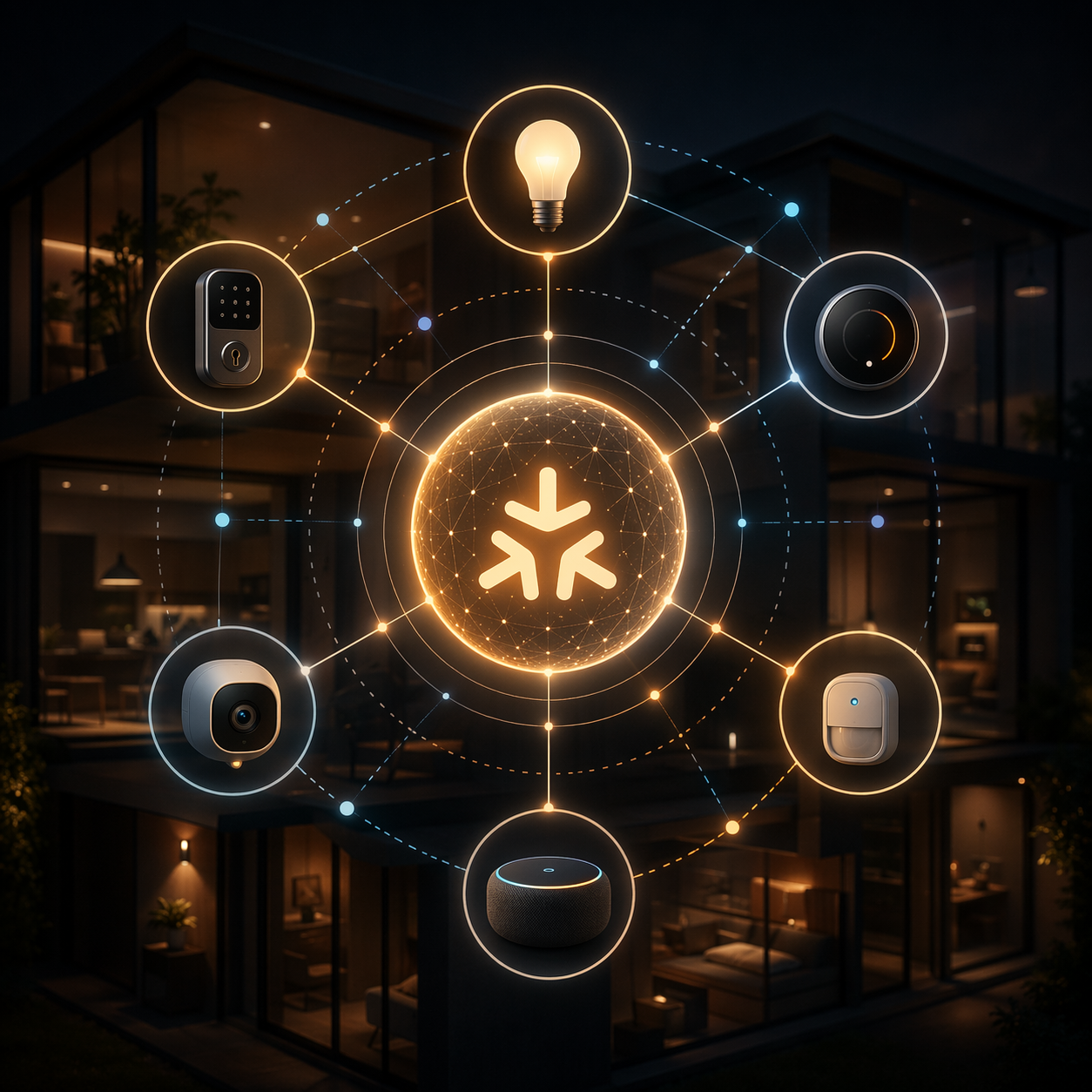
The current state is best understood in three layers: the certified ecosystem is now large, the specification has filled in major missing capabilities, and the platform implementations still disagree in ways buyers can feel. A Matter-certified device pairing once is progress. A device behaving the same way in every major app, surviving firmware updates, and exposing the same controls everywhere is the harder standard.
The Scale Is Real, but the Count Needs a Footnote
The most visible maturity signal is scale. Matter Alpha’s category database showed roughly 4,282 Matter products across more than 50 device categories in mid-2026, an inclusive count that captures variants such as color, size, and regional model differences rather than only one representative product per device family.[1] That is a meaningful ecosystem number. It means Matter is no longer a handful of bulbs, plugs, and optimistic launch partners.
It does not mean there are 4,282 substantially different buying choices. Matter-smarthome.de’s 2026 status review notes that curated product counts are much lower, around 750 to 1,100 depending on methodology, because they collapse variants and focus on distinct products rather than every certified listing.[2] Neither number is “wrong.” They answer different questions. The inclusive count shows certification momentum; the curated count is closer to what a buyer experiences while shopping.
| Count Type | What It Tells You | What It Does Not Tell You |
|---|---|---|
| Matter Alpha inclusive count, roughly 4,282 products | The certification pipeline is large and spans more than 50 categories. | How many distinct, easy-to-buy, well-supported products exist in your region. |
| Curated counts around 750 to 1,100 products | A more conservative view of practical product availability. | The full breadth of variants, regional SKUs, and certified model listings. |
That distinction matters because certification scale can hide uneven readiness. A light bulb and a door lock do not stress the same parts of the standard. A Matter bridge carrying older Zigbee devices into a new platform is not the same operational problem as a native Matter-over-Thread sensor. A camera brings different expectations again: live view, recording hooks, privacy indicators, latency, and app-specific behavior.
For purchase decisions, the badge now reduces risk in well-supported categories, especially lights, plugs, switches, basic sensors, and some locks. It does not remove the need to check the exact platform support matrix. Readers moving from overview to shopping should still compare current device behavior, not just certification labels, in a buyer-focused guide such as Which Matter-Compatible Devices Are Worth Buying in 2026.
Why 2026 Feels Different From the Matter 1.0 Era
Matter 1.0 arrived in late 2022 with the basic shape of a cross-platform smart home standard, but the early category list was narrow and the lived experience depended heavily on controller support, app behavior, border router quality, and the patience of early adopters.[2] The years since have not been one smooth march. They have been a sequence of missing pieces being added, with the newest pieces still waiting for field proof.
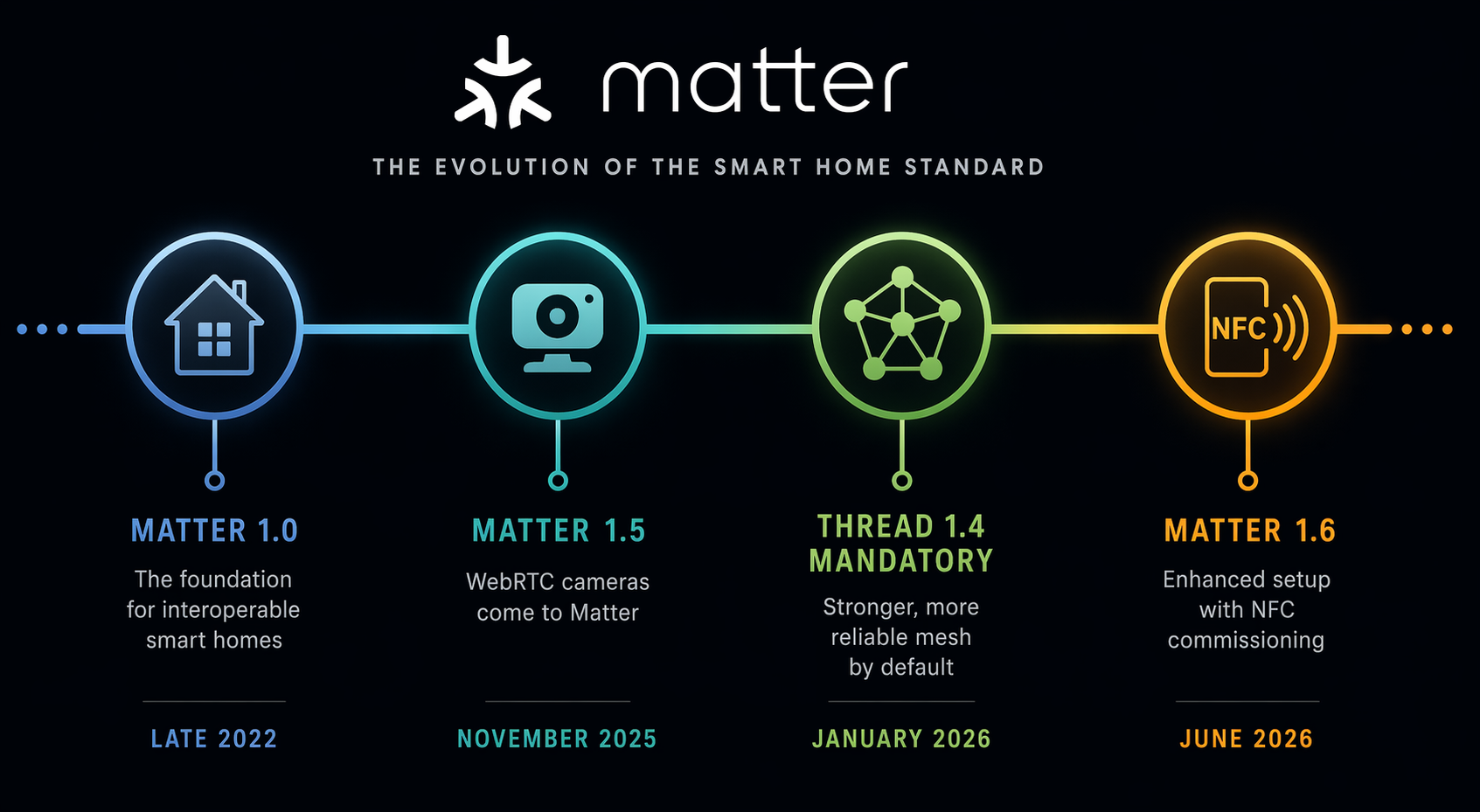
The compressed version is simple: early Matter made lights, plugs, switches, locks, thermostats, blinds, bridges, and some sensors more portable. Later releases widened the device map. The releases that change the mid-2026 conversation most are Matter 1.5, Thread 1.4 becoming mandatory, and Matter 1.6.
Matter 1.5: Cameras Finally Enter the Standard
Matter 1.5, released in November 2025, added several capabilities that smart home buyers had been waiting on, most notably camera support through WebRTC, new closure categories, and enhanced energy management features.[3] Camera support is the headline because cameras have always been one of the stickiest platform-lock-in categories. Once a household has doorbell history, indoor camera routines, notifications, and subscriptions tied to one ecosystem, switching becomes expensive in time even when the hardware is technically removable.
The WebRTC choice matters because it points Matter cameras toward real-time media behavior rather than treating them as just another sensor endpoint. Still, this is one of those places where a spec-level gain is not the same as a mature buying experience. A camera can be Matter 1.5-capable while app-specific recording, detection, history, notification, and cloud features remain outside what the buyer imagined “interoperable” would mean.
Matter 1.5 also expanded energy management, including support for more sophisticated energy flows and bidirectional EV charging.[3] That is not a feature most people will notice while pairing a sensor, but it points to Matter’s larger ambition: the standard is trying to cover the home as an energy system, not only a collection of convenience gadgets.
Thread 1.4: The Quiet Fix Early Thread Homes Needed
The Thread change is less marketable and more important than it sounds. Matter-smarthome.de’s 2026 review identifies Thread 1.4 becoming mandatory as of January 2026 as a key cleanup moment for early Thread behavior, especially the problem of homes ending up with parallel Thread meshes instead of one coherent mesh shared across border routers.[2] Anyone who has stared at a supposedly compatible Thread device while two ecosystems quietly build separate networks knows why this matters.
Thread is the low-power mesh networking layer used by many native Matter devices. It still requires a Thread border router, which may be built into hardware such as some smart speakers, displays, routers, Apple TV models, or hubs. For newcomers, this is where the “app” language gets misleading: the phone app is not necessarily the controller, and the controller is not necessarily the border router. If that distinction is still fuzzy, it is worth reading What “Matter Smart Home App” Really Means for Beginners before buying Thread sensors in bulk.
Making Thread 1.4 mandatory does not magically repair every existing network. It does, however, address a structural weakness that made early Matter-over-Thread feel like a protocol lab project in ordinary homes. Fewer parallel meshes should mean fewer cases where the buyer owns enough border routers and still gets unreliable reachability because the devices are not actually cooperating the way the box implied.
Matter 1.6: Better Setup and Multi-Ecosystem Homes, Mostly on Paper for Now
Matter 1.6 was released on June 17, 2026, only a few weeks before this Q3 2026 snapshot.[4] The additions are exactly the kind of plumbing the standard needs: NFC commissioning for more intuitive setup, Joint Fabric for better multi-ecosystem experiences, and Thermostat Suggestions for more context-driven control.[4] These are not cosmetic changes. They aim directly at the parts of Matter that have made real households do remedial work.
NFC commissioning could reduce the weird little ritual of scanning codes, choosing networks, waiting through handoffs, and hoping the right controller claims the device. Joint Fabric is even more interesting because Matter’s multi-admin story has often been better in architecture diagrams than in families where one person uses Apple Home, another uses Google Home, and a hub or automation platform sits in the middle.
But Matter 1.6 is too new to grade as a field success. As of this writing, its practical value depends on platform implementation, certified products, firmware rollouts, and whether vendors expose the features clearly. The right way to read Matter 1.6 in July 2026 is as a strong signal about where the standard is going, not as proof that the experience has already arrived in shipping homes.
CES 2026 Showed Products, Not Just Promises
One reason the mood around Matter is less theoretical in 2026 is that vendors showed real Matter 1.5-era products at CES 2026, including devices tied to cameras, energy, appliances, hubs, and broader category support.[5] Trade-show announcements are not the same as a reliable installed base, but they do show that manufacturers are building toward the newer parts of the standard rather than treating Matter as a checkbox for plugs and bulbs.
That product movement matters most in categories where Matter’s absence used to be a dealbreaker. Cameras, energy devices, and more complex appliances were never going to become interoperable just because light bulbs were. The hard categories need native models, platform UI work, and enough competitive pressure that vendors cannot hide behind partial integrations forever.
Platform Support Is Where the Badge Gets Messy
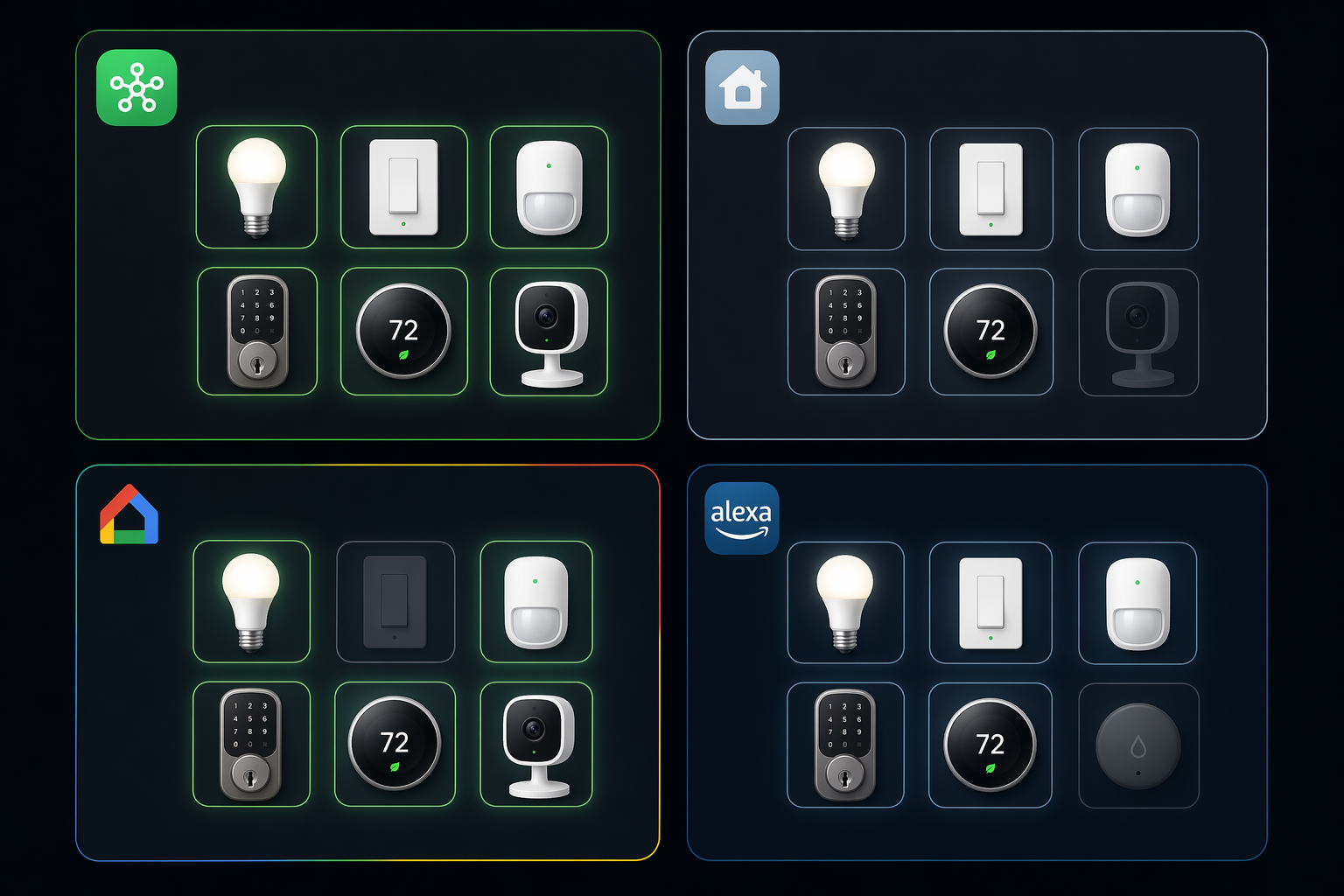
The phrase “supports Matter” still hides too much. A device can be certified, a platform can support Matter, and the buyer can still lose a capability in the app they actually use. Matter-smarthome.de’s 2026 platform comparison captures the practical split: SmartThings leads with full Matter 1.5 support, Apple Home is strong but selective, Google Home still does not expose generic switches, and Alexa lacks leak sensor support.[2]
| Platform | Mid-2026 Matter Position | Practical Caveat |
|---|---|---|
| SmartThings | Leads with full Matter 1.5 support. | Still depends on individual device firmware and app exposure. |
| Apple Home | Strong Matter support with a selective implementation style. | Best experience depends on supported Home hubs and the device categories Apple exposes well. |
| Google Home | Broad Matter role, but still missing generic switch exposure. | Some certified devices may pair but not appear or behave as expected in Google Home. |
| Alexa | Matter support remains useful but incomplete. | Leak sensors are not supported in the cited mid-2026 comparison. |
This is the part buyers usually discover too late. The standard can define a device type, but the app still has to expose it usefully. A generic switch that is visible in one platform and absent in another is not a philosophical interoperability problem; it is a Saturday afternoon problem. The same goes for sensors whose basic state appears but whose extra attributes are missing, or for devices that pair into one fabric cleanly and then become awkward when shared.
Apple Home users should check hub hardware and category support before assuming every Matter feature has landed; the details belong in a platform-specific guide such as Apple Home and Matter 2026: Hardware, Setup, and Gaps. Google users should be just as careful about the controller-versus-device distinction, especially with Nest hardware; Google Nest Matter Controllers vs Devices: What’s the Difference? covers that split. If a device simply refuses to appear in Google Home, troubleshooting starts with the controller, fabric, firmware, and network path, not with the assumption that certification failed; see Matter Device Not Showing in Google Home? Start Here.
For many households, the best Matter platform is not the one with the cleanest marketing page. It is the one that exposes the device categories they own, has the right always-on controllers, includes Thread border routers where needed, and plays nicely with whatever else is already installed. A broader platform comparison is useful before committing a whole home to one control layer; see Which Matter Smart Home App Should You Use in 2026? for that decision.
The Failures Are Still Useful Evidence
The case against premature celebration is not theoretical. XDA’s first-hand account of Matter disappointment describes the familiar pattern: devices that should be easier to adopt still create confusion around setup, reliability, app support, and the gap between what the standard promises and what ecosystems expose.[6] That kind of report should not be read as proof that Matter is doomed. It should be read as a reminder that interoperability standards mature through boring consistency, not through certification announcements.
The March 2026 IKEA situation is an even sharper warning. 9to5Mac covered Matter-over-Thread failures affecting IKEA smart home products, framing the episode as a sign of a larger Matter problem.[7] Because that report was published in March 2026, firmware updates or platform changes may have improved some behavior since then. The lasting point is narrower and more useful: when Matter-over-Thread fails, the buyer often has to understand device firmware, Thread mesh health, border routers, controllers, and platform exposure all at once.
That is precisely the support burden Matter is supposed to remove. Early adopters can tolerate logs, reset sequences, and forum archaeology. Mainstream buyers generally cannot, and should not have to. If a leak sensor misses support in one platform, a generic switch is invisible in another, and a Thread device behaves differently depending on which border router takes the lead, the standard is improving the industry architecture before it fully improves the customer experience.
Why Zigbee and Z-Wave Still Deserve Respect
Matter is strategically more important than Zigbee or Z-Wave because it is where the major consumer platforms, chip vendors, and device makers are concentrating the cross-ecosystem future. That does not make older protocols obsolete in working homes. Zigbee in particular remains hard to dismiss for battery-powered sensors and mature mesh behavior.
Howmation’s 2026 Zigbee-versus-Matter comparison cites the Aqara FP300 as an example where the Zigbee version is rated for about three years of battery life, compared with about two years for the Thread version.[8] One product comparison is not a universal law, but it captures a practical pattern many installers already respect: a stable Zigbee sensor network can be boring in exactly the right way.
Z-Wave has a different profile. Silicon Labs emphasizes Z-Wave’s established ecosystem, sub-GHz operation, and role in professionally installed or reliability-focused smart homes.[9] US buyers should remember that Z-Wave’s regional frequency model is part of the story; hardware is not as globally interchangeable as Wi-Fi-based expectations might suggest. Still, for locks, sensors, and long-lived installations, Z-Wave’s installed base remains relevant.
Zigbee 4.0 and SUZI deserve watching, but not overclaiming. Announced specification improvements are not the same as shipping products proving better range, reliability, or interoperability in ordinary homes. The same caution applies to Matter 1.6. Specifications point the way; installed devices prove the way.
What the Matter Badge Should Mean to a Buyer in Q3 2026
The Matter badge is now a positive signal, not just a future-facing sticker. It means the product is part of a large and growing certification ecosystem. It likely reduces the risk of being trapped in one platform, especially in mainstream categories. It also means the product may be shareable across ecosystems in a way older single-platform devices were not.
It does not mean every feature will appear in every app. It does not mean a Thread device will work without a suitable border router. It does not mean a camera’s recording features, AI detection, or cloud history will behave the same way across platforms. It does not mean the device’s firmware is mature. And it definitely does not mean a reliable Zigbee or Z-Wave installation should be ripped out on principle.
- For lights, plugs, simple switches, basic sensors, and supported locks, Matter is increasingly safe for mainstream buyers.
- For Thread devices, confirm that the home has a compatible, always-on Thread border router; Apple users can start with Which Apple TV Models Work as a Matter Hub?.
- For cameras, energy devices, appliances, and advanced thermostats, check both Matter version support and platform implementation.
- For multi-platform homes, verify multi-admin behavior before buying many copies of the same device.
- For existing reliable Zigbee or Z-Wave systems, add Matter where it solves a real compatibility problem rather than replacing everything at once.
The practical buying test is no longer “Does Matter exist for this category?” It is “Does my platform expose the parts of this Matter device I care about, on the hardware I already own, with firmware that other people are not still debugging in public?” That is a less elegant question than the standard’s promise, but it is the one that keeps a smart home from becoming unpaid QA work.
The Mid-2026 Verdict
Matter has crossed an important line. With thousands of inclusive certified listings, more than 50 categories, Thread 1.4 cleanup, Matter 1.5’s camera and energy additions, and Matter 1.6’s setup and multi-ecosystem improvements, it is no longer fair to treat the standard as vapor or as a launch-era experiment. The smart home industry is genuinely organizing around it.
It is also not fair to tell buyers that the “just works” era has arrived. Platform support remains uneven, newer features need implementation time, and real-world failures still land too much diagnosis work on the person who only wanted a sensor, lock, camera, or thermostat to behave. In Q3 2026, Matter is worth taking seriously and is increasingly safe in well-supported categories and ecosystems. It is not yet a reason to discard reliable Zigbee or Z-Wave systems, and it is not a guarantee that every Matter-certified device will behave identically in Apple Home, Google Home, SmartThings, and Alexa.
References
- Matter Alpha, Matter Categories
- matter-smarthome.de, The Matter Standard in 2026: A Status Review
- Connectivity Standards Alliance, Matter 1.5 Introduces Cameras, Closures, and Enhanced Energy Management Capabilities
- Connectivity Standards Alliance, Matter 1.6 Enables More Intuitive Setup, Multi-Ecosystem Experiences, and Context-Driven Control
- matter-smarthome.de, The Matter Innovations at CES 2026
- XDA Developers, Matter made me doubt the future of smart homes
- 9to5Mac, IKEA smart home failings point to a major problem with Matter, March 18, 2026
- Howmation, Should You Switch from Zigbee to Matter in 2026? What to Really Choose for Your Smart Home
- Silicon Labs, Matter vs Z-Wave: What You Need to Know
Updates & Corrections
Protocol specifications and platform features change rapidly — especially with Matter version evolution. Report version changes, certification count updates, or platform policy changes that have occurred since the last editorial review.
Comments
Join the discussion with an anonymous comment.