
Google Nest Hub (2nd Gen) Device Profile – Specs, Platforms, and Trade-Offs
This device profile covers everything the pre-purchase researcher needs to know about the Google Nest Hub (2nd Gen) – formerly the Google Home Hub – including its specifications, Matter controller and Thread border router capabilities, Soli sleep sensing, and a balanced assessment of whether this unrefreshed display still makes sense in 2026.
Last updated
If you searched for google home hub, the first thing to sort out is the box. Google Home Hub was the 2018 product name. Google renamed that line to Google Nest Hub in May 2019, and the device in this profile is the later Google Nest Hub (2nd Gen), launched in 2021—not the original 1st-gen Hub and not the larger Nest Hub Max.[1]
That distinction matters more than it sounds. The 2nd Gen model keeps the same small-display idea, but it adds a Soli radar sensor for contactless sleep tracking, improves the speaker, includes an 802.15.4 radio for Thread, and serves as both a Matter controller and Thread border router in Google Home. In Q3 2026, it is not a fresh device. It is a still-useful one, if the buyer wants a compact Google Home screen and understands where the age shows.
The Exact Device: Google Nest Hub (2nd Gen)
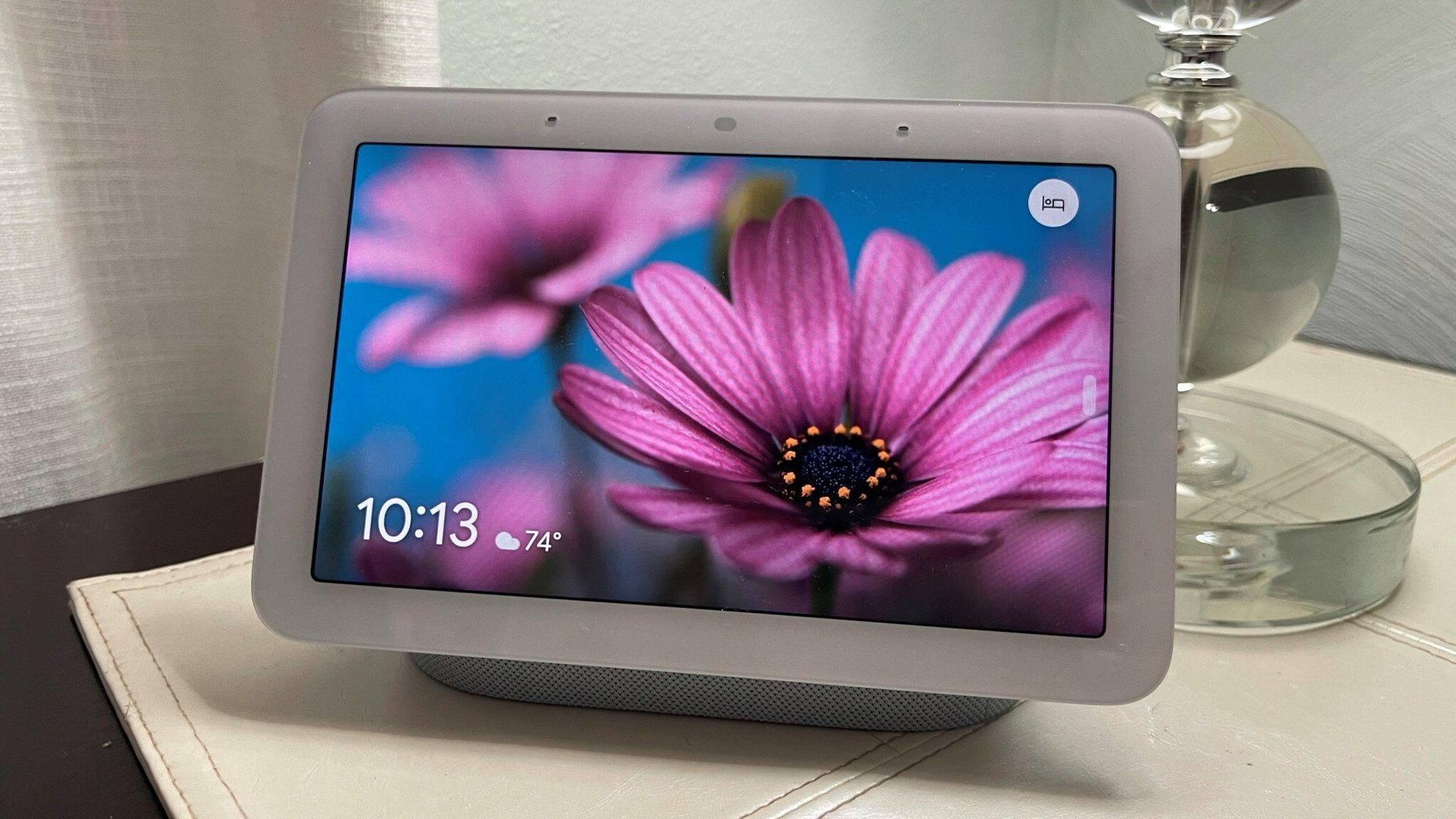
The Google Nest Hub (2nd Gen) is the small, camera-free Nest smart display with a 7-inch touchscreen, fabric-covered speaker base, Google Assistant, Soli sleep sensing, and smart-home hub functions. It is commonly mixed up with three nearby products: the 2018 Google Home Hub, the renamed 1st-gen Google Nest Hub, and the 10-inch Nest Hub Max.
| Name a buyer may see | What it means | Why it matters |
|---|---|---|
| Google Home Hub | Original 2018 name for the first-generation 7-inch smart display | Older hardware; not the 2021 model covered here |
| Google Nest Hub | Can refer to the renamed 1st-gen device or the product family | Check whether the listing says 2nd Gen |
| Google Nest Hub (2nd Gen) | 2021 7-inch model with Soli and Thread radio | The compact model still worth evaluating in 2026 |
| Google Nest Hub Max | Larger 10-inch model with a camera | Better for video calls; less private and more expensive |
For secondhand listings, open-box deals, and marketplace photos, the phrase “Nest Hub” by itself is not enough. The safest label is “Google Nest Hub (2nd Gen).” If the listing talks about Sleep Sensing or Soli, that points to the 2021 model. If it says Google Home Hub, it is usually the 2018 device unless the seller is using the old name loosely.
Specifications That Still Decide the Purchase
The official spec sheet gives the Nest Hub (2nd Gen) a 7-inch 1,024×600 display, a quad-core 64-bit 1.9 GHz ARM CPU with a dedicated machine-learning hardware engine, a 43.5 mm full-range speaker driver, three far-field microphones, 802.11b/g/n/ac Wi-Fi on 2.4 and 5 GHz, Bluetooth 5.0, Chromecast built in, and 802.15.4 support for Thread.[2]
| Spec | Google Nest Hub (2nd Gen) |
|---|---|
| Display | 7-inch touchscreen, 1,024×600 resolution |
| Processor | Quad-core 64-bit 1.9 GHz ARM CPU with dedicated ML hardware engine |
| Speaker | 43.5 mm full-range driver, advertised as 50% more bass than 1st gen |
| Microphones | Three far-field microphones |
| Wireless | 802.11b/g/n/ac Wi-Fi, 2.4/5 GHz; Bluetooth 5.0 |
| Smart-home radio | 802.15.4 for Thread |
| Camera | None |
| Power | Plug-in smart display; not a battery tablet |
The 7-inch display is the whole personality of the product. It is large enough for glanceable weather, timers, music controls, camera feeds, smart-home tiles, and a bedside clock. It is not large enough to feel like a kitchen TV, a serious recipe screen across the room, or a shared family dashboard from across an open-plan space. If that sounds like a defect, the Nest Hub Max is the more natural comparison. If it sounds like relief, the smaller Hub is doing its job.
The speaker spec also needs a realistic reading. Google says the 2nd Gen model has 50% more bass than the 1st-gen Nest Hub, and that makes it more credible for casual music, alarms, podcasts, and spoken responses.[2] It is still a compact smart display, not a living-room speaker. The win is that it sounds good enough to avoid needing a separate bedside smart speaker in many rooms.
The three far-field microphones matter because a smart display that misses commands becomes decorative very quickly. They support the expected Google Home jobs: setting timers, controlling lights, asking for weather, starting routines, playing music, and pulling up compatible camera feeds. There is also a physical mic switch, which is the sort of small part that becomes important only after the device moves from a demo table to a bedroom.
Matter and Thread Make It More Than a Bedside Screen
The most underrated line in the Nest Hub (2nd Gen) profile is the 802.15.4 radio. Google lists the device as both a Matter controller and a Thread border router, which means it can help set up and control Matter devices in Google Home and bridge Thread devices onto the home network without relying on a cloud relay for every interaction.[3]
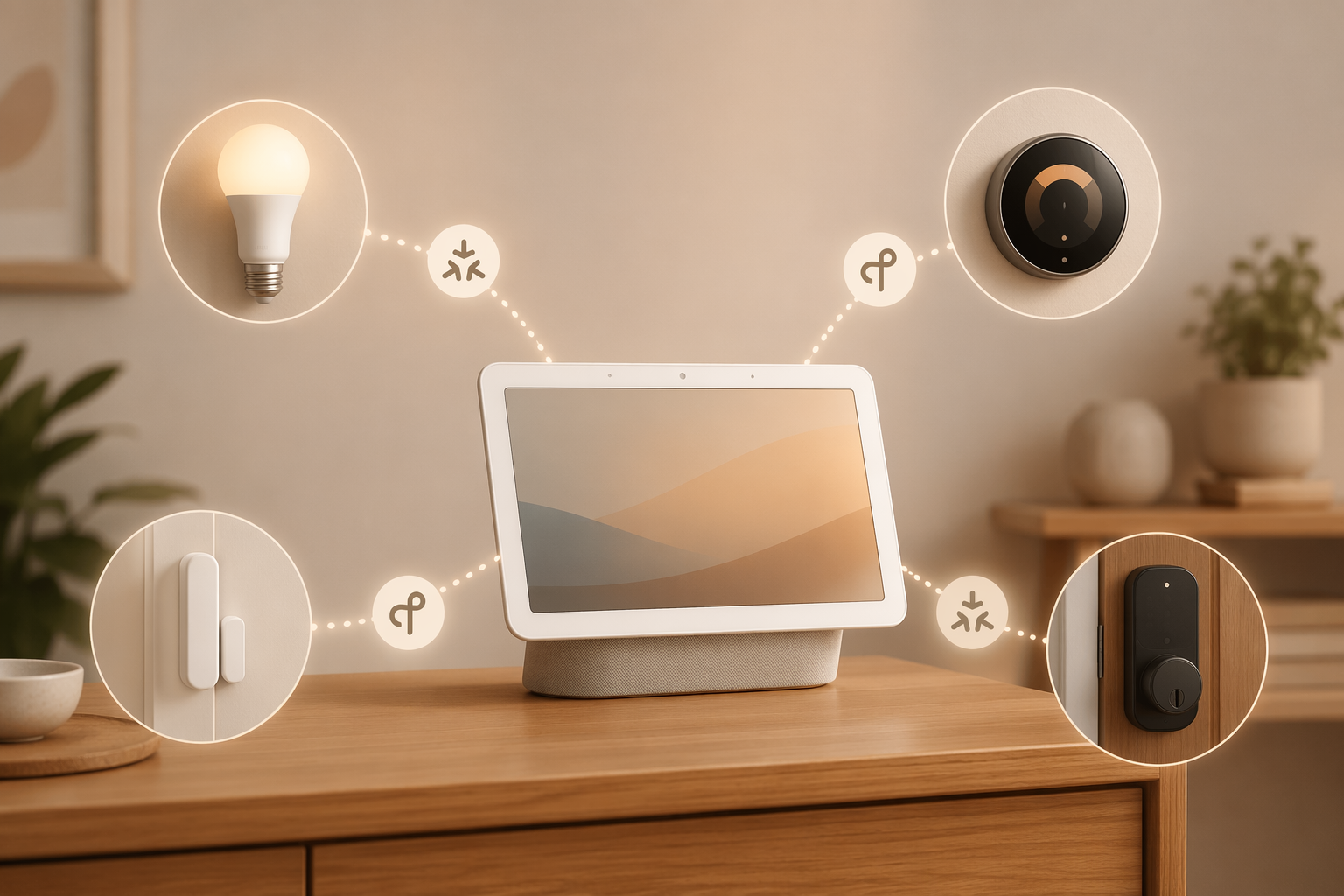
That does not make the Nest Hub a universal home-automation brain. It is still a Google Home device first. For a household already choosing Google Home, though, the hub role changes the purchase from “small screen with an assistant” to “small screen that also supports the smart-home fabric.” A buyer comparing hubs should treat that as a real infrastructure feature, not a bonus bullet. For a broader view of those roles, see our Best Home Automation Hub 2026 guide and the separate Home Automation Hub Protocols Explained reference.
The practical consequence is simple: if you plan to add Thread-based sensors, locks, switches, or other Matter-over-Thread devices, you need a Thread border router somewhere. The Nest Hub (2nd Gen) can be that “somewhere” while also sitting on a nightstand or counter. If your home is centered on Apple Home, Amazon Alexa, Home Assistant, or a dedicated controller, its value changes. It may still be useful, but it is no longer the obvious hub.
Matter support also needs one boundary. A Matter controller role helps with compatible Matter devices inside Google Home; it does not guarantee that every feature exposed by every device will appear exactly as it does in the manufacturer’s own app. For buyers who are comparing Google’s Matter role with local-first systems, our Best Matter Hubs for Home Assistant 2026 comparison is the better rabbit hole.
Soli Sleep Sensing Is the Distinctive Feature
The Nest Hub (2nd Gen) has one feature that still feels unusually specific: Sleep Sensing. Instead of using a camera or a wearable, it uses Google’s Soli radar sensor to detect movement and breathing patterns from a nightstand position. Security.org’s 2026 review says the radar sensor was validated against sleep lab studies with “no statistical difference,” using more than 100,000 nights of training data from about 15,000 participants.[4]
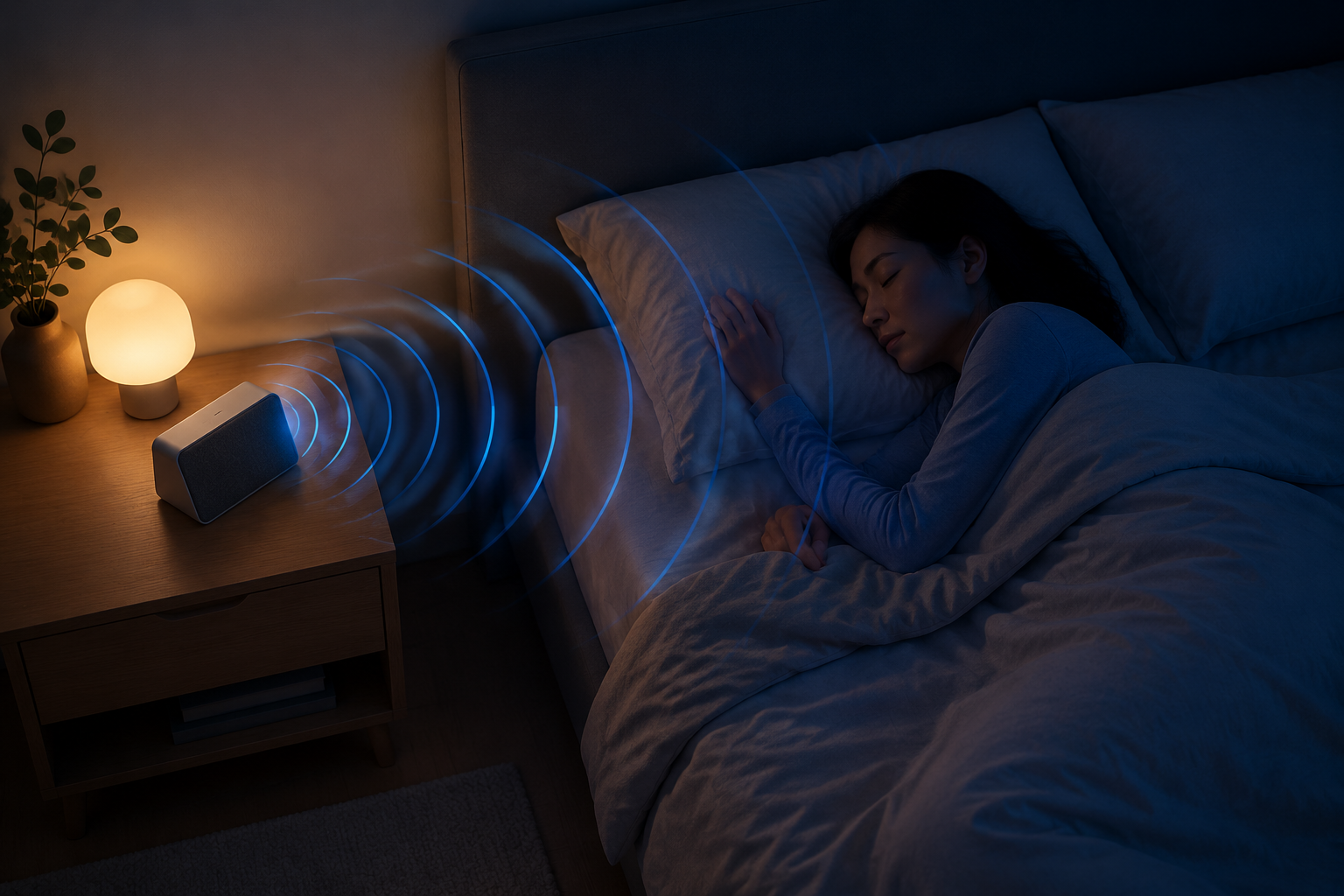
That is the feature most likely to justify choosing this over a plain smart speaker. A phone on the mattress is easy to forget. A smartwatch needs charging and wearing. The Nest Hub sits where an alarm clock would sit and quietly builds a sleep summary. For someone who wants trend-level sleep feedback without a camera in the room, that combination remains rare.
The paywall history is the part to read twice. Security.org describes Sleep Sensing as not requiring a subscription at the time of its review.[4] Earlier reviews from PCMag and CNET noted that Google had expected Sleep Sensing to eventually require Fitbit Premium.[5][6] The narrow, safe conclusion is that buyers should not treat “free forever” as a settled specification. It may be included now, but its long-term packaging has had enough ambiguity to be a buying risk.
There is also the ordinary limitation of any contactless sleep setup: placement matters. The Hub has to see the sleeper from the nightstand. It is not a medical device, it does not replace a sleep study, and it will not suit every bed layout. But for the intended job—low-friction sleep trends in a Google Home bedroom—it is still the feature that gives the 2nd Gen Hub a reason to exist beyond timers and weather.
No Camera Is Both the Comfort and the Catch
The Nest Hub (2nd Gen) has no camera. On a nightstand, that is easy to appreciate. It can show the time, listen for commands, run alarms, display sleep data, and control devices without putting a lens beside the bed. For privacy-conscious buyers, this is not a missing feature disguised as a virtue; it is a real design reason to choose the smaller Hub.
The trade-off is just as real. No camera means no video calling from the display and no camera-based room monitoring. The Nest Hub Max is the Google smart display for those jobs, and Business Insider’s comparison places the Nest Hub Max at $229 versus $99.99 for the Nest Hub (2nd Gen), a $130 gap.[7] That price difference is large enough that the camera question should be settled before checkout, not after the box is opened.
If the real use case is checking on a room, a dedicated camera is the cleaner tool. In Google’s ecosystem, our Google Nest Cam Indoor Wired (3rd Gen) Device Profile is the more relevant device profile. A smart display can show camera feeds; it should not be mistaken for a camera when it does not have one.
Everyday Use: Small, Useful, and Not Trying to Be a Tablet
Most Nest Hub jobs are ordinary, which is not an insult. It can sit in the kitchen and show timers, recipes, music controls, weather, shopping lists, and compatible camera feeds. It can sit in the bedroom and act as an alarm clock, speaker, sleep tracker, and smart-light controller. It can sit near an entryway and give quick access to Google Home controls. Those are not glamorous reasons to buy hardware in 2026, but they are the reasons a device stays plugged in.
It is also not a replacement for an old tablet in every home. A tablet gives you a full browser, app choice, battery power, and a more flexible interface. The Nest Hub gives you a purpose-built always-on docked display with voice control, smart-home integration, and no battery-management chore. If that comparison is still open, read Smart Display vs. Old Tablet before assuming the cheaper device in a drawer is the better dashboard.
The 2026 Relevance Check
The awkward part of the Nest Hub (2nd Gen) is not performance on paper. It is calendar age. The device launched in 2021 with a $99.99 price, and that is still the familiar MSRP in current comparisons.[5][7] As of Q3 2026, Google has not announced a direct Nest Hub display successor. The existence of newer Google speakers does not solve that; a speaker is not a camera-free bedside display with Soli and Thread.
Third-party reviewers have not abandoned it. PCMag’s 2026 smart display coverage still lists the Nest Hub (2nd Gen) as “Best for Gemini Users” with an Editors’ Choice 4.0 rating.[8] That does not make it future-proof. It does suggest that the device still occupies a practical slot in the current Google display lineup rather than surviving only on leftover inventory.
There are two confidence issues worth separating. First, Android Authority reported in 2025 that a firmware update bricked some 1st-gen Nest Hub smart displays.[9] That report concerns the 1st-gen device, not the 2nd Gen model profiled here, but it still affects how cautious buyers think about long-term Google smart-display support. Second, the Google Assistant-to-Gemini transition remains unsettled. Android Police has argued that Google’s current “Gemini-ification” of the smart home causes more problems than it solves for now, and its call for a new Nest Hub is commentary rather than a Google roadmap.[10]
Those risks do not erase the Nest Hub’s present usefulness. They do change the buying posture. This is not a device to buy because it feels new. It is a device to buy because the exact combination—small screen, no camera, Soli sleep tracking, Matter controller, Thread border router, Google Home surface—matches the room you are trying to equip.
Who Should Still Buy It
- Buy it if you want a compact Google Home display for a bedroom, kitchen counter, desk, or entryway.
- Buy it if the lack of a camera is a privacy advantage, especially on a nightstand.
- Buy it if Soli Sleep Sensing is genuinely useful to you and you accept the subscription uncertainty.
- Buy it if you need a Google Matter controller and Thread border router in a room where a display also helps.
- Buy it if you are already committed to Google Home and want the simplest small-screen option rather than a more open but more fiddly dashboard.
Who Should Skip or Wait
- Skip it if video calling is a primary use case; the Nest Hub (2nd Gen) has no camera.
- Skip it if you want the largest Google smart display; the Nest Hub Max is the closer fit.
- Wait if buying five-year-old display hardware bothers you and your current setup is good enough.
- Wait if the Gemini transition feels like a deal-breaker until Google’s smart-home behavior is clearer.
- Skip it if you are building around a non-Google ecosystem and only need Matter or Thread infrastructure.
Verdict
The Google Nest Hub (2nd Gen) remains the sensible Google smart display for most compact-display and bedside use cases in 2026. Its best qualities are specific rather than flashy: a 7-inch screen that fits where larger displays do not, no camera, Soli sleep tracking, enough speaker for casual use, three far-field mics, Matter controller support, and Thread border-router capability.
The caution label belongs on the same shelf as the product. It is unrefreshed hardware from 2021, Sleep Sensing’s long-term subscription status has been ambiguous, and the Gemini transition has not yet turned into a clean upgrade story for every smart-home user. Buyers who need video calls, want a fresher display, or can comfortably wait for a possible successor have good reasons to choose differently. Buyers who want the small Google display that still does several quiet jobs well can still justify the Nest Hub (2nd Gen).
References
- Google Nest (smart speakers), Wikipedia
- Nest and Home device specifications, Google Support
- Prepare your smart home for Matter, Google Help
- Google Nest Hub Review 2026, Security.org
- Google Nest Hub (2nd Gen) Review, PCMag
- Google Nest Hub (2nd gen) review: More for your money, CNET
- Google Nest Hub (2nd Gen) vs Nest Hub Max comparison, Business Insider
- The Best Smart Displays for 2026, PCMag
- Something is bricking Nest Hub smart displays, Android Authority
- The case for a new Google Nest Hub in 2026, Android Police
Known issues with this device / protocol
Spec-version history
For active regressions on this protocol, see Update Watch.
No linked Update Watch entries yet.