What $120 Gets You — And What It Doesn't
A starter kit with four color bulbs and the standard Bridge costs $119.99 on Amazon. That sounds like a deal until you add the rest of the house. Ten bulbs push you past $400, and the Bridge in that box tops out at 50 lights. The purchase isn't a gadget; it's an ecosystem entry fee.
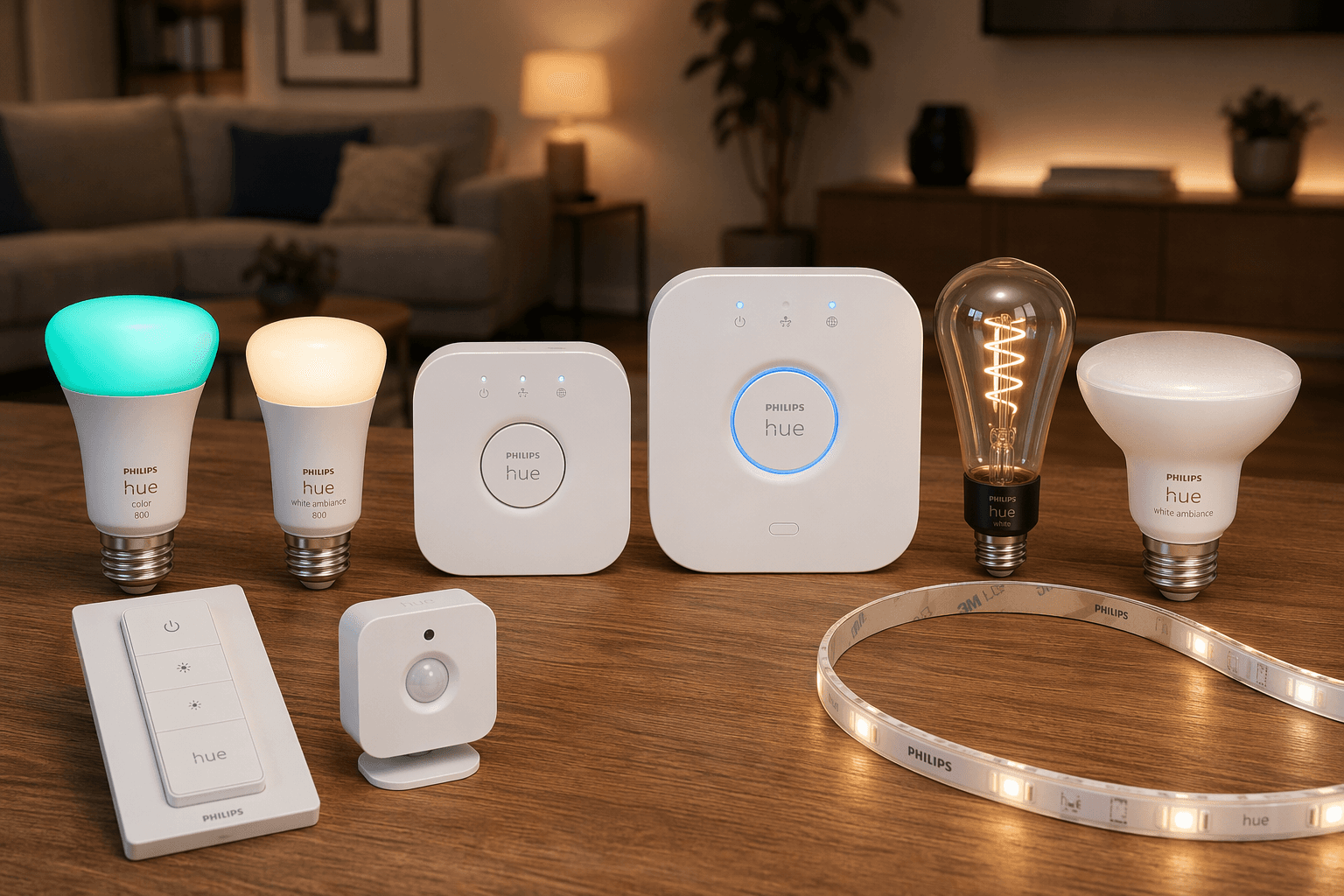
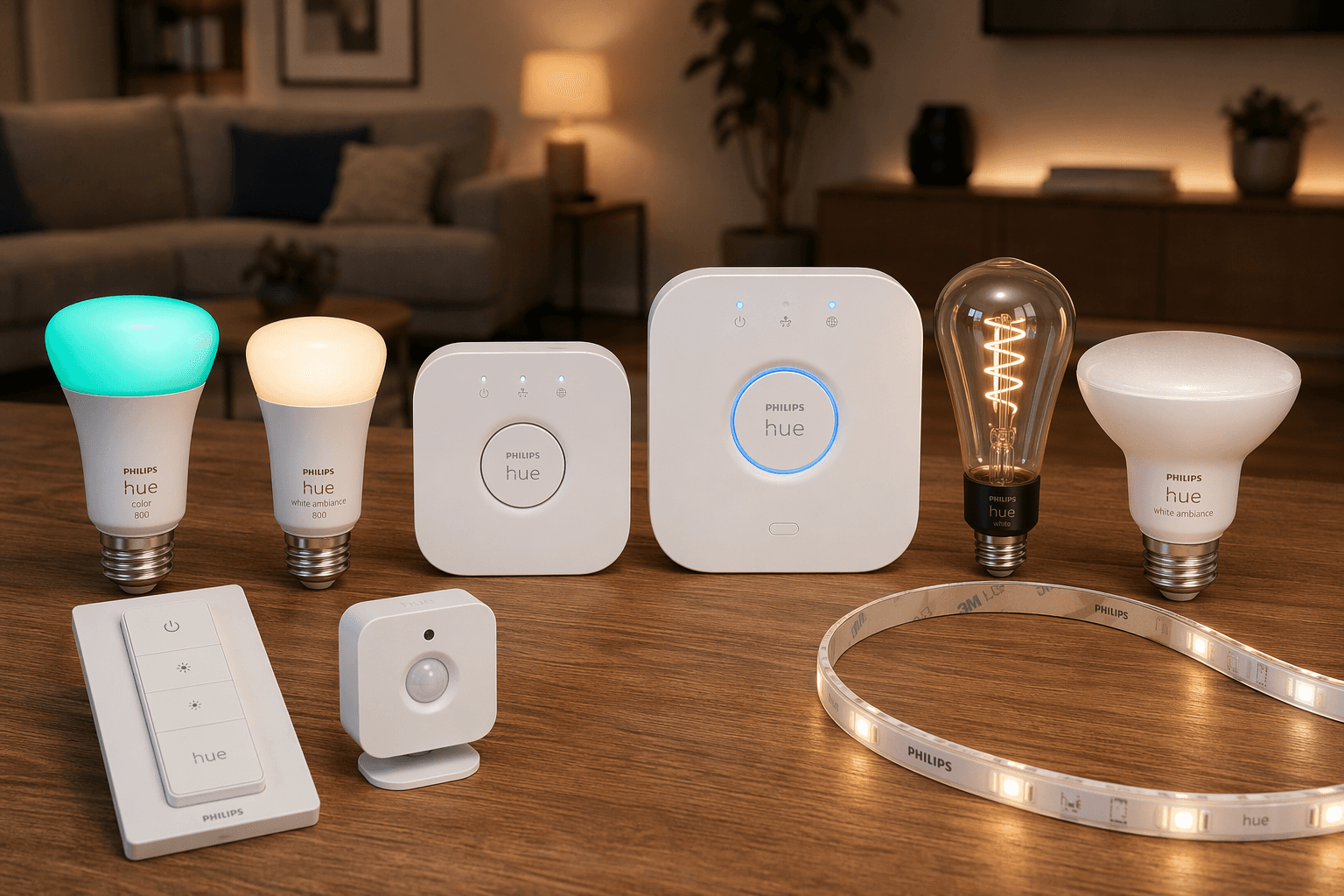
Philips Hue launched on October 29, 2012 — the first commercially available smart bulb. Thirteen years later it has three bulb tiers, two bridge options, Matter support, and a catalog of fixtures, strips, switches, sensors, and a Sync Box. No other platform covers this much ground. But that breadth comes at a price, and the question is whether the premium buys real reliability or just a recognizable logo.
Three Bulb Tiers, Same Bridge Decision
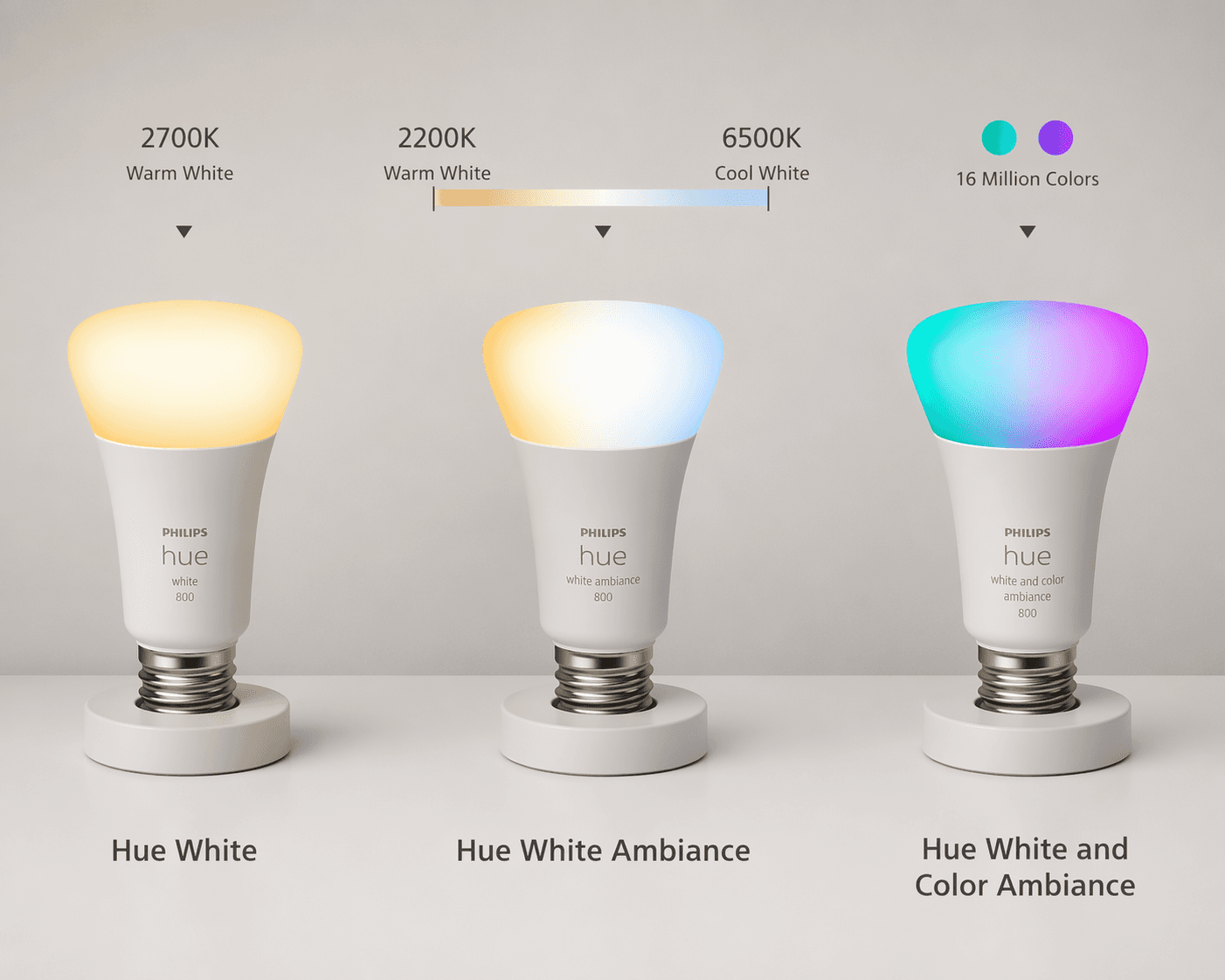
Not every Hue bulb costs $50. The lineup splits into three tiers, and you can mix them within the same room: White ($15, fixed 2700K), White Ambiance ($25–30, 2200K–6500K), and White + Color Ambiance ($50–60, 2000K–6500K plus 16 million colors). If you only need adjustable white, the Ambiance tier saves $25–30 per bulb. For a ten-bulb home, that's $250–300. The color bulbs do produce up to 1600 lumens (from iConnectHue's independent testing), so you aren't sacrificing brightness by going cheaper.
But the savings picture changes when you factor in the Bridge. Bluetooth mode — no hub — caps you at ten bulbs within 30 feet, no accessories, no remote control outside the room. That's fine for a single lamp. It is not a substitute for a Bridge.
| Tier | Color Range | Typical Price per Bulb | Best For |
|---|---|---|---|
| White | 2700K fixed warm | $15 | Hallways, closets, utility rooms |
| White Ambiance | 2200K to 6500K | $25–30 | Living rooms needing adjustable warmth without color |
| White + Color Ambiance | 2000K to 6500K + 16M colors | $50–60 | Entertainment, accent lighting, full control |
The standard Bridge ($69.99) supports 50 lights and 12 accessories. The Bridge Pro ($139.99 officially) supports 150+ lights and 50+ accessories, with a quad-core 1.7 GHz processor, 8 GB RAM, Wi-Fi, and MotionAware — a software feature that uses at least three bulbs to detect motion without a dedicated sensor. Ninety-five percent of existing Hue bulbs are compatible with MotionAware via a software update. For most homes the standard Bridge is enough. The Pro makes sense if you're lighting a large house and want motion-activated scenes without extra sensors.
| Feature | Bluetooth Only | Standard Bridge | Bridge Pro |
|---|---|---|---|
| Max lights | 10 | 50 | 150+ |
| Max accessories | 0 | 12 | 50+ |
| Range | ~30 ft | Mesh network (entire home) | Mesh network + Wi-Fi fallback |
| Motion detection | No | No | Yes (MotionAware) |
| Price | Free (bulb included) | $69.99 | $139.99 |
For step-by-step installation after you choose your Bridge, see the Smart Light Bulb Setup Guide.
Matter: The Fine Print
Matter support is a big selling point, but it isn't uniform. Both Bridges received a software update that makes every bulb connected through them Matter-compatible. If you already own older bulbs, you don't need to replace them — just keep the Bridge.
Newer bulbs with the Matter logo can also connect directly via Matter-over-Thread, but that requires a Thread Border Router — an Apple HomePod Mini, Amazon Echo (4th gen), or Google Nest Hub — hardware you may not own. Without that router, those bulbs still need the Bridge. So "no hub needed" only works if you buy new bulbs and already have the right router.
Platform Compatibility: No Workarounds Needed
Hue works natively with Alexa, Google Assistant, Apple HomeKit, Samsung SmartThings, and all Matter-certified platforms. No separate bridges for each assistant. That's the main reason ecosystem-loyal users choose Hue over cheaper brands that require flaky third-party integrations.
If you use Apple HomeKit: the Hue Bridge is not a HomeKit hub — it's a bridge. That distinction matters for remote access and automations. See the Apple HomeKit Hub vs Bridge explainer for a clear breakdown.
Energy Savings: The Self-Reported Numbers
A Philips-published study of over one million opted-in Hue bulbs across Europe found real-world energy savings of up to 37% compared to a manually controlled reference group. A separate blog post states that dimming a bulb to 70% reduces energy consumption by 51%. Both come from Signify itself. I would treat the 37% figure as a directional indicator, not a guarantee. Real-world savings depend entirely on how you use the lights. If you already turn off lights when leaving a room, the savings shrink. If you leave lights on all day and let automation dim them, the savings can be real. The dim-to-70% figure is harder to argue with — it's a physical property: lower brightness equals lower power.
Total Cost: Starter Kit to Full Home
The $119.99 starter kit leaves you with four bulbs for a living room. Here's what a typical ten-bulb home costs depending on the tier you choose:
| Scenario | Bulbs | Bridge | Total Cost |
|---|---|---|---|
| Starter Kit (4 color + Bridge) | 4 color | Standard | $119.99 |
| 10-bulb home, all color | 10 color (4 from kit + 6 at ~$50 each) | Standard | ~$420 |
| 10-bulb home, all White Ambiance | 10 Ambiance (~$28 each) | Standard | ~$280 |
| 10-bulb home, all color + Bridge Pro | 10 color | Bridge Pro | ~$490 |
| Bridge Pro Starter Kit (4 color + Bridge Pro) | 4 color | Bridge Pro | $289.99 |
The difference between a White Ambiance home and a full-color home is about $170 — enough to cover the Bridge Pro upgrade and still have money left. That's the kind of decision that makes sense to think through before buying the first bulb.
If Hue's premium stings, the Budget vs. Premium comparison guide shows where cheaper alternatives like Govee and IKEA cut corners — and where they actually deliver similar results for less.
Who Should Buy Hue — And Who Shouldn't
Buy Hue if you are a power user planning a large or multi-room system, if you are already in the Apple HomeKit ecosystem and want native compatibility, or if you want future-proofing through Matter and a platform that still receives firmware updates after 13 years.
Consider alternatives if you are a first-time buyer on a tight budget, if you only need a few bulbs for accent lighting in a small apartment, or if you just want color without the complexity of a hub. Govee, IKEA, and Lifx offer simpler setups at lower cost. They lack Hue's accessory ecosystem and long-term support, but for basic needs they work well enough.
For a broader view of where Hue fits in the 2026 smart home landscape, see the Best Smart Home Devices 2026: Category-by-Category Buyer's Guide.
Corrections & Community Notes
Spotted an outdated spec, changed compatibility, or new firmware behavior? Submit a correction below to help keep this profile current. For formal editorial updates, use the contact page.
Comments
Join the discussion with an anonymous comment.