
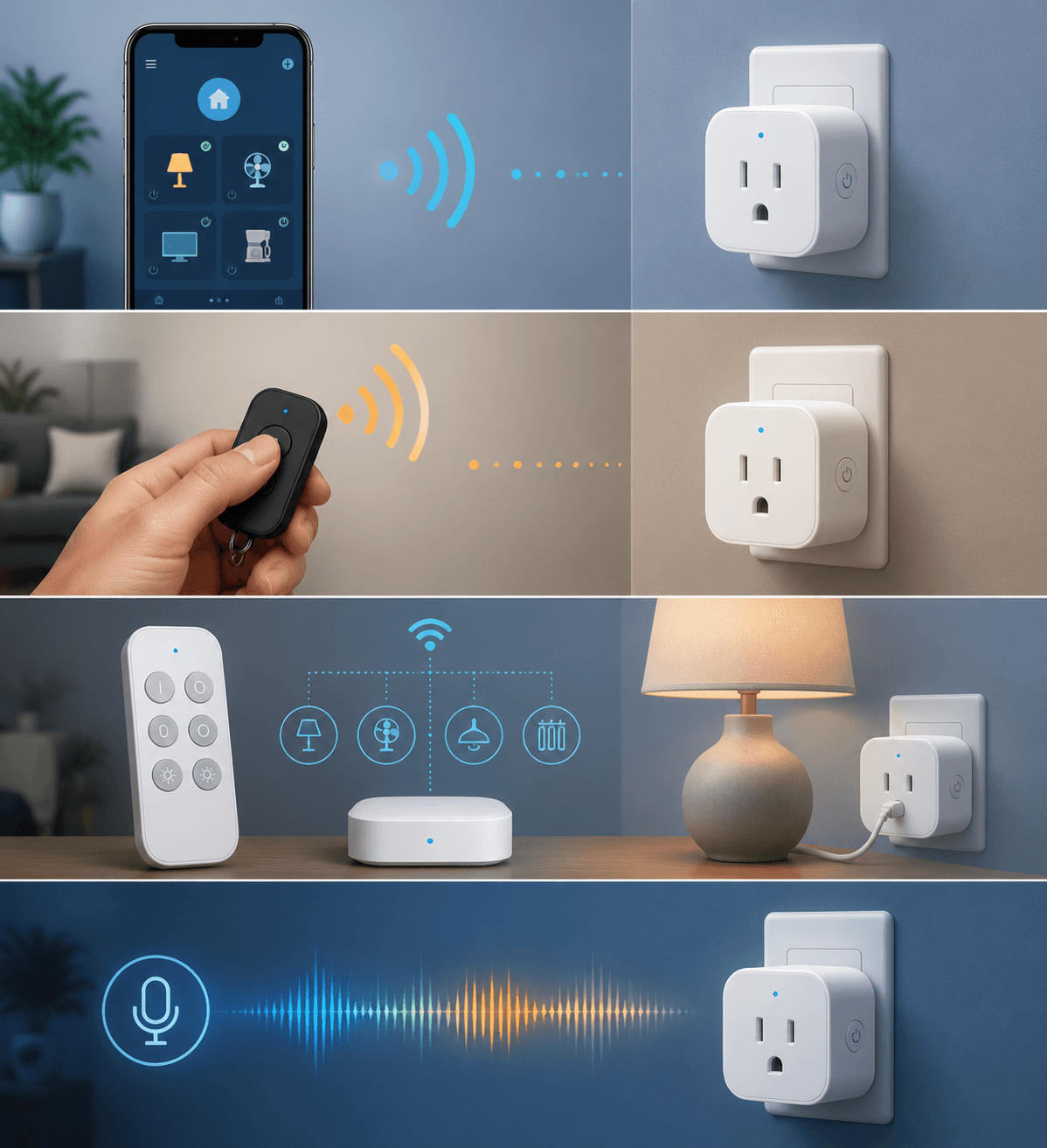
A smart plug with remote can mean four different products in 2026, and the difference matters more than the price tag. One buyer means a phone app. Another means a small clicker on the coffee table. Someone else wants a wall-mounted button for a lamp. A fourth person wants voice control without opening an app at all.
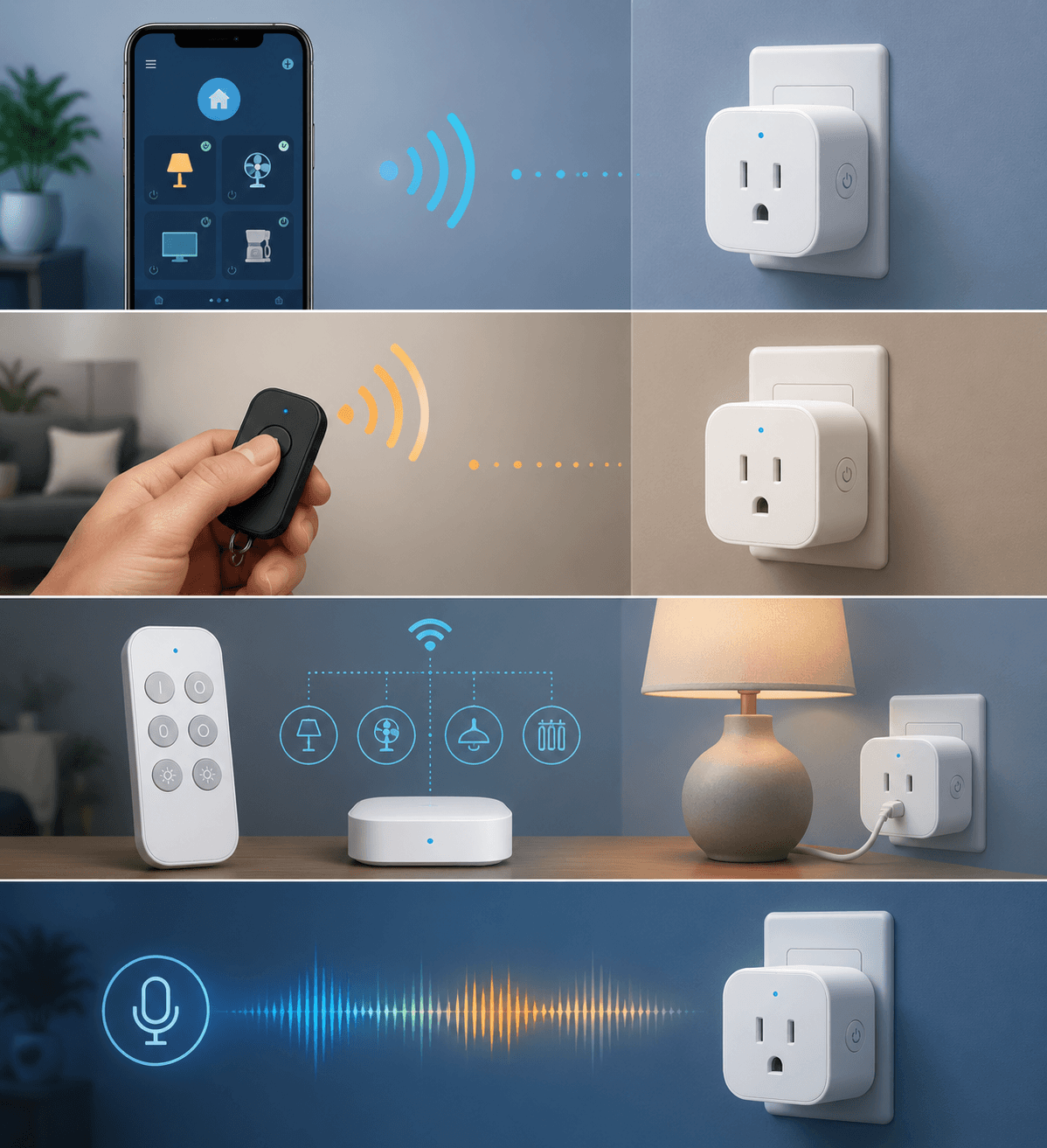
That is why the first choice is not brand. It is control method. A DEWENWILS 5-outlet kit with 2 remotes sits around $35, or about $7 per outlet, while a TP-Link Kasa EP25 4-pack is also around $35, or about $8.75 per plug.[1][2] Those are close enough that this is not a budget-versus-premium decision. It is a daily-use decision: who will turn the thing on, from where, and with how much patience for setup?
| Control method | What “remote” means | Best fit | Main trade-off |
|---|---|---|---|
| App-based Wi-Fi plug | Phone app, cloud access, often Alexa or Google voice | Schedules, away-from-home control, energy monitoring, automations | Requires setup, 2.4 GHz Wi-Fi, accounts, and troubleshooting tolerance |
| RF remote outlet | Physical clicker paired to outlet receivers | Lamps, holiday lights, mobility barriers, simple on/off control | Usually no app, voice assistant, energy data, or smart-home routines |
| Dedicated remote with expansion | Physical remote first, hub optional later | Households that want a real button now and app/voice later | Range, hub cost, and ecosystem limits need checking |
| Voice-first/app-free plug | Local voice command without phone control | Hands-free use where privacy or app avoidance matters | Narrower category with thinner availability evidence |
Start With The Person Who Has To Use It
For a tech-comfortable household, an app-based plug can be the clean answer. The phone becomes the remote, and the plug can follow schedules, work with voice assistants, and sometimes report energy use. If the user wants the porch lights on at sunset, a fan off after bedtime, or a coffee station controlled from outside the house, a plain clicker will feel underpowered quickly.
For a lamp beside a sofa, a holiday display, or a plug hidden behind furniture, a physical remote may be the better remote. The useful feature is not intelligence. It is that nobody has to bend down, unlock a phone, wait for an app to refresh, or remember which voice assistant name was assigned to the device.
That distinction is easy to miss because smart-home coverage often treats app control as the default kind of accessibility. Wirecutter’s aging-in-place guide recommends smart plugs so older adults can control lamps and fans without reaching or bending, but its recommended plug is the TP-Link Kasa EP25, an app-based Wi-Fi model.[3] That can be the right answer for some households. It is not the same answer as handing someone a labeled button that works without a phone.
App-Based Wi-Fi Plugs: Best When The App Is The Point
TP-Link Kasa EP25, Amazon Smart Plug, and Emporia-style plugs belong in the app-first group. These are the plugs to look at when the job includes scheduling, remote access away from home, voice assistant integration, or energy monitoring. PCMag lists the Kasa EP25 among its 2026 smart plug picks and notes the EP25 4-pack pricing around $35.[2] CNET’s 2026 smart plug coverage treats app and voice control as the normal center of the category, which is fair for households already comfortable with Wi-Fi devices.[4]
The setup burden is the cost of those features. Most Wi-Fi smart plugs require a 2.4 GHz Wi-Fi network, an app, account setup, pairing, naming, and occasional troubleshooting when a router, password, phone, or firmware update gets involved. For someone who already uses Alexa routines, that is ordinary maintenance. For someone who only wanted to turn on a lamp from bed, it can be a lot of machinery around a simple switch.
The Kasa EP25 makes sense when the household wants more than on/off. It fits the buyer comparing Alexa-compatible smart plugs, the person building routines from Alexa smart plug automation recipes, or the HomeKit user who first needs to compare platform support in HomeKit smart plug options. It is less satisfying when the primary user does not keep a phone nearby or cannot comfortably manage app screens.
Amazon’s first-party plug is even more clearly aimed at Alexa households. It is worth considering when the buyer has already chosen that ecosystem and wants a direct path into voice and routines. A household still deciding between Alexa, Google, HomeKit, or a hub-based setup should settle that platform choice before buying a drawer full of plugs; the broader smart home platform decision guide is the more useful stop at that point.
RF Remote Outlets: Not Really Smart Plugs, But Often The Right Tool
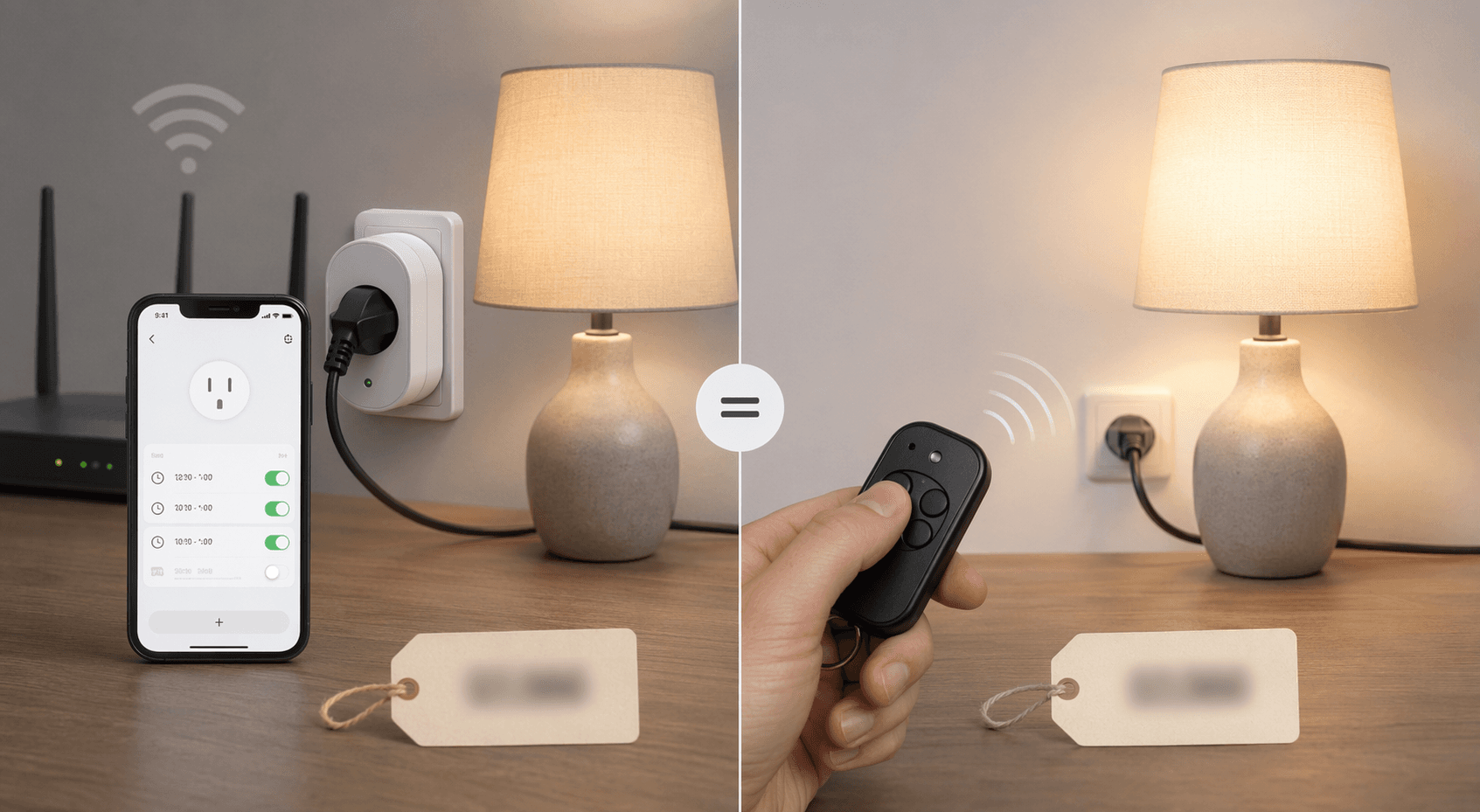
RF remote outlet kits from DEWENWILS and BN-LINK solve a different problem. They are usually not smart plugs in the app-and-automation sense. They are outlet receivers controlled by a radio remote. Press one button and the plugged-in lamp, string light, or fan turns on. Press another and it turns off.
The DEWENWILS HRS205S kit is the useful concrete example: 5 outlets, 2 remotes, around $35, 15A/1800W per outlet, and FCC listing on the product page.[1] DEWENWILS states a 200-foot open-area range and about 100 feet through walls, but that is a manufacturer claim, not a lab guarantee; walls, metal, appliances, and RF interference can all shorten real-world range.[1]
What the kit lacks is just as important. You do not get app scheduling, away-from-home control, voice assistant integration, energy charts, or hub automation. If those are the reasons you searched for a smart plug, an RF kit will disappoint you. If the actual job is “make this hidden outlet usable without bending down,” the missing cloud features may not matter at all.
This is where the near-price match with Kasa is clarifying. Around the same shelf price buys either app-based control for four Wi-Fi plugs or physical clicker control for five outlet receivers.[1][2] The better purchase is the one that removes the daily obstacle. For a renter setting up seasonal lights, a family member helping an older adult with a hard-to-reach lamp, or someone who wants a workshop light controlled from the doorway, the RF remote may be the less glamorous and more usable choice.
Dedicated Remotes That Can Grow Into A Smart System
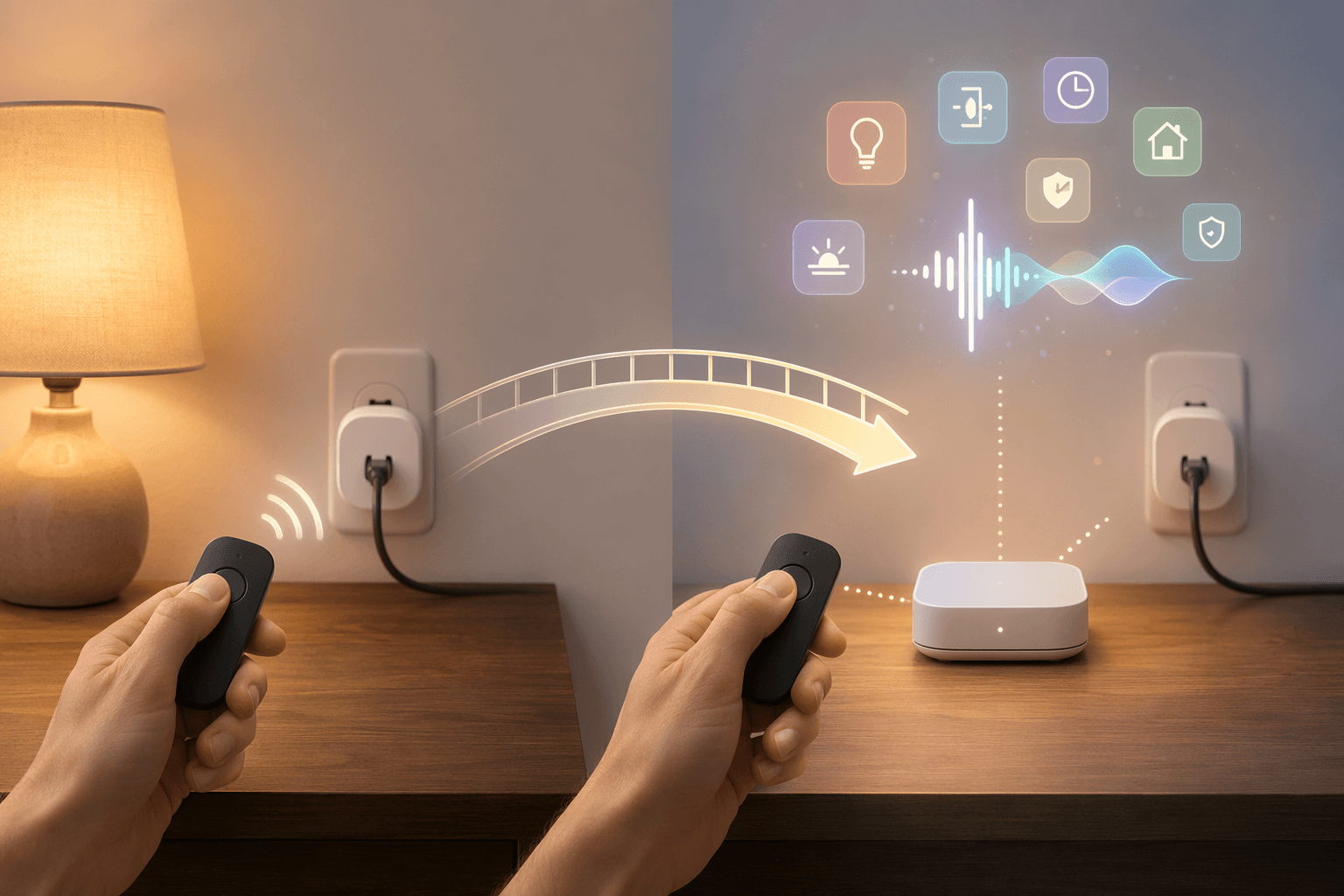
The middle category is the one many buyers should look at before committing either to app-only Wi-Fi or plain RF. IKEA TRETAKT and Lutron Caseta with Pico remote preserve physical control while leaving a path toward a hub, app control, voice integration, and scheduling.
IKEA TRETAKT: simple first, smarter later
IKEA TRETAKT is the cleanest “start simple” example. The plug with remote control is listed at $18.99, works without a hub, and can later be paired with IKEA’s DIRIGERA hub to add app control, scheduling, Matter support, and voice integration.[5] That means a buyer can put a physical remote on the table today and decide later whether the plug belongs in a larger smart-home system.
The range limit deserves a bright line. IKEA lists the remote-control range as about 11 yards through walls when used without a hub.[5] That is not the same expectation as a manufacturer-stated 100- to 200-foot RF kit. TRETAKT is better understood as room-to-room or nearby-area control, not a whole-property remote system.
The protocol difference explains the trade. A basic RF outlet is a simple radio clicker: one-way, practical, limited. TRETAKT uses Zigbee, which is a smarter two-way path that can join a hub and become part of a broader device network. Readers sorting out hubs, repeaters, and ecosystem requirements should treat the Zigbee hub requirements guide as the next stop before buying multiple devices.
Lutron Caseta Outdoor With Pico: the premium physical-control version
Lutron’s Caseta Outdoor smart plug with Pico remote is the more expensive version of the same principle: keep a real control in the household while allowing smart expansion. The Ambient’s review cites a plug-and-remote bundle around $95, with the Lutron Smart Bridge adding roughly another $80 when app features are needed.[6] The outdoor plug is IP66 rated, which puts it in a different use case than most indoor lamp plugs.[6]
The Pico remote is the detail that matters in daily use. It can function like a dedicated switch for a plugged-in lamp or outdoor load, and it can be wall-mounted so the lamp still has switch-like behavior. That is not a small ergonomic detail in a real home. A lamp that only responds to an app can feel broken to the person who walks into the room and reaches for a wall control.
For patios, landscape lighting, or other exterior loads, start with outdoor suitability before control style. Weather rating, outlet cover fit, load rating, and placement matter as much as app support. The outdoor smart plug selection guide is the better place to narrow those physical requirements.
Voice-First And App-Free Options Are A Narrower Bet
Voice control usually rides on top of an app-based ecosystem: Alexa, Google Assistant, Siri, or a hub. Emerson SmartVoice is different because CNET reviewed it as an offline voice-command smart plug that does not require an app, positioning it around privacy and local hands-free control.[7] The reported price was about $35.[7]
That idea is genuinely useful for a narrow household need: someone wants to say a command near the outlet without installing an app, creating an account, or sending commands through a cloud assistant. The evidence base is thinner than it is for Kasa, IKEA, Lutron, or common RF kits, so availability and current support need checking before purchase. Treat voice-first/app-free as an edge case, not the default recommendation.
What To Buy For Each Household
Choose an app-based Wi-Fi plug when the useful features are schedules, automations, remote access away from home, energy monitoring, or Alexa/Google integration. Kasa EP25 and Amazon Smart Plug belong here, with Emporia-style options worth considering when energy data is part of the reason for buying. Also accept the setup work: 2.4 GHz Wi-Fi, app pairing, account management, and occasional troubleshooting.
Choose an RF remote outlet kit when the household wants a button, not a smart-home project. DEWENWILS and BN-LINK-style kits fit lamps behind furniture, holiday decorations, basic fans, and situations where a physical remote is more accessible than a phone. Check the load rating and remember that manufacturer range claims are best treated as optimistic until proven in the building where the kit will live.
Choose IKEA TRETAKT or a Lutron Pico-style setup when physical control matters now but expansion matters later. IKEA is the budget-friendly bridge with a short standalone range and hub expansion through DIRIGERA. Lutron is the premium path, especially when a wall-mounted remote should behave like a real switch or when the load is outdoors and the plug itself needs the right weather rating.
Choose voice-first/app-free only when hands-free local control matters more than broad ecosystem features. It is an interesting answer for privacy-conscious or phone-avoidant use, but it should be verified carefully because the category is not as mature or widely documented as Wi-Fi plugs, RF kits, or hub-connected remote systems.
The practical rule is simple enough: app-based Wi-Fi for schedules, monitoring, and away-from-home control; RF remote outlets for simple physical control without setup; IKEA or Lutron-style dedicated remotes when you want a real button now and smart expansion later; voice-first/app-free only when local hands-free control is the main requirement.
References
- DEWENWILS Remote Control Outlet Wireless Wall Mounted Light Switch, DEWENWILS
- Best Smart Plugs and Power Strips for 2026, PCMag
- 18 Best Smart Home Devices to Help Aging in Place, Wirecutter
- Best Smart Plugs for 2026, CNET
- TRETAKT Plug with remote control, smart, IKEA
- Lutron Caseta Outdoor Smart Plug review, The Ambient
- My Privacy Stayed Safe With This Offline Voice Command Smart Plug, CNET
Discussion
Share your experience with the compared products, flag outdated pricing or specs, or ask clarifying questions about the comparison verdict.
Comments
Join the discussion with an anonymous comment.