For smart home air quality during wildfire smoke, the useful starting point is not a prettier app or a louder purifier. It is a three-part system: a monitor that actually measures PM2.5, a purifier sized to move smoke particles out of the room air, and a thermostat that can run the HVAC fan through a MERV 13 filter when outdoor smoke pushes indoors.
That system-level approach has better evidence than most single-device claims. A 2025 ScienceDirect study of about 5,000 homes during the 2020 California wildfire season found that an automated smart thermostat, MERV 13 filtration, and air purifier setup reduced indoor PM2.5 exposure by 61±5% during peak smoke days. The same study found that one central system with MERV 13 filtration could be as effective as running four portable HEPA air cleaners at once.[1]
That is not a promise that buying one thermostat or one purifier will cut smoke exposure by the same amount. The study was specific to California, the 2020 wildfire season, and the equipment in those homes. But it does show the part many buying guides skip: smoke defense improves when measurement, filtration, and air movement are coordinated instead of left to separate devices acting on separate schedules.
The Three Devices Do Different Jobs
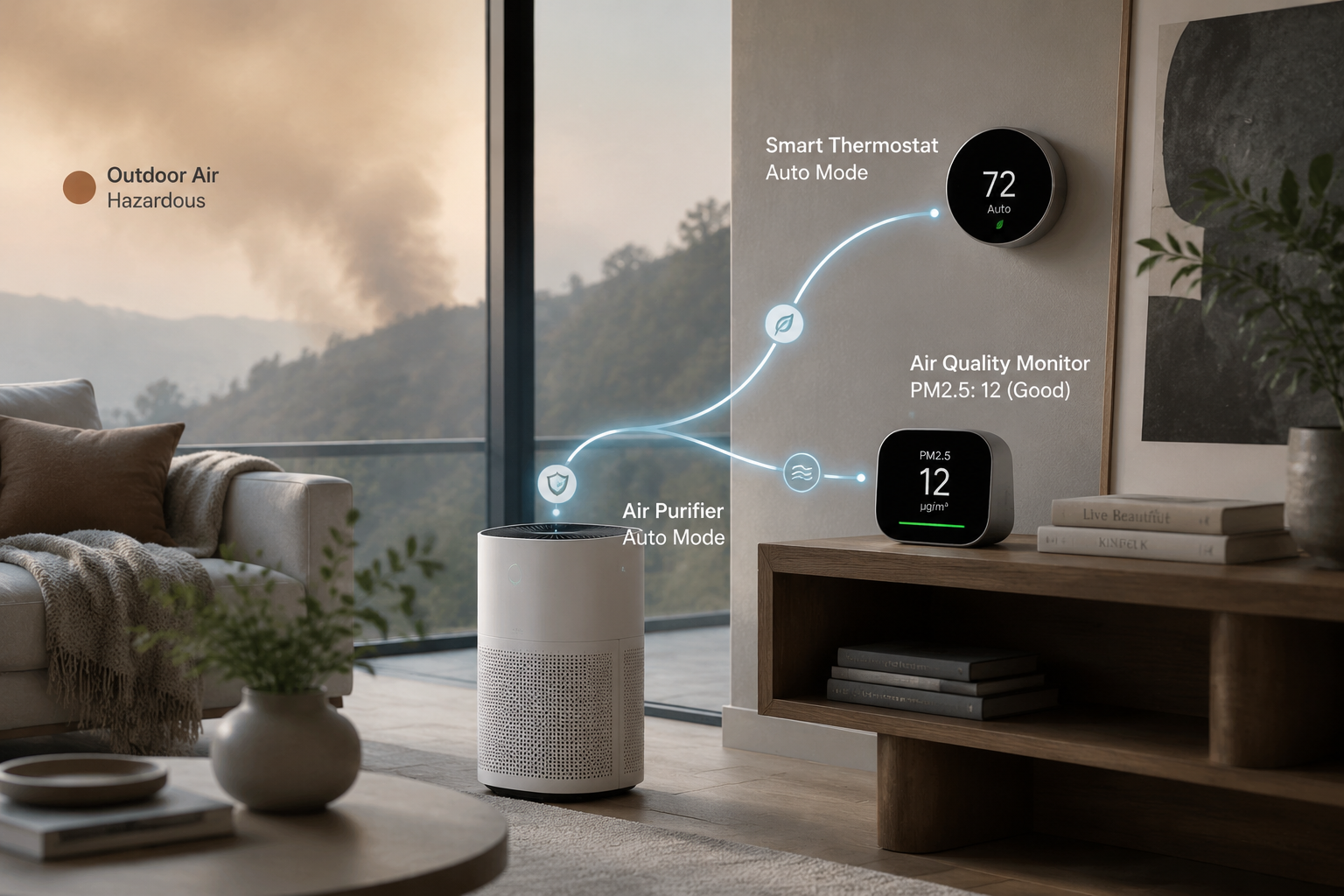
A smoke-ready smart home does not need every possible air gadget. It needs clear role separation. The monitor decides when the air is getting worse. The purifier removes particles in the rooms where people spend time. The thermostat keeps central filtration moving instead of waiting for a heating or cooling call.
| Component | What It Must Do During Smoke | What To Avoid |
|---|---|---|
| PM2.5 air quality monitor | Detect fine particulate matter from smoke and expose readings that can trigger alerts or automations | VOC-only or generic “air quality” sensors that do not measure PM2.5 |
| Smart air purifier | Move enough filtered air for the room and respond before the room becomes visibly hazy | Coverage claims without smoke CADR, filter details, or realistic room sizing |
| Smart thermostat with MERV 13 HVAC filtration | Run the HVAC fan deliberately so central air passes through a higher-efficiency filter | Auto fan settings that only run when heating or cooling is needed |
This matters because indoor smoke is not only a problem for homes beside an active fire. Airthings reported indoor PM2.5 spikes hundreds of miles from burn zones, which is exactly the situation where a household may feel safe because the sky is only faintly hazy while indoor particle levels are still climbing.[2]
If you want a lighter overview before getting into buying decisions, start with Three Smart Home Devices to Protect Against Wildfire Smoke. This guide goes deeper into what to buy and how to make the devices work together.
Start With PM2.5 Detection, Not Generic Air Quality
During wildfire smoke, the number that earns attention is PM2.5: fine particulate matter small enough to stay airborne and move through a home. A monitor that talks mainly about VOCs, odors, or a vague air quality score may still be useful for cooking fumes or cleaning products, but it is the wrong lead sensor for smoke defense if it cannot measure PM2.5.
This is where dedicated monitors such as PurpleAir Zen, Qingping Air Monitor Pro Gen 2, and AirGradient ONE make sense. They are bought for particle visibility, not just for a comfort dashboard. PurpleAir’s wildfire guidance is built around using air quality monitors to track smoke conditions, and monitor-focused reviews from HouseFresh treat PM2.5 capability as a core buying distinction rather than a bonus feature.[3][4]
The practical test is simple: can the monitor show a PM2.5 reading, can the household see when that reading changes, and can the device feed an alert or automation before the bedroom smells smoky? If the answer is no, the device may still be smart, but it is not the right control point for wildfire smoke.
How To Choose the Monitor
- Choose PM2.5 measurement first; treat VOC-only sensing as a secondary feature.
- Place at least one monitor where people sleep or spend long periods, not only near the thermostat.
- Check whether the platform you use can trigger automations from the monitor’s PM2.5 data.
- Prefer visible readings and history over a single color-coded light that does not explain what changed.
Apple Home users should be especially careful here. HomeKit support does not always mean every sensor exposes numerical PM2.5 thresholds in a way that can drive clean automations. If your plan depends on exact trigger levels, confirm the sensor and platform behavior before smoke season, or use a platform-specific workaround from an automation guide such as Automate Your Smart Home Air Quality Monitor for Wildfire Smoke.
Buy the Purifier for Smoke CADR and Room Size
Once PM2.5 is visible, the purifier has to move enough filtered air to matter. For smoke, Consumer Reports recommends looking at HEPA purifiers with smoke CADR above 300, and cites EPA research showing that HEPA purifiers in that class can cut particle concentrations by up to 85%.[5]
That “up to” matters. A purifier tested in a chamber will not behave identically in a leaky house, an open-plan room, a bedroom with the door closed, or a living room connected to a hallway. The number still helps because it forces the buying decision toward air movement and filtration instead of app polish.
CNET’s 2026 lab testing named the Blueair Blue Pure 311i Max its best overall air purifier, with a T90 time of 1 minute 28 seconds, a $230 price, 43 dB at medium speed, and estimated energy use of 11.65 kWh per month. CNET also measured the Coway Airmega 400S at a 21-second T90 time on high and lists it as covering 3,100 square feet, with a $750 price and smoke CADR of 350.[6]
Those are useful comparison numbers, not room guarantees. CNET’s T90 results came from controlled chamber testing with smoke-bomb particle loads, so they are best read as relative performance signals. A real home adds doors, ceiling height, furniture, air leaks, filter age, and the awkward fact that people move from room to room.
| Purifier | Why It Fits This Guide | Best Use |
|---|---|---|
| Blueair Blue Pure 311i Max | Strong tested performance, lower price, moderate noise and energy figures in CNET testing | Bedrooms, offices, and medium living areas where one room needs reliable filtration |
| Coway Airmega 400S | Higher-output option with smoke CADR 350 and large listed coverage | Larger rooms or open areas where a smaller purifier would run hard all day |
If the budget only allows one serious purifier, put it where sleep happens. If the home has an open living area and separate bedrooms, one large purifier in the main room may still leave nighttime exposure dependent on closed doors, hallway airflow, and whether the bedroom has its own unit.
For deeper purifier sizing, use What CADR Rating Do You Need for Wildfire Smoke? before buying. For purifier setup after purchase, use How to Configure Your Smart Air Purifier for Wildfire Smoke.
Use the Thermostat as an Air Mover, Not an Air Monitor
A smart thermostat does not clean the air by itself. Its value during smoke is control: it can run the HVAC fan so indoor air passes through a MERV 13 filter even when the home does not need heating or cooling.
The difference between fan “auto” and fan “on” is not cosmetic during a smoke event. With the fan in continuous on mode, the central system can cycle air through MERV 13 filtration at 4–6 air changes per hour, while auto mode may sit idle because the temperature is already comfortable.[1]
Resideo’s Honeywell Home wildfire guidance also emphasizes HVAC optimization during smoke season, while FilterBuy’s MERV guidance points homeowners toward MERV-rated filtration for smoke particles rather than basic dust-only filters.[7][8]
The ecobee Smart Thermostat Premium deserves credit for convenience because it includes a built-in air quality monitor and can trigger HVAC fan behavior and alerts without a separate sensor. Ecobee’s own wildfire air quality guidance positions the thermostat as part of the home’s response to wildfire smoke.[9]
Convenience is not the same as best measurement. A dedicated PM2.5 monitor such as PurpleAir Zen, Qingping Pro Gen 2, or AirGradient ONE is still the stronger control point if you want the smoke response to be based on particle readings in the rooms that matter most. The ecobee option is best for households that will maintain a simpler system more reliably than a more precise one.
Honeywell ElitePRO belongs in the same category: not an air purifier, but a system controller. Its job is to make central fan behavior deliberate. If you are comparing ecobee models, the site’s ecobee Premium vs. Enhanced vs. Essential comparison is the better place for thermostat-specific tradeoffs.
A Sensible Buying Framework
The right budget split depends less on brand loyalty than on which weak point your home has now. A house with no PM2.5 visibility should not spend everything on a flagship purifier. A house with one small purifier in a large open space should not solve the problem with another wall display. A house with decent portable filtration but an idle central fan may get more from thermostat control and MERV 13 filters than from a second app.
| Tier | Buy First | Add Next | When It Makes Sense |
|---|---|---|---|
| Minimum credible setup | Dedicated PM2.5 monitor | One smoke-capable purifier for the bedroom | You need visibility and one protected sleeping space |
| Balanced setup | PM2.5 monitor plus smart purifier | Thermostat fan automation with MERV 13 filtration | You want the home to respond before smoke becomes obvious indoors |
| Whole-home-oriented setup | Dedicated PM2.5 monitoring in priority rooms | Large purifier for main area, bedroom purifier, thermostat-controlled MERV 13 fan mode | You have repeated smoke days and multiple occupied zones |
The “minimum” tier is not a token purchase. A PM2.5 monitor and a real bedroom purifier can change nighttime decisions: close the bedroom door, run the purifier higher before sleep, replace a clogged filter, or move the clean-air zone when readings say the current room is not holding.
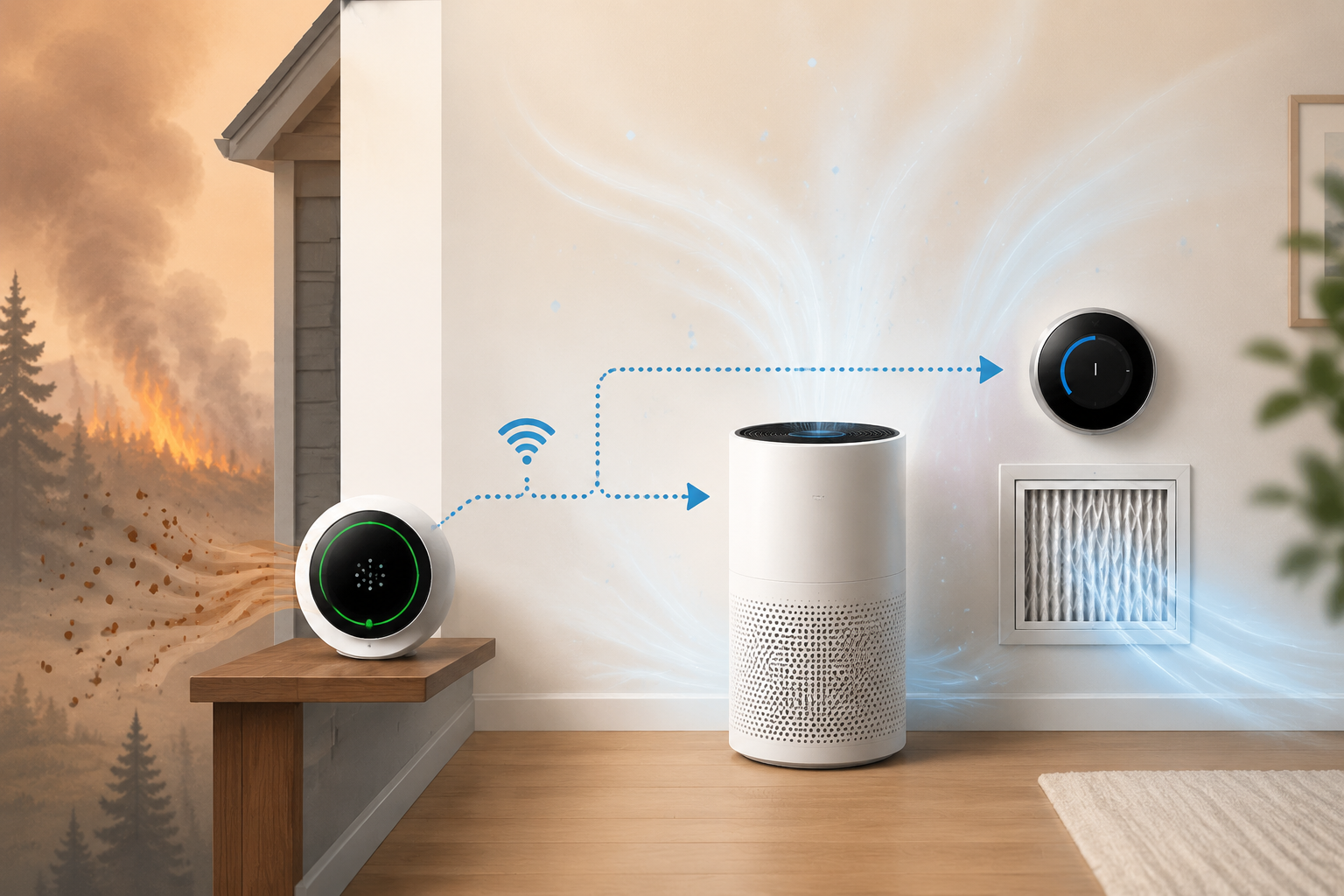
The balanced tier is where the smart home part becomes useful. The monitor sees particle levels rising, the purifier ramps up, and the thermostat runs the HVAC fan through MERV 13 filtration instead of waiting for temperature demand. This is the closest practical version of the system logic tested in the 2025 study, while still respecting that your home is not the study average.
Configure the System Before the Smoke Arrives
The worst time to discover an automation does not expose PM2.5 thresholds is the first night the outdoor AQI map turns red. Set up the system while outdoor air is normal, then test whether each device actually changes state when the monitor reading changes or when you manually trigger the scene.
- Name the smoke-response devices clearly: bedroom PM2.5 monitor, bedroom purifier, living room purifier, HVAC fan.
- Create a smoke mode that sets purifiers to an effective speed, not the quietest automatic setting.
- Set the thermostat fan to run continuously during smoke events, using MERV 13 filtration if the HVAC system can handle that filter.
- Add alerts for filter replacement and abnormal indoor PM2.5 readings.
- Test the routine with someone else in the household so the system does not depend on one person remembering every step.
A platform-generic automation framework can help, but smoke routines are rarely one-click universal. The Home Automation Cookbook’s automation approach is useful as a pattern, while the actual PM2.5 trigger behavior still depends on the sensor, thermostat, purifier, and ecosystem you choose.[10]
If you want platform recipes rather than broad logic, use the Code Purple automation guide for Google Home, Apple HomeKit, and Home Assistant ideas: Protect Your Health During Code Purple with Smart Home Devices. For a broader smoke-ready plan that includes alarms and other home layers, see Build a Smoke-Ready Smart Home with a Four-Layer Defense.
Filters Are Part of the Purchase
The purchase price is only the first bill. During heavy smoke season, MERV 13 HVAC filters may need replacement every 30–60 days, and HEPA purifier filters may need replacement every 1–3 months.[8]
That cadence changes how a “cheap” setup looks. A purifier with expensive or hard-to-find filters can become a worse smoke-season tool than a slightly more expensive unit whose filters you can actually keep in stock. A thermostat automation that runs the fan continuously also increases the importance of checking the central filter instead of treating it as a quarterly chore.
- Buy at least one spare HVAC filter before peak smoke season.
- Keep one purifier filter on hand for the bedroom or main clean-air room.
- Label the installation date on MERV 13 filters so replacement is not guesswork.
- Check whether higher-MERV filters are compatible with your HVAC system before forcing a restrictive filter into an older setup.
What This System Still Cannot Promise
A coordinated system can reduce indoor PM2.5 exposure, but it does not make a house sealed, medically safe for every resident, or immune to extreme smoke. Room size, outdoor concentration, leakage, HVAC design, filter age, and purifier placement all affect the result.
The study result is strongest as a buying direction: coordinate devices, move filtered air, and automate the HVAC fan. It is weaker as a personal forecast for any one house. The same caution applies to purifier lab tests and “up to 85%” particle-reduction language; they show what is possible under defined conditions, not what every bedroom will achieve on a bad smoke night.
The best smart home smoke defense is not the most expensive single purifier. It is a PM2.5-aware system that measures smoke, moves filtered air where people actually breathe, runs the HVAC fan deliberately through MERV 13 filtration, and gets maintained when filters load up during heavy smoke season.
References
- Using smart thermostats to reduce indoor exposure to wildfire fine particulate matter (PM2.5), ScienceDirect, 2025
- Wildfire smoke sparks indoor air quality alerts, Airthings
- How to Use Air Quality Monitors During Wildfires, PurpleAir
- Air quality monitor reviews, HouseFresh
- 5 Best Air Purifiers for Wildfire Smoke, Consumer Reports
- Best Air Purifiers for 2026: Lab-Tested Picks, CNET, 2026
- How to Optimize Air Quality During Wildfire Season, Resideo
- Best MERV Air Conditioner Filter for Wildfire Smoke?, FilterBuy
- How wildfires impact air quality, Ecobee
- Home Automation Cookbook
Reader Feedback
Share your purchase experience, flag outdated picks, or ask clarifying questions about the checklist items.
Comments
Join the discussion with an anonymous comment.